

Unique Art Coffee Mugs Gift: 7 Things to Compare Before Checkout
Reading time: about 8 minutes
The email arrives a few days after almost every art mug gift leaves our packing bench: “They love how it looks — but are they actually supposed to drink out of it?” We’ve handled enough of these orders to know the artwork is the easy part. What separates a unique art coffee mugs gift that gets used every morning from one that hides in a cupboard is everything underneath the design: how the art was applied, whether the surface touching hot coffee is food-safe, and whether the care routine fits the recipient’s kitchen.
Browse the unique coffee mugs on our shelves and the motifs do the talking: a crane, koi fish, a mountain-and-sea landscape. What no product photo shows at a glance is the decoration method or how the piece was finished. Those hidden details decide how the mug ages, and they’re exactly what this guide teaches you to compare.
Which unique art coffee mugs gift fits which recipient?
Start with the person, not the mug. Art mugs are opinionated objects — the right one feels picked for them; the wrong one feels like someone else’s taste. When a shopper asks us for help, three questions come first: does the recipient drink coffee or tea every day, do they lean toward figurative artwork like animals and landscapes or toward abstract shape and color, and where will the mug actually live — kitchen counter, office desk, or display shelf?
- The mentor, retiree, or quiet-morning person: Crane imagery reads calm and composed, which suits someone who appreciates birds and quiet, open compositions. That’s the recipient we point toward The Crane Coffee Tea Mug.
- The garden keeper or pond dreamer: Koi carry symbolism and a little playfulness, and they reliably start conversations on a desk. The Koi Fish Coffee Tea Mug fits people who keep gardens, love fish, or enjoy animal art with a story behind it.
- The hiker or coastal soul: A mountain-and-sea landscape is the safest figurative bet because it sits quietly in a home office instead of demanding attention. That’s the territory of the Mountain Sea Coffee Tea Mug.
All three are named as coffee and tea mugs, so they suit whichever hot drink the recipient favors — but here’s the honest trade-off: figurative motifs are specific. A minimalist may find a crane or koi busy, and an abstract design would suit them better; our unique abstract coffee mug gift guide covers that style. Also, these three mugs don’t share a spec sheet. Confirm the material, listed capacity, and care notes on each product page before checkout instead of assuming what’s true for one applies to all.
Hand-painted glaze, in-glaze decal, or surface print? The decoration method decides everything
“Art mug” describes the look, not the construction. Where the artwork sits within the ceramic determines how it wears through years of brewing and washing:
- Hand-painted glaze: pigment painted onto the mug and fused into the surface at kiln temperature. The most durable approach, and because a person painted it, expect small variations between pieces. That’s the charm and the catch — your mug won’t match the listing photo stroke for stroke.
- In-glaze decals: a printed transfer fired into the glaze. Consistent artwork with good durability, though abrasive scouring will eventually haze the surface.
- Surface printing: common on mass-market mugs, where the image is a coating sitting on top of the glaze. Vivid detail at low cost — and the first style to fade in a dishwasher.
- Etched or carved: no pigment to fade, but the texture traps coffee oils and wants a soft brush every so often.
| Method | Where the art lives | Typical care | Gifting trade-off |
|---|---|---|---|
| Hand-painted glaze | Fused into the surface | Sturdiest; still follow the listing | One-of-a-kind variations |
| In-glaze decal | Fired into the glaze | Tolerates gentle dishwasher cycles | Consistent but less personal |
| Surface print | Coating on top | Hand-wash safest | Fades first; budget pick |
| Etched or carved | Texture, no pigment | No fade risk; scrub the texture | Subtle look, not colorful |
If a listing doesn’t say how the art was applied, treat that silence as a preview of how the design will age — and default to hand-washing until you know.
Is the mug food-safe, or a display piece in disguise?
This is the question buyers skip and later regret. In the US, the FDA regulates lead and cadmium in ceramic foodware because misformulated or under-fired glazes can leach into hot, acidic drinks — and coffee is both. A seller who stands behind their mug says so in plain language. Before you buy, check that:
- The listing confirms the interior drinking surface is food-safe, not just that the mug is “for decorative use.”
- Heavy decoration sits on the exterior only, or the interior glaze is explicitly cleared for hot drinks.
- The seller answers a direct question with a direct answer. “It’s ceramic, it’s fine” is a deflection, not an assurance.
One defect mode worth knowing: crazing. Those fine hairline cracks that develop in older or under-fired glazes hold coffee stains and are a reason to retire a mug from daily duty. Some collectible art mugs also use pigments never intended for daily coffee contact. They can still make a thoughtful gift — just say so up front, and pair the display piece with a plain workhorse mug if the recipient drinks several cups a day.
Dishwasher, microwave, or sink only? Matching care rules to the recipient’s kitchen
One rule in our store is non-negotiable: any metallic detail — a gold luster rim, silver trim, a metallic-painted accent — stays out of the microwave. Metal luster can spark or arc, and it’s the most common way a beautiful mug dies in its first week. Dishwasher rules are softer. Harsh detergents and abrasive cycles slowly dull surface prints and luster, while kiln-fired artwork holds up far better. Translation: a recipient who loads a crowded dishwasher every night needs fired-in decoration; a dedicated hand-washer can choose anything on the shelf.
Mixed materials change the math again. A wooden handle should never see a dishwasher at all, which is why our unique coffee mugs with wooden handle guide walks through seven construction and care checks before you gift one.
What capacity matches the way the recipient actually brews?
Mug sizes don’t map to the coffee industry’s “cup.” The traditional cup measure is 6 ounces — it’s why brewing charts call for 1 to 2 tablespoons of grounds per cup — and it’s smaller than nearly any mug sold today. Translate habits into ounces instead:
- Drip or pour-over drinker: 8 to 12 oz matches a standard brew without half-empty pours going cold.
- Latte or big-mug person: 12 to 16 oz. Milk drinks and refill-averse drinkers want the volume.
- Espresso or tea sipper: 6 to 8 oz keeps the drink hot to the last sip.
Art mugs skew wide and sculptural, so read the listed capacity instead of guessing from photos — a dramatic silhouette can hold less than it appears to. We break down how size, shape, and care interact across gift mugs in our guide to unique coffee mugs as gifts.
Ordering against a birthday? Lead times, breakage, and returns on one-of-a-kind mugs
Made-to-order and one-of-a-kind mugs carry logistics that factory mugs don’t. Before ordering against a hard date, check four things:
- Lead time. Hand-finished work often needs extra days before it ships. Ask if the listing doesn’t state it.
- Breakage protection. Ask how the seller packs and what happens if the mug arrives cracked. Any seller worth ordering from has that answer ready.
- Personalization limits. Hand-painted names or dates usually add production time and often can’t be returned.
- Return terms on custom work. Many makers exclude personalized pieces from returns. Know before, not after.
“She loved it, but it arrived the day after the party.” We’d rather answer a lead-time question than ship that apology.
None of this is a dealbreaker — it’s the cost of giving something no one else owns. But know when an art mug is the wrong tool: if someone specifically wants a matched set of four identical mugs, or a replacement for a broken everyday favorite, a uniform set will make them happier.
The seven-point checklist we run before recommending an art mug
- Decoration method identified — fired-in or surface-applied?
- Food-safe disclosure covering the drinking surface, not just the outside?
- Dishwasher and microwave rules stated, with metallic trim flagged?
- Listed capacity matched to the recipient’s brewing habit?
- Motif matched to their taste — figurative or abstract?
- Lead time safely ahead of the gift date?
- Return and breakage terms clear?
Score all seven and your unique art coffee mugs gift becomes a mug they’ll actually use, not one that guards the back of a cupboard. Start in our unique coffee mugs collection, compare the crane, koi, and mountain-sea listings side by side, and confirm the capacity and care notes on each product page before you commit.
Frequently asked questions
Will a hand-painted mug fade in the dishwasher?
Not if the paint was glaze-fired into the surface, though harsh detergents will dull any finish over years of cycles. Surface-printed designs fade first. If a listing doesn’t state the method or a dishwasher claim, hand-wash it — five seconds of care protects the artwork indefinitely.
Can a mug with a gold rim go in the microwave?
No. Metallic luster contains real metal and can spark or arc, so we treat it as a hard rule regardless of brand or price. The same caution applies to silver trim and metallic-painted accents. When in doubt, heat the water in a separate cup and pour.
Is a unique art coffee mugs gift practical for daily use, or just for display?
Both, depending on the build. If the listing confirms a food-safe glaze and care the recipient can live with, there’s no reason it can’t become their everyday mug. If it’s labeled decorative or the glaze disclosure is missing, treat it as a display piece and add a simple daily driver alongside it.
What size should I buy for a latte drinker?
Plan on 12 to 16 oz, since milk-based drinks need the volume; drip and pour-over drinkers are happy at 8 to 12 oz, and tea or espresso sips suit 6 to 8 oz. Always confirm the listed capacity on the product page, because art mugs vary more in shape than standard mugs and photos mislead. Torn between two sizes? Pick the larger — nobody complains about a little extra coffee room.
Read more
Sculptural Ceramic Mug Gift: 7 Things to Compare Before You Buy
A sculptural ceramic mug gift has to work as drinkware first. We compare three forms — a 400 ml curved mug, a 250 ml ball-handle mug, and a 310 ml handbag silhouette — on capacity, grip, care limit...
Read more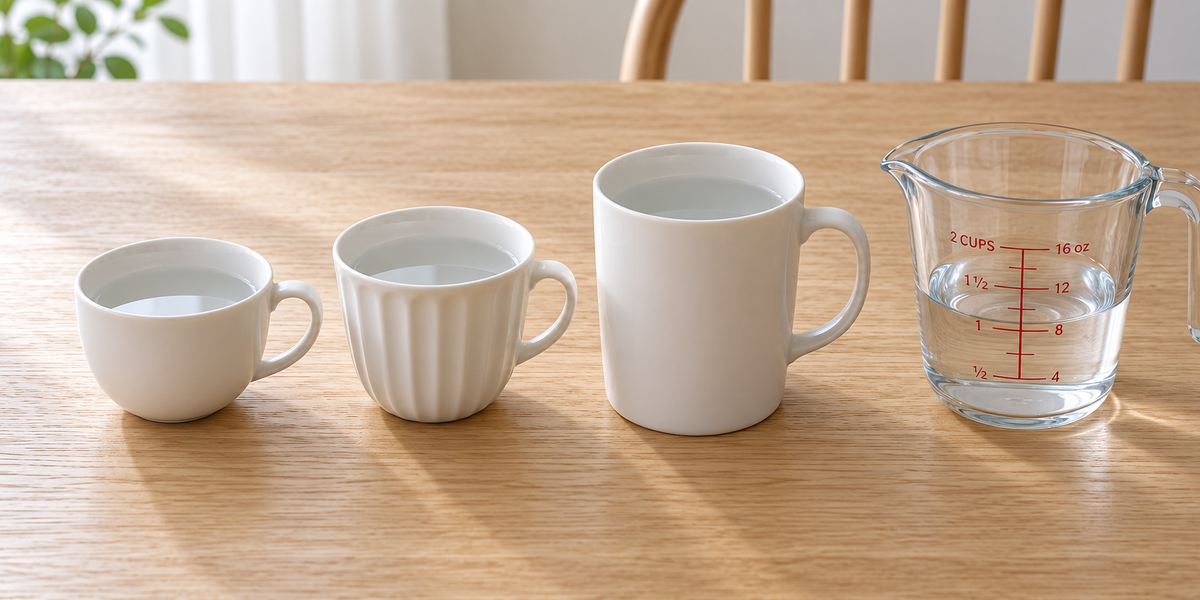
Breakfast Cup vs Mug Size: Oz, Ml, and Fill Levels Explained
A traditional breakfast cup holds about 284 ml — more than a teacup, less than many desk mugs. We compare breakfast cup vs mug size in ounces and milliliters, explain brim vs usable fill, and map o...
Read more
Leave a comment
This site is protected by hCaptcha and the hCaptcha Privacy Policy and Terms of Service apply.