
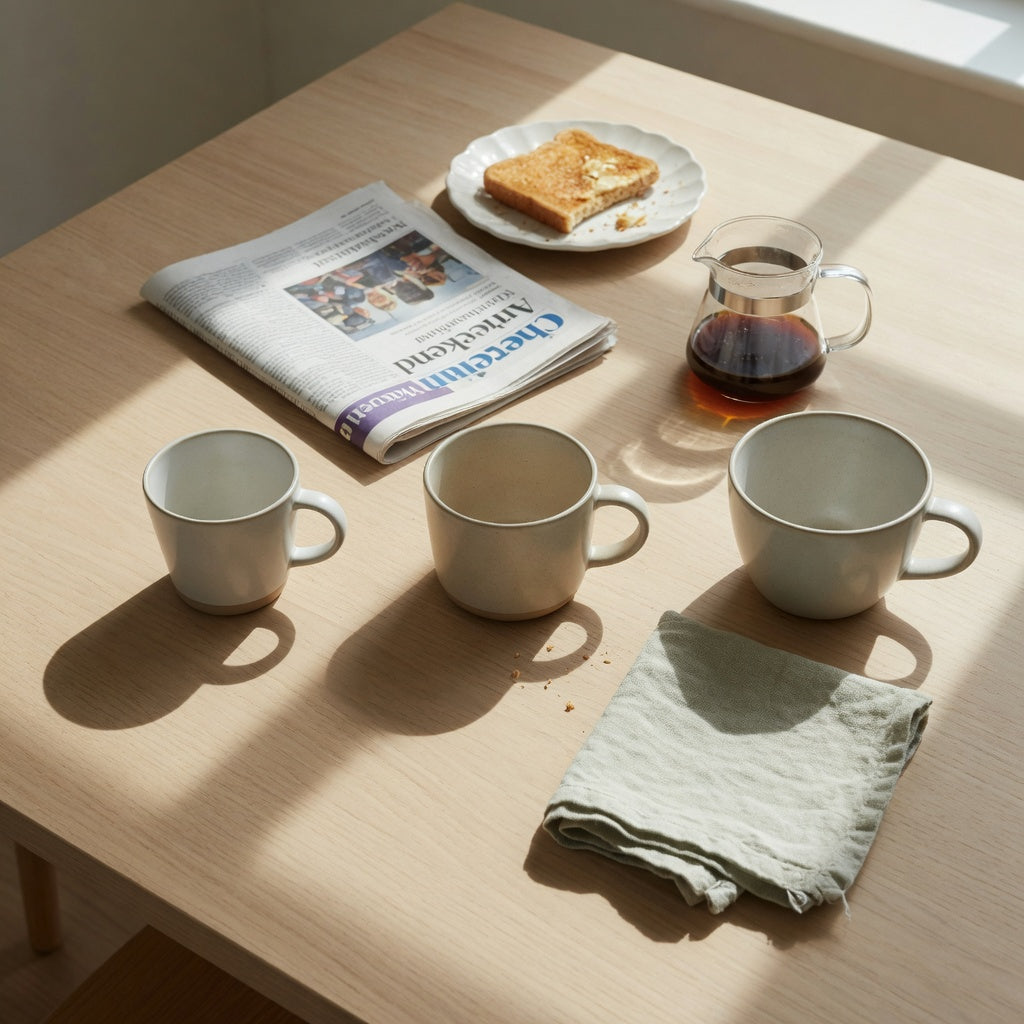
Breakfast Coffee Cup Weekend Coffee Practical Purchase Checklist
Reading time: about 10 minutes
A slow Saturday pour exposes cup problems that a rushed weekday can hide: the cup crowds the toast plate, the handle catches the edge of a tray, or the first serving is gone before breakfast reaches the table. This breakfast coffee cup weekend coffee practical purchase checklist starts with the details we can verify, then separates them from the details you still need to confirm. For the three CoffeifyMug options covered here, the verified listed capacities are Retro 170 ml, Pleated 200 ml, and Landscape Tall 350 ml.
In our store, we do not treat capacity as shorthand for every other specification. Capacity does not establish exterior dimensions, empty weight, handle clearance, material, dishwasher compatibility, microwave compatibility, or comfortable fill level below the rim. Keeping those boundaries clear leads to a better purchase than estimating specifications from a styled product photograph.
Why does a slower weekend routine change the cup decision?
Weekend coffee often shares the table with plates, a brewer or carafe, condiments, a phone, and something to read. The cup may also move from kitchen counter to dining table and then to a chair-side surface. That makes three variables especially useful: how much you normally pour, how often you are willing to refill, and how much clear surface remains after breakfast is served.
A larger listed capacity supports a larger serving, but it also means carrying more liquid when filled. A smaller capacity suits short pours and leaves you committed to more refills if your total intake stays the same. Neither approach is automatically better. We also make no heat-retention ranking here because the verified product facts supplied for this comparison do not support one.
Use the breakfast coffee cup weekend coffee practical purchase checklist before comparing styles
Start with your real serving rather than the amount you think you drink. A listed capacity may describe a nominal or brim-level measurement, while a comfortable working fill normally leaves space below the rim. Milk, foam, and other additions also use part of that capacity.
- Measure your usual pour. Use a marked brewer or measuring jug to check how much coffee actually goes into your current cup.
- Count your preferred refills. Decide whether getting up once or twice is part of the ritual or an interruption you would rather avoid.
- Allow room for additions. If you add milk or foam, include it in the measured serving rather than comparing black-coffee volume alone.
- Check direct-brewing clearance. If the cup sits beneath an espresso machine or brewer, compare the product height with the available space before ordering.
- Set the full breakfast table. Put out the plate, brewer, condiments, and anything else you normally use, then identify the surface left for the cup and its handle.
- Check storage after breakfast. Measure shelf height and depth, including the space needed for a handle that may project beyond the cup body.
The breakfast coffee cup weekend coffee practical purchase checklist works best when those measurements come before color or pattern. Style still matters, but it cannot correct a serving size that is too small or a profile that does not fit your shelf.
How do the 170 ml, 200 ml, and 350 ml options compare?
| Option | Verified capacity | Weekend serving fit | Main trade-off | Footprint detail to confirm |
|---|---|---|---|---|
| Retro | 170 ml | Short individual pours and refill-friendly routines | Smallest listed capacity, so it offers less room for a large drink or added milk | Exterior width, handle projection, and base diameter are not established by capacity |
| Pleated | 200 ml | A middle serving between the Retro and Landscape Tall | Only 30 ml more listed capacity than the Retro and 150 ml less than the Landscape Tall | Confirm maximum width and shelf depth on the current listing |
| Landscape Tall | 350 ml | The largest listed serving of these three | More liquid to carry when filled and more capacity than short-drink shoppers may need | Confirm height, brewer clearance, maximum width, and storage clearance |
These comparisons are deliberately limited. The Retro has the smallest listed capacity, but that fact alone does not prove it has the smallest exterior footprint. Handles, wall shape, and decorative profiles can change how much table space a cup uses. The same rule applies to the 350 ml Landscape Tall: its name makes vertical clearance worth checking, but it does not provide an exterior measurement.
How much breakfast-table footprint can you spare?
For a cup, footprint means more than the base ring touching the table. You need the maximum body width, the handle projection, and enough open space to grip the handle without knocking a plate. On a tray, you also need clearance so the cup does not sit against a raised edge.
- For a narrow place setting: shortlist by serving volume first, then verify the full width of the Retro and Pleated rather than assuming that lower capacity means a narrower body.
- For a shared table: measure the space for every cup at once. Two individually suitable cups can still compete for the same handle room.
- For a small tray: check maximum width and tray-edge clearance, not just base diameter.
- For open shelving: compare cup height and handle projection with the shelf opening.
Our practical method is to set the normal breakfast arrangement, place your current cup where the new one would sit, and measure the clear rectangle around it. Compare that space with current product dimensions if they are listed. If a required dimension is missing, ask before buying instead of estimating from camera perspective.
Which CoffeifyMug cup fits your refill preference?
You enjoy short pours and do not mind returning to the pot
The Retro coffee tea cup has a verified listed capacity of 170 ml. It fits a shopper who intentionally serves less at a time and sees a refill as part of a relaxed breakfast. It is not a strong match for a large milk-based drink or for someone who wants the biggest available first pour.
You want a moderate serving without moving to 350 ml
The Pleated coffee tea cup is listed at 200 ml. That places it 30 ml above the Retro, making it the closest step up rather than a dramatic increase. Choose it when 170 ml feels restrictive but 350 ml would exceed your usual serving; confirm its dimensions, material, and care guidance on the live product page.
You want the largest listed capacity of the three
The Landscape Tall coffee tea mug is listed at 350 ml. It suits a shopper whose measured weekend serving is well above 200 ml or who would rather make one larger pour than several short ones. The trade-off is simple: more liquid adds carrying weight, and the tall format makes cabinet and brewer clearance especially relevant. It is unnecessary for shoppers who normally stop at a short coffee.
You care about shape or finish before capacity
Start with the unique coffee mugs collection if none of these three serving sizes settles the decision. Use the collection to compare the available designs, then return to the same capacity, footprint, and care checks. A visually appealing cup still needs to fit the table and the drink you make.
Which product details still need confirmation before checkout?
The evidence used for this comparison verifies the three listed capacities. It does not verify the products' materials, exact exterior dimensions, weight, care compatibility, or package contents. Product information can also be updated, so the current product page should be your source at the time of purchase.
- Exterior measurements: Confirm height, maximum width including the handle, and base diameter.
- Material and finish: Read the stated composition instead of identifying it from photographs.
- Care instructions: Look for explicit dishwasher and microwave guidance. An omitted claim should be treated as unconfirmed.
- Usable fill: Leave normal headspace and check whether your measured recipe fits below the rim.
- Package contents: Do not assume a saucer, spoon, lid, matching tableware, coffee, or food is included. Rely on the contents stated on the product page.
This distinction matters for gifts as well. A product image may use breakfast props to show scale or mood, but those props do not establish what arrives in the parcel.
What should you inspect at unboxing and during care?
Our team uses a short physical inspection routine for drinkware because small issues are easier to identify before the cup enters regular use. These are standard category checks, not defects we are claiming exist in any of the products discussed here.
- Check the drinking rim: Under good light, look and carefully feel for a chip, rough point, or hairline line around the area that touches the mouth.
- Inspect the handle joints: Look at both attachment points for a visible crack or separation before carrying a full drink.
- Test the base on a flat counter: The cup should sit predictably rather than rocking because of damage or debris under the base.
- Review the finish: Compare unexpected marks with the product photography and description before deciding whether they are part of the intended decoration.
- Follow the stated wash method: Wash before first use and follow the live care instructions. Do not assume dishwasher or microwave compatibility when it is not explicitly stated.
If the cup is a gift, complete this check before wrapping it, and retain the original packaging until you know it arrived as expected. Avoid abrupt temperature changes unless the stated material and care guidance specifically support the intended use.
Who should choose a different cup style?
These three capacity options do not cover every weekend routine. A sealed travel vessel is a better category for coffee carried on a walk or in a vehicle. A shopper making a large iced drink should account for the substantial volume displaced by ice, especially before selecting 170 ml or 200 ml. Anyone building a coordinated place setting should seek a listing that explicitly states which saucer or tableware is included or compatible.
Commercial buyers should also avoid treating this article as evidence of hospitality testing, impact resistance, or high-volume service suitability. None of those claims is established here. If heat retention, repeated reheating, a lid, or a specific care certification is the leading requirement, choose a product whose current specification directly addresses it.
Frequently asked questions
How should I use the breakfast coffee cup weekend coffee practical purchase checklist?
Measure your normal complete drink, including milk or foam, and count how many refills you prefer. Then measure the available table and storage space before comparing 170 ml, 200 ml, and 350 ml. Confirm exterior dimensions, material, care, and package contents on the current product page before ordering.
Is a 170 ml breakfast coffee cup too small for weekend coffee?
It is too small if your measured serving exceeds its listed capacity or leaves no practical headspace. It can be a good fit for intentionally short pours and shoppers who enjoy returning for a refill. Added milk or foam makes the available coffee volume smaller.
Does a 350 ml cup automatically use more table space than a 170 ml cup?
No. Capacity describes internal volume, not maximum exterior width or base diameter. The 350 ml Landscape Tall holds the most of these three, but you still need current dimensions to compare its actual footprint with the Retro and Pleated.
Do these product links include saucers, spoons, coffee, or breakfast food?
Do not assume that any photographed prop or matching item is included. Check the package contents on the individual product page at the time of purchase. This article makes no bundled-tableware, food, or drink claim.
Can these coffee cups go in a dishwasher or microwave?
Use only the care compatibility explicitly stated on the current product page or supplied with the cup. The verified facts available for this comparison do not establish dishwasher or microwave suitability. If that information is absent, contact our store before placing the order.
For the clearest next step, measure your normal weekend pour and the free space beside your breakfast plate. Compare those numbers with the Retro 170 ml, Pleated 200 ml, and Landscape Tall 350 ml pages, verify the remaining specifications, and return to the CoffeifyMug cup collection if another shape or capacity better matches your table.
More from our blog
Read more
Piccolo Cup Weekend Coffee Practical Purchase Checklist
Use your real weekend pour, not cafe terminology, to compare CoffeifyMug's 170 ml, 250 ml, and 270 ml options. This checklist covers capacity headroom, handling, storage, care checks, gifting, and ...
Read more
Peppermint Tea Mug Weekend Coffee Practical Purchase Checklist
Compare the catalog-verified 400 ml, 440 ml, and 480 ml options by capacity and handle comfort. This checklist also identifies what the available facts do not establish, so you know what to verify ...
Read more
Leave a comment
This site is protected by hCaptcha and the hCaptcha Privacy Policy and Terms of Service apply.