
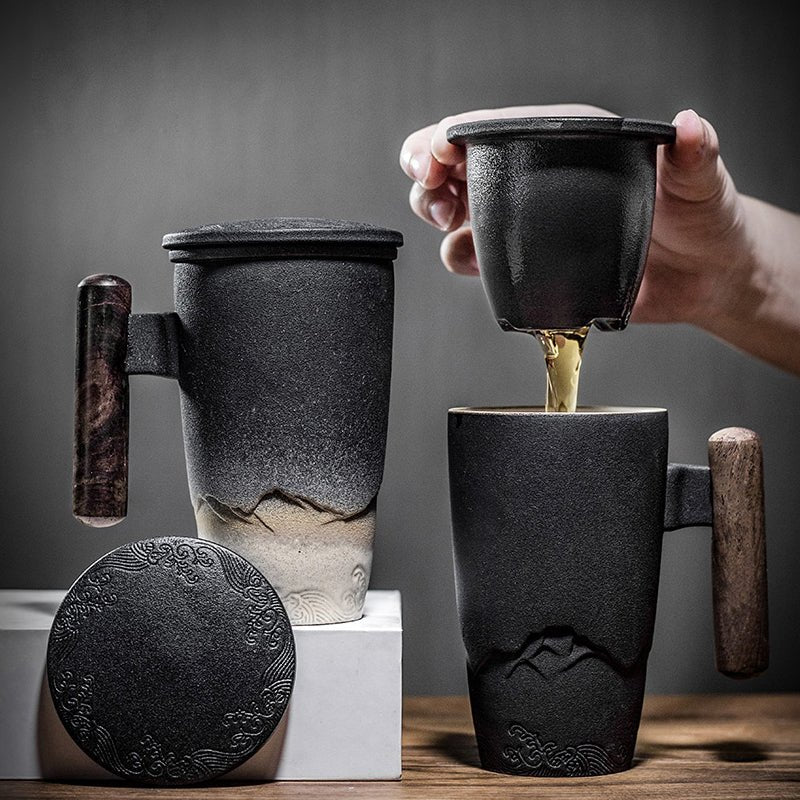
The breakfast coffee cup morning routine practical purchase checklist
Reading time: about 9 minutes
At 7:18 a.m., the wrong cup is obvious: the first pour reaches the rim, the handle crowds the place setting, or a refill is needed just as keys and bags come out. Our breakfast coffee cup morning routine practical purchase checklist starts with the clock, the amount you actually drink, and your tolerance for another trip to the kitchen.
In our store, the verified catalog starting points are the Retro Coffee Tea Cup, listed at 170 ml; the Pleated Coffee Tea Cup, listed at 200 ml; and the Landscape Tall Coffee Tea Mug, listed at 350 ml. If those capacities or silhouettes do not match your setup, scan the unique coffee mugs collection. Only items expressly named on a live product page should be treated as included; styled photography does not by itself promise a saucer, matching tableware, food, or a beverage.
From handling cups and answering buyer questions in our store, we have learned that the largest option is not an automatic upgrade. Extra capacity can prevent a refill, but it can also be unnecessary for a short drink, harder to place in tight storage, or simply more cup than a person wants at breakfast.
How to use this breakfast coffee cup morning routine practical purchase checklist?
Run this check during two ordinary weekday mornings rather than a relaxed weekend breakfast. The goal is to collect your own purchase data before comparing decoration or color.
- Time the drinking window. Record the first pour and when you stop drinking or leave the table. A nine-minute routine gives a refill a different cost than a 25-minute breakfast.
- Measure the complete drink. Count brewed coffee, added water, milk, or cream. Use a marked jug once, and leave extra room if you stir, add foam, or carry a full cup across the kitchen.
- Set your refill tolerance. Decide whether zero refills is essential, one is acceptable, or smaller repeated pours are part of the routine. For example, 280 ml total could mean one larger pour or two 140 ml pours.
- Map the cup-only space. Mark the available table rectangle and include the body, handle projection, and room for your fingers. Also check cabinet height and coffee-machine spout clearance.
- Confirm the unknowns. Read the current listing for exact material, exterior dimensions, care instructions, and included contents. Capacity alone cannot answer those questions.
Keep the five answers in a phone note. That prevents an attractive shape from overruling the morning habits the cup must support.
Which listed capacity fits your usual breakfast pour?
The capacities below are verified listing facts. The routine matches are purchase-screening guidance, not promises about a personal serving size or comfortable fill line.
| Current option | Listed capacity | Situation and reason it may fit | Footprint detail to verify | Weak fit for |
|---|---|---|---|---|
| Retro Coffee Tea Cup | 170 ml | A finished drink comfortably below 170 ml, or a routine built around smaller refills. It is the smallest listed capacity of these three. | Maximum body width and handle projection; smaller capacity does not prove the smallest exterior footprint. | A recipe near or above 170 ml, especially if milk, foam, or generous headspace is needed. |
| Pleated Coffee Tea Cup | 200 ml | A moderate drink that sits below 200 ml and a shopper seeking a middle step between the other listed sizes. | Width across the pleated profile, base contact area, and handle clearance. | A drink at or above 200 ml, or a larger zero-refill breakfast serving. |
| Landscape Tall Coffee Tea Mug | 350 ml | A larger measured drink and low refill tolerance. It provides the most listed capacity of the three. | Overall height, base width, handle projection, cabinet clearance, and space beneath a machine spout. | A small serving, tight vertical storage, or a routine that regularly leaves much of a large drink unfinished. |
Use simple arithmetic before choosing. These examples show the paper margin between a recipe and the listed capacity:
- 130 ml coffee plus 20 ml milk equals 150 ml, leaving a 20 ml paper margin against 170 ml.
- 155 ml coffee plus 20 ml milk equals 175 ml, leaving a 25 ml paper margin against 200 ml.
- 260 ml coffee plus 40 ml milk equals 300 ml, leaving a 50 ml paper margin against 350 ml.
A paper margin is not guaranteed usable headspace. Your preferred carry level, the cup shape, and the listing's capacity measurement all matter. If volume is still the main uncertainty, use our breakfast coffee cup capacity guide for 170, 200, and 350 ml for a more focused size comparison.
Does your morning timing make a refill annoying?
Timing changes the practical cost of a smaller cup. The scenarios below are examples to adapt, not universal serving rules.
- About 8 to 12 minutes and roughly 150 ml total: the 170 ml Retro cup may fit because one measured small pour sits below its listed capacity. Skip it if a 20 ml paper margin feels too tight.
- A drink around 175 ml with no planned refill: the 200 ml Pleated cup gives a 25 ml paper margin and avoids moving up to the largest option. It is not suitable if the recipe regularly reaches 200 ml.
- About 280 ml and zero refill tolerance: the 350 ml Landscape Tall mug provides enough listed capacity on paper, with 70 ml remaining. Confirm its exterior footprint and height before checkout.
- About 280 ml with one refill accepted: two 140 ml pours could make the 170 ml option workable. The reason to choose it would be a deliberate preference for smaller pours, not a belief that it holds the full 280 ml at once.
Buy for the amount you normally finish on a weekday, not the largest drink you can imagine serving occasionally.
For another view of these trade-offs, see our side-by-side breakfast coffee cup comparison.
How much table, cabinet, and machine clearance can the cup use?
Footprint is more than base diameter. Maximum body width, handle projection, grip clearance, and height can all decide whether a cup fits. The verified facts used here establish the three listed capacities, not exact exterior dimensions, so capacity should not be used as a substitute for measurement.
- Trace the table space. Put a piece of paper where the cup will sit and mark the maximum rectangle available. Include room to lift the handle without hitting a neighboring plate, bowl, phone, or other item.
- Separate base size from total width. A narrow base can still support a wider body, and a projecting handle can require more side clearance than the cup bowl suggests.
- Measure vertically. Because Tall is part of the 350 ml product name, cabinet shelves and coffee-machine spout clearance deserve particular attention. The name does not provide an exact height.
- Check the dishwasher rack only after confirming care. If the live listing permits dishwasher use, make sure the cup clears rack tines and the spray arm without forcing it into place.
For a crowded breakfast setting and a small measured drink, the 170 ml Retro product page is a logical starting point because it has the smallest listed capacity, but it is not confirmed here as the smallest exterior cup. If handle shape or height is the deciding issue, compare the live product specifications and return to the unique coffee mugs collection rather than forcing the wrong silhouette into the available space.
What must you confirm before washing, using, or gifting the cup?
The verified comparison facts for this checklist are capacity figures. They do not establish exact material, microwave compatibility, dishwasher suitability, finish care, or commercial durability. Check the current listing or ask our team before relying on any of those features.
- Read the exact material description. Do not substitute terms such as ceramic, porcelain, or stoneware unless the product page supports that wording.
- Look for explicit care statements. Dishwasher and microwave suitability should be stated, not inferred from the product photograph or general cup category.
- Check finish instructions. Decorative surfaces can have different cleaning requirements, so do not assume an abrasive pad is appropriate.
- Inspect the cup on arrival. Before washing, check the rim for chips, examine both handle joins for hairline damage, and place the dry cup on a flat counter to see whether the base rocks.
- Handle gift unboxings early. Inspect the cup before discarding protective packaging, particularly if the gift will not be handed over immediately.
This is a household purchase screen, not evidence of hospitality testing or repeated commercial dishwasher performance. If breakfast continues in a car or bag, do not assume these cups include a lid, insulation, or spill resistance; a purpose-built travel vessel is a more suitable product category.
If grip and handle clearance remain uncertain, our breakfast coffee cup shape and handle guide explains the related trade-offs without treating capacity as the only variable.
Frequently asked questions
What does the breakfast coffee cup morning routine practical purchase checklist compare?
It compares your measured drink volume, available breakfast time, refill tolerance, and usable table and storage space. Applied to the current products, it screens the listed 170, 200, and 350 ml capacities while identifying material, care, and dimension facts that still need confirmation.
Is a 170 ml cup large enough for breakfast coffee?
It can be if the complete drink stays comfortably below 170 ml or you plan to refill. If coffee, milk, and foam bring the recipe close to 170 ml, the 200 ml option may provide a more practical paper margin.
Should I buy the 200 ml or 350 ml cup if I dislike refills?
Measure the amount you normally finish first. A drink comfortably below 200 ml can point to the Pleated cup, while a larger drink around 250 to 300 ml can point to the Landscape Tall mug because of its 350 ml listed capacity. Confirm exterior space in either case.
How do I check cup footprint if exact dimensions are not shown?
Ask our team or consult updated product information before ordering. The useful measurements are base contact area, maximum body width, handle projection, and overall height; capacity alone cannot supply them.
Can I assume dishwasher safety or a matching saucer is included?
No. Treat care compatibility and included contents as separate product facts, and rely only on what the live listing expressly states. Food, drink, saucers, and other tableware shown as styling props are not included by implication.
Run this 60-second check before checkout
- Write down the total milliliters in your usual finished drink.
- Add the headspace you prefer for milk, foam, stirring, and carrying.
- Choose the maximum number of refills you will tolerate on a weekday.
- Mark the table rectangle, including handle and finger clearance.
- Check cabinet, machine, and permitted dishwasher clearance.
- Confirm live material, care, dimensions, and included-item details.
If the answers show a small measured pour and an acceptable refill, start with the 170 ml Retro cup. For a moderate drink below 200 ml, review the 200 ml Pleated cup. For a larger pour, low refill tolerance, and enough vertical space, check the 350 ml Landscape Tall mug. If none matches all six answers, compare another shape in the unique coffee mugs collection.
Read more
Mocha Mug Compact Kitchen Practical Purchase Checklist: 400–480 ml
Compare The Flow 400 ml, Morning and Night 440 ml, and The Rock 480 ml without guessing from capacity alone. This checklist covers counter, shelf, cabinet, handle, care, and delivery checks for a c...
Read more
Macchiato Cup Home Office Practical Purchase Checklist: 170–250 ml
Compare the 170 ml Retro, 200 ml Pleated, and 250 ml Ball Handle options by measured pour, milk headroom, desk fit, visible form, and care checks. It also flags exterior dimensions and compatibilit...
Read more
Leave a comment
This site is protected by hCaptcha and the hCaptcha Privacy Policy and Terms of Service apply.