
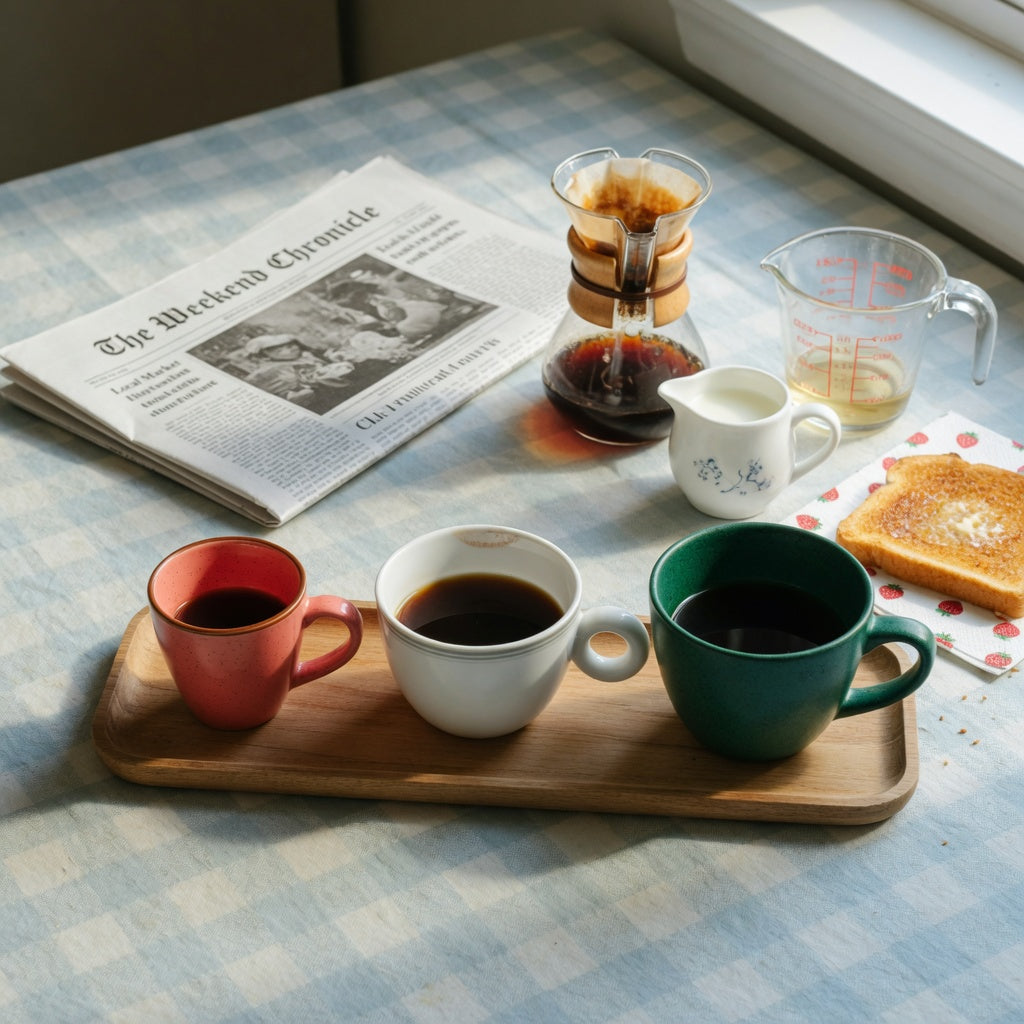
Piccolo Cup Weekend Coffee Practical Purchase Checklist
Reading time: about 10 minutes
A Saturday coffee can outgrow its cup in less than a minute: the short pour looks right, then milk or hot water takes the liquid to the rim and leaves no comfortable space for stirring. This piccolo cup weekend coffee practical purchase checklist starts with that kitchen-counter mismatch, because the name of the drink does not tell us its finished volume.
In our store, we handle compact cups during receiving, display setup, and customer comparisons. The useful product facts for this article are deliberately narrow: the Retro is 170 ml, the Ball Handle is 250 ml, and the Emerald is 270 ml. We are not presenting any of them as a certified piccolo cup, and we do not attach a fixed milk-to-coffee ratio, cafe provenance, or barista-testing claim to them. Our aim is to match a verified capacity to your slower weekend routine while identifying the details you should confirm on the current product page.
Piccolo cup weekend coffee practical purchase checklist: begin with volume
Measure the drink you already make before comparing cup styles. This takes one weekend serving and gives you a more useful answer than copying a recipe label. Record the coffee, water, and milk separately using markings on your brewer or a measuring vessel rated for the liquid being measured.
- Prepare your usual Saturday or Sunday coffee without changing the recipe to fit a cup.
- Record the brewed coffee volume, then measure any milk or water before adding it.
- Add those amounts to find the finished drink volume. Use the total, not a presumed coffee-to-milk ratio.
- Notice how much empty space you prefer above the drink for stirring and carrying it from the counter.
- Repeat the check with the largest version you commonly make, including the extra milk or water you add on a slower morning.
A 170 ml drink and a cup listed at 170 ml are not automatically a comfortable pairing. The number alone does not account for the headroom you prefer. If you dislike carrying a cup filled near the rim, choose a capacity above your measured total rather than treating the listed volume as your target pour.
What changes between 170 ml, 250 ml, and 270 ml?
The three verified capacities cover a 100 ml range. The largest change is between the 170 ml Retro and the other two options. The difference between 250 ml and 270 ml is only 20 ml, so those two should be compared on both usable space and design rather than treated as entirely different size categories.
| Option | Reader situation | Why it may fit | Trade-off |
|---|---|---|---|
| Retro coffee and tea cup, 170 ml | Your finished weekend drink stays comfortably below 170 ml. | It is the smallest verified capacity in this comparison and suits a deliberately short serving. | It leaves the least flexibility for an unplanned milk or water addition. |
| Ball Handled coffee and tea mug, 250 ml | Your recipe sometimes needs more room than the 170 ml option provides. | Its verified capacity is 80 ml greater than the Retro, and the named ball-handle design offers a distinct handling choice. | Handle comfort and storage clearance are personal; capacity cannot confirm either one. |
| Emerald coffee and tea mug, 270 ml | You want the largest capacity of these three and your finished drink remains below 270 ml with your preferred headroom. | It provides 100 ml more listed capacity than the Retro and 20 ml more than the Ball Handle. | The 20 ml increase over the Ball Handle is modest, so it is not a major step up in serving volume. |
The central rule in our piccolo cup weekend coffee practical purchase checklist is to use the upper end of your normal serving range. A cup that works only for your smallest pour is likely to feel restrictive as soon as a guest asks for more milk or you make a longer coffee.
If your measured drink is regularly above 270 ml, none of these three capacities is the honest recommendation. Browse the unique coffee mugs collection for another format instead of asking a compact cup to hold a larger serving.
Which cup suits a solo pour, flexible milk, or weekend guests?
In our experience handling this category, matching the cup to a repeatable scenario produces a clearer decision than choosing by style alone. Start with what happens after the coffee leaves the brewer.
- Short solo coffee at the kitchen counter: If the completed drink stays comfortably under 170 ml, the Retro is the direct candidate. It is not a good fit if you regularly change your mind and add more liquid after the first sip.
- One recipe that changes from week to week: If your drink sometimes crosses the range that works for 170 ml but remains within 250 ml with comfortable headroom, the Ball Handle offers the middle capacity. Review its handle photos and dimensions before assuming the shape will suit your fingers or cupboard.
- Individual guest drinks with varied additions: If each person's serving remains within 270 ml and the extra 20 ml over the Ball Handle matters, the Emerald is the larger option. It is still an individual cup, not a vessel for sharing one serving between two people.
- A gift for someone who owns only large mugs: Check the recipient's normal drink volume first. A compact cup can add a useful short-serving option, but it may stay unused if that person always fills a large mug with filter coffee, milk, or water.
Do not use the word piccolo as a substitute for measurement. There is no fixed ratio being prescribed here, and these products are not being represented as certified piccolo cups. Their practical value comes from their stated capacities and how those capacities compare with the drink you make at home.
What should you verify about material, handles, and care?
Capacity is the comparison we can state here. Before checkout, treat the current product page and any enclosed care label as the final source for material, finish, dimensions, microwave use, and dishwasher care. Do not infer those details from a photograph, color name, or the word mug.
- Material and finish: Confirm the exact material and surface description on the live listing. This affects how you should wash, store, and handle the cup, so it should not be guessed.
- Overall dimensions: Look for height, rim diameter, widest body point, and maximum width including the handle. Millilitre capacity does not tell you the cup's external footprint.
- Care instructions: Verify dishwasher and microwave guidance before the first cycle or reheating attempt. Similar-looking drinkware can have different care requirements.
- Handle clearance: Use close-up product images to judge where your fingers will sit. The Ball Handle has a design distinction in its product name, but comfort still depends on your grip and hand size.
- Arrival condition: During unboxing, inspect the rim for chips, the body and handle joints for hairline cracks, and the foot for damage or debris that makes the empty cup rock on a flat counter.
Those arrival checks are standard handling points for breakable drinkware, not a claim that any of these models has a known defect. Our team pays attention to rims, handle joints, and bases because those are the areas that affect safe everyday use. If a new cup arrives with a structural crack or sharp damaged edge, leave it unused and contact our store before discarding the packaging.
Will the cup fit your machine, shelf, saucer, and table?
A compact capacity does not guarantee compact external dimensions. A 250 ml cup can be wider or taller than another cup of similar volume, and a distinctive handle can determine whether it fits beside neighboring mugs. Check the intended space before buying.
- Espresso machine: If you brew directly into the cup, measure from the drip tray to the spout in the machine's actual brewing position. Compare that clearance with the current product dimensions.
- Cupboard shelf: Measure shelf height and available width, including the space needed by the handle. Do not assume the Ball Handle will occupy the same width as a conventional loop handle.
- Existing saucer: Compare the cup's foot diameter with the flat center of the saucer. Capacity alone cannot confirm a stable match.
- Weekend table: Consider the space beside a breakfast plate, milk jug, book, or newspaper. The cup should sit where it will not be clipped by a plate or repeatedly moved to make room.
For a gift, these measurements are harder to collect. The safer approach is to ask what cup the recipient currently uses or compare against a photograph with a familiar object for scale. Style still matters, but it should come after basic fit.
What are these compact capacities not good for?
A useful recommendation also needs a stopping point. These three options should not be forced into routines that require more volume or a different cup category.
- A finished coffee that regularly exceeds 270 ml before allowing for comfortable headroom.
- A large iced drink where cubes, milk, and coffee take up considerably more space than the liquid recipe alone suggests.
- Travel that requires verified leak resistance, a sealed lid, or a cup designed for a vehicle holder.
- A purchase based mainly on assumed insulation or cooling performance. We are making no comparative heat-retention claim for these products.
- A household where dishwasher or microwave compatibility is essential but has not yet been confirmed on the current listing or care label.
If one of those points describes your weekend, a larger mug or purpose-built travel vessel is the more practical purchase. Choosing a different category is better than accepting spills, cramped stirring, or a cup that never leaves the cupboard.
A five-minute checkout check for Saturday and Sunday
Run through this list after measuring one normal weekend drink:
- Write down the total volume after coffee, milk, and water are combined.
- Decide how much visible headroom you need for stirring and carrying the cup.
- Compare that requirement with the verified options: Retro 170 ml, Ball Handle 250 ml, and Emerald 270 ml.
- Rule out any capacity that would leave the drink uncomfortably close to the rim.
- Verify current material, external dimensions, handle clearance, and care instructions on the relevant product page.
- Measure your machine and cupboard if either space is tight.
- Choose another mug style if your drink exceeds 270 ml or requires travel-specific features.
If two cups remain after those checks, use the verified dimensional details and the handle design to break the tie. Do not rely on an imagined cafe rule. The right option is the one that fits your actual pour, storage space, and serving routine.
Frequently asked questions
What does a piccolo cup weekend coffee practical purchase checklist compare?
It compares your finished drink volume with the verified 170 ml, 250 ml, and 270 ml capacities, then checks headroom, handling, storage, and care requirements. It does not certify a cup as a piccolo vessel or prescribe a milk-to-coffee ratio.
Is a 170 ml cup too small for coffee with milk?
Not necessarily. Measure the coffee and milk together; if the total stays comfortably below 170 ml with the headroom you prefer, the Retro may fit. If the finished drink approaches that capacity, compare the 250 ml Ball Handle instead.
How different are the 250 ml Ball Handle and 270 ml Emerald?
The verified capacity difference is 20 ml. That is a modest increase, so compare the current dimensions and design as well as volume. Choose the Emerald only if the added space or its styling materially suits your routine better.
Are the Retro, Ball Handle, and Emerald certified piccolo cups?
No such certification is claimed here. We present them as compact coffee and tea options with verified capacities of 170 ml, 250 ml, and 270 ml. Select one by measured use rather than treating a product name as a brewing standard.
Can I put these cups in the dishwasher or microwave?
Check the current product page and the care information supplied with the cup before either use. This comparison does not make a blanket dishwasher-safe or microwave-safe claim. Appearance alone is not enough to determine the correct care method.
Your next step is to measure one normal weekend serving and open the product page whose capacity leaves your preferred headroom. If all three compact options are too tight or you need a different format, compare the full unique coffee mug selection against the same checklist.
More from our blog
Read more
Hot Cocoa Mug Gift Choice Practical Purchase Checklist for Daily Use
Compare The Rock at 480 ml with The Gradient and The Flow at 400 ml. This checklist matches verified capacity to recipient routines, then flags the dimensions, care, and gift details that still nee...
Read more
Breakfast Coffee Cup Weekend Coffee Practical Purchase Checklist
Compare the verified 170 ml Retro, 200 ml Pleated, and 350 ml Landscape Tall options by serving size, refill preference, and available breakfast-table space. The checklist also identifies the produ...
Read more
Leave a comment
This site is protected by hCaptcha and the hCaptcha Privacy Policy and Terms of Service apply.