
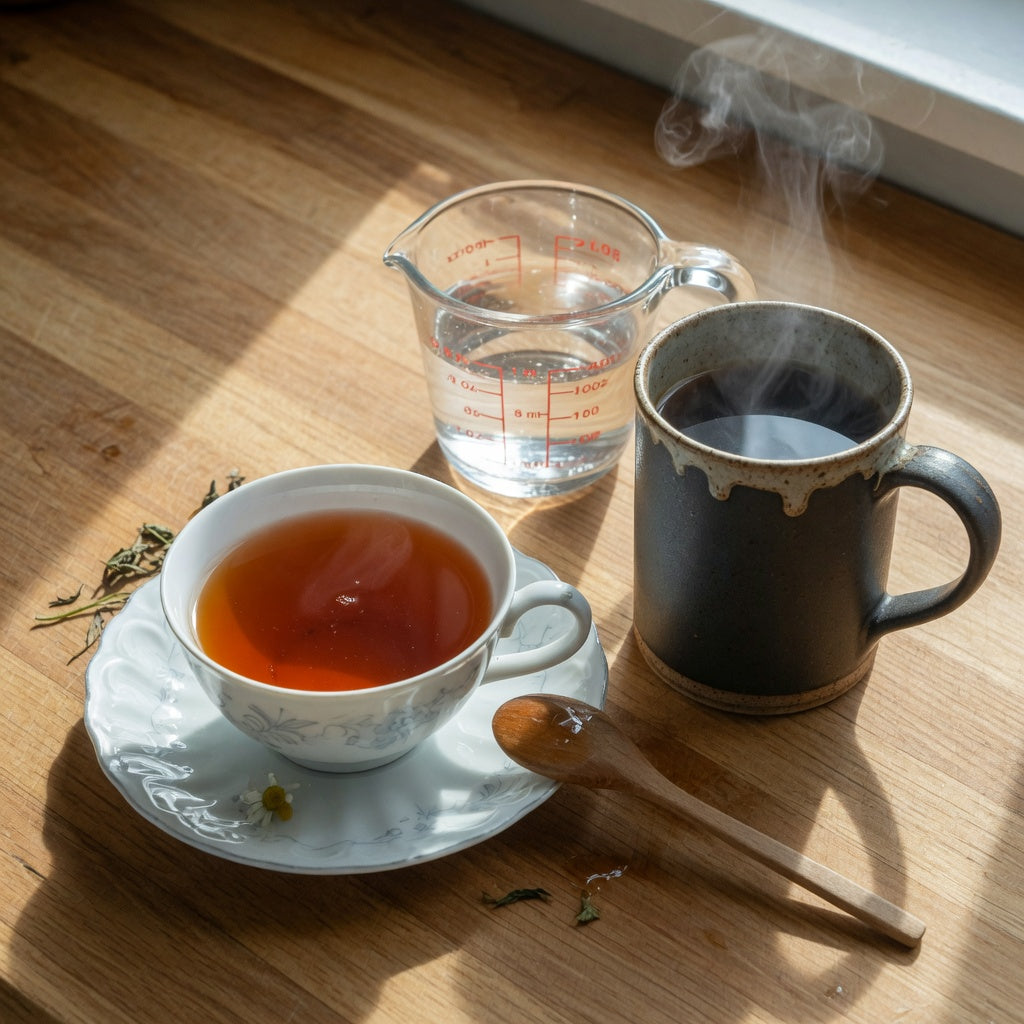
Round Tea Cup vs Coffee Mug Difference: Size, Shape, Heat
Reading time: about 9 minutes
Half the gift questions at our counter start the same way: a shopper holds a round, bowl-shaped cup in one hand, a tall everyday mug in the other, and asks which one the recipient will actually reach for. It sounds like a small decision. It isn't. The round tea cup vs coffee mug difference shows up in four places — capacity, bowl shape, heat behavior, and how formal the whole setup feels — and each one changes what your drink tastes like ten minutes after you pour it.
We sell both styles, we wash both in our office sink every day, and we've wrapped enough teacup-and-saucer gift sets to know where each one delights and where it disappoints. This is the breakdown we give shoppers in person, trade-offs included.
Round tea cup vs coffee mug difference: the short answer
A round tea cup is smaller, wider, and shallower than a coffee mug. Most hold 5–8 fluid ounces (about 150–240 ml) against the 12–16 ounces (roughly 350–470 ml) of a standard mug, and a teacup usually arrives with a saucer. The wide mouth puts more hot liquid in contact with air, so tea reaches a drinkable temperature sooner; a tall mug with thick walls does the opposite and holds heat through a long morning. Materials split the same way — bone china and porcelain on the tea side, stoneware and heavy ceramic on the coffee side.
| Feature | Round tea cup | Standard coffee mug |
|---|---|---|
| Capacity | 5–8 oz (150–240 ml) | 12–16 oz (350–470 ml) |
| Bowl shape | Wide, shallow, rounded | Tall, cylindrical, straight walls |
| Handle & saucer | Small handle, usually paired with a saucer | Large loop handle, no saucer |
| Typical materials | Bone china, porcelain | Stoneware, ceramic, glass |
| Heat behavior | Reaches drinking temperature sooner | Retains heat far longer |
| Best for | Tea service, guests, measured sips | Big morning coffee, desk refills |
If one vessel has to cover both drinks, that's why our store stocks a round coffee tea mug — the rounded silhouette is the whole point of the name. Capacity, wall thickness, and care instructions can change between production runs, so treat the current listing as the source of truth before you order. And if neither extreme sounds right, our unique coffee mugs collection covers the shapes in between.
How many ounces does each one actually hold?
Most of the confusion lives here, because the numbers on packaging rarely match what's on your counter:
- Traditional teacup: 5–8 oz (150–240 ml) — a single tea serving with headroom for milk or lemon.
- The “cup” printed on a coffee maker: 6 oz (about 180 ml) — a brewing convention for calculating water, not a real vessel. A “12-cup” machine brews roughly 72 oz, which fills only four to five actual mugs.
- Standard coffee mug: 12–16 oz (350–470 ml) — what most people picture when they hear “mug.”
- Oversized or latte mug: 16–20+ oz (470–590+ ml) — café-style drinks, soup, long desk sessions.
That mismatch has real consequences. Tea steeping guides assume a small water volume, so a full 16 oz mug stays hot enough to keep extracting long after the timer ends. Coffee runs the other way — a 6 oz teacup holds roughly half of what most people call one serving, so you refill constantly. Cappuccino cups land at yet another size, which we compared separately in our cappuccino cup size comparison, and our coffee mug vs tea mug size comparison lays the whole chart out in one place.
Why is a teacup round, wide, and shallow?
The shape is physics, not decoration. A wide opening exposes more hot liquid to the air, which speeds surface and evaporative cooling — exactly what tea wants, since black and green teas taste best below scalding. Rounded walls also pool the liquor where you can read its color and catch its aroma without leaning over the cup.
A wide bowl pulls your drink toward drinkable temperature fast. A tall, thick wall keeps it hot for the long haul. Neither is better — they serve different drinking speeds.
Sensory research backs the idea that the vessel itself matters: peer-reviewed work on crossmodal perception has repeatedly found that a cup's weight, color, and shape can nudge how intense or aromatic a drink seems. You don't need a lab to notice the basics — a narrow rim funnels aroma straight at your nose, while a wide teacup lets it drift.
The trade-offs cut both ways, and both land in our customer emails. Slow sippers tell us a round teacup goes lukewarm before they're halfway through. Fast green-tea drinkers report the opposite problem: a 14 oz stoneware mug, insulated by its own thick walls, keeps steeping the leaves until the cup turns bitter. If both options on your shortlist are mugs, our round tea mug vs coffee mug breakdown narrows that choice further.
Which material survives your kitchen: bone china, porcelain, stoneware, or glass?
Material decides weight, heat retention, and how a piece fares in the dishwasher rack. Here's the version we give shoppers standing at the counter:
- Bone china: the thinnest, lightest option, with a translucent edge you can see light through. Many pieces carry gold or metallic rims, which don't belong in the microwave — trim can arc or wear away — and prefer gentle hand washing. Thin rims also show chips first.
- Porcelain: fired hard and dense, so it resists chipping better than thin bone china while keeping a refined look. Without metallic decoration, most porcelain handles the dishwasher fine — confirm on the maker's care card.
- Stoneware: thick walls, real heft, the best heat retention of the group. The damage we see in customer photos is almost always a chip at the rim or the handle joint after a knock against a sink edge or dishwasher rack. Most modern glazes tolerate dishwasher and microwave use, but verify piece by piece.
- Double-walled glass: shows off the drink's color, and the double wall insulates while keeping the outer surface touchable. The weak point is fragility — thin single-wall glass can crack from thermal shock if boiling water hits a cold vessel.
One habit that helps any material: preheat the cup with hot tap water before pouring. A cold, thick stoneware wall pulls heat out of your first sip, and no shape choice fixes that.
Can you use a coffee mug for tea — or a teacup for coffee?
Yes to both, and we do both at the office. The trade-offs are still worth knowing before a gift lands under someone's tree. A 12–16 oz mug holds two to three tea servings of water, and its insulated walls keep that water hot enough to keep extracting — a bag left in for the whole drink turns tannic and bitter. The fix is simple: pull the leaves on time, use a large infuser you can lift out, and drop the water temperature for green teas. Herbal infusions, which don't oversteep the same way, are genuinely happier in a big mug.
Going the other direction, a 6 oz teacup holds roughly half a normal coffee pour, and the saucer that looks graceful on a living-room table is clutter next to a keyboard. If the recipient drinks one big pour at 8 a.m. and nurses it until 11, the mug wins that morning every time. If they brew a pot and take one elegant cup, the teacup wins.
Three buying situations we see every week — and what we hand those shoppers
- A gift for someone who hosts tea. They want the ritual: wide bowl, saucer, something that photographs well on a coffee table. A dedicated teacup-and-saucer set fits that brief; if they'd also use it for morning coffee, the round coffee tea mug listing is the piece to check — confirm whether it's a single cup or a set, plus capacity and care, on the current page before you gift it.
- The desk drinker who refills twice a day and hates cold coffee. Tall, thick-walled stoneware with a roomy handle and no saucer in sight. Pick from our shapes with more personality than a plain diner mug.
- The person who drinks both and has one cabinet slot left. This is the round-mug compromise: rounder and wider than a standard mug, roomier than a teacup. It won't out-perform a dedicated piece at either job — but it's the one vessel that gets used daily instead of stored.
Frequently asked questions
What is the real round tea cup vs coffee mug difference?
Four things: capacity (about 5–8 oz versus 12–16 oz), bowl shape (wide and shallow versus tall and cylindrical), heat behavior (reaches drinking temperature sooner versus holds heat for slow sipping), and formality (saucer-and-set presentation versus standalone workhorse). Choose based on how fast the recipient drinks and where the cup will live.
Can I drink tea from a coffee mug?
Absolutely — the vessels are interchangeable in practice. Adjust for volume: a mug's larger, hotter water mass keeps extracting, so remove the bag or infuser on schedule and use cooler water for delicate greens. Herbal and fruit blends need no adjustments at all.
How many ounces is a traditional teacup?
Most hold 5–8 fluid ounces (about 150–240 ml). Don't confuse that with the 6 oz “cup” printed on coffee maker packaging — that's a brewing convention for calculating water, not the size of an actual cup on your shelf.
Does the cup change how tea or coffee tastes?
It can. Peer-reviewed sensory studies on crossmodal perception have found that a vessel's weight, color, and shape can shift perceived intensity and aroma. The physics is easier to trust: a wide bowl cools the drink toward its flavorful temperature sooner, while thick insulated walls can push long-steeping tea toward bitterness.
Why did my tea turn bitter in a large mug?
Volume plus insulation. A full mug of near-boiling water stays hot far longer than a shallow teacup serving, so leaves keep releasing tannins well past the recommended steep time. Steep in a smaller amount and top up, or use an infuser you can lift out on schedule instead of letting a bag sit for the whole drink.
A 30-second checklist before you buy
- Measure the pour, not the cup: match capacity to how much the person actually drinks in one sitting.
- Time their habit — a ten-minute tea drinker and a two-hour coffee nurser need opposite shapes.
- Match the material to their appliances: metallic-trimmed bone china and microwaves don't mix, and stoneware wants a gentle slot in the dishwasher rack.
- Decide whether a saucer is charm or clutter on that specific countertop or desk.
- Read the actual listing for capacity and care before checkout — specs change between runs and designs.
If one vessel has to do both jobs, start with the round coffee tea mug we covered above and confirm its capacity and care details on the current listing before checkout. If the drink is always coffee, head to our unique coffee mugs and pick the shape that fits the desk.
Read more

Crane Tea Cup Gift: What to Compare Before You Buy
A crane tea cup gift carries real meaning — longevity, fidelity, good fortune — but the right pick depends on cup shape, capacity, glaze care, and the occasion. Here's how our team compares designs...
Read more
Unique Round Mug Gift for Coffee Lovers: What Buyers Should Compare
Round mugs win the unboxing, then face real life: desk edges, crowded cabinets, hot exteriors. We compare capacity by drink type, stoneware vs. porcelain, base stability, and glaze care so your gif...
Read more
Leave a comment
This site is protected by hCaptcha and the hCaptcha Privacy Policy and Terms of Service apply.