



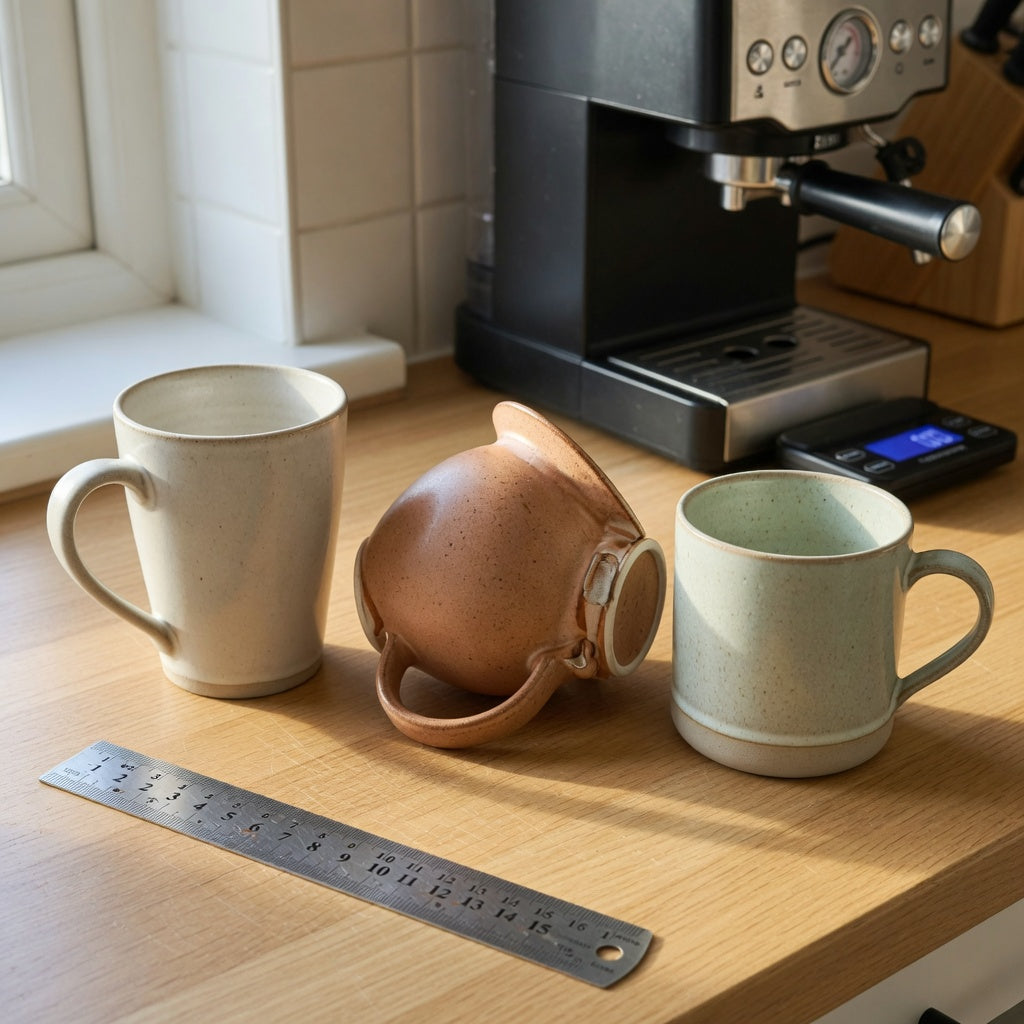
Big Latte Mug Shape and Handle Guide: 400, 440 or 480 ml
Reading time: about 10 minutes
A customer wrote to us last week after her order arrived. She had bought our 400 ml mug expecting it to look like the 16 oz mug she fills at the office, and it didn't. Neither mug was misdescribed. They were built for two different drinks wearing the same nickname. That gap is exactly what this big latte mug shape and handle guide is for — not the abstract question of which mug is best, but which of the three profiles we currently stock matches the drink you actually pour every morning.
We keep all three on a shelf behind the packing bench: The Flow at 400 ml, Morning and Night at 440 ml, and The Rock at 480 ml. After a few hundred orders, the questions that come back are almost never about the number on the page. They are about usable volume, rim width, handle opening, and how much counter or shelf depth the base eats.
Big latte mug shape and handle guide: what actually changes from 400 to 480 ml
Latte mug is a marketing term, not a size class. Specialty café latte cups are commonly listed somewhere around 300–355 ml, sized around a double shot, steamed milk, and a thin foam cap. Retail mugs sold under the same label run well above that. The FDA compliance policy guide for ceramic hollowware describes cups and mugs as vessels that normally hold about 240 ml (8 fl oz) and are made with a handle — a regulatory baseline for the object, not a latte standard.
Here is where our three current options sit:
| Mug | Listed capacity | Approx. US fl oz | What that number does for a drink |
|---|---|---|---|
| The Flow | 400 ml | ~13.5 | A 12 fl oz latte leaves roughly 1.5 fl oz of headroom |
| Morning and Night | 440 ml | ~14.9 | Space for a heavier milk ratio or a taller foam cap |
| The Rock | 480 ml | ~16.2 | Takes a 16 fl oz build, or ice plus a long pour |
Those are listed capacities — the figure the maker publishes, usually measured near the rim. That is not the same as a comfortable pour, which is the part most shoppers miss until the first spill.
How do 400, 440, and 480 ml convert to ounces without rounding surprises?
NIST Handbook 44 sets 1 US fluid ounce at 29.57353 ml, and Handbook 130 gives the packaging conversion as fluid ounces multiplied by 29.5735 to reach milliliters. Divide the other direction and 400 ml lands near 13.5 fl oz, 440 ml near 14.9 fl oz, and 480 ml near 16.2 fl oz.
Rounding is where buyers get burned. A listing that says 14 oz and one that says 440 ml are not automatically describing the same vessel, and a mug marketed as 16 oz may be quoting brim capacity rather than a fill you would actually carry.
- 400 ml / 13.5 fl oz: a 12 fl oz drink fits with headroom; a 16 fl oz drink does not.
- 440 ml / 14.9 fl oz: bigger than most café cups, smaller than a pint glass, and the size most people should probably buy.
- 480 ml / 16.2 fl oz: the 16 oz retail zone, with just enough spare room for foam.
Then there is the brim problem, which no capacity number solves on its own. A 480 ml mug filled to the top is a 480 ml mug you cannot carry across a room. Leave 15–20 mm of headroom for a hot drink with foam. For iced drinks, remember that ice claims volume before the coffee does — a 480 ml iced latte holds far less liquid than a 480 ml hot one. If you want the same size band read through a milkier drink, our café au lait mug shape and handle guide covers 400–480 ml from that angle.
Wide bowl or tall wall: which shape suits the latte you pour?
Shape does two jobs at once. It changes how the milk settles, and it changes how the mug behaves in your hand and on your desk.
A wide, shallow bowl gives foam a bigger surface to spread across, which is why latte art pours read more clearly in that profile. A taller, straighter wall keeps the drink deeper and is easier to carry one-handed from kitchen to desk, but there is less surface to work with if you are pouring rosettas or hearts.
The trade-off people notice second is temperature. A wide mug exposes more liquid surface, so the top of the drink cools faster. That is fine if you finish a latte in ten minutes and irritating if it sits beside a laptop for an hour. A tall mug with a narrow base is also easier to knock over on a crowded desk than a wide, low one. Neither shape wins outright; they match different habits.
One detail worth zooming in on in any listing photo: rim thickness. A rolled, thick rim changes how the drink feels on your lip more than a 40 ml capacity difference does. If you want the same comparison applied to smaller café cups, our ceramic latte cups shape and handle guide covers 250, 400, and 440 ml. And if your drink is foamier than a latte, the cappuccino coffee mug shape and handle guide works through the same question at a smaller capacity.
How much handle room does a full 480 ml mug actually need?
Handles cause more returns than capacity does. A mug can hold 480 ml and still be miserable if the opening only takes two fingers, because your grip slides forward toward the hot rim.
- Opening clearance: fingers should pass through with a knuckle of space to spare. If your fingertips touch the far side of the loop, you will grip near the rim.
- Attachment height: a handle set high on the wall keeps knuckles away from the hottest part of the body. One set low lifts off a low shelf more easily but puts fingers closer to the drink line.
- Filled weight: 480 ml of a milk-based drink is roughly half a kilogram of liquid before you add the mug itself. That is a firm one-hand carry, not a fingertip lift.
- Projection: a handle that loops far out from the body suits large hands but adds depth, which matters on a narrow shelf.
Product photos are the fastest way to compare handle form. Open The Rock and Morning and Night side by side and look at where the handle joins the wall and how much daylight sits between handle and body. Then confirm the printed dimensions and care line on the current listing. The product page is the only place those figures stay current, and it outranks any general sizing table, including this one.
Will a big latte mug clear your group head, shelf, and cup holder?
Fit failures are boring and common. In our experience they show up as a mug that lives on the counter instead of under the machine. Run these five checks in this order before you order:
- Espresso group head. Measure from the drip tray to the portafilter spout with your scale already in place. A tall mug plus a scale is the classic clearance failure.
- Cabinet shelf. Measure the gap to the shelf above, then subtract the height of anything the mug sits on. Stacking two large mugs rarely works.
- Car cup holder. Measure the narrowest point of the holder, not the rim. A wide base will not drop in.
- Desk and coaster. A wide base needs a wide coaster and eats more of the square you have.
- Dishwasher rack. Taller mugs sometimes only fit the top rack, and only if the tines are spaced for them.
Dishwasher, microwave, and lead-free: what the label does and does not cover
Care labels are instructions, not guarantees. The failure modes are predictable:
- Dishwasher. Heat, detergent, and crowding do the damage over months. Glaze can dull, and metallic or gilded rims are usually the first thing to go. If a listing says nothing about dishwasher use, treat the mug as hand-wash only — that is the safer read.
- Microwave. Fine glaze cracks (crazing) and metallic trim are the usual problems, along with thermal shock. Moving a cold mug straight into a hot microwave is harder on it than a normal reheat.
- Lead. The FDA compliance guide for ceramic cups and mugs sets a lead action level of 0.5 micrograms per milliliter of leaching solution, applied to any one of six units tested, and the agency notes that some ceramic foodware can leach lead from food-contact surfaces. Lead-free is marketing language; a test result is evidence. For a daily driver or a gift, it is fair to ask which one you are getting.
None of that is a reason to avoid glazed mugs. It is a reason to read the care line and treat a silent listing as a no.
Which of the three sizes fits your morning: hot, iced, art, or gift?
Hold your usual mug, then answer three questions honestly.
- How much liquid do you actually pour? A double-shot latte with a modest milk ratio sits comfortably in The Flow at 400 ml. If you build 16 oz drinks at home most mornings, 400 ml is the wrong pick — you will fill near the brim and wear some of it.
- Hot or iced? With iced lattes, ice claims volume before the coffee does, which is where The Rock at 480 ml earns its place. For a hot latte you sip slowly at a desk, the smaller Flow simply holds less liquid to cool down.
- Do you pour art? If yes, a wide rim and shallower bowl help, and 440 ml is the middle ground where you gain milk without losing the pouring surface. That is Morning and Night, and it is the size we suggest to anyone stuck between the other two.
Two honest limits. The 400 ml Flow is not the mug for someone drinking a pint-sized iced coffee every morning; by the second week it will feel small. And the 480 ml Rock is a poor match for a compact espresso setup with limited group-head clearance, or for anyone who wants a short, strong latte rather than a long drink. Big is a shape decision as much as a volume decision.
If you want to see the whole set — including the novelty and patterned options we rotate in — browse our unique coffee mugs collection and compare all three capacities in one place. Before you check out, do one last pass: measure your group-head clearance with the scale in place, confirm the handle opening in the photos, and check whether the capacity printed is a brim figure or a fill figure.
Frequently asked questions
Is 400 ml enough for a 12 oz latte?
Yes. 400 ml converts to about 13.5 US fl oz, so a 12 fl oz drink leaves roughly 1.5 fl oz of headroom — enough for a foam cap without filling to the rim. If your usual build runs closer to 16 fl oz, move up to 480 ml instead.
Does a wider mug really help with latte art?
A wider, shallower cup gives foam more surface to spread across, which is why art pours read more clearly in that shape. Milk texture still matters more than mug width — well-textured milk in a narrow mug beats thin milk in a wide one.
What is the most common sizing mistake this big latte mug shape and handle guide runs into?
Confusing brim capacity with a comfortable fill. A 480 ml mug holds 480 ml at the very top, but once you leave 15–20 mm of headroom for foam and for carrying it without spilling, you are pouring meaningfully less than the printed number.
Is 440 ml a real size, or just a marketing number?
It is a listed capacity, and it converts to roughly 14.9 US fl oz. That places it between a large café latte cup and a 16 oz retail mug, which is why it is often where people land when 400 ml feels slightly tight and 480 ml feels like a bowl.
Can these mugs go in the dishwasher?
Only if the current product page says so. When a listing is silent on care, hand-washing with warm water and a soft sponge is the safe assumption — dishwasher heat and detergent are what dull glazes and wear metallic rims over time.
Ready to pick your mug? Two ways to save on today's order:
Ordering 1–3 mugs? Get an extra 10% off your 1st order with code 10_OFF Apply 10% Off & Shop Wooden-Handle Mugs →
Gifting 4+ mugs? Buy 3, Get the 4th Free applies automatically at checkout (no code needed; offers do not stack) · Free standard shipping (Nov pre-Christmas delivery: 15–20 calendar days US) · Free replacement if chipped in transit.
Popular mug buying guides: Ceramic Mugs with Lids Compared · Wooden-Handle Tea Infuser Mugs Compared · Christmas & Secret Santa Mugs 2026 · Espresso & Cortado Cups Guide · Cup & Saucer Gift Sets · All 25 Mugs Spec Table · Mug Size Guide · Shipping & Promo FAQ
FIRST ORDER 10% OFF (CODE: 10_OFF) · OR BUY 3, GET THE 4TH FREE


Read more
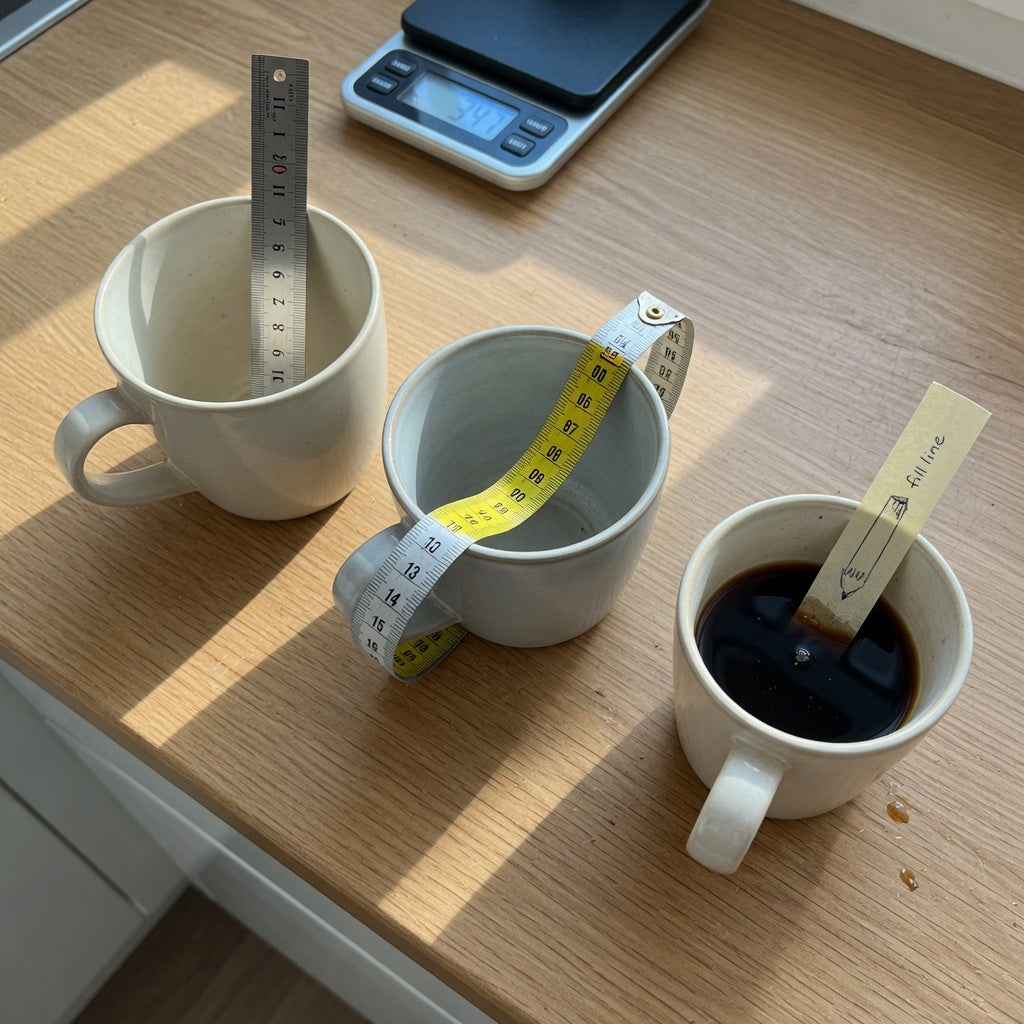
14 Oz Ceramic Coffee Mugs Shape and Handle Guide: 400 vs 440 vs 480 ml
14 US fl oz is about 414 ml, but most listings quote brim capacity rather than a pour you can carry. This guide compares our 400 ml, 440 ml, and 480 ml ceramic mugs on handle clearance, glaze care,...
Read more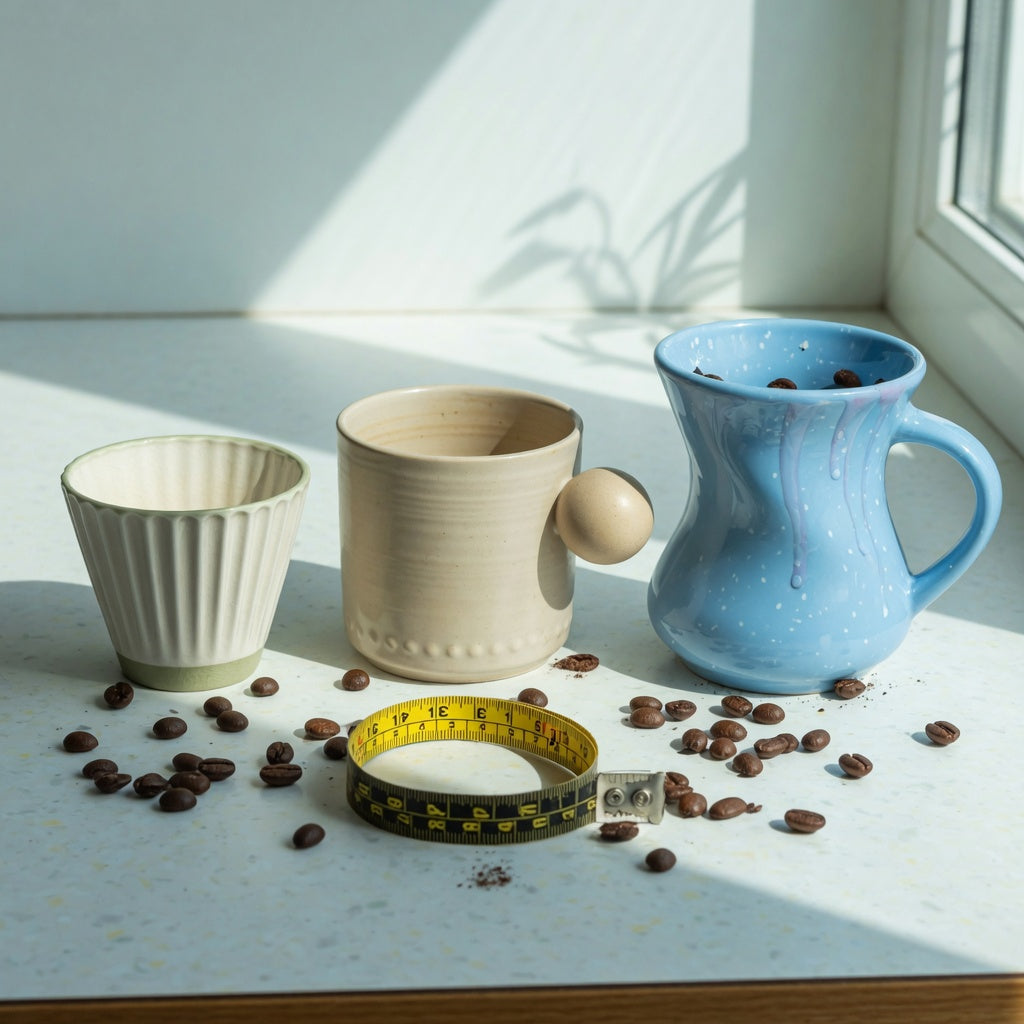
Ceramic Mug Shapes Shape and Handle Guide: 3 Current Mugs
A practical comparison of three current ceramic mugs by silhouette, handle geometry, and listed capacity: 200 ml pleated, 250 ml ball handle, and 400 ml flow. Includes rim, spout-clearance, and foo...
Read more
Leave a comment
This site is protected by hCaptcha and the hCaptcha Privacy Policy and Terms of Service apply.