



Ceramic Mug Shapes Shape and Handle Guide: 3 Current Mugs
Reading time: about 10 minutes
The mug looks right in the product photo. Then it lands on the counter and the handle takes two fingers, not three; the rim is wider than your usual sip; the body is too tall for the office coffee spout. Capacity alone does not tell you how a mug will feel. This ceramic mug shapes shape and handle guide compares visible silhouette, handle geometry, and listed capacity across three current options, then flags what to verify before checkout.
What does this ceramic mug shapes shape and handle guide compare across 200, 250, and 400 ml?
U.S. FDA guidance gives a useful starting vocabulary. It defines cups and mugs as small ceramic hollowware commonly used for drinks such as coffee or tea above room temperature. They normally, but not exclusively, hold about 240 ml (8 fl oz) and are made with a handle. In that guidance, cups normally have a base and curved sides, while a mug has cylindrical sides. Those are broad definitions, not retail labels. Sellers use barrel, belly, tulip, and diner freely, and a product name may describe a look rather than a standard measurement.
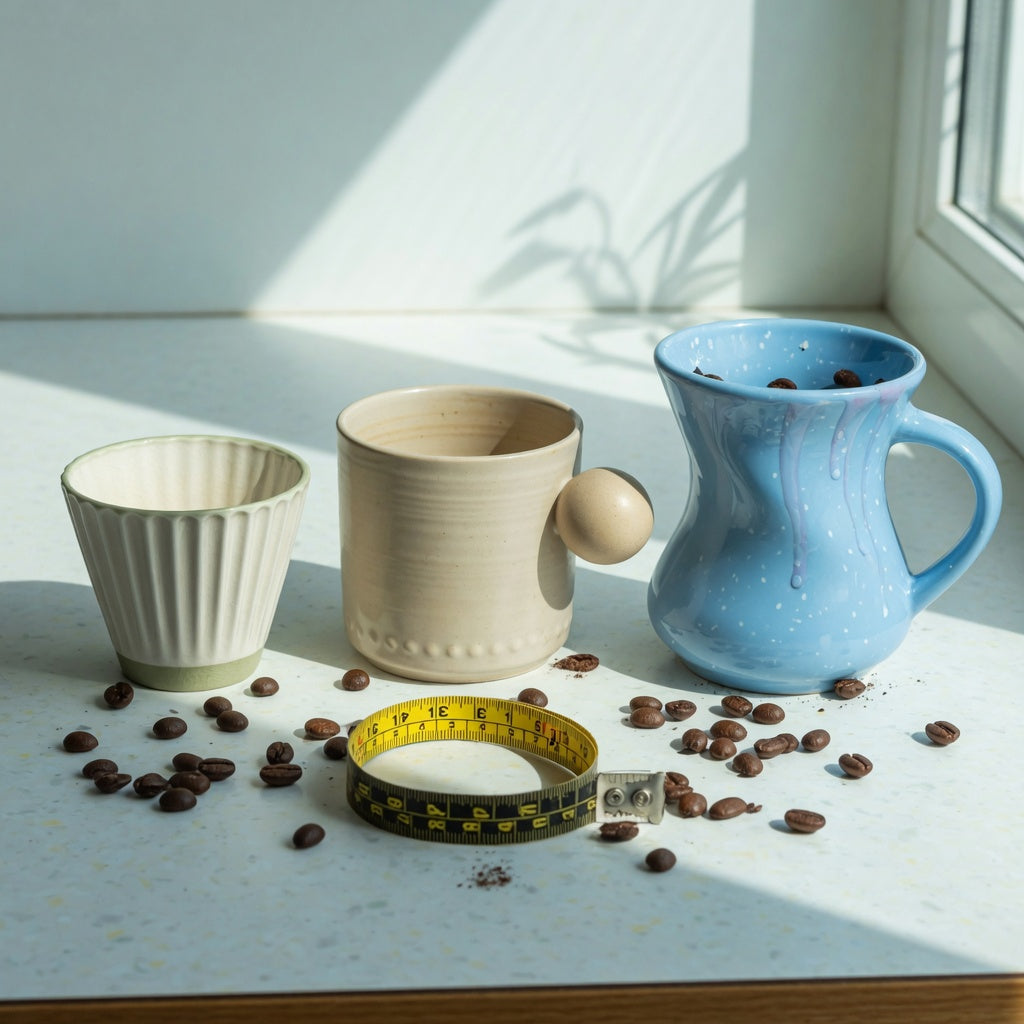
That is why we start with the photo and the listed capacity, not the shape name. In our store, we photograph mugs next to a ruler because handle span and rim width are the details buyers ask about after delivery. Our unique coffee mugs collection is the place to browse current silhouettes if you are still deciding between a small cup, a handled mug, and a larger flow profile.
NIST’s approximate conversion is 1 fluid ounce = 29.57 milliliters, and its household table treats 1 cup as 240 ml. Use those numbers to translate the listed millilitres, then confirm the current listing for dimensions and care. The three current options in this guide are 200 ml, 250 ml, and 400 ml.
Why does a 200 ml pleated cup suit tea and small coffee better than a desk mug?
The Pleated 200 ml cup is the smallest of the three current options. At 29.57 ml per fluid ounce, 200 ml is about 6.8 fl oz. That is smaller than the 8 fl oz typical mug in the FDA definition, so treat it as a deliberate portion rather than an all-day mug.
- Listed capacity: 200 ml, about 6.8 fl oz.
- Typical fit: tea, a small coffee, a measured afternoon pour, or a drink you want to finish while it is still hot.
- Trade-off: it will not replace a 12 oz travel mug or a long milk drink. If you refill often, the smaller volume becomes a chore.
- Check on the listing: rim diameter and handle opening. The word pleated describes the exterior; it does not tell you how the rim will feel against your lip.
If your routine is one concentrated coffee or a tea you sip slowly, the 200 ml size makes sense. If you want a handled middle option for a standard coffee, the Ball Handle 250 ml mug is the next step up. Compare both in the current collection before you commit to a volume.
Where does the 250 ml ball-handle mug fit in an everyday coffee routine?
The Ball Handle 250 ml mug sits near the 240 ml typical mug size in FDA guidance. Converted, 250 ml is about 8.5 fl oz. The product name points to a ball-style handle. That is the detail to inspect, because a 250 ml body can be paired with a generous opening or a tight one. Listed capacity does not predict finger room.
- Listed capacity: 250 ml, about 8.5 fl oz.
- Typical fit: everyday coffee, a tea drinker who wants a handle, or a desk mug for someone who does not want a large pour.
- Trade-off: a ball handle can feel secure for hooked fingers, but we cannot tell you it fits larger hands from capacity alone. If you wear gloves or have larger knuckles, compare the clear opening before buying.
- Check on the listing: handle thickness, distance from the body, and whether the handle height clears your cabinet shelf.
This is the middle option in the line, and it is the one we would point to when a 200 ml cup sounds too small but a 400 ml mug sounds like too much. If you already know you want a larger desk mug, read the next section before you add the 250 ml to your cart.
When is The Flow 400 ml mug the right desk companion—and when is it too much?
The The Flow 400 ml mug is the large option here. At 29.57 ml per fluid ounce, 400 ml is about 13.5 fl oz. That is a desk mug, a long coffee, or a mug for someone who drinks slowly and does not want to refill. It is also heavier when full: 400 ml of liquid weighs roughly 400 g before you add the mug’s own weight, so check your grip and the walk from kitchen to desk.
- Listed capacity: 400 ml, about 13.5 fl oz.
- Typical fit: long black coffee, large tea, iced coffee with room for ice, or a workday mug that stays put.
- Trade-off: it may not fit under a low coffee spout or in a crowded cabinet. A full 400 ml mug is also a lot to hold one-handed.
- Check on the listing: overall height, opening width, and handle clearance. The Flow name does not tell you whether the opening is wide or narrow; the current photos and dimensions do.
If capacity is your priority and you have measured the landing zone, The Flow is the logical choice. If you want a smaller handled mug for a standard coffee, go back to the Ball Handle 250 ml. If you want a small tea cup, start with the Pleated 200 ml. The unique coffee mugs collection shows the three side by side.
How do rim width, opening area, and wall thickness change the sip?
Rim comfort is not a decorative detail. A thin rim and a thick rim feel different against the lip, and a pour lip helps if you transfer from a kettle. A wide opening adds surface area and evaporation, which is why an open mug cools differently from a lidded tumbler. A narrow opening can concentrate aroma, but it can also make a large-volume mug awkward to sip. None of this proves that a named silhouette makes coffee sweeter or more acidic. We would not make that claim.
- Run a finger around the rim: check for a sharp edge, a wobble, or a glaze break.
- Look for a pour lip: useful for tea from a kettle, less important if you only pour from a carafe.
- Compare opening area: wide for latte art and cooling, narrower for slower sipping and less spill risk when you walk.
- Inspect interior corners: facets and square shoulders can trap residue if the inside is not smoothly rounded.
Wall thickness also affects how the mug feels in hand and how quickly heat moves through the wall. More surface area and thinner walls increase conductive heat flow, while an open top adds evaporation that a lid removes. Preheat the mug with hot water if heat retention matters to you, and use the shape you will actually enjoy holding.
Will the handle clear your coffee spout, cabinet shelf, and dishwasher rack?
This is where online mug shopping goes wrong most often. The product photo is styled; your kitchen is not. Before you choose between 200 ml, 250 ml, and 400 ml, measure the actual landing zone.
- Coffee spout clearance: measure from the drip tray to the spout, then compare the mug height including the handle.
- Cabinet shelf gap: a tall handle can stop a mug from sliding under a shelf even when the body fits.
- Dishwasher rack: check the listing for care guidance; do not assume a decorative shape is dishwasher-safe just because it is ceramic.
- Stacking: straight-sided mugs usually stack more predictably than belly or ball-handle forms. If you stack, put the odd shapes on the top shelf.
| Option | Listed capacity | Approx. fl oz | Visible cue to check | Typical fit |
|---|---|---|---|---|
| Pleated cup | 200 ml | 6.8 | Pleated body; rim and handle opening | Tea, small coffee, portion control |
| Ball Handle mug | 250 ml | 8.5 | Ball-style handle; clear finger room | Everyday coffee; near a typical 8 oz mug |
| The Flow mug | 400 ml | 13.5 | Height and opening width | Long coffee, desk use, larger servings |
The fluid-ounce figures are conversions, not extra product specifications. Use them to compare the listed millilitres, then confirm the current listing for dimensions and care.
What should you verify about glaze, lead, and food contact before first use?
Shape does not decide whether a glaze is safe. The glaze and firing do. FDA guidance for ceramic cups and mugs used for food sets a lead guideline of 0.5 micrograms per milliliter of leaching solution in any one of six units, and it cites ASTM C738 among the examination methods. ASTM C738 uses acetic acid to extract lead and cadmium from glazed ceramic surfaces and describes that extraction as a severe test unlikely to be matched in ordinary use. FDA also states that lead in a glaze can leach if it is not properly fired into the ware, and that there is no known safe level of lead exposure, with developing fetuses, infants, and children particularly vulnerable.
That is why we do not use a mug’s silhouette as a safety claim. Ask for the current listing’s food-contact statement and any test information the seller can share. Treat decorative ceramics as decorative unless the seller confirms food use. This ceramic mug shapes shape and handle guide can help you compare capacity and handle room, but it cannot substitute for the maker’s glaze and firing information.
Frequently asked questions
Is 200 ml too small for coffee?
It depends on the drink. At about 6.8 fl oz, 200 ml is close to a small coffee or a generous tea, but it is not a long latte or a travel mug. Choose it for portion control, not for all-day volume.
How many fingers should fit through a mug handle?
There is no universal finger count. The useful check is the clear opening between handle and body, plus handle thickness. If you have larger hands or wear gloves, compare that opening before buying; 250 ml of capacity tells you nothing about finger room.
Does a wider mug make latte art easier?
A wide opening gives the milk more room to settle, but milk texture and pouring control matter more than capacity. A 400 ml mug with a narrow opening can be harder to pour into than a 250 ml mug with a wide one. Check the opening photo, not just the millilitres.
Are thick-walled mugs better at keeping coffee hot?
Wall thickness and opening area affect heat flow, but we would not rank a named shape as proven hotter. An open top adds evaporation, and a lid changes the result. Preheat the mug if heat retention matters to you, and use the shape you will actually enjoy holding.
What is the quickest way to compare these three mugs before checkout?
Use this ceramic mug shapes shape and handle guide as a checklist: note listed capacity, handle opening, rim style, height with the handle, and care instructions. If you want the small tea cup, start with the Pleated 200 ml; for a middle-size handled mug, compare the Ball Handle 250 ml; for a large desk mug, measure for The Flow 400 ml. Browse the unique coffee mugs collection when you are ready to compare the current line side by side.
More from our blog
Ready to pick your mug? Two ways to save on today's order:
Ordering 1–3 mugs? Get an extra 10% off your 1st order with code 10_OFF Apply 10% Off & Shop Wooden-Handle Mugs →
Gifting 4+ mugs? Buy 3, Get the 4th Free applies automatically at checkout (no code needed; offers do not stack) · Free standard shipping (Nov pre-Christmas delivery: 15–20 calendar days US) · Free replacement if chipped in transit.
Popular mug buying guides: Ceramic Mugs with Lids Compared · Wooden-Handle Tea Infuser Mugs Compared · Christmas & Secret Santa Mugs 2026 · Espresso & Cortado Cups Guide · Cup & Saucer Gift Sets · All 25 Mugs Spec Table · Mug Size Guide · Shipping & Promo FAQ
FIRST ORDER 10% OFF (CODE: 10_OFF) · OR BUY 3, GET THE 4TH FREE


Read more
Big Latte Mug Shape and Handle Guide: 400, 440 or 480 ml
A side-by-side look at our three current sizes — The Flow 400 ml, Morning and Night 440 ml, and The Rock 480 ml — covering ounce conversions, wide-versus-tall shape, handle opening, and the fit che...
Read more
14 oz Ceramic Coffee Mugs for Small Coffee Setup: What to Compare
A 14 oz mug is roughly 414 ml, but most listings quote brim capacity, not a comfortable pour. Here is how we compare usable volume, counter footprint, handle clearance, care labels, and glaze safet...
Read more
Leave a comment
This site is protected by hCaptcha and the hCaptcha Privacy Policy and Terms of Service apply.