



14 Oz Ceramic Coffee Mugs Shape and Handle Guide: 400 vs 440 vs 480 ml
Reading time: about 11 minutes
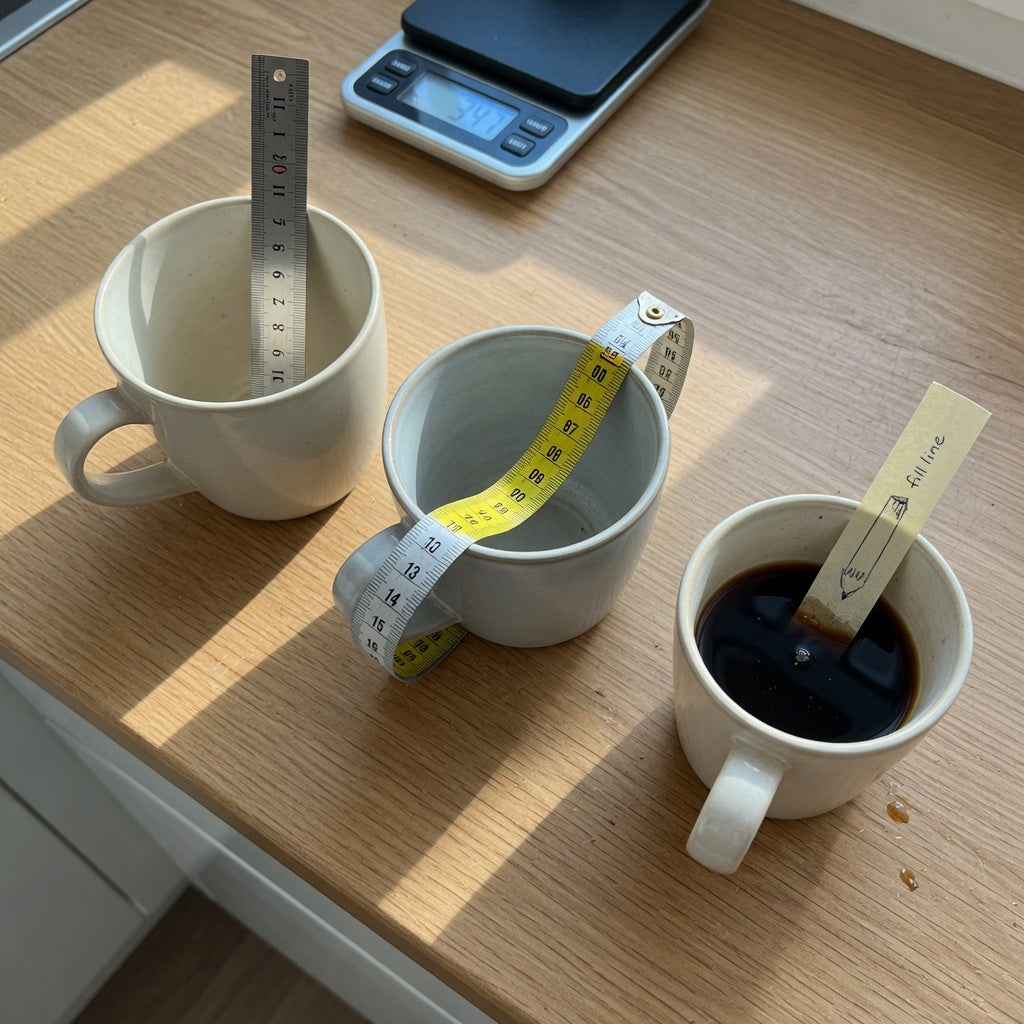
Two mugs sit side by side on our packing bench, one filled to 400 ml and one to 480 ml. The second holds a fifth more coffee. From arm’s length they look like the same mug, and nothing on the base tells you which is which.
That gap between a photograph and a spec line is where most online mug purchases go sideways. This 14 oz ceramic coffee mugs shape and handle guide stays with things you can check before checkout: the millilitre conversion behind the ounce figure, the three handle measurements that decide whether a full mug feels steady, and how our current 400 ml, 440 ml and 480 ml bodies line up against the number you typed into the search bar.
What does 14 US fluid ounces actually mean in a mug?
Fourteen US fluid ounces is 414 ml. NIST defines the US fluid ounce as 29.57353 ml, so the arithmetic is settled — it’s the listings that aren’t.
FDA’s ceramicware guidance describes cups and mugs as small hollowware, normally around 240 ml (8 fl oz) and usually made with a handle. A 14 oz mug is roughly 1.75 times that reference, and it sits well below the agency’s 1.1 L threshold for large hollowware. Read plainly, a 14 oz mug is a generous everyday cup rather than an oversized vessel.
Two different numbers hide inside “14 oz”:
- Brim capacity — filled to the lip. Bigger, more flattering, and the figure most listings print.
- Pour capacity — filled to a line you can carry across a kitchen without sloshing. Usually 1 to 2 fl oz lower.
A mug sold as 14 oz at the brim drinks like a 12 oz mug. If a lid is part of the design, the figure quoted with the lid in place is closer to the drinkable number, because the lid displaces volume. Ask which figure a listing means. If it publishes one number with no context, assume brim.
Which drinks suit a 14 oz ceramic mug, and which go lukewarm in one?
Capacity only helps once it’s matched to a drink. In our experience the mismatch is nearly always the same: someone buys the largest mug on the page, pours 9 oz of drip into it, then wonders why the coffee is tepid by the second email.
- Drip coffee, 8–10 oz: a lot of empty air sits above the surface, and air plus exposed wall is where heat goes. A 12 oz body handles this pour better; in a 14 oz mug the last third cools noticeably.
- Latte or cappuccino, 12–16 oz: the range where a 440 ml body earns its place. Milk-heavy drinks need the volume, and the ceramic mass holds heat while you drink.
- Tea, 10–12 oz: workable in a 14 oz mug if you pre-warm with hot water first. A cold wall pulls the first minute of heat straight out of the brew.
- Iced coffee: treat a 14 oz mug as a 10–11 oz iced drink, because ice and milk need headroom you didn’t budget for.
To see how much the silhouette itself changes between shapes, browse the unique coffee mugs collection and put the three bodies side by side. Rim width tells you more about how a full mug will feel in the hand than any capacity figure does.
How do you judge a handle opening without holding the mug?
Handles are where online mug shopping fails hardest. Two 14 oz mugs with identical capacity can feel completely different in the hand, and most listings never publish the handle opening at all.
Three measurements do most of the work:
- Opening height — from the top of the arc to the underside. Tight enough that you grip with fingertips rather than the whole hand, and a full mug will feel slick.
- Body clearance — handle to wall at the narrowest point. This decides whether knuckles rest against a hot wall.
- Wall thickness at the grip. A thick wall paired with a tight opening is the combination buyers describe as “hot to hold.”
The test we run in the store: pick the mug up in a normal grip, not with fingertips, and check whether any knuckle touches the body. If it does while the mug is empty, it will feel worse full of hot coffee. Larger hands usually want a squared or long vertical handle; smaller hands do better with a compact loop on a narrower body, because a wide body pushes the wrist out and forces a fingertip grip.
If a listing doesn’t state opening height or clearance, treat the handle as unknown instead of guessing from a photo angle. You can also weigh a mug you already own on a kitchen scale — empty weight plus 14 fl oz, roughly 414 g of liquid, gives the weight you’d actually be lifting one-handed. That last number surprises people more often than any spec line.
14 oz ceramic coffee mugs shape and handle guide: our 400, 440 and 480 ml options compared
| Mug | Stated capacity | Approx. US fl oz | Reader it suits |
|---|---|---|---|
| The Flow | 400 ml | ~13.5 | Closest to a 14 oz brim measurement; drip coffee and tea drinkers who want a large cup without a wide footprint |
| Morning and Night | 440 ml | ~14.9 | The nearest match to a real 14 oz pour with headroom — milk drinks and long mornings |
| The Rock | 480 ml | ~16.2 | Shoppers who already drink 16 oz and don’t want a refill before lunch |
Those are the capacities we state on each product page, in millilitres, converted here at 29.57353 ml per US fluid ounce. Everything else about the three — exterior height, rim diameter, empty weight, handle opening, glaze and care line — belongs on the individual listing, and it’s worth reading there rather than inferring it from a glossy photo. We’d rather you check than assume.
Which one to pick comes down to what you mean by “14 oz”:
- If 14 oz is the mug you point at in a shop — full to the lip — start with the 400 ml Flow. It sits closest to that brim measurement and takes less counter and cabinet room.
- If 14 oz is what you actually drink — poured with an inch of headroom — Morning and Night at 440 ml is the honest match. It’s the one we’d hand someone who wants a 14 oz coffee, not a 14 oz vessel.
- If you finish 16 oz before your first meeting ends, The Rock at 480 ml is the size. It is also too much mug for a 10 oz pour, and we’ll say so plainly: a half-filled 480 ml body sheds heat faster than a full 400 ml one, because of the air gap above the liquid.
Porcelain, stoneware, double-wall, or ceramic-lined steel — which are you buying?
Capacity gets all the attention; construction decides how a mug feels at seven in the morning and how it looks after a year of dishwasher cycles. Four types turn up in 14 oz listings, and they are not interchangeable:
- Porcelain — a denser body that can be formed thinner, so a porcelain mug often weighs less than stoneware at the same capacity. The trade-off is a rim that chips more readily.
- Stoneware — thicker walls and more mass, slower heat loss, heavier when full. A 480 ml stoneware mug of coffee is a two-hand lift for some people.
- Double-wall ceramic — an air gap keeps the outer wall cooler, and the inner wall defines capacity. A double-wall 14 oz mug is physically larger on the outside than a single-wall mug holding the same volume.
- Ceramic-lined steel — lighter and far more drop-resistant, with a ceramic interior doing the flavour work. Care marks differ piece by piece and many are not microwave-safe, so read the specific line rather than the collection page.
Two things a shape photo never shows: a matte interior tends to hold coffee oils and show staining sooner than a glossy one, and crazing — the fine web of cracks in a glaze — is a defect worth returning, not a rustic feature. If the material line isn’t on the listing, ask before ordering.
Will a 14 oz mug clear your cabinet shelf, brewer spout, and cup holder?
Fit complaints outnumber capacity complaints in our inbox. A mug that holds exactly what you wanted but won’t stand under the brewer spout is still the wrong mug. Measure five things with a tape, not by eye:
- Cabinet gap — the clear space between shelves. A tall body with a thick foot is usually the piece that won’t clear.
- Brewer clearance — drip tray to dispenser spout on a single-serve machine, remembering that a full mug sits lower than an empty one.
- Cup holder — handle plus a wide foot is the usual failure point; tapered bases fit more often than straight cylinders.
- Stack height — two stacked mugs multiply, and handles plus rim decoration stop some shapes stacking at all.
- Full weight — stated capacity plus empty weight. Weigh a similar mug you already own; the figure is usually a surprise.
What does “lead free” actually promise on a glazed mug?
This is the part of the category shoppers ask about least and should ask about most.
- FDA’s compliance guidance sets an action level of 0.5 micrograms of lead per millilitre of leaching solution for cups and mugs, judged on any one of six units using ASTM C738 or specified FDA methods. For cadmium, the small-hollowware action level is also 0.5 micrograms per millilitre. A 14 oz mug sits inside that small-hollowware category.
- California’s Department of Public Health is direct about the limits of inspection: you cannot tell whether a dish contains lead by looking. Plain white ware rarely carries it; higher concern sits with damaged or chalky glaze, decoration applied on top of the glaze, and bright colour on the food-contact surface. Coffee is acidic, which raises the chance of leaching.
- Under 21 CFR 109.16, decorative ceramicware that looks food-suitable is treated as foodware unless it carries the required “Not for Food Use” warning or is physically disabled for food contact. Some pieces that look like mugs are legally decorative objects.
“Lead free” and “lead safe” are not synonyms. CDPH separates them: lead-free ware contains no lead, while lead-safe ware may contain some but does not leach above California Proposition 65 levels. FDA has also found imported pottery labelled “Lead Free” that still released extractable lead above its action levels, and a small peer-reviewed pilot study of ceramic mugs measured lead in brewed coffee from 0.2 to 8.6 micrograms per litre depending on the individual mug.
The practical move is to ask for the leach-test statement rather than trusting the label — that goes for any seller, including us. And per CDPH, don’t microwave or repeatedly dishwash a piece that contains or might contain lead: heat and repeated washing can damage the glaze and make later leaching more likely.
Frequently asked questions
Can you judge 14 oz capacity from a listing photo?
Not reliably. That assumption is the first thing this 14 oz ceramic coffee mugs shape and handle guide asks you to drop. Wide bodies and narrow bodies can hold the same volume, and a low camera angle flatters a small mug. Work from the stated millilitres instead, and ask whether the figure is brim or pour.
Is a 14 oz ceramic mug the same as a 400 ml mug?
No. 400 ml is about 13.5 US fl oz, while 14 US fl oz is about 414 ml. Our 440 ml mug works out to roughly 14.9 fl oz, which makes it the closer match to a genuine 14 oz pour with headroom. When a listing gives both units, compare millilitres — that figure is less likely to be rounded up for marketing.
Are 14 oz ceramic mugs microwave and dishwasher safe?
Not automatically. Plain glazed ceramic usually is, but metallic handles, gold rims and overglaze decals frequently are not, and a single piece can be excluded even when the rest of a collection is rated safe. Check the care line for the exact mug in your cart, not the collection page.
How do I know the handle opening will fit my hand?
Ask for opening height and body clearance at the narrowest point. If neither is published, treat the handle as unverified: compact loops on narrow bodies suit smaller hands, squared or long vertical handles suit larger ones. Any knuckle contact with the body while the mug is empty is a warning sign, because a full mug is both heavier and hotter.
Does a bigger ceramic mug keep coffee hot for longer?
Extra ceramic mass holds heat, but a large mug half full loses heat faster than a small mug filled near the shoulder — surface area and the air gap above the liquid do the damage. Match capacity to your real pour rather than buying the largest option, especially for 8–10 oz drip servings.
Work through it in this order and the decision takes about five minutes: convert the listed capacity to millilitres, decide whether you’re buying a brim measurement or a pour, check handle opening and body clearance, measure your cabinet gap and cup holder, then read the care and glaze line for that specific piece. Start with The Flow if you want the closest thing to a brim-14 cup, move to Morning and Night if a true 14 oz pour with room to spare is the point, or compare all three shapes in the unique coffee mugs collection before you commit.
More from our blog
Ready to pick your mug? Two ways to save on today's order:
Ordering 1–3 mugs? Get an extra 10% off your 1st order with code 10_OFF Apply 10% Off & Shop Wooden-Handle Mugs →
Gifting 4+ mugs? Buy 3, Get the 4th Free applies automatically at checkout (no code needed; offers do not stack) · Free standard shipping (Nov pre-Christmas delivery: 15–20 calendar days US) · Free replacement if chipped in transit.
Popular mug buying guides: Ceramic Tea Cups & Infuser Mugs · Ceramic Mugs with Lids Compared · Wooden-Handle Tea Infuser Mugs Compared · Christmas & Secret Santa Mugs 2026 · Espresso & Cortado Cups Guide · Cup & Saucer Gift Sets · All 25 Mugs Spec Table · Mug Size Guide · Shipping & Promo FAQ
FIRST ORDER 10% OFF (CODE: 10_OFF) · OR BUY 3, GET THE 4TH FREE


Read more
Unique Espresso Cups Shape and Handle Guide: 170–250 ml
This unique espresso cups shape and handle guide compares our 170 ml Retro, 200 ml Pleated, and 250 ml Ball Handle ceramic cups — covering capacity versus shot volume, rim feel, handle grip, machin...
Read more
Big Latte Mug Shape and Handle Guide: 400, 440 or 480 ml
A side-by-side look at our three current sizes — The Flow 400 ml, Morning and Night 440 ml, and The Rock 480 ml — covering ounce conversions, wide-versus-tall shape, handle opening, and the fit che...
Read more
Leave a comment
This site is protected by hCaptcha and the hCaptcha Privacy Policy and Terms of Service apply.