




Best Everyday Pottery Tea Cups: What Buyers Should Compare
Reading time: about 9 minutes
Six months of daily tea tells you more about a cup than any product photo. The handle either clears your knuckles or it doesn't. The rim either meets your lip cleanly or it dribbles down the side. And the cup either comes back from the sink without a chip, or it joins the graveyard on the top shelf. Shortlisting the best everyday pottery tea cups comes down to capacity, ceramic body, and a few finishing details nobody photographs.
We keep our range deliberately small — three ceramic cups in this category — so we get the follow-up messages most brands never see: the photo of a hairline crack three weeks after delivery, the question about whether the tea stain inside is permanent, the note that the handle pinches a thumb. Those messages shaped the comparison below. If you would rather browse while you read, the unique coffee mugs collection shows all three shapes side by side.
Here is how we would compare them if we were buying instead of selling — capacity first, then body, then the things a studio photo hides.
What does 170 ml, 200 ml, or 250 ml actually feel like in the hand?
Capacity is the first number to compare and, in our experience, the last one shoppers check. Most people misjudge their cup size by 50 ml or more, because they picture a full mug rather than the amount they genuinely pour before the tea goes cold.
| Cup | Listed capacity | Body | Visible form | Where it fits |
|---|---|---|---|---|
| Retro coffee and tea cup | 170 ml | Ceramic | Retro profile | Short, frequent steeps; tasting-style pours |
| Pleated coffee and tea cup | 200 ml | Ceramic | Pleated sides | One standard tea; gifting |
| Ball-handled coffee and tea mug | 250 ml | Ceramic | Rounded ball handle | Desk sessions; longer steeps |
The Retro coffee and tea cup is listed at 170 ml. That is a small pour — closer to a tea-tasting cup than a breakfast mug. Drink two or three short teas across a morning and it makes sense. Fill it once, expect it to survive a forty-minute call, and it will run dry before you do. The people who love this size are usually the ones who refill often and dislike the lukewarm final third of a big mug.
The Pleated coffee and tea cup sits at 200 ml, the middle of the three. Customers tend to describe it as the "one proper cup" size: enough for a standard steep, small enough that the last mouthful is still warm. The pleated sides are the other practical detail. Vertical ridges give your fingers a grip surface on a hot body, which matters more than it sounds when you carry a full cup from counter to sofa.
The ball-handled coffee and tea mug is the largest at 250 ml, and the one that survives a long work session without a refill. The trade-off is honest: 250 ml of tea carries more weight, so a slender handle on a cup this size gets tiring by mid-morning. That is exactly why handle design matters most on the biggest cup in a range, not the smallest.
Which ceramic body holds heat through a slow morning?
Pottery generally falls into three bodies, and the difference shows up in your hand before it shows up in the tea.
- Earthenware fires at lower temperatures. Unless it is fully glazed, the body stays somewhat porous, so it warms through quickly and can stain at an unglazed foot. It is usually made thicker to compensate for lower strength.
- Stoneware fires higher and comes out denser and heavier. Thick-walled stoneware resists chipping well in our experience, but it is also the body most likely to feel like a small dumbbell at the end of a long desk day.
- Porcelain can be thrown thin and stays light. Tap it and it rings. Thin porcelain is lovely for a quick sip and the least forgiving if you knock it against a tap while washing up.
All three of our cups are listed as ceramic, which is the umbrella term rather than a specific body. If weight or heat retention is your deciding factor, treat the exact body as a question to confirm on the current product listing rather than something to assume — we would rather you check than guess. What we can stand behind is the listed capacity, the ceramic body, and the visible form of each cup.
Does the handle shape change how you use the cup?
More than any other feature, yes. A handle opening that only fits two fingers forces a pinch grip, and a pinch grip on a hot cup is how people drop things. We hear about it after the fact, usually phrased as "it's fine, I just hold it differently." It is fine, until the morning you are carrying a full cup and a phone at the same time.
Try this before ordering. Hold the cup you reach for most and count how many fingers slide through the handle without pressing against the sides. Two fingers is normal for a 170–200 ml cup. Three is what most people want once the cup passes 250 ml.
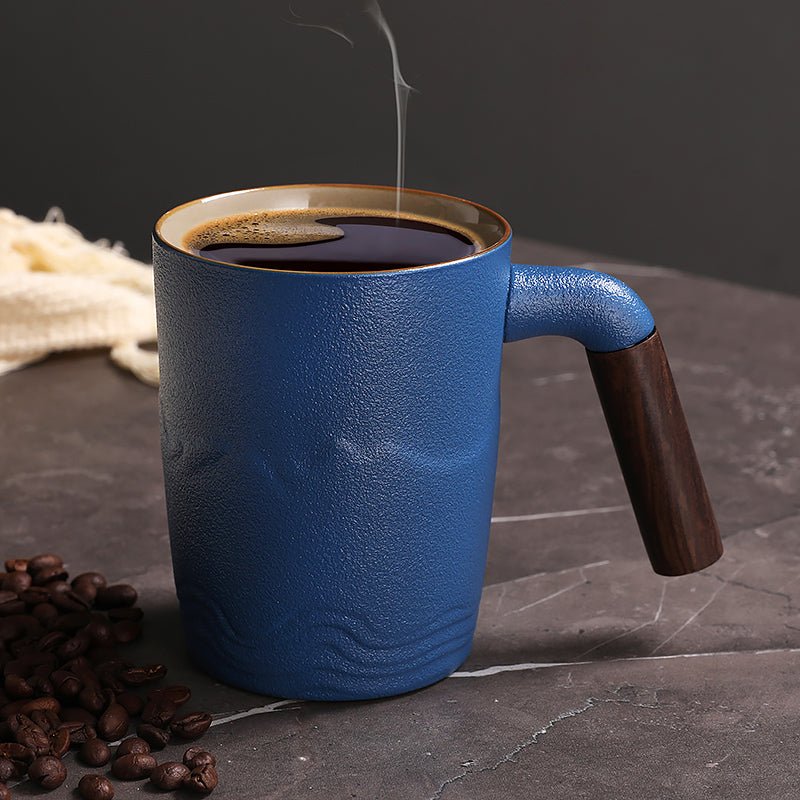
The second handle question is balance, and it is the one buyers skip. A heavy body on a slender handle torques your wrist forward. A light body with an oversized handle feels clumsy and top-heavy. The pairing matters more than either measurement on its own. On the ball-handled mug, the rounded ball at the top of the handle gives your thumb somewhere to rest while you carry it one-handed across a kitchen — a small detail you notice every single morning.
Rim thickness, glaze coverage and foot rings: what photos never show
This is where a generic buying guide stops and a useful one starts. None of the three details below survive a studio photograph, and all three decide whether you still like the cup in month six.
The rim. A thin, slightly flared rim delivers tea cleanly. A thick rim that rounds outward feels sturdy in the hand but tends to dribble, because the liquid follows the curve outward instead of breaking away. The rim also takes the most knocks, so it is the first place a chip appears — and the first thing to inspect on arrival.
The glaze. Pooling where the handle meets the body is normal in glazed pottery and generally harmless. What matters more is the interior: a fully glazed inside is far easier to keep free of tannin staining than a partially glazed one. Fine crackle — crazing — can be a deliberate decorative finish. If it develops on a cup you use daily, run a fingernail across the surface. If the crackle catches, retire the cup; if it still feels smooth, keep drinking.
The foot ring. The unglazed ring underneath should be sanded smooth. A rough foot ring scuffs a wooden table and scratches neighbouring cups in the cupboard. Run a thumb around it the day the cup arrives. Two seconds, and it tells you how carefully the piece was finished.
How do you shortlist the best everyday pottery tea cups in five checks?
- Measure the cup you already reach for. Fill it, pour it into a measuring jug. That number, not your guess, is your target capacity.
- Count fingers, not centimetres. Two fingers for 170–200 ml, three for 250 ml and above.
- Check whether the interior is fully glazed. Less staining, easier washing, longer useful life.
- Match wall thickness to your drinking style. Quick repeated steeps suit a thinner wall; a single long steep suits a thicker one that holds heat.
- Read the care notes on the listing before you buy. Dishwasher and microwave guidance varies by piece, and it is the one thing you cannot judge from a photograph.
What care routine keeps a daily cup out of the cabinet?
Pottery fails in predictable ways, and most of them are avoidable with habits that take seconds.
- Pre-warm in cold weather. Rinse the cup with hot tap water before pouring boiling water into it. Going straight from a cold shelf to a full boil is the classic route to a thermal-shock crack.
- Do not stack glaze against glaze. A cloth or paper towel between cups prevents the rim chips that seem to appear out of nowhere.
- Lift tannin stains with a paste of bicarbonate of soda and water. Leave it ten minutes, rinse, repeat if needed. Skip abrasive scouring pads, which dull glaze over time.
- Dry upside down on a rack, not right-side up in a puddle sitting in the foot ring.
- Never heat a pottery cup on a hob or over an open flame. If you want hotter tea, heat the water, not the cup.
When is a pottery tea cup the wrong purchase?
Three cases, and we would rather say so before you order.
You drink big volumes. If your usual pour is 350 ml or more, a 170 ml cup will feel like a sample and you will be back at the kettle twice as often. Start from the largest shape in the unique coffee mugs collection instead of the smallest.
You need it to travel. Ceramic is not a commuter vessel. It belongs on a desk or a tea tray, not loose in a backpack pocket next to a laptop charger.
You want one cup for a shared office kitchen. Pottery in a communal dishwasher gets handled roughly and stacked carelessly. A heavier, plainer mug usually survives that environment better than a delicate cup with a decorative profile — and a decorative cup you love is better kept at home.
Frequently asked questions
Is 200 ml enough for a normal cup of tea?
For most people, yes — 200 ml is close to a standard teacup rather than a mug. It holds a full steep with a little room for milk. If you routinely finish a drink and immediately want another, step up to 250 ml instead.
Are pottery tea cups dishwasher safe?
It depends on the individual piece, so check the care notes on the listing rather than assuming. Hot cycles and harsh detergents are hard on glazes and on hand-painted decoration. When we are unsure about a cup, we wash it by hand — it takes seconds and removes the risk entirely.
Why does my pottery cup get hot on the outside?
Thin walls and lower-fired bodies conduct heat to the surface faster. That is not a defect; it is a property of the material. It does mean a cup without a generous handle will feel uncomfortable when full of boiling water, which is one reason handle clearance matters so much on smaller cups.
Which size works best for an office desk?
250 ml is the practical answer for most desk drinkers — it survives a meeting without a refill. If you take short, frequent teas and dislike lukewarm dregs, a 170 ml or 200 ml cup is the better match.
What should I check first when comparing the best everyday pottery tea cups?
Measure the capacity of the cup you already use most, then compare that number against the listing. After capacity, check handle clearance and whether the interior is fully glazed. Rim and foot-ring finish you can verify in the first minute after unboxing.
Start with the number you measured in step one, then let the shape decide. The 170 ml retro cup suits short repeated steeps, the 200 ml pleated cup covers a standard single tea, and the 250 ml ball-handled mug is built for long desk days. All three sit in the same collection if you want to compare capacities and handle shapes in one place before you commit.
More from our blog
Ready to pick your mug? Two ways to save on today's order:
Ordering 1–3 mugs? Get an extra 10% off your 1st order with code 10_OFF Apply 10% Off & Shop Wooden-Handle Mugs →
Gifting 4+ mugs? Buy 3, Get the 4th Free applies automatically at checkout (no code needed; offers do not stack) · Free standard shipping (Nov pre-Christmas delivery: 15–20 calendar days US) · Free replacement if chipped in transit.
Popular mug buying guides: Ceramic Tea Cups & Infuser Mugs · Ceramic Mugs with Lids Compared · Wooden-Handle Tea Infuser Mugs Compared · Christmas & Secret Santa Mugs 2026 · Espresso & Cortado Cups Guide · Cup & Saucer Gift Sets · All 25 Mugs Spec Table · Mug Size Guide · Shipping & Promo FAQ
FIRST ORDER 10% OFF (CODE: 10_OFF) · OR BUY 3, GET THE 4TH FREE


Read more
What Size Landscape Mug for Tea? Ounces, Rim Width, and Fit
A practical sizing guide for tea drinkers drawn to the low, wide landscape mug shape. We break down ounce targets, rim width, handle fit, steeping room, and the cases where a tall mug is the smarte...
Read more
Large Round Coffee Mug for Office: What Buyers Should Compare
A large round mug can cut refills or crowd your mouse hand, and the difference is a few centimetres. We break down the 400, 440, and 480 ml options we carry, the finish details photos hide, and wha...
Read more
Leave a comment
This site is protected by hCaptcha and the hCaptcha Privacy Policy and Terms of Service apply.