
Best Retro Coffee Mugs Tea Cups Gift Guide: Size and Safety
Reading time: about 14 minutes
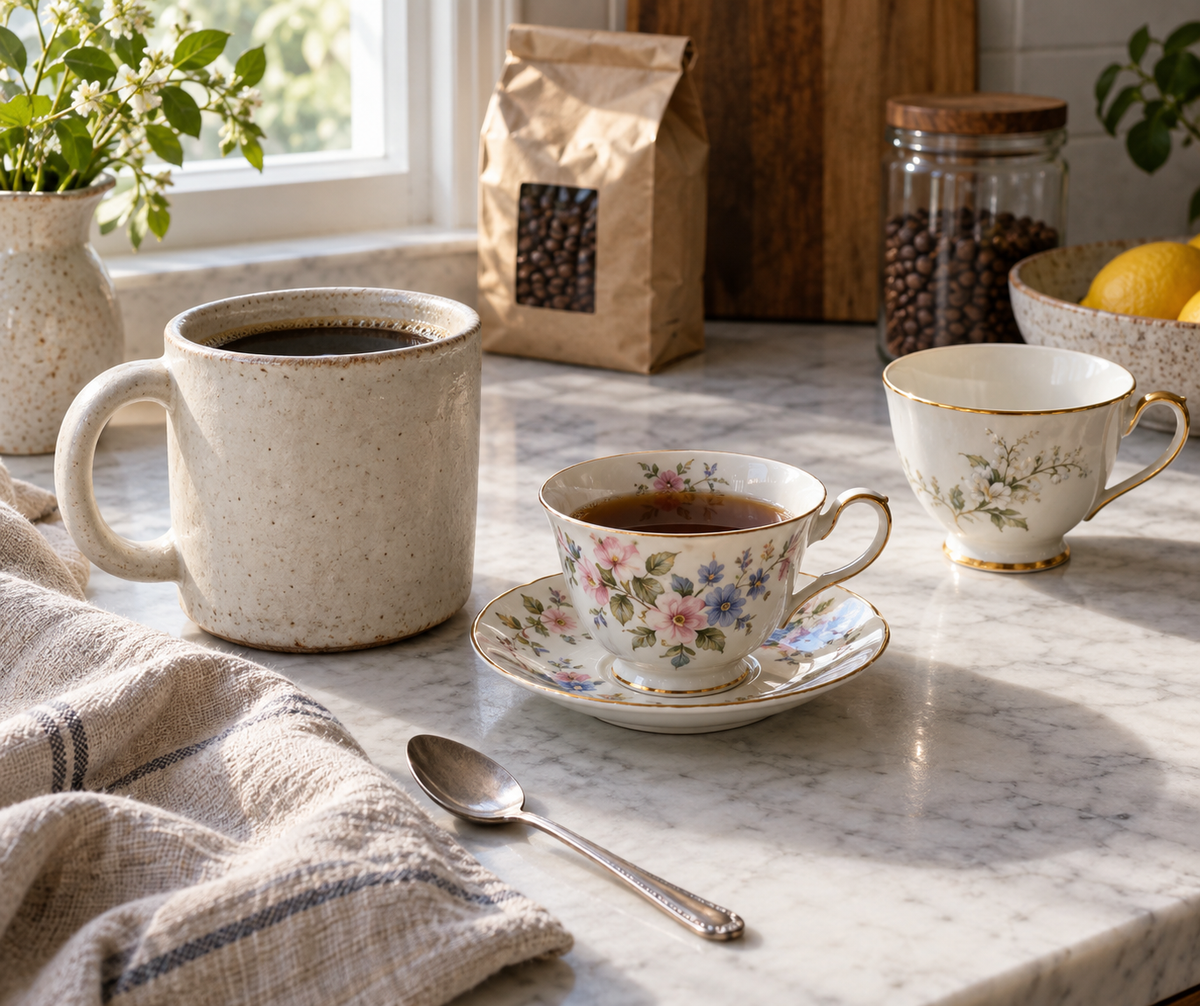
A shopper set two boxes on our packing counter last month. One held a thick, restaurant-style mug built for weekday coffee. The other held a thin floral cup with a gold line at the rim, the kind that looks right on a saucer and wrong next to a microwave. Both were sold as retro. Only one was a simple daily gift. If you are using a best retro coffee mugs tea cups gift guide to choose between those paths, the silhouette is the easy part. Drink safety, usable capacity, metallic decoration, and whether the piece is new drinkware or true vintage decide whether anyone actually drinks from it.
In our store we split this category before pattern and color enter the conversation. New retro-style mugs and tea cups are built to be used: diner shapes, embossed glass, stoneware sets, porcelain carrying a vintage print. True vintage and antique cups are sentimental objects first. Some are reasonable for tea once you know the maker and the glaze is sound. Many belong on a shelf. A pretty backstamp does not make a piece food-safe.
New retro drinkware or a true vintage cup: which gift gets used?
Reproduction retro is the safer default when the recipient drinks coffee or tea every morning. U.S. food-safety guidance describes commercially made everyday pottery as much less likely to have a lead problem than a handmade, antique, damaged, or flea-market piece. A new listing can also state dishwasher, microwave, and food-contact limits in plain language. An estate-sale cup almost never arrives with those marks, and the person unwrapping it should not have to guess.
True vintage still earns its place for a collector, a parent who already displays china, or someone who named a pattern. Gift the story and, when it belongs, the saucer. Say on the tag if the cup is for looking at, not for Tuesday coffee. In our experience, unboxings go sideways when a cute thrift find is treated as a morning mug and then shows a hairline crack, a worn gilt line, or no maker's mark. The recipient smiles, then parks it on a shelf. That is a fine outcome only if you planned it.
The piece we point shoppers toward for a small retro coffee or tea gift is our Vintage Retro Small Coffee Cup. The catalog title is the only product fact we will treat as settled. Vintage and retro in that title are style words on a current catalog piece, not a report on age, clay, or glaze. Capacity, body, handle shape, food-contact wording, and any dishwasher or microwave mark have to be read on the live listing. If the page is silent, we leave that point open. If a small cup is the wrong scale, browse unique coffee mugs and match the shape to the habit, not to a styled photo.
What a best retro coffee mugs tea cups gift guide should check for lead
Lead is the question that lands on our counter the moment someone mentions a thrifted tea set. It is a fair question. Lead can sit in the glaze or in the decoration on some traditional pottery. If the piece was not made properly, that lead can move into coffee or tea. Properly made ceramic that still contains lead can be sold in the United States, so "it is ceramic" is not a safety test.
FDA pottery compliance guidance sets an action level of 0.5 micrograms of lead per milliliter of leaching solution for cups and mugs. That level is applied to any one of six units, using specified ASTM, AOAC, or FDA methods. It is a laboratory standard. Soap and a long soak will not reproduce it. The same guidance treats cups and mugs as small ceramic hollowware, commonly used for coffee or tea served above room temperature. They normally, though not always, hold about 240 milliliters (8 fluid ounces) and are made with a handle. That is a regulatory description. It is not a promise that the retro mug in your cart holds eight ounces.
When a customer asks us about a flea-market cup, this is the caution list we walk through. Take extra care if the piece is handmade and rough, antique, chipped or heavily worn, bought from a flea market, a street vendor, or an unknown maker, or brightly decorated in orange, red, or yellow. Commercially made everyday pottery is described as much less likely to have those lead problems. The CDC's line matches what we tell gifters: lead can be present in vintage and antique dishware and can leach into food or drinks, so do not serve with vintage dishware unless you are sure it does not contain lead.
Home remedies do not fix this. Washing, boiling, and other kitchen processes do not take lead out of pottery. If a cup tests positive for leachable lead, or if it is labeled not for food use or ornamental, do not cook, serve, or store drinks in it. When you cannot document food-contact safety, keep the cup for display and write that on the gift tag. A new retro mug with an intact commercial glaze is a different object from a crazed cup that has lived in a cabinet for decades.
Crazing, the fine web of cracks in an old glaze, and chips at the rim are more than cosmetic. Stains settle in those lines. On an older piece they are another reason to retire it from hot drinks. If you would not pour your own morning coffee into it, do not wrap it as drinkware.
Stoneware, porcelain, bone china, or glass: which body fits the drink?
Material is the next split, and it is not a quality ladder. It is a fit question. None of the notes below is a claim about our small retro cup unless the live listing names the body. Open the page and read it. Do not infer clay from a photograph.
- Heavy stoneware is the diner-mug body we see most often on breakfast counters. Thick walls keep a black coffee hot through a short meeting, the mug sits planted on a desk, and a C-handle or two-finger grip is built for a full cup. The trade-off is bulk. These mugs eat cabinet space, and a heavy wall is clumsy beside a formal tea service.
- Porcelain is lighter and usually thinner at the rim. It suits tea and a modest coffee, and it takes a printed or embossed retro pattern cleanly. Thin rims chip if you stack cups lip to lip in a crowded dishwasher rack.
- Bone china is the light, often translucent body behind many vintage-style cups and saucers. It feels special in the hand. It is a poor match for someone who wants one indestructible office mug, and gilt on bone china usually changes the care routine.
- Embossed or pressed glass shows the color of the tea or coffee, which some people want. Glass can still be hot to hold. Moving a cold glass cup straight onto boiling water is a bad idea. Confirm thermal-shock and dishwasher language on that specific listing before you promise it.
If the product page does not name stoneware, porcelain, bone china, or glass, leave the feel in the hand as an open question. Weight matters more than shoppers expect. A very light cup tips when a spoon is left in it. A very heavy one tires a sore wrist by the second refill. Our team checks that on the packing bench: half full, spoon in, does it rock?
Handle comfort is the detail generic roundups skip. A finger should clear the knuckle curve. The join should look thick enough to survive a bump against the sink. The cup should balance when it is half full, not only when it is posed empty. A ball handle, a square diner grip, and a delicate tea-cup ear are three different gifts. If the person already has a favorite grip, do not force a saucer on a black-coffee drinker. Our morning coffee ceramic mug comparison is a useful side read when the habit is a desk mug, not a tea service.
Brim-full ounces versus the coffee you can actually carry
Capacity labels are where gifts go wrong. A number printed as ounces is often the mug filled to the rim, with no room for milk, a splash of cream, or foam. Hot liquid should not ride at the lip while someone walks from the brewer to the table. We have reboxed gifts for exactly that reason: the pattern was right, and the drink did not fit.
Use the FDA's about-8-fluid-ounce description as a mental floor for a traditional hot-drink cup, not as a target for every buyer. Restaurant-style retro mugs are often sold by a brim-full figure, sometimes near 10 ounces and sometimes larger. Leave a finger of headspace and the drink you can carry is smaller. Add a lot of cream, or pour a milk-heavy cup, and a small retro bowl will disappoint no matter how good the pattern is. Someone who drinks tea or a short black coffee often prefers that smaller size, because a giant mug leaves a lukewarm inch at the bottom.
Before checkout, measure the real constraints on the listing and, if you can, against the kitchen the mug will live in:
- Usable fill, not just brim-full ounces, if the listing states a volume at all. If it states none, do not invent one from the word small.
- Height under the cabinet and under the coffee-maker spout. A tall retro mug can miss the clearance on a single-serve machine.
- Footprint in the cupboard, and whether the shape stacks. Many vintage-style cups do not nest, so a set of four can claim a whole shelf.
- Saucer need. A formal tea cup without its saucer is an incomplete gift. A diner mug does not need one, and adding one can look like the wrong object.
A small retro coffee cup is the wrong recommendation when the recipient's normal drink is a large takeaway-size cup. Say that out loud. A retro look does not require a tiny vessel, and a tiny vessel is not automatically more charming. For iced coffee that needs room for ice, for soup, or for a commute, this style of cup is the wrong tool. Look at a larger shape in the unique coffee mug collection instead of squeezing the wrong drink into a nostalgic silhouette.
Gold rims, heated dry, and care marks we will not guess
Metallic decoration is the care trap on retro tea cups. Gold, platinum, silver, and foil bands show up on vintage-style rims and handles. When a rim or handle carries metal, treat microwave and dishwasher use as unconfirmed until that maker's care note says otherwise. Metallic decoration is a common reason those notes say hand wash only: metal and microwave heating do not belong together, and detergent plus a heated dry cycle can dull or lift gilt. Do not copy one brand's care card onto every floral cup. Read the bottom stamp, the hang tag, or the current product listing for the exact piece.
If the listing does not say microwave-safe, we do not tell a customer to reheat coffee in it. If it does not say dishwasher-safe, we do not promise a gold line will survive a heated dry cycle. The conservative routine, when decoration is metallic and the page is silent, is a soft cloth, no abrasive pad, and a spot on the rack that does not knock the rim. Plain diner mugs without metal are the ones that usually earn an easy dishwasher claim, and only when the maker marks them that way.
The same honesty applies to chips. A new mug with a manufacturing nick at the rim should not leave our shop as a gift. On older china, a chip or a stained craze line is a reason to reframe the present as decor. We would rather drop the line about using it tomorrow than hand someone a cup we would not pour for ourselves.
Single cup, boxed set, or cup and saucer for this recipient
The format of the gift matters as much as the pattern. A boxed set is a housewarming move when two people share a kitchen. A single cup is personal. A saucer belongs with tea, not with someone who walks the hallway holding coffee.
| Recipient | Better retro gift | Poor fit |
|---|---|---|
| Weekday coffee at a desk or a diner-style breakfast | A new mug, or a set of two or four, with care marks you can read | A fragile gilt cup, or an untested antique |
| Afternoon tea, brunch, or a china collector | Cup and saucer, with a readable backstamp if the piece is vintage | A thick diner mug that will not sit with their saucer stack |
| Nostalgia, one sentimental piece | A single cup they can display, with an honest note if it is not for daily drinks | Assuming a thrift find is lead-safe because it is pretty |
| Modest coffee or tea in a new retro shape | A small retro cup only after the listing confirms size and care | Large latte drinkers, travel mugs, or soup |
Backstamps help when the piece is actually old. Turn the cup over and look on the foot ring for a maker name, country, pattern name, or number. That mark is how collectors start an identification, and it is worth copying onto the gift note. A missing mark does not prove a cup is unsafe, and a famous name does not prove the glaze is intact or free of lead. If you cannot read the stamp and you cannot document food-contact safety, give it as decor.
What this kind of small retro cup is not good for: oversized milk drinks, iced coffee that needs room for ice, travel, the microwave when metal is present or the page is unmarked, and any guest who needs a mug you can run through every dishwasher cycle without checking. Pair a usable new mug with coffee or tea the recipient already drinks. Do not pair an ornamental or untested vintage cup with a bag of beans and call it drinkware.
A counter check before the gift leaves our shop
Run this list the way we do when a gift order is still on the bench. If a line is unknown, open the listing or choose a different piece.
- New retro daily drinkware, or true vintage and possibly display-only?
- Food-contact status stated, and no ornamental or not-for-food-use wording?
- For vintage: condition, maker if known, and a plan if lead status is uncertain?
- Material named on the page, and does that material match coffee, tea, or display?
- Usable size, not just a brim-full ounce claim, plus brewer and cabinet clearance?
- Metallic rim or handle? If yes, assume hand wash and no microwave until the maker says otherwise.
- Dishwasher and microwave marks present, or explicitly absent?
- Chips, crazing, or a loose handle?
- One cup, a set, or cup and saucer, and does that match how they drink?
- On our small retro cup, have you read the current product listing rather than a screenshot or an old description?
If the answers point to a different shape, start from the unique coffee mug collection and choose by where the mug will live: a desk, a brunch table, or a shelf. A retro gift that gets used beats a retro gift that gets apologized for.
Frequently asked questions
Are vintage or thrifted tea cups safe to drink from?
Not by default. Lead can sit in older glazes and decorations, and the CDC advises against using vintage dishware for food or drinks unless you are sure it does not contain lead. Washing or boiling does not remove lead. If the cup is antique, damaged, from an unknown maker, or labeled not for food use, keep it on display until leachable lead has been ruled out.
What should a best retro coffee mugs tea cups gift guide settle before you buy?
Settle four things: new daily drinkware versus true vintage, whether the piece is meant for food contact, usable size after cream or tea still leaves room at the rim, and care limits from metallic trim. A floral pattern answers none of those. Read the current listing, and for older china read the condition of the glaze before you write a gift tag that promises daily use.
Can a gold-rimmed retro tea cup go in the microwave or dishwasher?
Do not assume it can. Gold and other metallic decoration are a common reason makers say hand wash only and not microwave-safe. Detergent and a heated dry cycle can dull gilt even when a microwave is never involved. If the stamp or the product page is silent, hand wash it and reheat the drink another way.
Is a small retro coffee cup big enough for everyday coffee?
It can be, for short black coffee or tea, if the listing's capacity still leaves headspace. It is a weak gift for someone who adds a lot of milk or expects a large cafe-size drink. Brim-full ounces overstate what you can carry without spilling. Check the live product page for volume instead of guessing from the word small in a title.
How do I read a vintage teacup backstamp before I gift it?
Look on the foot ring for a maker name, country, pattern name, or number, and compare that mark with the maker's own references if you can. A clear stamp helps a collector and belongs on the gift note. It does not prove the glaze is food-safe or free of chips and crazing. If the mark is missing and the history is unknown, treat the cup as a display gift.
More from our blog
Read more

Tall Ceramic Coffee Tea Mug Size: What Buyers Compare
A tall mug can mean a high silhouette, a bigger ounce claim, or a cafe drink name. We compare usable fill, exterior height, base and handle fit, full weight, and the safety labels to verify on the ...
Read more
What Size Mountain Coffee Mug for Desk, Gift, or Camp
An 11 fl oz mountain camp cup and a 15 fl oz ceramic can share the same ridge graphic and still pour very differently. We sort fluid ounces, handle comfort, heat, and gift fit so the listing matche...
Read more
Leave a comment
This site is protected by hCaptcha and the hCaptcha Privacy Policy and Terms of Service apply.