
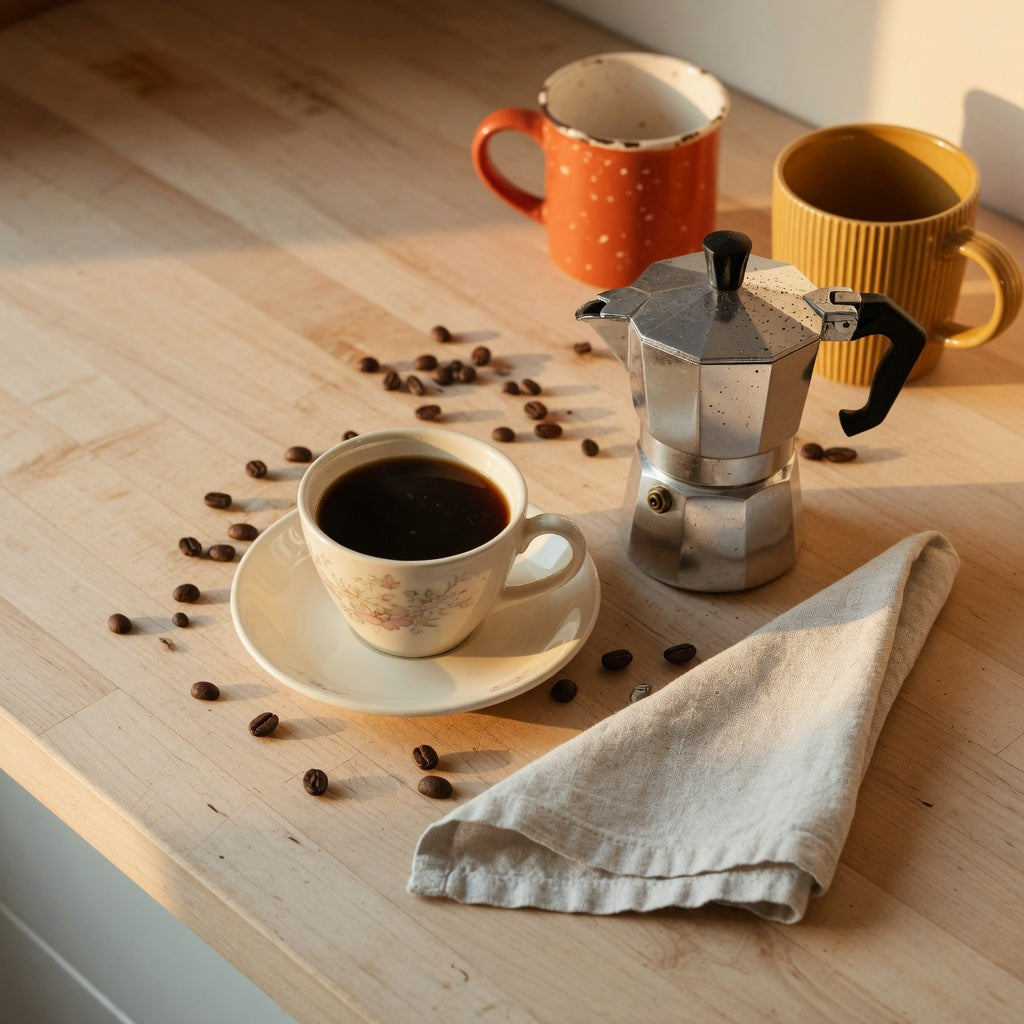
Best Retro Coffee Cups for Everyday Use: 6 Things to Compare
Reading time: about 10 minutes
Before any retro cup earns a spot on our daily-drink shelf, someone on our team does the same three things: wraps a hand around the handle, tilts the glaze under the shop lights to hunt for flaws, and pours hot water to the rim to see how the cup actually carries. It sounds fussy. It isn't. The two problems we see most often with retro cups that come back — a rim chipped on a cupboard shelf, a printed pattern gone dull after weeks on the dishwasher's top rack — are both visible on day one if you know where to look. The best retro coffee cups for everyday use are rarely the loudest pieces on the shelf. They're the ones whose capacity, weight, and care demands quietly match how you actually drink. Here's the comparison we run, in the order we'd run it for you.
What separates the best retro coffee cups for everyday use from shelf-ware?
Retro-styled cups usually fail daily life for one of four reasons: the pour doesn't fit the cup, the handle fights your fingers once the cup is full, the decoration can't survive your washing routine, or the glaze starts to craze — the fine spiderweb of lines you see on old crackle finishes — and the cup becomes harder to keep clean than it's worth. Six checks catch almost every one of these before checkout:
- Capacity vs. your real pour. Fill the mug you use most with water, pour it into a measuring jug, and write the number down. In our experience, shoppers overestimate their everyday volume by a wide margin.
- Handle fit when full. A handle that feels generous empty can pinch knuckles once hot coffee is in. You want real air between the loop and the cup wall — not a handle that rests against the body.
- Weight when loaded. A 12 oz pour adds roughly 350 grams before the cup's own heft, a difference you feel by the time coffee has traveled from kitchen to desk.
- Care match. A dishwasher household and a hand-wash household should not buy the same decorated cup. This is the mismatch we see most often in our store.
- Rim shape. Thin, refined rims feel elegant in hand and are the first place chips show. Slightly thicker or rolled rims shrug off daily clatter.
- Label honesty. A listing that states capacity, material, and care in plain terms signals a maker who expects daily use. Vague listings usually mean a shelf piece.
None of this makes pretty cups a bad buy. Some pieces are genuinely made to be looked at. But a display piece and a daily driver are different purchases, and mixing them up is the fastest route to a cupboard full of good intentions.
How much capacity does your actual pour need?
Capacity is where retro styling and modern habits clash hardest. Classic diner-era proportions run smaller than what many coffee drinkers pour today, and "small" on a retro listing can mean very different things from one model to the next. Use this table as a starting point, then verify against the numbers stated on the listing:
| Your usual drink | Typical capacity | Retro-style fit notes |
|---|---|---|
| Espresso, cortado | 2–4 oz (60–120 ml) | Small vintage cups are at their best here; handle comfort matters more than volume |
| Standard drip or tea | 8–10 oz (240–300 ml) | The everyday sweet spot for most modern retro reproductions |
| Latte or big Americano | 12–16 oz (355–475 ml) | Many retro designs run smaller than this — confirm the listed capacity before ordering |
Three fit checks shoppers forget until the cup is already home:
- Machine clearance: compare the rim height to the gap under your single-serve or espresso machine's spout — tall cups paired with saucers often don't slide in.
- Cupboard reality: handled cups plus saucers stack poorly and eat vertical shelf space. Measure the gap between your shelves before you fall for a set.
- Carry test: if you drink standing at the counter or walking between rooms, full-weight comfort beats looks every time.
Side-by-side is how our team shops this category too — differences in capacity and handle shape are far easier to judge across our unique coffee mugs collection than one listing at a time.
Is a small retro cup a daily driver or a specialist's tool?
Here's who this format fits best: you drink espresso or tea, you prefer small pours refilled hot over one big mug that goes lukewarm, or your cupboard genuinely doesn't have room for a shelf of oversized mugs. That's who our Vintage Retro Small Coffee Cup is for — the piece we hand across the counter when a customer wants the retro look in a format sized to a morning routine rather than a display shelf.
Do one thing before ordering: open the current listing and hold its stated capacity and care instructions against the table above. Small retro cups vary more between models than standard mugs do, so the listing's numbers — not the photos — are what count. We would rather you measure twice than return once.
Be just as honest about mismatches. If your habit is a 16 oz latte or a tall iced coffee loaded with ice, a small retro cup will frustrate you every single morning. Slow desk sippers who nurse one drink for an hour want more volume and better heat retention — our comparison of tall mugs for coffee and tea desk use covers that path instead. Neither choice is wrong. They're just different mornings.
Which materials survive daily washing — and which quietly don't?
Most retro-look cups come from one of four material families, and each carries a different maintenance bill:
- Vitrified ceramic and stoneware. The default daily-workhorse body: dense, glaze-friendly, good at holding heat. Care still depends on the decoration, so read the listing rather than assuming.
- Decorative ceramic with unlabeled finishes. Treat as hand-wash until the listing says otherwise. Hope is not a care instruction.
- Enamelware. Lightweight with genuine mid-century camping-trip charm, but a chip exposes bare metal underneath, and it never belongs in a microwave. Lovely in a cabin kitchen; a harder sell as your only office mug.
- Glass in retro shapes. Excellent for layered or iced coffee serves. Thermal shock matters more here than with thick ceramic, so don't take a glass straight from a cold cupboard to boiling water.
The honest trade-off: the more hand-finished the decoration, the more hand-care the cup demands. Metallic rims and applied decals are the reason some retro cups must stay out of dishwashers and microwaves entirely. If your household runs everything through a hot cycle and never looks back, prioritize simpler glazes — or genuinely commit to the sink.
Do vintage-style glazes raise safety questions worth asking?
"Retro-style" and "vintage" are not the same purchase. A retro-style cup made recently is produced under modern food-contact manufacturing practices, and the listing should state what you're getting: glaze type, care terms, and whether it's labeled for food use. A true vintage piece is secondhand, with a history you can't fully check, and older glazes are a fair question mark for hot, acidic drinks like coffee.
- Read the listing for food-use labeling and care terms before buying — not after.
- Ask the store directly when a listing is unclear. Any shop that handles its own stock can answer glaze questions quickly, and how they answer tells you as much as what they say.
- Be cautious around worn, chipped, or crazed glaze on secondhand pieces. Crazing's fine crackle lines trap coffee oils and tannins, and a compromised glaze is much harder to keep genuinely clean.
- Unknown-history pieces with showy glazes are often happiest as pen cups, planters, or shelf display.
We'd rather lose a sale than guess at a glaze. If a seller can't tell you what a cup is made for, treat that silence as the answer and move on.
How do you keep retro decals, prints, and glazes looking new?
Daily use is a maintenance agreement. This is the routine that keeps retro cups in rotation for years instead of one season:
- Hand-wash anything with metallic trim or unconfirmed labeling. Applied decals are the first casualty of a hot dishwasher cycle.
- Prevent thermal shock. Don't move a cup from fridge-cold straight to boiling water. A splash of hot tap water first pre-warms the body and takes stress off the glaze.
- Inspect the rim and handle joint monthly. A chip exposes the porous body underneath, which absorbs liquid and stains — retire chipped cups from hot drinks.
- Stack with a barrier. A paper towel between decorated rims costs nothing and prevents the most common self-inflicted damage we see in returned stock.
- Microwave in short bursts only — and never with metallic decoration. If you reheat daily, confirm the listing says microwave-safe first.
None of this is complicated. It is, however, the difference between a retro cup that still looks new after a year of mornings and one that looks tired after a month.
Your 60-second check before you click buy
Run any candidate — ours included — through the same six checks, compressed to sixty seconds:
- Does the listed capacity match your measured pour?
- Does the handle fit your hand with a full cup inside?
- Do the care instructions match how your kitchen actually washes dishes?
- Is the glaze clearly labeled for food use, and will the store answer questions about it?
- Does the height clear your machine's spout and your cupboard shelf?
- Are you buying a modern retro-style cup or a true vintage piece — and do you know what each asks of you?
If you want the extended version, our retro coffee cup buying checklist walks the same ground in more depth. And if you're honestly shopping for the shelf rather than the sink, start with our guide to retro mugs styled for home decor — that's a different, perfectly valid purchase. For a starting point today, the Vintage Retro Small Coffee Cup covers the small-pour end of the list, with the wider unique coffee mugs collection ready when you want to compare formats. Measure your usual pour tonight. Everything after that gets easier.
Frequently asked questions
What size should I look for in the best retro coffee cups for everyday use?
Most daily drinkers land between 8 and 12 oz (roughly 240–355 ml), which covers a standard drip pour or tea with milk. Espresso and cortado drinkers can drop to 3–6 oz, while latte drinkers need 12 oz or more. Measure the mug you actually use most, then compare it to the capacity stated on any listing — retro designs often run smaller than they look in photos.
Can retro coffee cups go in the dishwasher?
Only if the listing says so. Plain glazed stoneware without extra decoration often tolerates dishwasher cycles, but metallic rims, applied decals, and unlabeled finishes are hand-wash territory. When a listing doesn't state dishwasher safety, treat the cup as hand-wash-only or ask the store before you buy.
Are vintage-style ceramic cups safe for hot coffee?
Modern retro-style cups produced under current food-contact manufacturing practices are generally intended for hot drinks when the listing labels them for food use. True vintage pieces deserve more caution, especially with worn, chipped, or crazed glaze, because a compromised surface is harder to keep clean. If a seller can't answer your questions, keep that piece for display.
Why do so many retro coffee cups seem smaller than regular mugs?
Retro styling borrows its proportions from mid-century diner and tea service, when a 6–8 oz serving was normal, while everyday mugs have since drifted toward 12–16 oz. The styling and the sizing travel together, so a genuinely retro-looking cup is often genuinely smaller. That's a feature for espresso and tea drinkers and a dealbreaker for big-pour drinkers — know which one you are.
Is a retro cup with a saucer practical for daily use?
It can be, with two checks. Confirm the cup-and-saucer height clears your coffee machine's spout, and make sure your cupboard has vertical room, because saucers stack poorly next to handled mugs. Saucer sets suit table-served coffee and tea far better than desk use.
Read more

Christmas Mugs for Office Gifts: What Buyers Should Compare
A shop-floor comparison of Christmas mugs for office gifts: what to spend on Secret Santa and team gifts, which safety labels matter, ceramic vs. stainless trade-offs, personalization lead times, a...
Read more
Christmas Coffee Mug Checklist: What to Compare Before You Buy
The christmas coffee mug checklist our team runs before every December order: compare material, match capacity to the drink, read the base markings, mind personalization deadlines, and pack the rim...
Read more
Leave a comment
This site is protected by hCaptcha and the hCaptcha Privacy Policy and Terms of Service apply.