



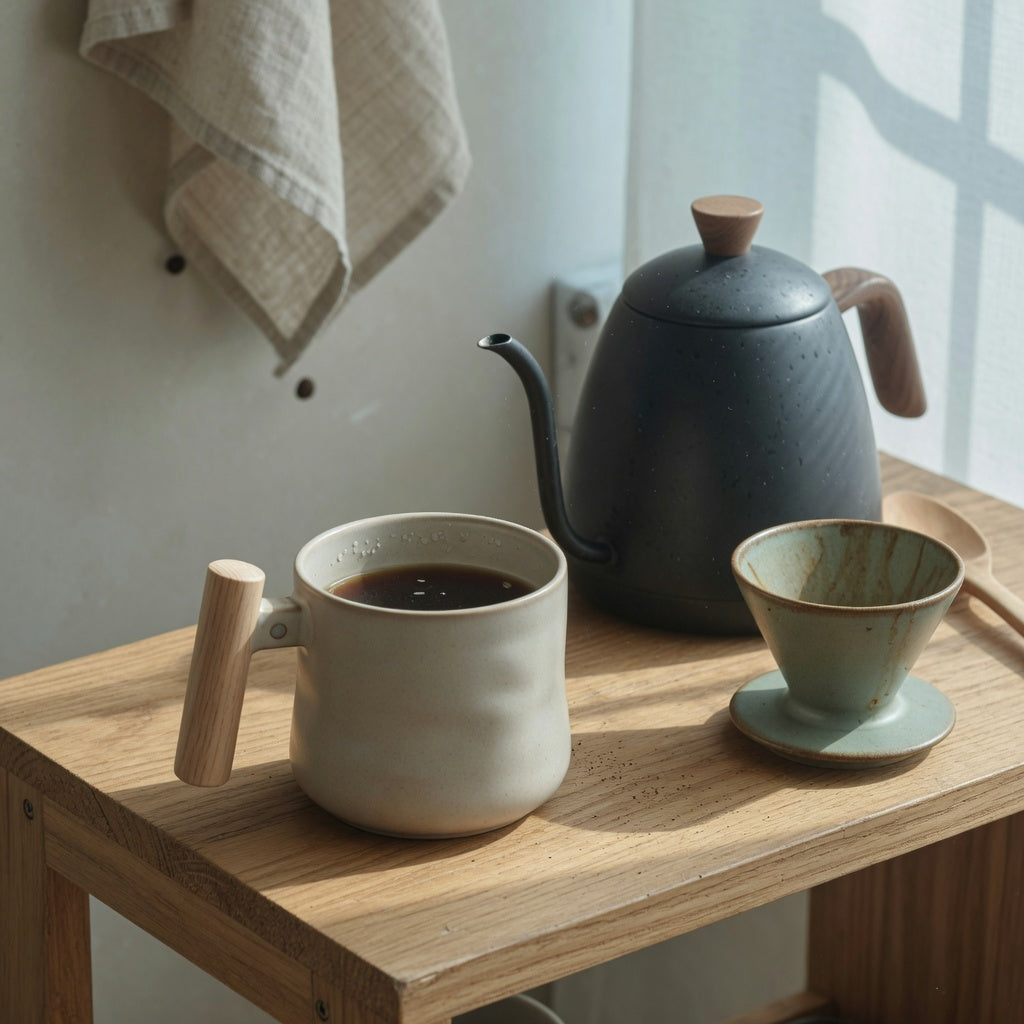
Wooden Handle Mug Gift for Home Decor: What to Compare
Reading time: about 12 minutes
The two mugs on our packing table looked related only in the product photos. One had a glazed body and a slim wooden grip. The other was a solid tankard, heavier, with no ceramic in it at all. The buyer had searched for a wooden handle mug gift for home decor and assumed the wood was the whole story. It is not. A grip and a wooden cup fail in different ways, and the person who unwraps either one finds that out on the first wash.
In our store we pack both. Coffee-bar shoppers want a cup that looks settled on an open shelf and still feels steady when it is full. Some decor shoppers only want the silhouette. Those are different orders. The care routine is part of the gift, whether you write it on a card or leave the recipient to guess.
What should a wooden handle mug gift for home decor actually do?
Start with the job, not the grain. A housewarming cup beside an espresso machine is a different object from a groomsman tankard that mostly lives on a bar cart. At the counter we ask three questions before we reach for tissue paper:
- Will someone drink from it on a normal weekday, or is it mainly for the shelf?
- Are the drinks hot coffee and tea, cold beer, or both?
- Who washes dishes in that kitchen, and will they follow a care note after the holiday weekend?
Daily hot drinks plus a visible coffee station usually point to a ceramic, porcelain, or glass body with a wood handle. The cup holds the liquid. The wood is the grip and the break against glaze, steel, and stone. A rustic home bar, or a gift that will be admired more than used, can justify a solid-wood mug or stein, but only if the buyer accepts lining, leak risk, and finish limits.
For a coffee or tea station, the listing we open first is the Mountain Sea II coffee and tea mug with a wooden handle. Treat that page as the spec sheet. Do not read capacity, wood species, glaze notes, or handle construction out of a styled photo. If ounces, attachment, and appliance limits are not written there, ask before you buy. Shoppers who want the wood grip next to a plainer cup can browse our unique coffee mugs and see the care trade-off in one sitting.
Is it a ceramic cup, a solid-wood tankard, or a lined shell?
Roundups still file all three under one rustic heading. Heat use, washing, and leak risk do not travel together.
| Construction | Gift it fits | Where it fails |
|---|---|---|
| Ceramic, porcelain, or glass body with a wood handle | Weekday coffee or tea on a styled shelf, housewarming, host gift | The handle joint, plus any plan to soak, dishwasher, or microwave the wood |
| Solid-wood mug or tankard | Home bar, groomsman gift, rustic display | Porous wood, an unnamed interior finish, and leaks if it is not actually watertight |
| Wood shell with a metal or other liner | Cold drinks or occasional use when the liner is clearly meant for food contact | A liner you cannot inspect, and metal that does not belong in a microwave |
The U.S. Food and Drug Administration describes cups and mugs as small ceramic hollowware, commonly used for coffee or tea above room temperature. They normally, though not always, hold about 240 mL (8 fl oz) and are made with a handle. That is a reference for an ordinary cup. It is not the capacity of the mug in your cart. Oversized rustic photos hide small drinking volumes. If a listing only says generous, or shows the cup in a hand with no scale, get the number in ounces or milliliters before you call it a daily driver.
Glaze sits next to style. FDA compliance policy sets an action level of 0.5 micrograms of lead per milliliter of leaching solution for ceramic cups and mugs, applied to any one of six units tested. Lead that leaches into food or drink can cause harm, including chronic lead poisoning if that use continues. The California Department of Public Health notes that cooking or microwaving can speed lead leaching from dishes that contain lead, and that dishwashing a lead-containing piece can damage the glaze so later leaching is more likely. That is not a verdict on every handmade or imported cup. It is a reason to pass on a chipped, crazed, antique, or unlabeled glaze for everyday drinking. If a piece is sold as decorative only, leave it on the shelf.
When the real decision is the ceramic body, matte or glossy, tall or wide, our notes on a ceramic coffee mug gift for home decor lovers stay with glaze and shape and leave the wood-handle variables aside.
Glued, pinned, or riveted: what fails first?
Handle loss is the complaint we hear most, and many pages never name the joint. A wooden handle can be glued into the body, pinned or pegged, or held with metal rivets. The repair story is different for each.
Glue is the joint repeat buyers worry about. Hot liquid warms it. A long soak swells the wood. Wood swells as it takes on water and shrinks as it dries, and if it dries quickly the surface can crack and check. We have seen a grip that felt solid on day one open a hairline gap at the ceramic, or come off in the hand, after someone left the mug standing in a soapy basin. Pins and rivets are easier to confirm by looking. Metal also ends the microwave question: a rivet does not go in there. A rivet head can snag a dish towel and look busy on a quiet shelf.
Read the listing for plain words: glued, pegged, pinned, or riveted. Handmade is not an attachment method. If the page is silent, that silence is an open question, not a hidden feature. Ask what happens if the bond gets wet or hot, and whether a repair is realistic. A glaze photo does not survive a handle that fails at the first holiday brunch.
Balance matters in the hand, too. A tall cup with a short wood grip can feel tippy once it is full. We notice it when a customer lifts a sample one-handed while still talking. Latte drinkers and people who fill to the rim usually do better with a lower, wider body than with a dramatic silhouette. Match that feel to the stated capacity, not to how tightly the photo is cropped.
Can it take hot coffee, a microwave, or the dishwasher?
The questions arrive in almost the same words. Can I heat this in the microwave, and can it ride through the dishwasher with the other mugs?
Do not assume yes because the bowl of the cup looks like ordinary ceramic. In our experience a wooden grip, a glue line, and any metal pin stay off the microwave list unless that exact listing allows it in writing. Dishwasher heat, detergent, and a long wet cycle are a poor match for porous wood. The U.S. Department of Agriculture notes that wood is porous, and that nonporous surfaces such as plastic, marble, tempered glass, and pyroceramic are easier to clean. That does not make a wooden handle unsafe on its own. It does make a top-rack-and-forget habit the wrong plan.
Unless the maker's care card is clearly different, this is the routine we tell gift buyers to pass along:
- Hand wash the ceramic or glass body.
- Keep the wooden handle as dry as you reasonably can. Do not leave the mug soaking handle-down in a basin.
- Dry it promptly. A damp cup shut in a closed cabinet stays wet longer than it should.
- Skip the microwave unless the current listing explicitly allows it for that construction.
- Let the wood air out. Parking the mug upside down on a wet rack is a common way the grip stays damp.
A water-repellent finish reduces what a brief wash does to the wood and makes the surface easier to clean. It does not turn the handle into a dishwasher part.
Hand wash. Keep the wooden handle dry. Do not microwave it unless the listing for this exact mug says you can.
Stay with the finish the maker already applied. For wooden bowls, utensils, and similar food-contact items, the USDA Forest Products Laboratory says the finish should be safe, nontoxic, and recommended for food or labeled food grade. Mineral oil is the penetrating finish long used on those pieces. Baby oil is not a stand-in, because it contains ingredients that should not touch food. Olive, corn, peanut, and safflower oils can eventually go rancid and may leave an odor or a flavor. We are not sending you off to refinish a gift. If the handle looks dry after months of hand washing, ask the seller which food-grade product they approve. Do not reach for the bottle next to the stove.
Separate the two wood problems. If only the handle is wood, you are mostly keeping water off the outside. If the cup itself is wood, the interior is the drinking surface. An unnamed coating might be mineral oil, wax, varnish, lacquer, or something never listed, and the page may never say daily drinks, cold drinks only, or shelf. Buyers also ask whether a walnut cup can put anything from the wood into the drink. That depends on the species, the finish, and whether the interior is actually sealed for food contact. If the seller cannot name the finish, do not make it someone's everyday coffee.
Tea often means a smaller pour, sometimes a lid, and a longer sit while the cup cools. Those details are in our note on a wooden handle tea mug for home decor.
Will it fit the open shelf and the morning coffee bar?
Home decor here is a measured spot: the open shelf, the coffee bar, the gap beside the kettle. A wide tankard that looks right in a square photo can overhang a shallow shelf and catch a cabinet door.
- Matte versus glossy. Matte ceramic sits quieter on pale oak. Gloss catches window light and shows fingerprints and tea stains more honestly.
- Wood tone. Set it against the cutting board, brackets, or pulls already in the room. A red-brown grip can argue with a cool white kitchen. A very pale grip can vanish on a honey-oak bar.
- One cup or a set. A single wooden-handle mug can be the focal object. Unrelated rustic mugs look accidental unless the bodies share a glaze family. For a couple, two related cups beat a random stack.
- Footprint. Count the handle's outward reach, not only the cup diameter.
- Clearance under the machine. If they pull shots, the mug has to fit under the espresso spout. A tall display piece can be useless on that machine.
Engraving, lids, spoons, and gift boxes show up as add-ons. Engraving usually belongs on the wood, not on a glazed wall, and a name often limits the return. Read the current return note before you personalize. Unsure of the spelling, or unsure they will use the mug? Skip the engraving. Confirm on the listing whether a box is included. A lifestyle photo is not proof of packaging.
This category is a poor match for a dishwasher-every-night kitchen, a microwave-only office, or anyone who soaks mugs overnight. It is also a weak gift when the recipient already refuses special-care objects. A plain ceramic will get used. The hybrid migrates to the back of the cabinet. In that case, leave the wood handle and choose from the unique coffee mug collection instead. If you are still sorting occasion against daily habit, the checks in our gift mug guide for coffee lovers and home decor are a useful second pass.
The checkout questions we ask before we pack one
In our experience the listing either answers these or it does not. Ask. Do not fill the blanks from the photograph.
- Body: ceramic, porcelain, glass, solid wood, or wood over a liner.
- Capacity in ounces or milliliters, not a size adjective.
- Wood species named on the page, not just a generic wood handle.
- Attachment: glued, pinned, pegged, or riveted.
- Hot drinks, cold drinks, or display only.
- If any wood touches the drink, an interior finish named and described as suitable for food contact.
- Dishwasher and microwave stated in words.
- For a ceramic cup, whether the maker stands behind the glaze for everyday drinking, especially on handmade or imported pieces.
- Gift box, and what personalization does to returns.
- Shelf depth and machine clearance, if you know the kitchen.
A wooden handle earns its place when someone wants a grip that does not feel like a thin glazed loop, plus a material break on the shelf. It does not earn a pass on washing, heat, or a drink-safe interior. That is the practical test for a wooden handle mug gift for home decor: still on the coffee bar in March, not only in the unboxing photo. If the current Mountain Sea II listing answers the points above for that kitchen, shortlist it for a coffee or tea station. If you need another body, another color, or no wood at all, stay in the unique mug collection and pick the cup they will still reach for after the holidays.
Frequently asked questions
Is a wooden handle mug gift for home decor safe in the microwave?
Do not assume it is. The cup can look like ordinary ceramic while the wooden grip, any glue line, and any metal pin or rivet are a different problem. Heat the drink another way and keep the handle dry, unless the current listing for that exact mug says microwaving is allowed.
Will a glued wooden handle come off with hot coffee?
It can. Hot drinks warm the joint, and washing swells the wood, which then shrinks as it dries. A gap at the body, or a grip that comes off in the hand, is the failure we hear about. Pins or rivets are a different construction and are easier to confirm by looking. If the page never names the attachment, ask before you gift it.
Can I run a mug with a wooden handle through the dishwasher?
Not as a habit. Dishwasher heat and a long wet cycle are hard on porous wood, and a soaked joint is how handles loosen. Hand wash, keep the grip as dry as you can, and dry the piece promptly. Follow the maker's care card if it is stricter than that.
What finish should be on wood that might touch a drink?
It should be safe, nontoxic, and recommended for food or labeled food grade. Mineral oil is a known penetrating option. Baby oil is not a substitute, because it contains ingredients that should not contact food. Olive, corn, peanut, and safflower oils can go rancid and may change odor or flavor. If the seller will not name the interior finish, do not treat an all-wood mug as an everyday cup.
Should I buy this for daily coffee or only for the shelf?
Choose a ceramic or glass mug with a wood handle for daily coffee or tea only when capacity, attachment, and care limits are clear, and the person washing it will hand wash. Choose a solid-wood tankard for a home bar, a groomsman gift, or rustic display, and only for drinking if the liner or food-contact finish is explicit. If the mug has to survive the dishwasher every night, skip the wood handle.
Ready to pick your mug? Two ways to save on today's order:
Ordering 1–3 mugs? Get an extra 10% off your 1st order with code 10_OFF Apply 10% Off & Shop Wooden-Handle Mugs →
Gifting 4+ mugs? Buy 3, Get the 4th Free applies automatically at checkout (no code needed; offers do not stack) · Free standard shipping (Nov pre-Christmas delivery: 15–20 calendar days US) · Free replacement if chipped in transit.
Popular mug buying guides: Wooden-Handle Tea Infuser Mugs Compared · Christmas & Secret Santa Mugs 2026 · Espresso & Cortado Cups Guide · Cup & Saucer Gift Sets · All 25 Mugs Spec Table · Mug Size Guide · Shipping & Promo FAQ
FIRST ORDER 10% OFF (CODE: 10_OFF) · OR BUY 3, GET THE 4TH FREE


Read more
Christmas Tea Cup vs Coffee Mug Size: Ounces That Fit
A Christmas tea cup and a coffee mug are often different servings, not two names for one pour. We show how to read listed ounces, usable capacity, and drink fit so a holiday gift matches tea, drip ...
Read more
Everyday Round Coffee Mug: Capacity, Handle, and Fit
Judge an everyday round coffee mug by usable ounces, handle clearance, lip, weight, care marks, and fit under a brewer. A round photo does not tell you any of that, and an open cup is not a travel ...
Read more
Leave a comment
This site is protected by hCaptcha and the hCaptcha Privacy Policy and Terms of Service apply.