



Christmas Tea Cup vs Coffee Mug Size: Ounces That Fit
Reading time: about 12 minutes
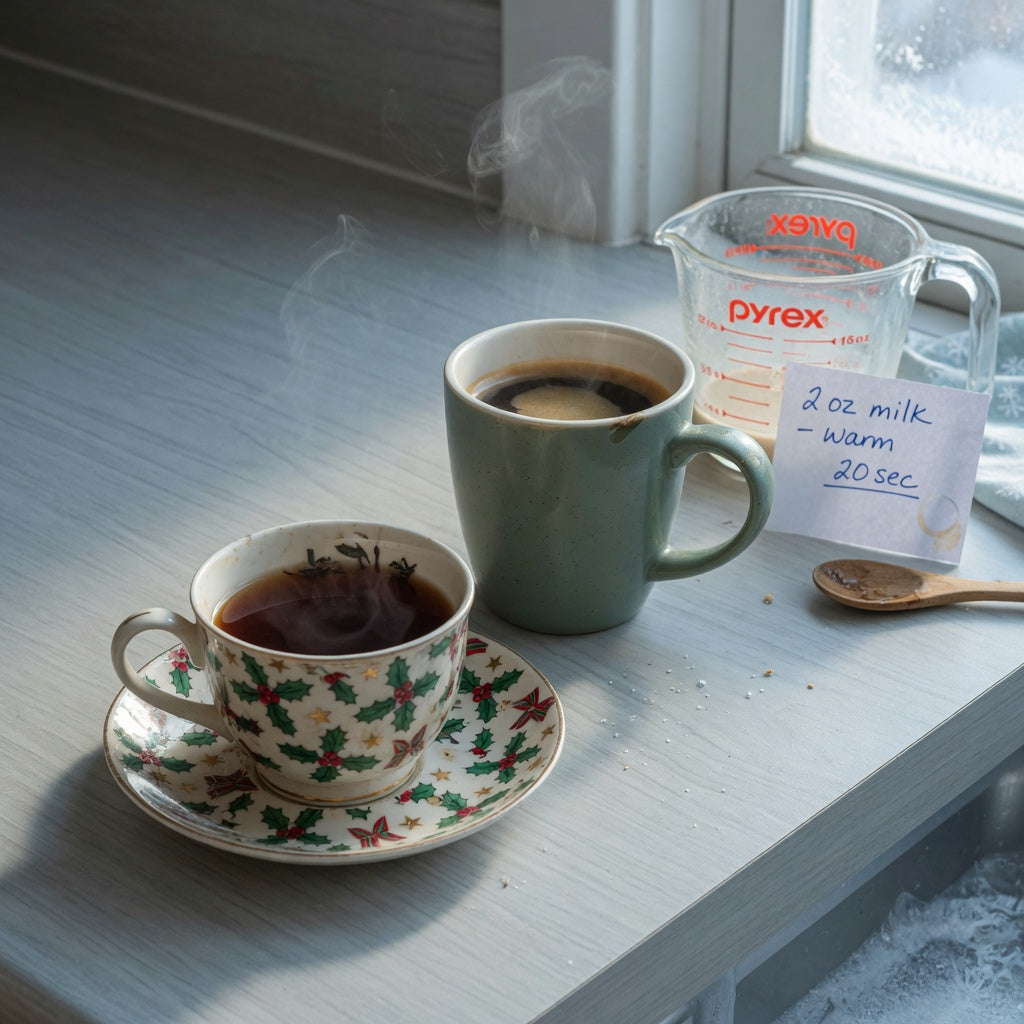
Last November a shopper set a just-unboxed Christmas tea cup on our counter, right beside the mug she fills from the drip machine on workdays. Same hand. Same kitchen waiting at home. The holiday cup looked finished after a short splash of tea. Her coffee mug still had room for milk. That gap is what people are really asking about with christmas tea cup vs coffee mug size, and it is why a pretty pattern sometimes comes back after Christmas breakfast.
In our store the same worry shows up every gift season. The photo looks generous. The first real drink feels small. Ounces settle it faster than the words printed on the box.
What does a christmas tea cup vs coffee mug size comparison actually measure?
Shoppers use the word cup for three different things. Mixing them up is how a holiday gift misses the person who has to drink from it.
- A kitchen measuring cup. U.S. nutrition labeling defines a cup as 240 mL and one fluid ounce as 30 mL. Eight fluid ounces and one labeling cup are the same 240 mL. That is a measure of liquid, not a piece of china sitting on a saucer.
- A coffee-maker cup. In our experience matching pots to the mugs people already own, many home drip machines mark a cup closer to 5 fl oz than to that 8 fl oz kitchen cup. Not every brewer does this, so read the carafe. When the smaller mark is what your machine uses, a brewer labeled 5 cups holds about 25 fl oz of coffee. That fills two 12 fl oz mugs to the rim and leaves almost nothing. It does not fill five coffee mugs.
- The drinking vessel itself. A Christmas tea cup is often shorter and wider, and it is sometimes sold with a saucer. A coffee mug is usually taller, with a larger handle and no saucer. The name does not lock the volume. Holiday patterns show up on small formal teacups and on everyday or oversized mugs. The number that matters is the fluid ounces or milliliters printed on the current listing.
CDC food-portion models used handled mugs with rim capacities of 8, 10, and 14 ounces so people could picture a beverage. Those fills go to the lip. You will not carry a mug that full from the kettle to the sofa, especially with a narrow holiday handle and a mug of cocoa that sloshes.
How do 8, 9, 12, and 14 fl oz holiday cups convert to milliliters?
Pick one conversion and keep it. Multiply fluid ounces by 30 to get milliliters, then check that the listing's two numbers agree. We have opened holiday pages where a 5 oz line sits next to a milliliter figure near 200. Five times 30 is 150 mL. One of those figures is using a different rule, or one of them is simply wrong. Do the multiplication before you trust either line.
These ranges are what we use when a shopper says tea cup or mug without a number. They describe common pours, not the capacity of any single product page, including ours.
| What shoppers usually mean | Listed size | Milliliters at 30 mL per fl oz | Practical read |
|---|---|---|---|
| Formal bone-china style teacup | about 5 fl oz | 150 mL | A short, hot serving of tea. Not a morning coffee. |
| Small holiday mug or large teacup | 8 to 9 fl oz | 240 to 270 mL | One modest tea, or a short black coffee. |
| Everyday coffee mug | 12 fl oz | 360 mL | Drip coffee with a little room for milk. |
| Generous Christmas mug | 14 fl oz | 420 mL | Coffee or cocoa if you still leave headroom. |
| Oversized desk mug | 16 to 20 fl oz | 480 to 600 mL | A long coffee. Often too much hot tea at once. |
Listed capacity is brim capacity, liquid level with the rim. Usable capacity is what you can pour, walk with, and still finish after milk or toppings. Leave about a finger's width of empty cup under the rim. On a wide, low teacup that band holds less liquid than the same finger of air in a tall, narrow mug, because the walls open outward. Two pieces both stamped 12 oz can feel different once they are full. The wide one looks like more and gives you less warning before a spill.
FDA consumer guidance describes about 400 milligrams of caffeine a day, for most adults, as an amount not generally associated with negative effects, and it lines that up with roughly two to three 12 fl oz cups of coffee. The same guidance puts typical decaf around 2 to 15 milligrams in an 8 fl oz cup. We are not setting a caffeine limit for your kitchen. The sizing clue is what matters. A public cup of coffee in that guidance is an 8 or 12 fl oz pour. It is not a 20 oz tankard, and it is not a 5 oz china teacup.
Which drink should set the size: afternoon tea, drip coffee, or cocoa?
Match the vessel to the drink the person actually finishes. The pattern they liked in a gift photo is the second decision.
Afternoon tea wants a smaller, hotter cup
A smaller cup stays hot through a short pour, and a pot refills it. That is why a Christmas tea cup in the 5 to 8 fl oz range still earns a place for someone who already brews in a teapot. It is a weak match for the person who steeps one large mug and parks it beside a laptop. A 16 to 20 oz mug of tea often cools before it is finished, and the leaf was never meant to sit that long in that much water. Buy the small cup on purpose only when refills are part of the ritual.
Drip coffee usually wants the middle of the chart
People who ask for a mug of coffee usually mean something near 10 to 14 fl oz in the vessel, plus a splash of milk inside the headroom. An 8 fl oz Christmas piece can feel stingy next to a full carafe. It still works as a second cup, a shorter pour, or the right size for someone who already drinks small. It is not the single mug you fill once and carry into a meeting. If their machine uses the smaller cup marks, do the pot math too. At about 5 fl oz a mark, a 12-cup brewer holds roughly 60 fl oz, which is about five practical 12 fl oz mugs, not twelve.
Cocoa needs room above the liquid
Cocoa is where brim capacity flatters the listing. Whipped cream, marshmallows, or a thick chocolate rim occupy the space you thought was drink. A 9 or 12 fl oz cup plus toppings can leave a short sip. For Christmas Eve cocoa, start above a formal teacup, then still plan on headroom. A 14 fl oz mug is 420 mL at the rim, which is more honest for cocoa than a 5 fl oz cup, and it is still not a bottomless bowl once the toppings go on.
If you want one festive piece for someone who drinks both coffee and tea, and you do not want a saucer set that lives in a cupboard, start with our Christmas coffee and tea mug. The product title is not a capacity. Before you add it to a gift, read the ounces or milliliters, the height, the material, and the care line on that live page, then set those numbers next to the mug already by their kettle. When the printed size is the wrong pour, leave that listing and look through unique coffee mugs, choosing by listed capacity before you fall for the pattern. A holiday scene on the outside does not change the milliliters on the inside.
Be plain about the misses. A teacup is not a daily coffee mug for a 16 oz habit. A tall mug is not a formal tea service, even with a Christmas motif. Thin decorative china is a poor bet for a crowded dishwasher, a stacked cabinet, and a commute in a tote. On decorative holiday china we handle, a printed gold rim or a thin lip is what fails first in a hot cycle, which is why a hand-wash note on a listing should be believed. Heavier everyday ceramic usually survives weekday use better, and you feel the weight: 14 fl oz of water is already close to 14 ounces before the clay is in your hand. Small hands and narrow handles notice that on the walk from counter to couch. None of this is a measured verdict on a listing whose ounces are not printed here. If the page leaves capacity blank, treat the size as unknown.
Will the height, handle, and saucer clear the shelf and the dishwasher?
Volume is half the fit. The other half is shape, and product photos are bad at showing it.
- Height versus the cabinet. A tall 14 fl oz mug can hit the shelf above a shorter cup that holds nearly the same liquid because it is wider. Measure the open height where the mug actually lives, including a lid if they use one, and compare it with the listed height.
- Handle and hand. Formal teacup handles are often a one-finger loop. Coffee mug handles usually take two or three fingers. A dainty Christmas handle on a full 12 oz piece fights a larger hand, and the weight sits farther from the grip.
- Saucer diameter. A cup-and-saucer set needs a drawer, a plate groove, or rack space that a mug never asks for. The saucer does catch drips a mug leaves on the table. For a desk gift, the saucer is often the part left in the cupboard after opening day.
- Dishwasher tines and brew-head clearance. Short, wide cups can sit loose between tines and chip at the rim. Tall mugs can block the top rack or the spray arm. Under a drip machine, the piece has to clear the brew head. We have watched a good-looking holiday mug stay on the counter because only the shorter cup actually fit the machine.
Plain white photos erase scale. A familiar 12 fl oz drink can is a useful mental ruler. If the holiday mug is also listed at 12 fl oz, it should not look twice that can unless the shape is very wide and low. If the listing gives no ounces, no milliliters, and no height, the crop of the photo is not evidence. Put a ruler on your current favorite mug and write down height plus a full pour. That homemade note beats a styled picture.
Shape changes heat as well. A wide tea cup gives the drink more surface, so it cools faster. A taller mug keeps a smaller surface and stays hot longer, which suits black coffee and can work against tea you hoped to finish while it was still bright. If the open question is the pour rather than the pattern, our guide to how many ounces a mug of coffee holds stays on that number. When the gift needs to feel generous rather than formal, the notes on large unique coffee mugs for gifts are the next comparison, still led by listed capacity.
Christmas tea cup vs coffee mug size: what should you check before you wrap it?
This is the pass we use at the counter when the mug is for somebody else's kitchen.
- Name their usual drink. Pot-and-cup tea, one big mug of tea, drip coffee with milk, or cocoa with toppings. That choice picks the row in the chart.
- Read listed capacity, then cut it to a usable pour. Confirm fluid ounces times 30 matches the milliliters. Leave headroom. A 9 fl oz Christmas mug is 270 mL at the rim and less once you can carry it. Plenty of tea drinkers are happy there. Someone replacing a 16 oz desk mug will feel shortchanged on the first morning.
- Check height, handle, and saucer against the real kitchen. Shelf, dishwasher rack, and the gap under the coffee maker. A beautiful cup that does not fit the machine becomes a display piece by New Year.
- Separate guest china from daily ware. A decorative Christmas tea cup can come out with a saucer for visitors. It is the wrong gift if they need a workhorse five mornings a week. Say that before you wrap it. Chips on a thin rim are a common way festive china leaves the weekday rotation.
- Verify the live listing, then decide. Capacity, height, and material can differ by version, so do not borrow specs from a similar photo or from a mug you handled last year. If ounces are missing, keep shopping until a page prints a number you can check.
Frequently asked questions
Is the christmas tea cup vs coffee mug size gap big enough to matter?
Yes, when the drinks do not match. A formal teacup near 5 fl oz (150 mL) and a 14 fl oz mug (420 mL) are different servings, not two names for one cup. If both pieces are listed around 12 fl oz, you are mostly choosing shape, handle, and headroom. Read the ounces before you trust the photo.
How many milliliters are 8, 9, 12, and 14 fl oz?
Using 30 mL per fluid ounce from U.S. nutrition labeling: 8 fl oz is 240 mL, 9 fl oz is 270 mL, 12 fl oz is 360 mL, and 14 fl oz is 420 mL. If a product page prints a different milliliter figure, treat one of the two numbers as unverified until you know which one is brim capacity.
Is a teacup too small for coffee?
For a full drip-coffee habit, it usually is. Five to 8 fl oz is closer to a short pour than to the 12 fl oz amounts people mean by a mug of coffee. It can suit someone who drinks small cups or refills from a pot. It disappoints the person who fills one mug and leaves the house.
Why do photos make holiday mugs look the wrong size?
Tight crops, a blank background, and no reference object remove scale. A wide cup reads larger than a tall mug holding the same volume. Check listed fluid ounces, milliliters, and height. If those are missing, do not buy on the picture.
Is a 9 oz Christmas mug too small for tea?
For many teapot drinkers, 9 fl oz is a normal cup: 270 mL at the rim, less once you leave room to carry it, and easy to refill while it is still hot. It feels small only if the person is used to a 16 to 20 oz mug they sip for a long time. Buy for the habit they already have, not for the pattern on the box.
Write down the drink, the ounce target, and the shelf height, then open the current Christmas coffee and tea mug listing and match those three to what is printed there today. If the size is off, stay inside the unique coffee mugs collection and pick capacity before pattern. Festive on the outside still has to fit the morning.
More from our blog
Ready to pick your mug? Two ways to save on today's order:
Ordering 1–3 mugs? Get an extra 10% off your 1st order with code 10_OFF Apply 10% Off & Shop Wooden-Handle Mugs →
Gifting 4+ mugs? Buy 3, Get the 4th Free applies automatically at checkout (no code needed; offers do not stack) · Free standard shipping (Nov pre-Christmas delivery: 15–20 calendar days US) · Free replacement if chipped in transit.
Popular mug buying guides: Wooden-Handle Tea Infuser Mugs Compared · Christmas & Secret Santa Mugs 2026 · Espresso & Cortado Cups Guide · Cup & Saucer Gift Sets · All 25 Mugs Spec Table · Mug Size Guide · Shipping & Promo FAQ
FIRST ORDER 10% OFF (CODE: 10_OFF) · OR BUY 3, GET THE 4TH FREE


Read more

Ceramic Mountain Tea Mug Home Decor: What Buyers Compare
We compare ceramic mountain tea mug home decor the way we check a piece before it leaves the bench: food-contact glaze, usable volume once any infuser is seated, mesh that matches the leaf, and car...
Read more
Wooden Handle Mug Gift for Home Decor: What to Compare
A wood grip on a ceramic cup and an all-wood tankard are not the same gift. Compare the body, the handle joint, heat limits, finish, and coffee-bar fit before you buy.
Read more
Leave a comment
This site is protected by hCaptcha and the hCaptcha Privacy Policy and Terms of Service apply.