
Wooden Handle Tea Mug Home Decor: What Buyers Should Compare
Reading time: about 9 minutes
Last winter, a customer emailed us under the subject line "handle fell off." She had chosen her mug for the same reason most people shop the wooden handle tea mug home decor category — the way it looks on a shelf — then ran it through the dishwasher three times and watched the wood turn pale, fuzzy, and loose at the fitting. She wasn't chasing a refund. She wanted to know what she should have checked before buying.
"Three cycles in, the handle went pale and it wobbles now. Nobody told me wood couldn't go in the dishwasher."
That gap — nobody told her — is why we wrote this guide. In our experience packing and selling these mugs every week, nearly every disappointment traces back to one of three comparisons the buyer skipped: how the handle attaches, what the body is made of, and whether their kitchen habits suit wood at all. A mug like this is really two purchases in one. It has to survive your daily tea routine and still earn its spot on an open shelf. Compare both sides and the category rarely disappoints.
Body, wood species, and joinery: the three comparisons that predict lifespan
Start with the body, because it carries the tea. Two materials dominate this category:
- Borosilicate glass shows off the tea's color and sits light in the hand. It takes hot pours well for glass, but no glass likes sudden swings — never fill a mug that just came in from a cold car with boiling water. Check the wall thickness on the listing too; thin, featherweight glass at a bargain price is more fragile than the photos suggest.
- Glazed stoneware holds heat longer, feels heftier, and reads warmer on a shelf. With ceramics the glaze matters as much as the clay: a listing worth trusting states the glaze is food-safe and free of lead and cadmium.
Next, the handle wood. Teak carries natural oils and tolerates kitchen moisture better than most species, which is why it turns up on better glass mugs. Beech has a tight, pale grain that suits Scandinavian-styled pieces but is thirstier — it wants regular oiling to stay smooth. Acacia is dense, dark-grained, and naturally water-resistant. A listing that never names the species at all is a small yellow flag.
Finally, joinery — the part no product photo shows you. Handles attach three common ways: a glued peg set into a socket, a metal ferrule with a screw fitting (frequent on glass bodies), or a stainless collar. On every sample that reaches our store we run the same test: lift the mug by the handle only, press a finger against the rim, and listen. Any flex, tick, or creak means the fitting will loosen within months of daily washing. Run the same test the day your mug arrives.
Dishwasher, microwave, or boiling tea: what can a mixed-material mug take?
Nearly every pre-purchase question we get is one question in disguise: what breaks these mugs? Here is the honest matrix we give customers at the counter:
| Daily situation | Safe default | Why |
|---|---|---|
| Dishwasher | Hand wash instead | Heat and detergent strip the wood's oils; water swells the grain, and cracks follow as it dries |
| Microwave | Assume no | Some fittings contain metal that can spark, and microwave heat over-dries and splits wood |
| Fresh boiling tea | Usually fine | Wood conducts heat slowly, so the handle stays comfortable; the body material is the real limit |
| Soaking in the sink | Avoid | Water wicks into the peg hole and loosens the joinery over weeks, not days |
One exception is worth watching. If a specific listing explicitly claims dishwasher-safe construction — sealed fitting, fully finished handle — follow the maker's instructions. Absent that statement, hand-wash-only is the default we assume for every mixed-material mug, including the ones on our own shelves.
What keeps a wooden handle from drying out, cracking, or turning musty?
The full routine takes about a minute per wash and five minutes a month:
- Hand wash in warm, soapy water and finish within the minute — wood doesn't need a soak to come clean.
- Towel-dry immediately, including the seam where the handle meets the body. That seam is where moisture hides.
- Store upright with airflow around the handle. A damp handle pressed into a counter corner is how musty smells start.
- Once a month, or whenever the wood looks pale or feels rough, rub in a few drops of food-safe mineral oil — sold as cutting board oil — wait 15–20 minutes, and wipe off the excess.
- Skip kitchen oils. Olive and vegetable oil sit in the grain and go rancid, which is worse than dry wood.
One limit we state plainly: if the wood ever develops dark spotting or a sour, damp smell that survives drying, stop drinking from that mug. That's trapped moisture turning toward mold, and no amount of oil brings it back. Cared for this way, a well-made handle lasts for years; neglected, it can fail in a single season — our customer with the wobbling handle managed it in three dishwasher cycles.
Wooden handle tea mug home decor: where does it earn its shelf space?
Function is half the purchase. The other half is what the mug does when it's empty. The category splits into two looks, and both pass through our store week after week. Clear glass with pale wood — the quiet, Japanese-inflected direction — nearly disappears on a shelf until light passes through it. Matte stoneware with darker wood reads rustic and warm, closer to cabin and farmhouse styling. Neither is better; they anchor different rooms.
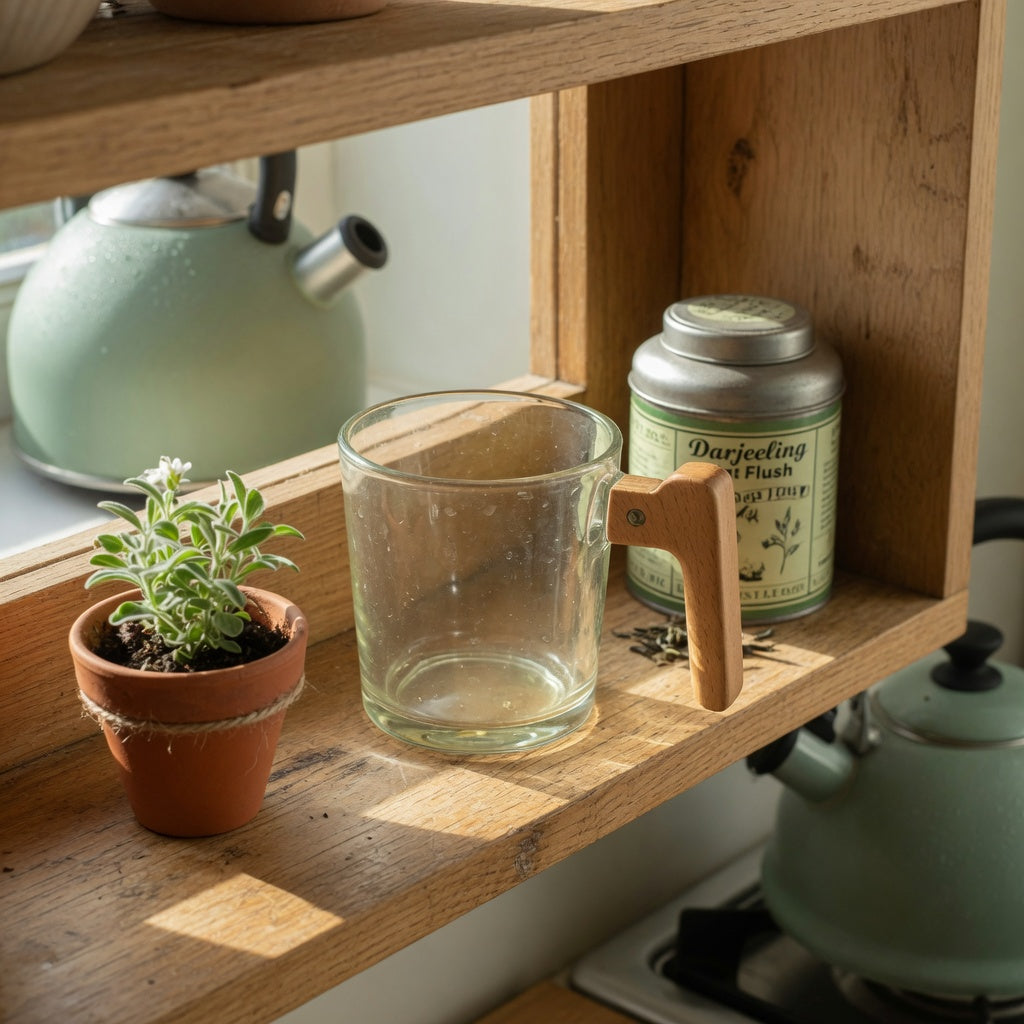
- Coffee-bar vignette: mug at the front, kettle behind it, a tin of leaves and a small plant between. The wooden handle warms up all that metal.
- Open kitchen shelving: group mugs in odd numbers with varied heights so the shelf reads styled, not stored.
- Desk-side: a wooden handle softens the clink against a saucer and looks deliberate next to a laptop — a detail home-office workers notice daily.
- Seasonal tables: come autumn, wood and warm glaze do half the decorating work alongside dried orange or a cinnamon stick.
The mug customers most often ask us to gift-wrap is the Mountain Sea II coffee tea mug with wooden handle, and it gets bought for exactly these spots. It's the style people mean when they say they want a mug that "looks like decor."
One styling trade-off deserves honesty: these mugs are quiet. If your shelves lean bold — bright glazes, prints, novelty shapes — a wood-handle style can vanish into the mix. For louder statements, browse our unique coffee mugs collection instead. And for a fuller framework on display choices, our home decor coffee mug buying checklist walks through the decisions mug by mug.
When is a wooden handle mug the wrong pick for your kitchen?
We'd rather lose a sale than set someone up to break their mug, so here is who should skip the style entirely:
- Everything goes in the dishwasher, including the good mugs. Wood will not forgive that habit.
- You reheat forgotten tea in the microwave several times a day.
- Mugs soak overnight in the sink — shared flats, office kitchens, busy family sinks.
- You want a lid, insulation, or travel use. These are sit-down mugs, and most ship without lids.
For those households, an all-ceramic or insulated steel mug is the honest recommendation. A wooden handle rewards a specific routine — quick hand washes, a shelf it lives on — and it's fair to ask whether that routine actually exists in your kitchen before you spend money on one.
Mountain Sea II: who it fits, and what to verify on the listing
The Mountain Sea II suits a specific buyer: someone who drinks tea or coffee daily, wants one mug to serve both the cupboard and the coffee bar, and prefers quiet, nature-leaning design to loud prints. It's our go-to answer when a shopper asks for a gift that doesn't look like it came from an office cupboard. Buying it as a present? Tuck a care card in the box, because the recipient won't know the hand-wash rule unless someone tells them.
Because specs can change between production runs, we won't quote numbers we can't stand behind today. Check the current listing for four things: exact capacity in ml or ounces, the body material, whether it ships as a single mug or a set, and the maker's own care instructions. Those four details decide whether the mug fits your routine. Our Mountain Sea II buying checklist goes through them line by line.
Six checks to run before you pay for any wooden handle mug
Run any candidate — ours or another shop's — through this list in order:
- Capacity in ml or oz: around 300 ml suits a solo tea session; size up if the mug doubles as a latte mug.
- Body material and heat limits: borosilicate glass or glazed ceramic, plus whatever the maker says about boiling-water pours and thermal shock.
- Handle fitting: does the listing describe how the handle attaches and name the wood species? On arrival, do the handle-only wobble test.
- Glaze disclosure: a food-safe, lead- and cadmium-free statement — worth insisting on for any imported ceramic.
- Care instructions: hand-wash guidance should appear somewhere in the listing. A seller with nothing to say about wood care probably hasn't thought about the wood.
- Gifting plan: if it's a present, add a care card so the routine survives the handoff.
Work through those six and the decision usually makes itself. If you'd rather shortlist visually first, start in our unique coffee mugs collection, pick two or three candidates, and hold each one against this list before you commit.
Frequently asked questions
Can a wooden handle tea mug go in the dishwasher?
Treat it as hand-wash-only unless the specific listing explicitly claims dishwasher-safe construction. Dishwasher heat and detergent strip the natural oils from the wood, the grain swells with absorbed water, and cracks follow as it dries again. Hand washing takes under a minute and adds years to the handle's life.
Can you microwave a mug with a wooden handle?
Assume no unless the maker states the mug is microwave-safe. Some handle fittings contain metal that can spark, and microwave heat over-dries wood, which leads to splitting. To reheat tea, pour it into a kettle or transfer it to a plain microwave-safe vessel.
Does a wooden handle stay cool when the tea is boiling hot?
Usually, yes. Wood conducts heat far more slowly than metal or ceramic, so the handle normally stays comfortable to grip during a fresh pour. The body is the hotter part — glass walls especially — so lift the mug by the handle rather than the body.
How do I stop the wooden handle from drying out or getting musty?
Towel-dry the mug immediately after washing and never leave it soaking in the sink. When the wood looks pale or feels rough, rub in a little food-safe mineral oil, let it sit 15–20 minutes, and wipe off the excess. A sour smell or dark spotting means moisture got trapped — retire that mug from drink use.
Is the wooden handle tea mug home decor style practical for everyday drinking?
Practical, with one condition: you have a hand-wash habit. The better designs genuinely work as two products — daily drinkware plus a shelf piece that holds its own in a coffee-bar display. To spot the well-made ones before spending, our guide to wooden handle mug gift comparisons covers the six checks that separate keepsakes from drawer filler.
Read more

Big Desk Mug for Office: 5 Things Buyers Should Compare
A big desk mug for office use means fewer refills — but also more weight when full, a wider desk footprint, and a real spill decision if a keyboard is in reach. We compare capacity, material, fit, ...
Read more
Flow Coffee Tea Mug Gift for Coffee Lovers: What Buyers Should Compare
We pack and ship mugs from our store every day, so we know what separates a keeper from a cabinet mug. This guide compares capacity, material, heat retention, glaze safety, and gift presentation be...
Read more
Leave a comment
This site is protected by hCaptcha and the hCaptcha Privacy Policy and Terms of Service apply.