



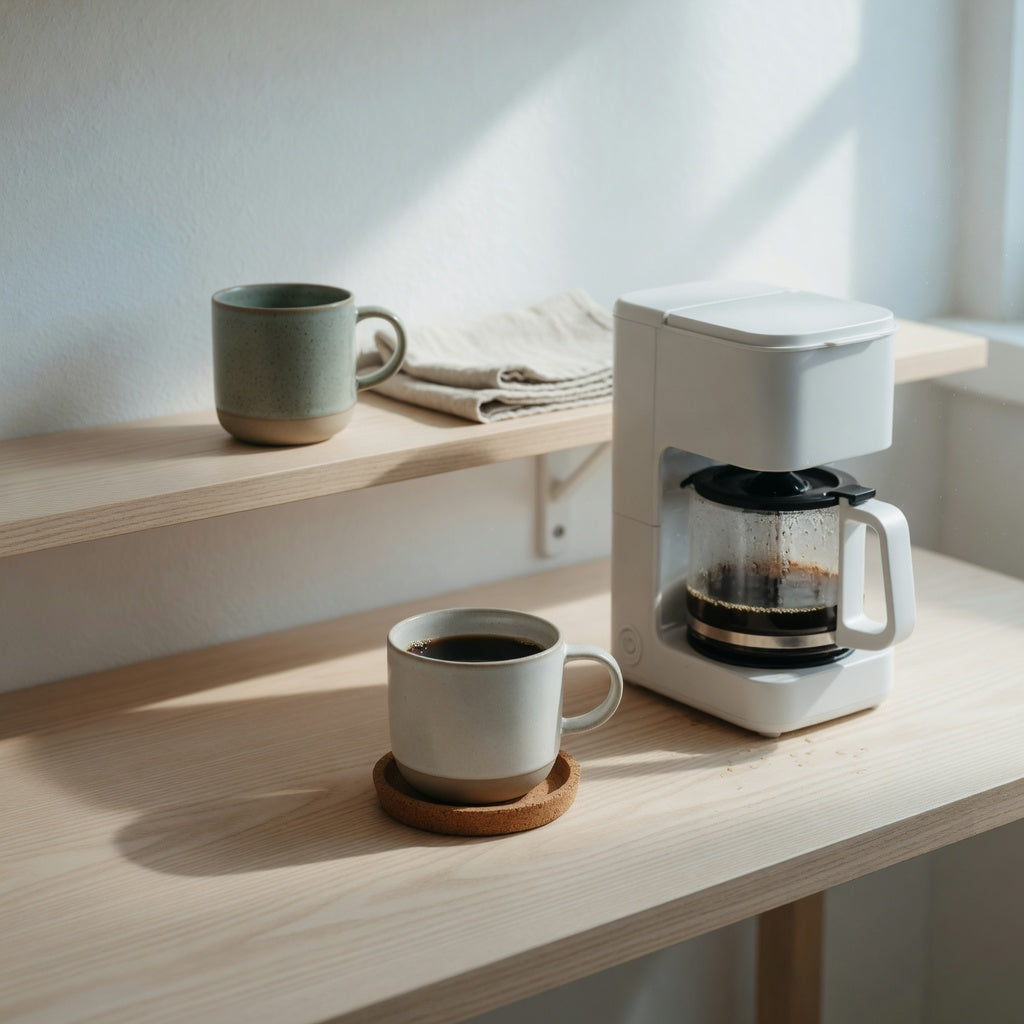
Wide Based Coffee Mugs for Small Coffee Setup: What to Compare
Reading time: about 9 minutes
Our packing counter holds a grinder, a scale, and roughly one mug at a time. That is why we measure mugs instead of trusting how compact they look in a product photo. When shoppers ask us which wide based coffee mugs for small coffee setup spaces will actually fit, the number that matters is not how broad the bottom appears on screen. It is the clear room the mug needs once the handle, the rim, and your knuckles are counted.
Volume is the one spec we can give you plainly. Our Ball Handle mug is listed at 250 ml, The Flow at 400 ml, and The Rock at 480 ml. Those figures describe drink capacity, not shelf width, height, or how much of the base touches the counter. Browse the full unique coffee mug collection to compare shapes side by side, then confirm dimensions on each listing before checkout.
Which wide based coffee mugs for small coffee setup counters actually fit?
Three widths get mixed together in listings, and each does a different job.
- Contact foot. The ring or pad that rests on the surface. This is the part that provides support.
- Body width. The widest point of the wall. It decides how far the mug leans past a coaster and crowds its neighbors.
- Overall width with the handle. Usually the figure that decides whether the mug fits in the slot at all.
A mug can have a broad foot and still need a wide slot because the handle juts out. It can also have a wide rim sitting on a small foot, which is a different shape entirely. For the foot-versus-rim distinction, our guide to ceramic wide-bottom mug shapes and fit breaks the geometry down further.
- Counter slot. Measure clear width and depth beside the machine with the drip tray in place. Add handle projection to body width, not just to base width.
- Shelf. Check usable depth and the height gap between shelves, including the lift clearance you need to pull the mug out by its handle.
- Coaster or tray. Use the flat usable area, not the decorative lip. A mug resting partly on a raised rim can rock.
- Neighbors. Decide which way handles will point. Turning one inward saves width but makes the mug harder to grab in a hurry.
Photos help you read base geometry, meaning whether the foot looks broad relative to the body or the wall tapers down to a smaller ring. They cannot replace the numbers. If a listing omits them, ask us before ordering.
Does a broad foot really stop a mug from tipping?
A wider base of support and a lower center of gravity both make an object harder to tip, all else being equal. All else is rarely equal. Height, weight distribution, fill level, the direction of a knock, handle position, and whether the foot sits flat all change the outcome. The phrase wide base also has no agreed minimum diameter, so it is not a rating you can compare across brands.
Look at how the base meets the counter. A foot that is broad relative to the body spreads support outward; a narrow ring under a wide body concentrates it. Once a mug arrives, set it empty on a flat surface and press gently on the rim in four directions. A foot that rocks is a defect, not a design choice.
We do not describe any of our mugs as tip-proof, because no base shape earns that word. On a crowded station, most spills start with a sleeve catching a handle or a mug resting half on a tray edge, and geometry cannot fix either one. If sliding is your concern, confirm whether a non-slip foot is specified on the exact listing instead of assuming it from the silhouette.
What do 250 ml, 400 ml, and 480 ml change on a narrow shelf?
Capacity and footprint are separate specs, so do not choose by volume alone. Use this table as a starting point, then verify dimensions on the product page.
| Mug | Listed capacity | Reasonable starting point for |
|---|---|---|
| Ball Handle | 250 ml | A short coffee or a modest tea you finish in one sitting |
| The Flow | 400 ml | A typical pour with room for milk |
| The Rock | 480 ml | A long drink where fewer refills matter more than a light cup |
Smaller listed capacity does not guarantee a smaller footprint. If your coffee is short, the 250 ml Ball Handle is the first listing to open, but still confirm its width and height. A 400 ml pour covers most milk-and-coffee routines, which puts The Flow in the middle of our range. The 480 ml The Rock is the option to check most carefully for shelf clearance and for how it feels when full: water weighs close to one gram per millilitre, so that much drink adds roughly half a kilogram before you count the mug itself.
Will the mug clear your brewer, drip tray, and cup holder?
Shelf fit and brewer fit are different problems. Measure the machine as it is actually set up.
- Spout clearance. Measure from the mug's resting surface to the lowest part of the spout, with the drip tray installed unless the maker says otherwise. Compare with the mug's full height plus a little slide room.
- Drip tray flat area. A foot wider than the tray's flat zone can overhang a rim and sit unevenly.
- Brewer opening. Pour-over cones and AeroPress rely on the rim, not the foot. A stable base tells you nothing about whether a dripper will seat securely.
- Handle swing. On compact machines the handle can meet the housing before the mug centers under the spout.
- Cup holder. Most are tapered. Measure at the narrowest point and compare that with the mug's lower body and any handle.
None of this can be settled from capacity. If a listing does not publish height, rim, or base measurements, ask. Brewing into a narrower vessel and transferring the coffee is a workable fallback when the extra step suits your routine.
What do we check before a mug goes on our own shelf?
We keep a few samples out of rotation for handling checks, because a mug you cannot lift confidently when full stops being useful.
- Handle room. Count the fingers that fit without scraping knuckles against the body. Handle photos flatter clearance; hands do not.
- Weight when full. Add drink weight to the empty mug. If the listing omits empty weight and you have grip or wrist concerns, ask us.
- Foot contact. Flat and even, with no rocking. A recessed or concave foot can trap water in a dishwasher, so tip it out after the cycle.
- Care instructions. Dishwasher and microwave suitability is decided per item. Confirm it on the exact listing or the care card in the box rather than assuming from appearance.
That routine is why we treat wide bottom as a shape description, not a performance claim. Shape supports stability; the details decide whether the mug works in your kitchen.
Is a wide ceramic base a heat-retention feature?
No. Base width does not measure insulation. Heat loss depends on material, wall thickness, whether there is a lid, and how hot the drink was at the pour. Retail roundups sometimes credit a broad ceramic base with longer warmth, but we found no testing that isolates base width from those other variables, so we do not repeat the claim.
If you need coffee to stay hot for hours, an insulated vessel is the better tool. For a mug you finish in one sitting at a desk, an open vessel is fine, and the trade-off is an exposed surface that responds badly to a careless elbow. Read lid language closely as well: splash-resistant and leakproof are separate claims, and only the second survives a drop.
Should you check food-use labeling on a decorative mug?
Yes, briefly. The FDA guidance on lead-glazed pottery explains that improperly fired glazes can leach lead into food or drink, that washing or boiling does not remove it, and that cups and mugs have an action level of 0.5 micrograms of lead per millilitre of leaching solution. The same guidance flags handmade, antique, damaged, and brightly orange-, red-, or yellow-decorated pieces as higher concern, while noting that ordinary commercial factory tableware is much less likely to be affected.
For our own range, check food-contact status and care instructions on the listing instead of inferring them from a photograph, and never drink from a piece marked decorative or not for food use. That is general guidance, not a certification claim about any specific mug we sell.
Frequently asked questions
Are wide based coffee mugs for small coffee setup spaces always harder to tip?
No. A broader base of support helps, but height, weight distribution, fill level, and whether the foot sits flat matter just as much. We do not label any mug tip-proof.
Which of your mugs has the smallest listed capacity?
The Ball Handle at 250 ml, against 400 ml for The Flow and 480 ml for The Rock. Those figures describe volume, not which mug takes up the least shelf space.
Will a wide mug fit my car's cup holder?
Measure the holder at its narrowest point first, because most taper. Compare that with the mug's lower body and handle. A broad foot can rule out a shallow holder even when the top of the mug looks slim.
Does a wider base mean more coffee?
Not automatically. Base width and interior volume are separate specs, and a broad foot can sit under a modest interior. Compare listed capacity with your usual pour.
Can these mugs go in the dishwasher?
Check the individual listing or the care card that ships with the mug. Suitability can differ between items, and a recessed foot may hold water after a cycle.
Match the mug to the spot where it will actually live
A desk mug is judged by handle comfort and how it behaves when bumped. A shelf mug is judged by handle projection. A mug that rides in a car needs a lid rated for the trip and a holder that grips it, so a wide foot alone is not a commuting solution and a dedicated travel mug is usually the better buy.
- Short coffee, tight shelf: start with Ball Handle at 250 ml.
- Typical pour with milk: compare The Flow at 400 ml.
- Long drink, fewer refills: check The Rock at 480 ml and its height when full.
- Undecided on shape: browse the unique coffee mug collection.
Before checkout, write down four numbers from the listing: height, overall width, base contact width, and empty weight. If one is missing, message us and we will confirm it rather than let you guess. That check catches the fit problem product photos hide best.
More from our blog
Ready to pick your mug? Two ways to save on today's order:
Ordering 1–3 mugs? Get an extra 10% off your 1st order with code 10_OFF Apply 10% Off & Shop Wooden-Handle Mugs →
Gifting 4+ mugs? Buy 3, Get the 4th Free applies automatically at checkout (no code needed; offers do not stack) · Free standard shipping (Nov pre-Christmas delivery: 15–20 calendar days US) · Free replacement if chipped in transit.
Popular mug buying guides: Ceramic Tea Cups & Infuser Mugs · Ceramic Mugs with Lids Compared · Wooden-Handle Tea Infuser Mugs Compared · Christmas & Secret Santa Mugs 2026 · Espresso & Cortado Cups Guide · Cup & Saucer Gift Sets · All 25 Mugs Spec Table · Mug Size Guide · Shipping & Promo FAQ
FIRST ORDER 10% OFF (CODE: 10_OFF) · OR BUY 3, GET THE 4TH FREE


Read more
Coffee Mugs With Big Handles for Small Coffee Setup: What to Compare
A generous loop is only half the decision. We compare listed capacities, handle clearance and counter footprint so a mug with a genuinely open handle still fits a cramped coffee setup.
Read more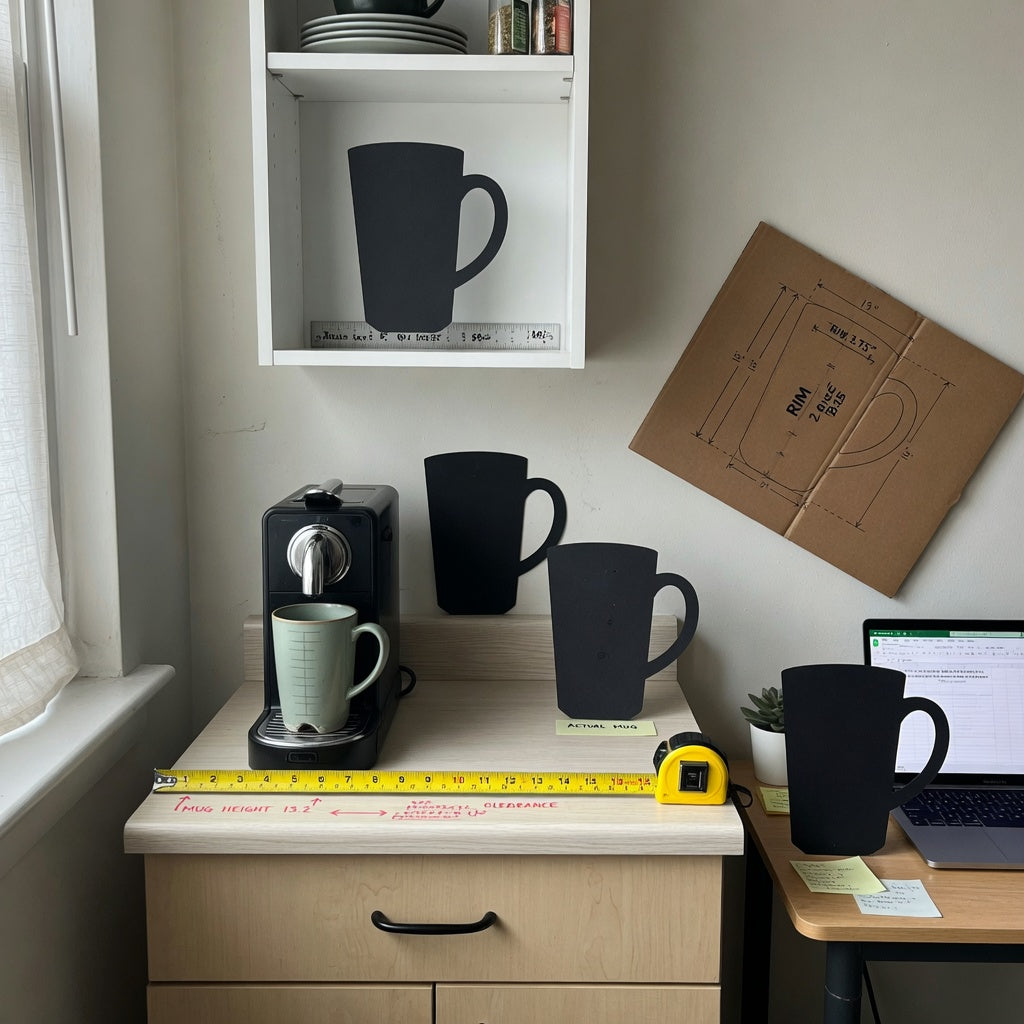
Latte Mugs Tall for Small Coffee Setup: Compare Fit and Capacity
A tall mug can save shelf footprint while failing under an espresso spout. Compare base diameter, rim width, cabinet clearance, usable fill, and CoffeifyMug’s 400, 440, and 480 ml options before bu...
Read more
Leave a comment
This site is protected by hCaptcha and the hCaptcha Privacy Policy and Terms of Service apply.