



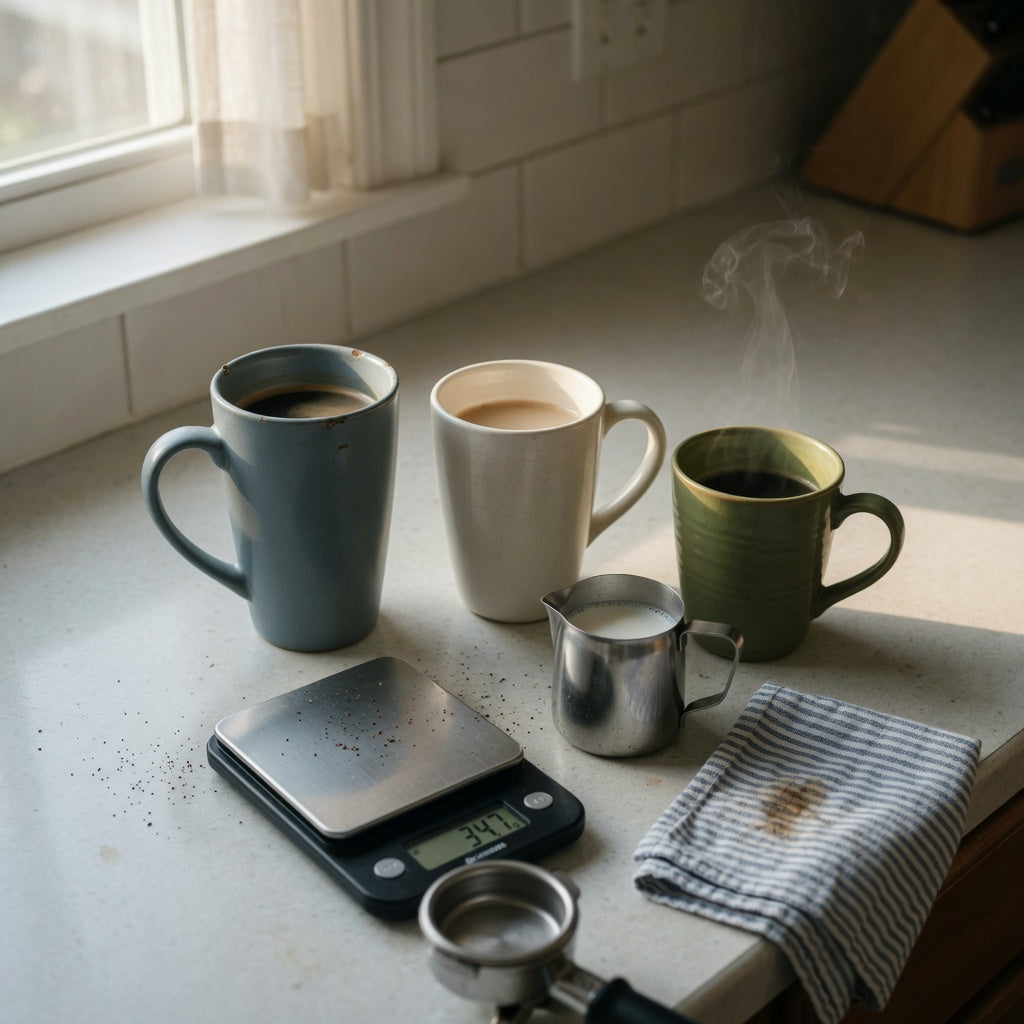
Latte Mugs Tall Morning Routine Product Shortlist Guide (400–480 ml)
Reading time: about 9 minutes
At 6:50 on a weekday, nobody wants to re-pour. You pull a double shot, steam a small pitcher of milk, then find out the mug you grabbed leaves either a finger-width of foam clearance or so much empty headroom that the last third goes lukewarm. We pack and ship these mugs every week, and the returns we see rarely come from bad coffee. They come from a mismatch between the drink someone actually builds and the vessel they ordered. This latte mugs tall morning routine product shortlist guide stays deliberately narrow: three capacities, three morning scenarios, and a plain reason to skip each one.
What 'tall' means when a 400 ml mug and a 480 ml mug share a shelf
"Tall latte mug" covers three different objects. Sometimes it means a straight-sided everyday mug, sometimes a conical gift or photo mug, sometimes a cafe-style cup built to show off milk layers. The word describes height, and height tells you nothing about usable volume. The three mugs in our unique coffee mugs collection sit at 400 ml, 440 ml and 480 ml, which is a useful spread precisely because those numbers are close enough to force a real decision.
Two reference points keep the numbers honest. FDA's guidance on ceramic hollowware describes a typical cup or mug as holding about 240 ml (8 fl oz) — that is a regulatory description of a category, not a rule that a latte has to be 8 oz. And NIST's approximate conversion of 1 U.S. fluid ounce = 29.57 ml lets you translate any listing: 8 fl oz is about 237 ml, 12 fl oz about 355 ml, 16 fl oz about 473 ml.
The gap most listings hide is brim capacity versus fill line. A mug rated at 440 ml holds 440 ml when it is full to the lip — the point where you cannot carry it across a kitchen. Your practical pour sits lower, and that difference is exactly the foam and settling room you need. Decide which number the seller is quoting before you compare anything else.
The latte mugs tall morning routine product shortlist guide: three capacities, three morning jobs
Our catalog notes give us three plain capacities. Everything else about a given mug — height, rim diameter, base width, handle opening, glaze and care status — belongs to the exact product page, not to this table.
| Mug | Listed capacity | Approx. U.S. fl oz | Morning job it suits | Reason to skip |
|---|---|---|---|---|
| The Flow | 400 ml | about 13.5 | One 8–10 oz latte, modest pitcher, tight counter space | A 12 oz drink with thick foam leaves almost no headroom |
| Morning and Night | 440 ml | about 14.9 | Standard 12 oz latte with a real foam margin | 16 oz drinkers will want more volume |
| The Rock | 480 ml | about 16.2 | 14–16 oz desk mug, iced drinks, long refill window | Not enough headroom for a brim-full 16 oz latte plus foam |
Read the skip column first. It is the column that saves return shipping. Then think about silhouette: two mugs with identical capacity can have completely different rim diameters, wall taper and handle clearance, so a 440 ml vessel with a wide mouth drinks and pours differently from a 440 ml vessel with a narrow one. Capacity is the entry ticket, not the whole comparison.
One 10 oz latte, rinsed before you leave: the 400 ml case
Choose the 400 ml Flow mug if your usual morning drink lands around 8–10 fl oz including foam, if you steam a modest pitcher, or if counter space is tight and you want something that does not dominate the drip tray. In our experience the smaller-capacity mug is also the one people actually rinse and leave by the sink between pours — a habit that matters more on a rushed morning than any design detail.
Skip it if you build a full 12 oz latte with a thick cap. The arithmetic is unforgiving: 355 ml of drink inside a 400 ml mug leaves roughly 45 ml, or about 1.5 fl oz, before you reach the listed capacity. That is a thin layer of microfoam, not a generous dome. Skip it too if you want a broad surface for latte art, since smaller vessels usually give you less rim to work with — though confirm the rim diameter on the listing rather than assuming.
A 12 oz default with foam that stays off the rim: the 440 ml case
The 440 ml Morning and Night mug is the one we would shortlist for a standard 12 oz latte drinker who wants margin. If the listed figure is brim capacity, 355 ml of drink leaves about 85 ml — roughly 2.9 fl oz — for foam and settling. That is a much more forgiving pour at 7 a.m. than 400 ml gives you.
It is a middle option, not a universal one. Drink 16 oz in one sitting and 440 ml will feel like a compromise; you will be back at the machine by nine. Make 8 oz lattes and the extra volume can leave the drink looking shallow and cooling faster than you like. And if your priority is a wide bowl for pouring rosettas, capacity is the wrong spec to shop by — browse the shapes in the collection instead and compare mouth widths directly.
The desk mug that shouldn't need a refill before lunch: the 480 ml case
Go straight to the 480 ml Rock mug if your morning drink is 14–16 oz, if the mug travels to a desk and you do not want a second trip before noon, or if you build iced drinks with a lot of milk and ice. At 480 ml it is the largest of the three, roughly 16.2 fl oz.
Skip it if your goal is a brim-full 16 fl oz latte with foam on top. A 473 ml drink leaves about 7 ml of headroom inside a 480 ml mug — not a realistic foam allowance, and not a comfortable carry. Skip it as well if your cabinet shelves are low or your espresso spout sits close to the drip tray; the biggest mug in a lineup is the one that usually fails those two tests. Measure before you commit, not after.
Measure the spout, the shelf and the cup holder before you commit
Capacity will not tell you whether a mug fits your kitchen. Five minutes with a ruler settles it:
- Spout clearance. Measure from the drip tray up to the group head or coffee spout. If the mug is taller than that gap, you will be pouring into a pitcher first every single morning.
- Cabinet shelf gap. Tall mugs fail here more often than at the machine.
- Rim diameter. A wider rim gives you room to sip and to pour art; a narrow rim suits small sips but is harder to clean at the corners.
- Base diameter. Check stability on a coaster and fit in a car cup holder.
- Handle opening. Measure the gap for your fingers, not the outside of the loop. A thick handle on a shallow loop is still cramped.
We also look at rim thickness and where the handle meets the body when we handle stock. Thin rims chip in transit and in the dishwasher; a proud handle join traps water and can craze over time. Most listings do not show either detail, so ask. Our 350 ml tall mug comparison works through the height-first version of this check if you want an example.
Care and food-contact claims belong to the exact mug, not the word 'ceramic'
Do not treat "ceramic" as a care guarantee, and do not carry a claim from one mug to another — including between the three mugs in this shortlist. USDA's microwave guidance is blunt: only cookware manufactured for microwave use should go in, ceramic that is microwave safe is usually labeled as such, and china with metallic paint or trim is listed as not safe. If an unlabeled piece gets hot after one minute next to a cup of water, USDA says it is not microwave safe.
On lead, FDA advises extra caution with handmade or crude pottery, antiques, damaged or worn pieces, flea-market items from unknown makers, and brightly colored orange, red or yellow decoration. Everyday commercial factory pottery is described as much less likely to have lead problems, and items marked not for food use should never hold a drink. Practical checks before you buy:
- Does the exact product page state food-contact suitability?
- Is microwave status stated for that mug, with any metallic-trim warning?
- Is dishwasher status stated by the maker rather than inferred from the glaze?
- Is the piece chipped, crazed or worn at the rim? Retire it instead of reasoning about it.
If any of those answers is missing, ask us before checkout. We would rather answer a question than process a return, and we do not extend one mug's care claim to its neighbors. Our coffee mug size guide goes deeper on capacity and measurement, and our notes on ounces in a coffee mug explain why advertised capacity and usable fill so often disagree.
Frequently asked questions
Is a 440 ml mug big enough for a 12 oz latte?
It can be, if the listed 440 ml is brim capacity and you keep the foam modest. A 12 oz drink is about 355 ml, which leaves roughly 85 ml of headroom. Confirm the fill line and rim height on the exact listing before you rely on that margin.
Should I buy a 16 oz tall latte mug for a standard latte?
Usually not. A home latte is often closer to 8–12 fl oz, and a 16 oz vessel makes a smaller drink look thin and go cool faster. Choose the 480 ml Rock mug only if you routinely make 14–16 oz or want a desk mug with a long refill window.
Will a tall latte mug fit under my espresso machine?
That depends on your machine, not the ounce rating. Measure from the drip tray to the group head or spout and compare it with the mug height shown on the product page. If height is not listed, ask before ordering.
How much headroom should I leave for milk foam?
Enough that the foam does not touch the rim when you set the mug down. As a working rule, 1–2 fl oz (about 30–60 ml) suits a 12 oz latte; thick foam or a larger drink needs more. This latte mugs tall morning routine product shortlist guide treats headroom as the deciding number, not a decorative detail.
Are these mugs microwave and dishwasher safe?
Only if the exact mug is labeled that way on its own product page. USDA's guidance excludes metallic trim from microwave use, and dishwasher claims have to come from the maker for that specific piece. Do not assume either one from the word "ceramic."
Before you pick a capacity, pour your normal morning drink into a measuring jug once. That single number — not the mug you happen to own — is the one worth shopping against. Then open the full mug lineup, narrow it to the capacity that matches, and check height, rim diameter and care status on the exact listing. If you are torn between two sizes, size up for a mug that commutes to a desk and size down for one you rinse and reuse at the counter.
More from our blog
Ready to pick your mug? Two ways to save on today's order:
Ordering 1–3 mugs? Get an extra 10% off your 1st order with code 10_OFF Apply 10% Off & Shop Wooden-Handle Mugs →
Gifting 4+ mugs? Buy 3, Get the 4th Free applies automatically at checkout (no code needed; offers do not stack) · Free standard shipping (Nov pre-Christmas delivery: 15–20 calendar days US) · Free replacement if chipped in transit.
Popular mug buying guides: Ceramic Mugs with Lids Compared · Wooden-Handle Tea Infuser Mugs Compared · Christmas & Secret Santa Mugs 2026 · Espresso & Cortado Cups Guide · Cup & Saucer Gift Sets · All 25 Mugs Spec Table · Mug Size Guide · Shipping & Promo FAQ
FIRST ORDER 10% OFF (CODE: 10_OFF) · OR BUY 3, GET THE 4TH FREE


Read more
15 Oz Ceramic Coffee Mugs Morning Routine Practical Purchase Checklist
A 15 oz ceramic mug is roughly 444 ml at the brim — which is not the same as your coffee. Use this morning-routine checklist to match usable pour, handle clearance, full-mug weight, care claims, an...
Read more
Wide Based Coffee Mugs Morning Routine Product Shortlist Guide
A scenario-first shortlist that starts with how much you really pour before 9 a.m., how many refills you will tolerate, and how much clearance your coaster and brewer leave. Three capacities, each ...
Read more
Leave a comment
This site is protected by hCaptcha and the hCaptcha Privacy Policy and Terms of Service apply.