




Wide Based Coffee Mugs First Time Buyer Product Shortlist Guide
Reading time: about 11 minutes
The mug that ends up on the floor is almost never the one you were worried about. It is the tall one you filled to the rim and parked beside your elbow while you answered a message. First-time buyers searching for wide based coffee mugs usually arrive the morning after a spill like that, and the category greets them with words nobody has to prove: tip-proof, weighted, non-skid, anti-tip. We pack, inspect, and ship ceramics daily, and we have answered enough of these questions to know where the real decisions sit. This wide based coffee mugs first time buyer product shortlist guide does three things only: it separates the shapes people confuse, it shows what we actually stock at 250 ml, 400 ml, and 480 ml, and it tells you plainly which details are still unknown until you read the listing.
Three different shapes get called "wide based" — only one of them adds stability
Before you compare a single product, sort the phrase into the three things shoppers mean by it. They behave nothing alike.
- A wide foot. The base ring is broad relative to the body. This is the one that changes how the mug behaves when something clips it.
- A wide mouth. The rim opening is broad. That affects aroma, how fast the coffee cools, and whether a dripper or AeroPress sits on it properly. A wide rim can still sit on a small foot.
- A wide, tall body. Big capacity, generous shoulders, and — sometimes — a foot that never grew with the rest of the mug. A full one of these is the classic top-heavy offender.
Here is the uncomfortable part: there is no agreed minimum diameter that makes a mug "wide based." Two listings can use the phrase and differ by a centimeter at the foot. That is why we treat base diameter as a number to ask about, not an adjective to trust. If a listing in our own store does not show it, message us and we will put a ruler against one.
A broad foot still tips: height, fill line, and a foot that rocks
Stability comes from keeping the mug's center of gravity inside its base of support. Widen the base and you widen the zone gravity has to escape before the mug goes over. That is real, and it is why a short, broad mug survives a hip check that would send a tall tumbler flying.
But the base is one variable of five. Height decides how far the weight sits above the table. Fill level raises the center of gravity with every centimeter of coffee you add. A handle that juts far out from the body works like a lever — brush it with a wrist and the force lands right at the rim of the base.
And then there is flatness. Pottery moves in the kiln. The defect we catch most often when inspecting ceramics is a foot that rocks a millimeter on a granite counter — invisible on a tablecloth, maddening on a desk, and worse than a narrower foot that sits dead flat. Spin any mug on a hard surface before you trust it. We could not find a public test that scores commercial mugs on tip angle against base diameter, height, and fill level, so treat "tip-proof" as marketing and the physics as your guide.
Fit checks that fail silently: coasters, shelves, brewers, cup holders
Most returns we see are not about quality. They are about a mug that did not fit a surface the buyer never measured. Run these five checks before you fall for a photo.
- Your coaster or desk mat. Measure the flat area you will actually set the mug on, not the coaster's outer edge. A broad foot overhanging a lipped coaster rocks every time you lift it.
- Overhead clearance. Upper cabinets, monitor risers, and pull-out drawers have a height limit. A 480 ml mug plus a splash lid can be taller than the gap you have.
- Brewer clearance. Drip machines, Nespresso spouts, AeroPress, and pour-over drippers care about the opening, not the foot. A narrow-rimmed mug with a huge base can still be the wrong vessel under a V60.
- Cup holders. These are not a standard size across vehicles, and some wide-handled mugs are explicitly listed by their makers as not cup-holder compatible. Measure the narrowest point of your holder, not the top.
- Mug warmer plates. If you use an electric warmer, its plate diameter sets the limit. Check it before assuming any wide mug will sit centered.
The shortlist: 250 ml, 400 ml, and 480 ml from our own shelf
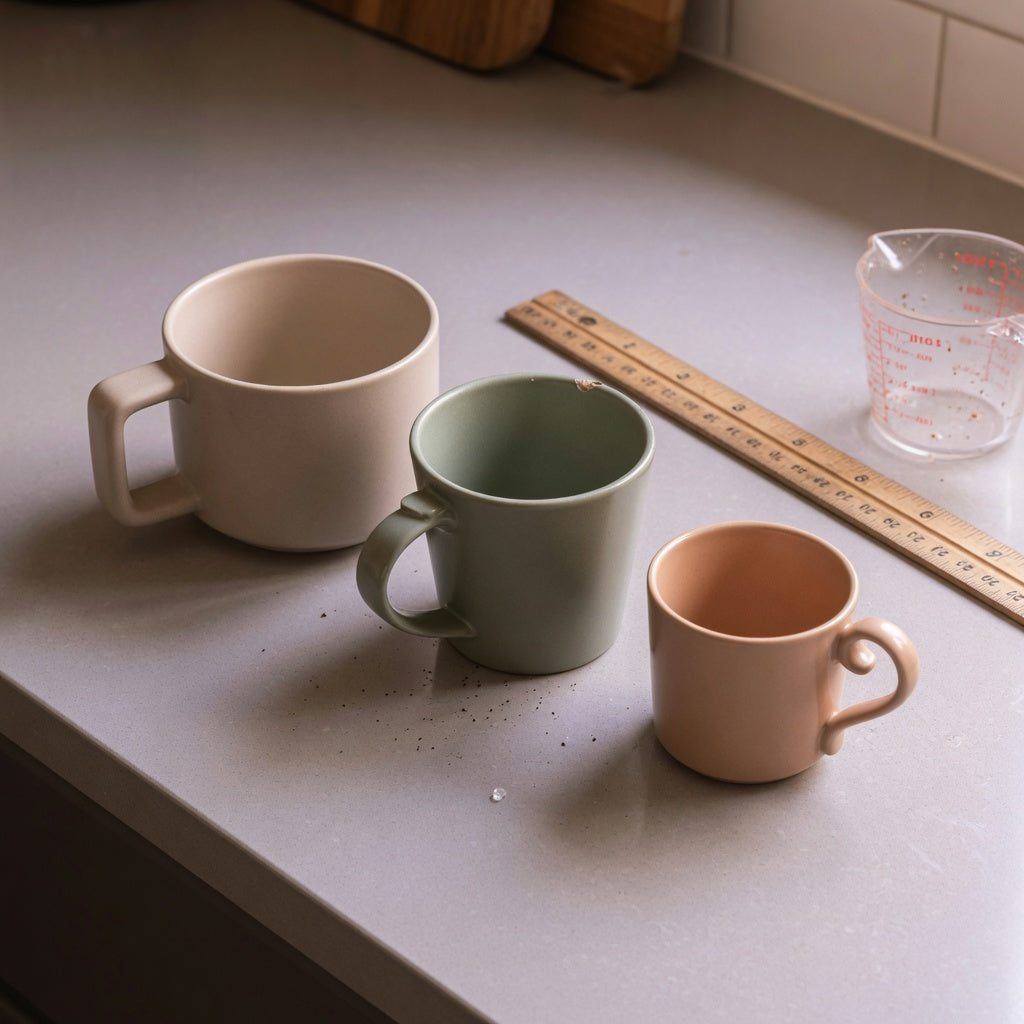
We keep this simple on purpose. Three capacities, three different jobs. Capacities below are the ones we list on each product page; the silhouette notes describe what the product photography shows, and the last column tells you what to confirm yourself.
| Mug | Listed capacity | Roughly | Best-fit scenario | Confirm on the listing |
|---|---|---|---|---|
| Ball Handle | 250 ml | ~8.5 oz | Small desks, cortados and flat whites, tea for one | Foot diameter, empty weight, care instructions |
| The Flow | 400 ml | ~13.5 oz | Everyday desk coffee with room for milk | Base width, handle span, microwave guidance |
| The Rock | 480 ml | ~16 oz | Long focus blocks, iced coffee, big evening teas | Empty weight, height, shelf clearance |
Ball Handle 250 ml — choose it for a crowded desk, skip it if you drink 12 oz mugs
The Ball Handled Coffee & Tea Mug is our small-format piece at a listed 250 ml. In practice that is a cortado, a flat white, a single-cup pour-over, or a proper cup of tea — not a travel-bottle refill. The ball handle is the detail people comment on when they open the box, and it changes where your fingers sit against the body, which matters more than most shoppers expect.
- Choose it if: your desk real estate is contested by a keyboard and a second monitor, you drink two or three small coffees rather than one giant one, or you are buying a first mug for someone who takes espresso-length drinks.
- Skip it if: your morning pour is a 12 oz drip or a 16 oz batch brew. You will be walking to the kitchen twice as often, and a stable mug you have to refill constantly is not actually convenient.
- Still unknown: the exact foot diameter and empty weight. Ask before you assume it clears a narrow coaster.
The Flow 400 ml — choose it as the daily default, skip it if you need one big brew
The Flow Coffee & Tea Mug sits where most American mug habits actually land: a listed 400 ml, roughly 13.5 oz, which leaves sensible headroom for milk or a splash of water without brushing the rim. This is the one we suggest most often to a first-time buyer who has not measured anything yet, because it is the least likely to feel like the wrong size on day one.
- Choose it if: you brew a standard drip serving, add milk, and drink at a desk where the mug lives for an hour or two. It is the middle option that rarely surprises anyone.
- Skip it if: you want a single vessel for a 16 oz batch brew, or you drink iced coffee with a full glass of ice — ice displaces volume quickly, and 400 ml fills up fast.
- Still unknown: base diameter, handle span, and whether the listing confirms microwave and dishwasher suitability for that specific glaze.
The Rock 480 ml — choose it for long sessions, skip it if weight or shelf height is tight
The Rock Coffee & Tea Mug is the big one, listed at 480 ml — about 16 oz. Filled, it is a substantial object, and that is the point: the mass and the broad stance are what keep it planted through a long stretch of work.
- Choose it if: you settle in for hours and hate interrupting yourself, you make large Americanos or iced drinks, or you want a mug that reads as furniture rather than tableware.
- Skip it if: you have wrist or grip fatigue, you store mugs in a cabinet with tight vertical clearance, or you want something you can carry one-handed up a staircase.
- Still unknown: empty weight and overall height. Check the product page before you plan shelf space around it.
If none of these three shapes match how you actually drink, our full lineup of unique coffee mugs covers the sculpted handles and glazed finishes that did not make this short list. For the deeper geometry discussion — foot shapes, rims, and how they change the drinking experience — read our ceramic wide bottom mug shape and fit guide.
Heat, lids, and the concave foot that holds dishwasher water
Wide base does not mean longer heat retention. Heat leaves an open mug mostly through the liquid surface, so a broad opening cools faster than a narrow one of the same ceramic. If keeping coffee hot is your goal, wall thickness, a fitted lid, and how hot the coffee was when it hit the mug matter far more than the foot. Do not let a listing sell you stability and insulation as the same feature.
On lids: splash-resistant and leak-resistant are different promises. A press-fit lid with a sliding tab handles a bumped desk or a short walk. Inverted, it will leak. If a listing shows a lid, read what it claims carefully instead of assuming sealed.
The detail almost nobody mentions is the underside. Many wide ceramics have a recessed foot ring, and upside down in a dishwasher that recess becomes a shallow cup that traps rinse water. It is not a defect, but it does mean hand-drying if you want a dry cabinet shelf. Check the care guidance on the specific listing before your first wash.
Glaze safety: what the FDA actually says, and what we cannot confirm for you
Ceramic is a food-contact material, so this belongs in a first-purchase decision as much as footprint does. The FDA's guidance is specific about cups and mugs rather than vague about pottery in general:
FDA guidance addresses lead leaching from ceramic foodware, and for cups and mugs sets an action level of 0.5 micrograms of lead per milliliter of leaching solution in any one of six units, using methods that include ASTM C738. The FDA notes that continued food use of lead-leaching ware can cause adverse health effects, including chronic lead poisoning.
The same guidance explains why the risk is uneven. Lead in improperly fired traditional glazes can migrate into food or drink, and washing, boiling, or household cleaning will not remove it. Handmade, antique, damaged, and brightly orange-, red-, or yellow-decorated pieces are called out as higher concern, while ordinary commercial factory tableware is described as much less likely to have the problem. Anything labeled not for food use should stay out of your coffee.
What we cannot do is certify a kiln for you. If a glaze origin or food-contact statement is not on the listing, ask before buying — that is a fair question for any store, including ours.
Frequently asked questions
What should I measure before ordering wide based coffee mugs?
Three things: the flat area of the coaster or mat where the mug will live, the clearance under your brewer spout or dripper, and the narrowest point inside your car's cup holder if the mug travels. Base diameter is the number to request from the seller, since "wide base" has no agreed minimum.
Is a 250 ml mug too small for coffee?
Only if your normal pour is bigger. At roughly 8.5 oz it suits a cortado, flat white, single-cup pour-over, or tea — the kind of drink you finish while it is still hot. For a 12 oz drip habit, the 400 ml size is the more realistic daily mug.
Does a wide base keep coffee hot longer?
No. Most heat leaves through the liquid surface, so a wide opening loses heat faster than a narrow one in the same ceramic. Base width buys stability. Heat retention comes from wall thickness, a lid, and starting temperature.
Can I put these mugs in the dishwasher and microwave?
Check the individual listing — glaze and any metallic detailing decide it, and we will not guess on a product page we have not quoted. One practical note: a recessed foot ring can pool rinse water when the mug is inverted, so hand-drying avoids spotting.
Should I worry about lead in a ceramic coffee mug?
For ordinary commercial factory ware, the FDA describes the risk as much lower than for handmade, antique, damaged, or brightly red-, orange-, or yellow-decorated pieces. The cup-and-mug action level is 0.5 micrograms of lead per milliliter of leaching solution. If a maker will not state food-contact status, buy elsewhere.
Where does this shortlist leave me if nothing fits?
The shortlist in this wide based coffee mugs first time buyer product shortlist guide is sized around common drinking habits, not every one. If you need a lidded commuter mug or a metal vacuum option, a ceramic desk mug is the wrong tool and you should look at insulated drinkware instead.
Your five-minute pre-checkout routine
Before you add anything to the cart, run this once. It takes less time than cleaning up a spill.
- Write down your usual pour in ounces, then match it to 250, 400, or 480 ml.
- Measure the coaster and the overhead shelf gap with a tape, not by eye.
- Ask the seller for the actual foot diameter if it is not published.
- Confirm care instructions and food-contact status on the exact listing.
- Decide whether the mug stays on a desk or rides in a car — if it commutes, ceramics are probably the wrong answer.
Start with The Flow if you want the safe middle, drop to the Ball Handle if your desk is small, and step up to The Rock if refills annoy you more than weight does. And if a number you need is missing from a page, ask us — we would rather measure a mug than process a return.
More from our blog
Ready to pick your mug? Two ways to save on today's order:
Ordering 1–3 mugs? Get an extra 10% off your 1st order with code 10_OFF Apply 10% Off & Shop Wooden-Handle Mugs →
Gifting 4+ mugs? Buy 3, Get the 4th Free applies automatically at checkout (no code needed; offers do not stack) · Free standard shipping (Nov pre-Christmas delivery: 15–20 calendar days US) · Free replacement if chipped in transit.
Popular mug buying guides: Ceramic Mugs with Lids Compared · Wooden-Handle Tea Infuser Mugs Compared · Christmas & Secret Santa Mugs 2026 · Espresso & Cortado Cups Guide · Cup & Saucer Gift Sets · All 25 Mugs Spec Table · Mug Size Guide · Shipping & Promo FAQ
FIRST ORDER 10% OFF (CODE: 10_OFF) · OR BUY 3, GET THE 4TH FREE


Read more
Coffee Mugs With Big Handles First Time Buyer Product Shortlist Guide
A practical shortlist for first-time buyers: compare the 250 ml Ball Handle, 400 ml The Flow, and 480 ml The Rock, then verify handle clearance, filled weight, and care details before ordering.
Read more
Latte Mugs Tall First Time Buyer Product Shortlist Guide: 400–480 mL
A first-time buyer's shortlist for tall latte mugs built on three real capacities — 400, 440, and 480 mL — plus the height, headroom, and care details most listings leave out, and an honest note on...
Read more
Leave a comment
This site is protected by hCaptcha and the hCaptcha Privacy Policy and Terms of Service apply.