
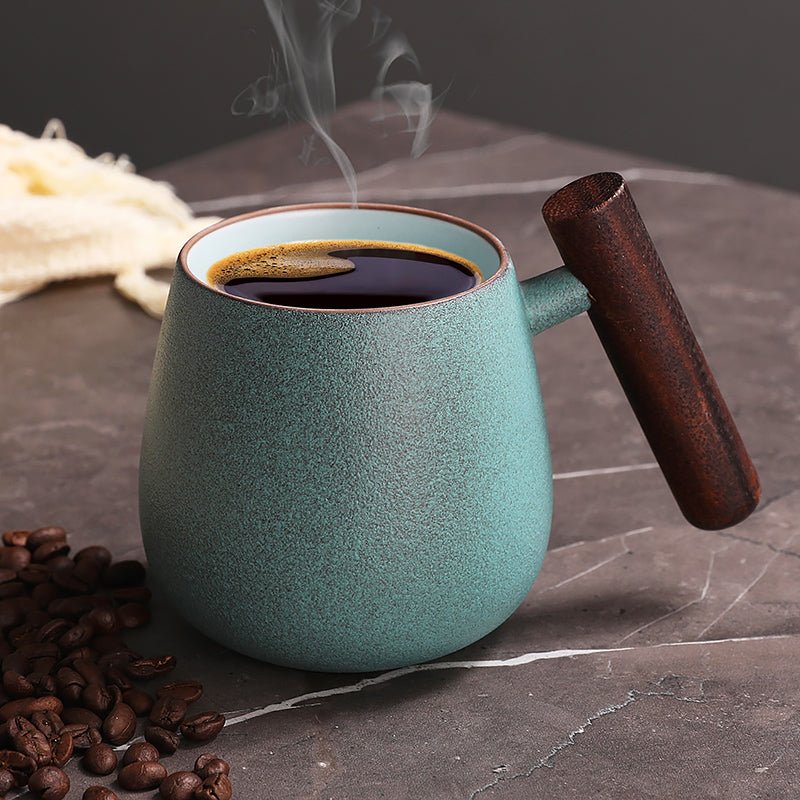
Ceramic wide bottom coffee mugs first time buyer product shortlist guide
Reading time: about 11 minutes
A mug can look reassuringly broad in a product photo, then fail a simple real-life check: it is too tall for the brewer, consumes half the desk, or lacks the care information you assumed was standard. Our ceramic wide bottom coffee mugs first time buyer product shortlist guide is built for that checkout moment. It helps you eliminate poor fits before deciding among the Round, Spittoon, and The Rock product pages.
We sell and handle this category, so we start with the contact points and measurements that affect daily use: the foot that meets the counter, the handle opening around your fingers, the rim, and the space the mug occupies in a cupboard or dishwasher rack. We also keep general ceramic guidance separate from product-specific claims. A visible shape can help you choose a style, but it cannot prove capacity, appliance compatibility, weight, or stability.
The ceramic wide bottom coffee mugs first time buyer product shortlist guide: six listing checks
Record these six details for every candidate. If a product page does not state one, write “unknown” rather than filling the gap from a photo or another mug listing.
- Exact material wording: Confirm how the page identifies the material. Ceramic is a broad category, so do not relabel a product as stoneware or porcelain unless the listing uses that term.
- Stated capacity: Look for ounces or milliliters. If the page does not explain whether capacity is measured to the brim, allow for practical headroom rather than assuming every stated ounce is comfortable usable space.
- Height and three widths: Overall height affects brewer and shelf clearance. Rim diameter, maximum body width, and the diameter of the foot or contact ring are different measurements; one generic “diameter” may not answer all three questions.
- Handle opening and product weight: Check inner handle dimensions and listed weight where available. A side photo cannot tell you how many fingers fit comfortably or how balanced the mug feels when full.
- Microwave and dishwasher instructions: Ceramic alone does not establish appliance compatibility. Glaze, decoration, and construction can affect care, so require an explicit statement if either appliance is part of your routine.
- Glaze and foot details: Zoom in on the base, rim, and exterior finish. An unglazed or rough foot ring may call for a coaster on wood, while color or surface variation should be confirmed in the listing rather than assumed from one photograph.
Product-claim boundary: Our recommendations below rely on the product names and the details or design cues shown on their current pages. We do not assign unstated dimensions, capacity, weight, care status, or performance. If the current page does not confirm a detail, treat it as unknown and ask us before ordering.
Will the base, brewer clearance, and cabinet footprint work together?
The widest part of a mug is not necessarily the part touching the counter. The foot ring is the actual contact point, while a rounded or flared body may occupy more surrounding space. Check both if your kitchen or desk has tight clearances.
- Measure the brewer: Measure vertically from the drip tray in its normal position to the dispensing spout. Compare that number with the listed mug height, leaving enough room to place and remove the mug without tilting a full drink.
- Measure the cupboard: Check shelf height, usable depth, and side-to-side space. A broad lower body may fit vertically but crowd neighboring cups or prevent the cabinet door from closing comfortably.
- Map the desk footprint: Use the stated maximum width to mark the space on scrap paper. Put that template beside your keyboard, notebook, charging cable, and mouse before deciding that the mug is “desk friendly.”
- Check the dishwasher only after confirming care: If the listing states that the mug is dishwasher-safe, compare its height and widest point with your rack. A mug that must be forced between tines or against another ceramic piece is more exposed to rim chips and handle impact.
A wide lower profile can resist a casual bump better than a narrow, top-heavy shape on a flat surface, but no mug is tip-proof. The trade-off is footprint: more room near the base can mean less room beside a laptop, dish rack, or row of cabinet mugs.
Which of the three product pages matches your first-use scenario?
This is not a best-to-worst ranking. Each recommendation maps one common buying situation to the first page we would inspect, followed by a clear reason to choose it and a reason to pause or skip it.
Shared kitchen and mixed tableware: start with the Round
For a first apartment, shared kitchen, or buyer who wants the most familiar-looking option of the three, open the Round Coffee Tea Mug product page. Choose it if the rounded silhouette shown there works with your existing plates and mugs and you prefer a less sculptural visual style. Skip or pause if proven stackability, a measured handle opening, or exact brewer clearance is essential and the current page does not confirm those points. A familiar outline is not evidence that mugs will stack or fit a particular machine.
Dedicated office desk and statement styling: inspect The Rock
For a desk where the mug can function as a visual object rather than blend into a matching set, inspect The Rock Coffee Tea Mug listing. Choose it if the rock-referencing presentation in the current photos suits your workspace and visual character matters more than uniform tableware. Skip or pause if you require a smooth, understated exterior, a compact footprint, or a verified low weight. On a crowded workstation, stated base and maximum-body measurements matter more than how grounded a mug appears in a staged image.
Gift unboxing for someone who collects unusual mugs: open the Spittoon
For a roommate, coworker, or friend who enjoys unconventional drinkware, start with the Spittoon Coffee Tea Mug page. Choose it if the spittoon-referencing silhouette is part of the gift appeal and the recipient does not need every mug to match. Skip or pause for someone with traditional taste, a narrow mug tree, or a tightly packed cabinet. Distinctive shapes can create a stronger unboxing moment, but they often require more careful storage measurements than a standard cylinder.
The value of this ceramic wide bottom coffee mugs first time buyer product shortlist guide is elimination, not declaring one universal winner. If two designs suit your taste, let the hardest practical constraint—capacity, shelf clearance, care, handle fit, or footprint—make the decision.
Which missing details should stop checkout rather than be guessed?
A missing specification is not automatically a product defect. It is still an unknown, and some unknowns directly affect whether the mug can do the job you are buying it for.
| Missing or unclear detail | Why it changes the decision | Practical response |
|---|---|---|
| Capacity | You cannot match the mug to your normal coffee, tea, milk, or creamer volume. | Pause if drink size is a must-have; request the current stated capacity. |
| Overall height or maximum width | Brewer, shelf, desk, and dishwasher fit remain uncertain. | Measure your space and ask for the corresponding product measurement. |
| Foot or base dimensions | A broad-looking body does not reveal the size of the contact ring. | Request a base measurement or clear underside photo if stability and coaster fit drive the purchase. |
| Microwave or dishwasher status | The word “ceramic” does not confirm either care method. | Do not infer. Ask before buying if appliance use is part of your daily routine. |
| Weight or handle opening | Carry comfort and knuckle clearance cannot be judged reliably from scale-free photos. | Ask for measurements if grip comfort or one-handed carrying is a priority. |
Use the same standard for all three products. Do not hold one listing to precise measurements while giving another a pass because its styling is more appealing.
What should you inspect at unboxing and after the first wash?
Once a ceramic mug arrives, our team looks at the contact and stress points before focusing on color or styling. These checks take only a few minutes and catch the common category issues that matter during regular kitchen and office use.
- Test the foot on a level surface: Place the empty mug on a clean, flat counter and press gently near several points around the rim. Persistent rocking can indicate an uneven foot, but verify the counter itself before judging the mug.
- Check the rim: Inspect it visually, then carefully feel for an unexpected chip, sharp glaze burr, or rough patch where your lip will make contact.
- Inspect both handle joins: Look at the upper and lower attachment points for a hairline separation or crack. These joints take repeated stress whenever a full mug is lifted.
- Read the glaze surface: Pinholes are small pits, while crazing appears as a fine network of lines in the glaze. Some surface effects may be intentional, so compare them with the product images and description before deciding something is wrong.
- Feel the foot ring: A rough, unglazed contact ring can mark a finished wood desk or table. Use a coaster if the base feels abrasive.
- Follow the stated first-wash method: If dishwasher use is approved, leave enough rack space to prevent the mug from knocking against plates or other ceramic pieces. Avoid abrupt hot-to-cold temperature changes that can stress ceramic and glaze.
These are general ceramic inspection steps, not claims that the Round, Spittoon, or The Rock has any listed defect. If something differs from the current product description or photos, document it before use and contact our store.
Who should skip a wide-bottom ceramic mug altogether?
A ceramic mug with a broad lower profile makes sense for many counters and desks, but a different drinkware category is more practical in several situations.
- Daily commuting or car use: Choose a lidded travel mug designed for cup holders and spill control.
- Camping, pool areas, or young children: A shatter-resistant material is a safer fit than breakable ceramic.
- Very narrow cabinets or mug trees: A conventional narrow-bodied mug with verified dimensions may store more efficiently.
- Grip or wrist comfort is the main concern: Prioritize a listed low weight and measured handle clearance rather than assuming a wide base will feel balanced.
- All-day temperature retention: An insulated tumbler is more suitable if keeping a drink hot or cold for an extended period matters more than ceramic feel.
The right shortlist sometimes ends with no ceramic option at all. That is a better result than forcing an attractive shape into the wrong routine.
A five-minute product shortlist before checkout
Use this process while the three product pages are open. It keeps styling preferences visible without allowing them to overrule a practical deal breaker.
- Choose your highest-use scene: shared kitchen, office desk, gift, or another specific setting.
- Open the product page mapped to that scene, then open one alternative for comparison.
- Record only stated facts for material, capacity, height, maximum width, base or foot size, weight, handle opening, and care.
- Mark each missing detail as unknown. If it affects a must-have use, ask our store or remove that option.
- If all three fail a key requirement, browse the unique coffee mugs collection and apply the same checks to another shape.
Frequently asked questions
How should I use the ceramic wide bottom coffee mugs first time buyer product shortlist guide?
Start with the scenario closest to your daily use, then open that linked product page and one alternative. Compare only the details currently stated on those pages and mark missing specifications as unknown. Choose only after capacity, fit, care, and handle needs are either confirmed or judged nonessential.
Does a wide bottom make a ceramic mug tip-proof?
No. A broad lower profile may improve resistance to some casual bumps, but the contact ring, mug height, fill level, surface condition, and direction of impact all matter. A wide-looking mug can also rock if its foot is uneven or the table is not level.
Are the Round, Spittoon, and The Rock mugs dishwasher- and microwave-safe?
Use the care statements on each current product page; do not assume that all ceramic mugs share the same appliance compatibility. If either instruction is absent and appliance use is essential, contact our store before ordering. Product-specific care guidance takes priority over general category advice.
Which product page should I open first for a gift?
Open the Spittoon page first if the recipient enjoys unusual silhouettes, or the Round page if familiar styling is safer for their taste. The Rock is worth inspecting when the recipient likes more sculptural, statement-oriented objects. In every case, confirm capacity, care, dimensions, and storage fit before treating visual appeal as the deciding factor.
How can I tell if a wide-bottom mug will fit under my coffee brewer?
Measure from the drip tray in its intended position to the brewer spout, then compare that clearance with the mug's stated overall height. Leave room to insert and remove the mug without tipping it. If the product height is not listed, request the measurement rather than estimating from a photograph.
Open the page tied to your main scenario now and write down capacity, height, maximum width, base size, weight, handle details, and care. If any must-have remains unknown, ask our store before checkout rather than buying around an assumption.
More from our blog
Read more

Mocha Mug Weekend Coffee Product Shortlist Guide: 400–480 ml
Compare The Flow 400 ml, Morning and Night 440 ml, and The Rock 480 ml for slower weekend coffee-and-cocoa routines. This shortlist covers headspace, serving load, care checks, and clear reasons to...
Read more
Ceramic Coffee Mugs With Large Handles Compact Kitchen Buying Checklist
Measure the full mug footprint, cabinet depth, shelf height, counter clearance, and grip needs before buying. Compare CoffeifyMug's ball, wooden-handle, and Flow designs using practical compact-kit...
Read more
Leave a comment
This site is protected by hCaptcha and the hCaptcha Privacy Policy and Terms of Service apply.