



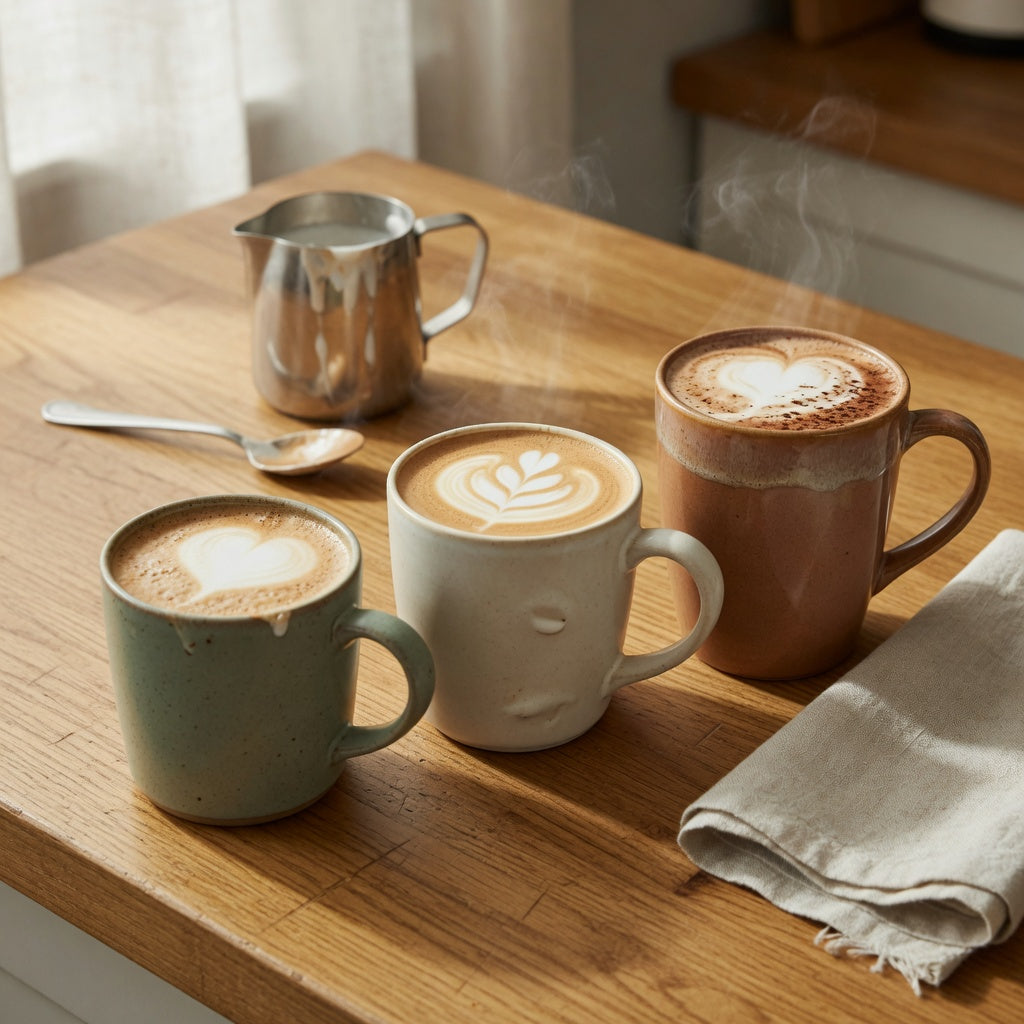
Latte Mugs Tall First Time Buyer Product Shortlist Guide: 400–480 mL
Reading time: about 11 minutes
You measure 12 ounces of milk into a mug the listing calls tall, and the foam stops a millimeter under the rim. Or the mug looks right on the counter and will not slide under the group head. Neither is a defect. Both are first-purchase problems, and they start when you shop a shape instead of three numbers: capacity, height, and rim diameter.
We handle these mugs every day at CoffeifyMug, and the questions arrive in the same order — volume first, clearance second, care last. So read this latte mugs tall first time buyer product shortlist guide as a filter, not a catalog. It covers what a listing actually proves, what it quietly leaves out, and how three real capacities map to three different kinds of drinker.
Three different objects get sold as a tall latte mug
Sort the category before comparing anything, because the phrase covers at least three shapes that behave nothing alike.
- The tall everyday mug. Straight or gently tapered sides, a handle, sized for a full milk drink at a desk. Volume leads; latte art is an afterthought.
- The wide café latte cup. Shorter and broader, often with a flared rim — the shape free-pour art is built around, because the pitcher spout can drop close to the surface.
- The conical gift or photo mug. Narrow base, wide mouth, commonly sold in the 16–17 oz band. It photographs beautifully and shows off drink layers, but the taper changes how it sits in your hand and where the foam settles.
Regulators do not settle it either. FDA’s ceramic hollowware guideline describes a cup or mug as a handled vessel that normally holds about 240 mL (8 fl oz), with mugs having cylindrical sides and cups having a base and curved sides. That language exists for lead-leaching testing. It is not a rule that a latte must be eight ounces, and retail mugs run far larger.
Your latte mugs tall first time buyer product shortlist guide, narrowed to three numbers
Capacity is the one spec nearly every listing publishes, so start there — but read it as a brim measurement until something proves otherwise. NIST’s approximate conversion is 29.57 mL per US fluid ounce, which turns the numbers most of us juggle into these:
- 8 fl oz ≈ 237 mL
- 12 fl oz ≈ 355 mL
- 16 fl oz ≈ 473 mL
Our three tall options sit between roughly 13.5 and 16.2 ounces. The listed capacities are plain: The Flow at 400 mL, Morning and Night at 440 mL, and The Rock at 480 mL.
| Mug | Listed capacity | Approx. US fl oz | Headroom over a 12 fl oz (355 mL) pour |
|---|---|---|---|
| The Flow | 400 mL | ≈ 13.5 fl oz | ≈ 45 mL |
| Morning and Night | 440 mL | ≈ 14.9 fl oz | ≈ 85 mL |
| The Rock | 480 mL | ≈ 16.2 fl oz | ≈ 125 mL |
That last column is the part first-time buyers never see. A mug listed at 400 mL does not hand you 400 mL of drink. Steamed milk expands and foam needs somewhere to go, so a usable pour is always smaller than brim capacity. Put a 355 mL drink into The Flow and roughly 45 mL remains — a modest foam cap, not a domed finish. The same drink in The Rock leaves 125 mL, which is a lot of empty wall for a 12-ounce latte.
Here is the honest limit: capacity tells you nothing about clearance. A 400 mL body can be built tall and narrow or short and wide, and only one of those slides under a group head. Height, rim diameter, and base diameter decide that. If a listing omits them, treat the gap as unknown rather than assuming the number you like implies the fit you want. Our mug size guide and the comparison of a 350 mL tall mug both show how those measurements change real-world fit.
Will a 400, 440, or 480 mL body clear your machine, shelf, and hand?
Ounce size and mug height are separate problems, and the second one sends more mugs back than the first.
- Espresso machine clearance. Measure from the counter to the group head with the portafilter locked in — or to the spout on a super-automatic — then compare that to the listed height. Do it before you fall for a profile.
- Cabinet clearance. Measure shelf to counter and subtract a couple of centimeters so you are not wedging the mug in twice a day.
- Base diameter. This decides car cup-holder fit and how stable the mug sits on a narrow desk. A tapered body with a small base is tippier when full.
- Handle span. If the listing gives an inner handle measurement, compare it to your fingers. A tight opening is the fastest route to looks-great-feels-wrong in our experience.
- Full weight. A 480 mL mug holding a 16 oz milk drink is a genuinely heavy object. If you carry it up stairs or across an office, that belongs in the decision.
The shortlist: match the body to the drink you actually make
Ranking mugs best to worst is useless without a scenario, so each of ours gets a clear reason to choose it and a clear reason to skip it. The three also differ in silhouette, and silhouette is what settles cup-holder fit, hand feel, and shelf clearance. Confirm height, rim, and base on each live listing before you commit — we can state listed capacities with confidence, but the dimensions belong to the product page, not to this article.
The Flow, 400 mL — for the one-latte-a-day desk drinker
At 400 mL (≈ 13.5 fl oz) this is the tightest of the three. Pour a 12 fl oz drink and roughly 45 mL remains for foam: a normal cap, not a dome.
Choose it if your default latte is 10–12 fl oz and the mug has to live on a desk, in a tight cabinet, or under a machine spout. Skip it if you routinely pour 16 oz, or you want a showy domed finish on a full 12 oz latte, where the margin gets thin. Verify on the listing: height against your spout clearance, and rim diameter against the width of your usual pitcher. Start with The Flow coffee and tea mug.
Morning and Night, 440 mL — for the coffee-then-tea household
At 440 mL (≈ 14.9 fl oz) the extra 40 mL over The Flow buys about 85 mL of headroom on a 12 fl oz pour, which is roughly where a normal foam cap stops feeling risky.
Choose it if one mug has to handle a morning milk drink and an evening tea without feeling like two separate purchases, and your drinks run 12–14 fl oz. Skip it if you drink 6–8 oz coffee, because a small pour looks lost in it, or if you want maximum room for a 16 oz build. Verify: empty weight and handle span, since a mid-size mug plus 14 oz of liquid is a two-hand carry for some of us. See the Morning and Night coffee and tea mug.
The Rock, 480 mL — for 16 oz pours, with one caveat
At 480 mL (≈ 16.2 fl oz) this clears a 16 fl oz (473 mL) liquid pour with about 7 mL to spare. That is a true 16 oz mug and almost nothing more — there is no headroom left for a domed top. And ice displaces liquid, so a 16 oz iced latte with a full scoop of ice needs either less milk or a larger vessel than the number suggests.
Choose it if 16 oz is your default pour and you want one vessel that never negotiates. Skip it if cabinet space is tight, your hands are small, your drinks usually land at 10–12 fl oz, or latte art is the point — a deep narrow profile makes it hard to bring a pitcher close to the surface. Verify: base diameter for cup holders and full height for shelf clearance. See The Rock coffee and tea mug.
None of the three matches your routine? Shop by capacity rather than by design in our unique coffee mugs collection and open the tallest options first.
When a tall mug is the wrong tool entirely
Barista instruction on free-pour latte art keeps circling the same mechanics: hold the pitcher spout close to the milk surface and use the rim as the canvas. A wide, flared mouth makes that easy. A tall, narrow one does not, no matter how good your milk texture is.
The trade-off is real, not marketing:
- Tall and narrow: better for layered drinks, iced pours, and showing the contrast between espresso and milk. Worse for free-pour art, and you tilt further to reach the last sip.
- Wide and shallow: better for art, aroma, and a natural drinking angle. Worse for volume — and more exposed surface means the drink cools faster, which is why a small mug you refill can beat a huge one you nurse.
If art is the goal, a shorter café cup is the right tool and a tall mug is the wrong purchase. If you drink in layers or over ice, the tall body wins.
Microwave, dishwasher, and glaze claims a listing may dodge
Care claims are where decorated mugs quietly diverge from plain ones, and where a material name tells you almost nothing.
- Microwave. USDA’s guidance is blunt: only cookware manufactured for microwave use belongs in there, and microwave-safe glass or ceramic is usually labeled as such. China with metallic paint or trim is listed as not safe. If an unlabeled piece turns warm or hot after one minute beside a cup of water, USDA treats it as not microwave safe.
- Dishwasher. Do not infer it from the ceramic body. An explicit maker statement is the only reliable signal, and applied or printed decoration is where wear shows first — the print is what you are really asking about.
- Lead. FDA sets a leachable-lead action level of 0.5 micrograms per milliliter for cups and mugs, measured across six units. FDA also flags higher risk with handmade or crude pottery, antiques, damaged or worn pieces, unknown makers, and bright orange, red, or yellow decoration. Washing or boiling does not remove lead from pottery, and some pieces labeled lead free have still shown extractable lead. Everyday factory-made pottery is described as much less likely to be a problem.
Practical version: read the care line word for word. If microwave safety or a food-contact statement is missing, ask the seller before you buy. One email beats one return.
What to ask a seller before you check out
- What is the exact height, rim diameter, and base diameter in millimeters?
- Is the listed capacity brim-full, or a practical fill line?
- Does the maker state microwave safety in writing, and is there any metallic trim?
- Is a dishwasher statement provided, or only a general ceramic claim?
- Is there a food-contact or glaze statement for the drinking surface?
- How wide is the handle opening, measured inside?
- What does the mug weigh empty?
Frequently asked questions
Is a 400 mL tall latte mug enough for a 12 oz latte?
Yes, with roughly 45 mL left over — enough for a normal foam cap, not a tall dome. If you routinely pour 16 oz, 400 mL is too small and the 480 mL body is the better match.
How do I know a tall latte mug will fit under my espresso machine?
Measure from the counter to the group head with the portafilter locked in, then compare that figure to the mug’s listed height. No latte mugs tall first time buyer product shortlist guide can answer it for you, because clearance is model-specific. If the listing does not publish height, ask before ordering.
Why did my 14 oz mug overflow on a 12 oz drink?
Because the number on the box is usually brim capacity, and steamed milk plus foam takes more room than the liquid you started with. Leave at least 30–50 mL of headroom, or size up one step.
Can a decorated tall latte mug go in the microwave or dishwasher?
Only if the maker says so in writing. Metallic paint or trim rules out microwave use under USDA guidance, and printed decoration is usually what fails first in a dishwasher. A missing statement is a question for the seller, not a detail to assume.
Should I worry about lead in a ceramic latte mug?
Factory-made mugs carry lower risk according to FDA, which still sets a 0.5 microgram per milliliter action level for leachable lead in cups and mugs. Be more careful with handmade, antique, damaged, or brightly colored orange, red, or yellow pieces, and do not rely on a lead free label alone.
Start with the number you control: your usual pour. Match it to 400, 440, or 480 mL with real headroom left over, confirm height and rim diameter on the product page, and pick the silhouette last. You can compare our tall mugs side by side and finish the shortlist in one sitting.
More from our blog
Ready to pick your mug? Two ways to save on today's order:
Ordering 1–3 mugs? Get an extra 10% off your 1st order with code 10_OFF Apply 10% Off & Shop Wooden-Handle Mugs →
Gifting 4+ mugs? Buy 3, Get the 4th Free applies automatically at checkout (no code needed; offers do not stack) · Free standard shipping (Nov pre-Christmas delivery: 15–20 calendar days US) · Free replacement if chipped in transit.
Popular mug buying guides: Ceramic Mugs with Lids Compared · Wooden-Handle Tea Infuser Mugs Compared · Christmas & Secret Santa Mugs 2026 · Espresso & Cortado Cups Guide · Cup & Saucer Gift Sets · All 25 Mugs Spec Table · Mug Size Guide · Shipping & Promo FAQ
FIRST ORDER 10% OFF (CODE: 10_OFF) · OR BUY 3, GET THE 4TH FREE


Read more

Wide Based Coffee Mugs First Time Buyer Product Shortlist Guide
A short, specific shortlist of wide based coffee mugs by capacity — 250 ml, 400 ml, 480 ml — with honest pick-or-skip reasons and the listing details that actually decide whether a mug earns its pl...
Read more
15 oz Ceramic Coffee Mugs First Time Buyer Product Shortlist Guide
A first-mug shortlist that starts with usable fill, not the biggest number on the page. We compare three verified CoffeifyMug capacities, flag the listing details still worth confirming, and match ...
Read more
Leave a comment
This site is protected by hCaptcha and the hCaptcha Privacy Policy and Terms of Service apply.