



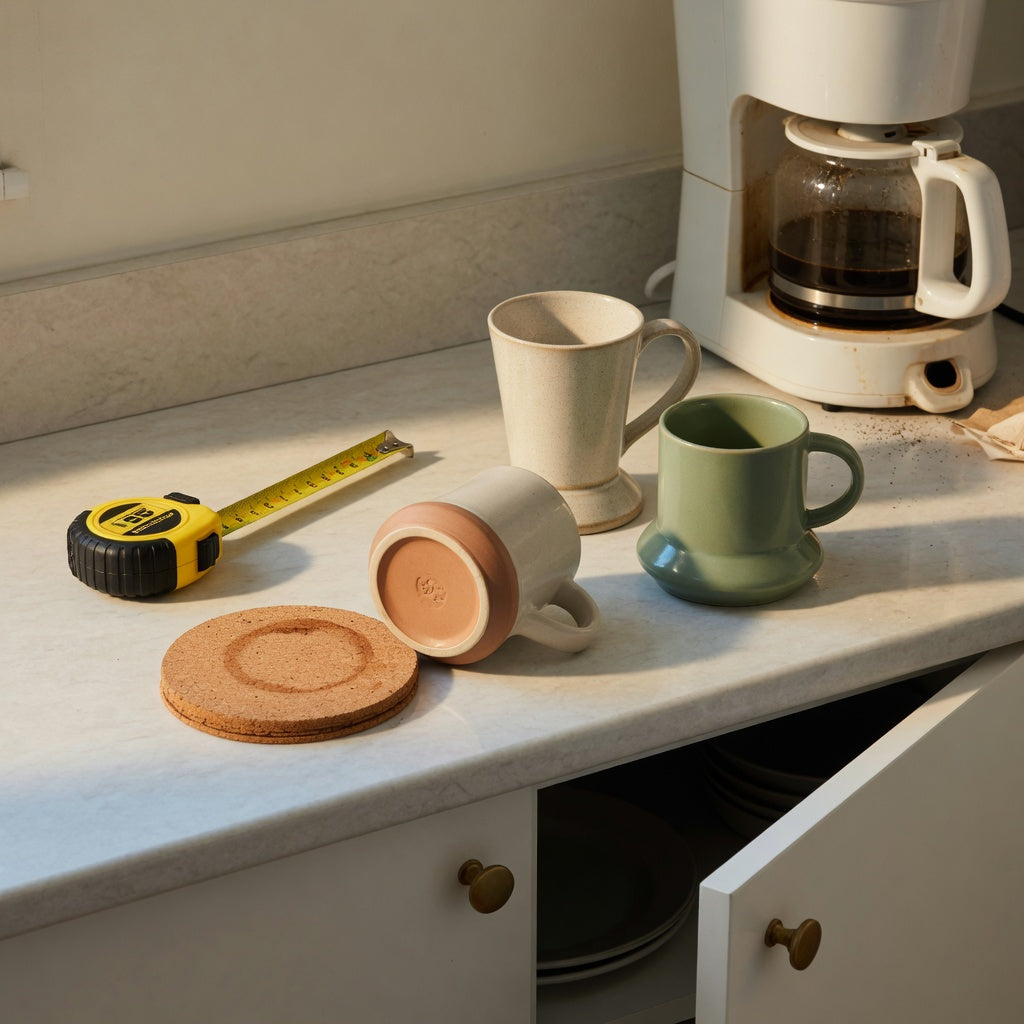
Wide Based Coffee Mugs Compact Kitchen Practical Purchase Checklist
Reading time: about 10 minutes
The mug fits on the shelf. It does not fit under the brewer. That gap between two measurements is the most common reason a small-kitchen mug comes back to us, and no product photo will ever show it. This wide based coffee mugs compact kitchen practical purchase checklist is built around the numbers you can measure before ordering: exterior footprint, cabinet clearance, pour height, handle swing, cup-holder width, and the volume you actually drink. We sell these mugs and process the returns, so the list below comes from the questions that arrive after the box is open rather than the ones that sound good on a landing page.
Wide based coffee mugs compact kitchen practical purchase checklist: start with the foot, not the rim
A wide base describes the support area at the bottom of the mug. It says nothing about the drinking opening. Those two dimensions get confused constantly, and the confusion sends shoppers hunting for stability and arriving with a rim that will not sit under their dripper.
The mechanics are plain. A mug tips once its center of gravity travels past the outer edge of its base of support. A broader, flatter foot gives it further to travel before that happens, and a lower center of gravity — a partial fill, or liquid sitting low in the body — helps too. What geometry cannot do is make a mug tip-proof. Height, fill level, how the load sits relative to the handle, and whether the foot is genuinely flat all push back on that assumption.
Flatness is the part listings never mention. A mug with a high spot on its foot will rock on a level counter, and a rocker is a worse daily companion than a narrower mug that sits dead still. We set every mug on a stone surface and watch the rim before anything else, because a wobble is a defect you cannot photograph and cannot fix with a coaster.
- Counter footprint: compare the published exterior width or base dimensions with the clear space beside the kettle, grinder, keyboard, or sink. If the listing omits those numbers, ask before you order instead of scaling from a photo.
- Shelf and cabinet: measure the opening width, the interior depth, and the vertical gap to the shelf above. Include the handle when you decide whether the mug stores face-out or sideways.
- Coaster: a coaster has to support the actual foot, not the narrower center of the body. A recessed base also traps rinse water, so check how it drains.
- Cup holder: measure the holder at its narrowest internal point and compare that with the base, not the rim and not the handle. Vehicle cup holders are not one standard size.
There is no industry minimum diameter for the phrase wide base, so “wide” on one listing means nothing on another. Treat it as a shape description, and look for the actual measurement. Our own shape and fit guide covers base geometry in more detail, but the product page is where the final dimensions belong.
Which listed capacity actually fits your daily pour?
Capacity and footprint are only loosely related. A broad foot can carry a modest interior volume, and a tall body can hold the same amount on a smaller base. Pick the drink amount first, then confirm the exterior numbers and the base shape that carries them.
| Mug | Verified listed capacity | Where it makes sense | Confirm before checkout |
|---|---|---|---|
| Ball Handle | 250 ml | A short coffee or tea when counter and cabinet space are the real constraint | Exterior footprint, height, handle opening, current care guidance |
| The Flow | 400 ml | A mid-size pour for someone who wants more than a small cup without jumping to the largest option | Clearance under the brewer and the shelf opening |
| The Rock | 480 ml | A longer coffee or tea session with fewer refills | Full-mug weight in hand, outer width, coaster and cabinet fit |
Those capacities are comparison points, not predictions about physical size. We would not call the Ball Handle the smallest-footprint mug without an exterior measurement in front of us, and we would not call The Rock cup-holder friendly without checking both the holder and the current listing. More liquid also means more weight to lift, which is why a 480 ml mug suits a two-handed carry on a wide counter and frustrates someone who wants to pick up a mug one-handed beside a keyboard.
Comparing several silhouettes at once — for a gift, or for a kitchen where two people drink different amounts — works better in the unique coffee mugs collection than on a single product page. Use the collection to shortlist, then open each listing for the capacity and care check.
Will it clear the brewer, the shelf, and the cabinet door?
A mug can pass the counter test and still fail at the machine. The usual mistake is measuring available space rather than the path the mug takes to get there. A wide body may sit fine once it is in position, but the handle can foul the machine housing on the way in.
- Measure the pour zone. With the drip tray in its normal position, record the width and height under the spout. Repeat for a pour-over dripper or an AeroPress if that is your routine — a wide rim can interfere with a dripper that needs to sit inside the opening.
- Measure the storage opening. Note the narrowest point between cabinet sides and the distance to the shelf above. Leave lifting room so the rim does not scrape on the way out.
- Mark the working footprint. Tape the shape onto the counter with painter's tape, including handle swing and the space your knuckles need. It takes two minutes and prevents most of the returns we see.
- Measure the car or dashboard holder separately. A counter measurement tells you nothing about cup-holder fit. Compare the holder's narrowest point with the published base dimension.
In a compact kitchen the right capacity is usually the one that fits the routine, not the one with the bigger number. A mug that has to be shifted every time a cabinet door opens is not saving you space in any practical sense.
Which material, lid, and care details still need an answer?
Wide base is geometry, not a material specification. An open ceramic mug and a double-wall vacuum stainless mug behave differently in the hand, in the dishwasher, and under a lid. Nothing about a similar-looking mug transfers to a product unless the listing states it, so treat these as open questions to resolve before purchase.
- Ceramic bodies: confirm microwave and dishwasher guidance on the exact listing. When the mug arrives, run a thumbnail around the rim and foot for chips or rough glaze, and set the foot on a flat counter to check for rocking.
- Double-wall vacuum steel: heat retention is a property of the construction, the lid, the starting temperature, and how long the drink sits — not of a wide base. Look for the maker's stated construction and care instructions.
- Lids: splash resistance and leak resistance are different claims. A lid that contains a bump on a desk is not automatically safe in a bag, a car, or a boat. Verify the exact wording.
- Handles: check the internal opening and the clearance above it rather than assuming a large-looking handle takes three or four fingers. Handle comfort changes with the weight of a full mug.
- Recessed feet: a concave base can hold water after a dishwasher cycle. If the listing does not say, plan to dry it foot-up.
A wide ceramic base is not evidence of longer heat retention. We could not find authoritative testing that isolates base width from wall thickness, material, lid design, and starting temperature, so we do not repeat that claim. If heat retention is your priority, buy on construction and lid specification instead.
Desk, gift, commute, or boat: which surface are you buying for?
The right mug changes with the surface and with the cost of a spill. Match the situation first, then the product.
| Situation | Why a wide-foot shape may help | Trade-off to accept | Next step |
|---|---|---|---|
| Small desk, shared workspace | A flat foot uses a defined coaster area predictably | Still needs handle swing room and may not suit a recessed desk cup well | Compare the Ball Handle 250 ml and The Flow 400 ml by volume, then verify exterior dimensions |
| Gift for a coffee or tea drinker | Capacity and silhouette give you preference points beyond color | Shape tells you nothing about food-contact or appliance suitability | Shortlist in the collection, then read the exact product page |
| Car, boat, or dashboard | A broad base may look steadier on a stationary surface | It does not prove cup-holder fit, lid performance, or safe use while moving | Measure the holder and verify any lid claim; otherwise treat the mug as stationary-use only |
| Long coffee or iced tea session | The Rock's 480 ml listed capacity means fewer refills | A full mug is heavier to lift and needs more counter room | Check The Rock listing for dimensions, handle clearance, and care |
| Accessibility or limited grip at home | A wider support area may be easier to set down accurately | We cannot point to clinical guidance specifying mug weight or base size for this use | Test with your own hand and cup holder before committing to a full set |
If you want a mug for a car, a boat, or a moving surface, be honest with yourself: a ceramic mug without a verified lid is the wrong tool, and a wide foot does not change that.
Should lead glazing be on a mug checklist?
It belongs on the checklist if you are considering handmade, antique, damaged, or brightly decorated ceramic ware. FDA guidance explains that lead in improperly fired traditional pottery glazes can leach into food or drink, and that washing, boiling, or other household processes do not remove it. Items labeled not for food use should not hold coffee or tea at all.
For cups and mugs, FDA guidance cites an action level of 0.5 micrograms of lead per milliliter of leaching solution in any one of six units, using methods that include ASTM C738. The same guidance describes ordinary commercial factory tableware as much less likely to present this problem, while flagging handmade, antique, damaged, and certain brightly orange-, red-, or yellow-decorated traditional pieces as higher concern. The FDA pottery guidance is worth reading if this is a deciding factor.
For any CoffeifyMug product, use the current listing or ask us directly if a food-contact, material, glaze, microwave, or dishwasher detail is not shown. We will not fill that gap from a photograph or from a similarly shaped mug made somewhere else.
Frequently asked questions
Are wide based mugs actually harder to tip over?
A wider, flat support area does make a mug harder to tip on a level surface, but it is not a guarantee. Height, fill level, weight distribution, handle position, and a foot that sits completely flat all matter. Treat terms like tip-resistant or tough to tip as product-specific claims to verify on the listing.
How do I check whether a wide-bottom mug fits my car cup holder?
Measure the holder at its narrowest internal point, especially if it tapers or has flexible retaining arms. Compare that number with the mug's base width or diameter — not the rim, not the handle. If the product page does not publish the base measurement, ask before assuming it fits.
Does a wider base mean the mug holds more coffee?
No. Base width and interior capacity are separate measurements. Our verified listed capacities are 250 ml for the Ball Handle, 400 ml for The Flow, and 480 ml for The Rock, so choose by the amount you pour and then confirm the exterior footprint separately.
Can I put a wide ceramic mug in the microwave or dishwasher?
Only when the exact product listing or maker instructions say that use is suitable. A wide foot does not establish microwave or dishwasher compatibility, and a recessed base can hold water after a wash cycle. Check the rim and foot for chips or roughness when the mug first arrives.
What does this wide based coffee mugs compact kitchen practical purchase checklist help me confirm?
It helps you confirm listed capacity, visible base geometry, counter and cabinet clearance, brewer fit, handle comfort, cup-holder limits, and care instructions before you buy. It is a buying framework — not proof that any wide-base mug is non-slip, leakproof, or tip-proof.
Next step: measure the counter, shelf, and pour zone where the mug will actually live, then compare the 250 ml Ball Handle, 400 ml The Flow, and 480 ml The Rock by capacity and visible base shape. If you are still deciding between silhouettes for a gift or a two-person kitchen, browse the unique coffee mugs collection to shortlist, then open each product page and verify the dimensions before checkout.
More from our blog
Ready to pick your mug? Two ways to save on today's order:
Ordering 1–3 mugs? Get an extra 10% off your 1st order with code 10_OFF Apply 10% Off & Shop Wooden-Handle Mugs →
Gifting 4+ mugs? Buy 3, Get the 4th Free applies automatically at checkout (no code needed; offers do not stack) · Free standard shipping (Nov pre-Christmas delivery: 15–20 calendar days US) · Free replacement if chipped in transit.
Popular mug buying guides: Ceramic Tea Cups & Infuser Mugs · Ceramic Mugs with Lids Compared · Wooden-Handle Tea Infuser Mugs Compared · Christmas & Secret Santa Mugs 2026 · Espresso & Cortado Cups Guide · Cup & Saucer Gift Sets · All 25 Mugs Spec Table · Mug Size Guide · Shipping & Promo FAQ
FIRST ORDER 10% OFF (CODE: 10_OFF) · OR BUY 3, GET THE 4TH FREE


Read more
Pottery Tea Cups Compact Kitchen Practical Purchase Checklist
A shelf-first checklist for small kitchens: measure the cabinet opening, match 170, 200, or 250 ml to your tea routine, and settle the glaze and care questions before the cup ships.
Read more
Coffee Mug Gifts Ideas Compact Kitchen Product Shortlist Guide
A small kitchen doesn't need another mug, it needs the right one. We map our 200 ml, 400 ml and 440 ml ceramic mugs to real shelf space, drink routines, and the listing checks that decide whether a...
Read more
Leave a comment
This site is protected by hCaptcha and the hCaptcha Privacy Policy and Terms of Service apply.