
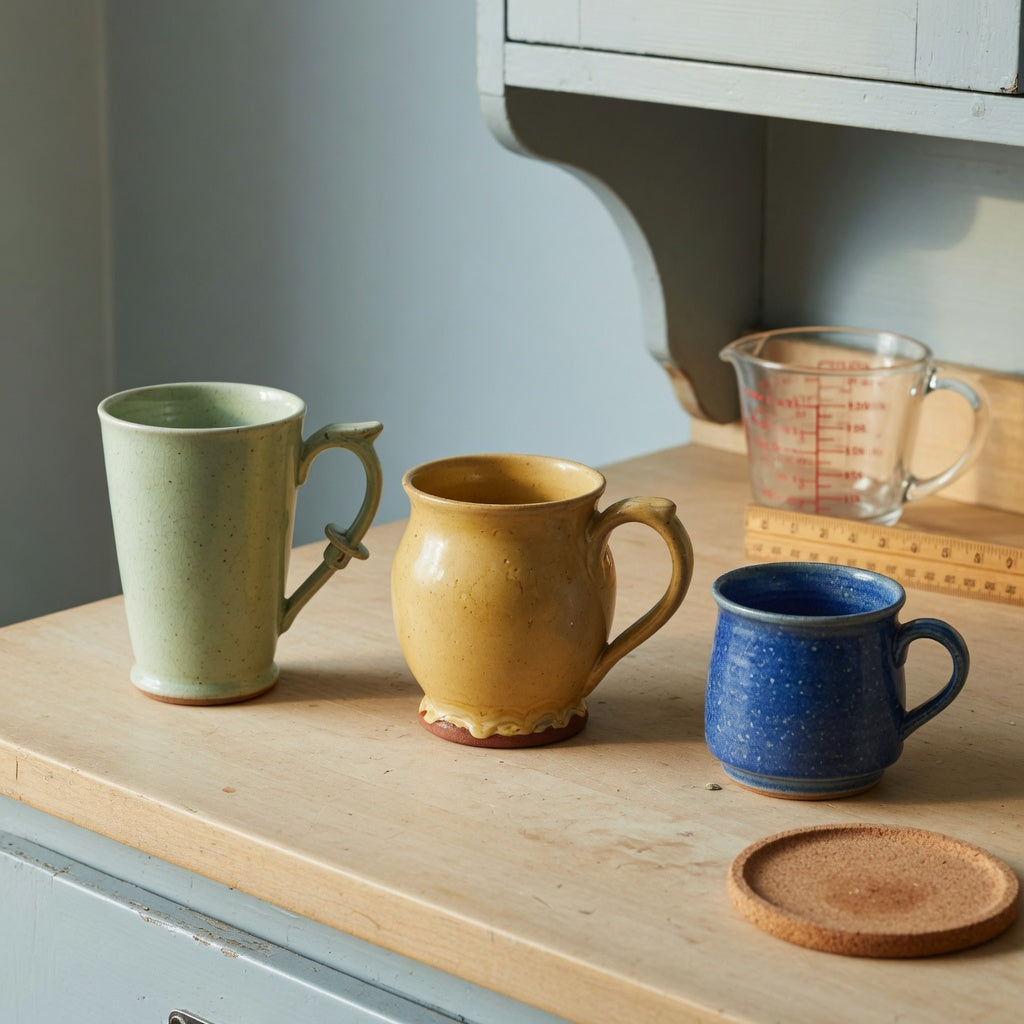
Vintage pottery coffee mugs buying priorities: Capacity, Shape, Space
Reading time: about 10 minutes
A mug can clear a cupboard by height and still be a poor fit. Its handle may hit the neighboring glass, its base may overhang your coaster, or your normal latte may reach the rim with no carrying room. In our store, these ordinary mismatches matter more than a decorative glaze once the mug enters daily use. Sorting vintage pottery coffee mugs buying priorities by capacity, shape, and available space helps prevent a good-looking purchase from ending up at the back of the shelf.
We keep general fitting advice separate from product-specific facts. The product comparisons below rely on the names, photographs, and any capacity, dimension, material, or care information shown on the linked CoffeifyMug pages. If a specification is not listed, we do not treat it as confirmed or estimate it from a photograph.
Vintage pottery coffee mugs buying priorities: which comes first?
Start with the parts of your routine that cannot easily change. A scenic design can make the shortlist, but it cannot create more clearance beneath a cabinet or make an undersized cup hold your usual drink. We use this order when helping shoppers narrow the options:
- Normal fill volume: Measure the coffee, tea, milk, or other additions you actually use, not an occasional maximum serving.
- Usable headspace: Leave room between the drink and rim for walking from the kitchen to a desk without spilling.
- Full exterior footprint: Include the handle, widest part of the body, base, and any projecting decorative details.
- Visible shape: Compare the rim, body taper, handle opening, and foot with the mug you already find comfortable.
- Confirmed material and care: Follow the current product listing rather than assuming every pottery-style mug is microwave or dishwasher suitable.
This order keeps vintage pottery coffee mugs buying priorities tied to repeat use. Style still matters, especially for an open shelf or gift, but it becomes the deciding factor only after the practical fit is established.
Does the listed capacity match the drink you actually pour?
The most reliable capacity test starts with your current mug. Fill it to your normal stopping point, then pour that liquid into a graduated measuring cup. For a latte, measure the finished drink after adding milk. For iced coffee, note how much space the ice occupies because the vessel's liquid capacity does not tell you how much finished iced coffee it will comfortably carry.
Do not judge capacity from exterior height alone. Wall thickness, internal taper, and the shape of the base can make two similarly sized mugs hold different amounts. A capacity listed to the brim may also exceed the amount you can carry without splashing, so check how the product page defines the measurement when that detail is provided.
If your routine involves a modest coffee or tea serving and your style priority is a classic retro presentation, begin with the Retro Coffee Tea Cup. The next step is still practical: compare your measured pour with any capacity shown on the page and confirm the exterior measurements if listed. Do not assign it a volume based only on the product photography.
Will the visible shape work with your grip and drinking pace?
Shape changes more than appearance. All else being equal, a broad exposed surface can let a drink cool faster than a narrower opening. A pronounced taper can affect how easily a sponge reaches the lower interior, while a small handle opening may suit one-finger carrying but feel cramped to someone who prefers a fuller grip.
We evaluate the silhouette in four zones: rim, body, handle, and foot. The rim affects the drinking angle. The body determines how the mug sits in your palm. The handle affects finger and knuckle clearance, and its projection adds to the real width. The foot or base decides whether the mug fits an existing coaster and how much contact it makes with the desk.
For shoppers who want a scenic design to remain visible on an open shelf, compare the product photography for the Mountain Sea Coffee Tea Mug and the Great Mountain Coffee Tea Mug. If the mug will travel repeatedly between a kitchen and office desk, give listed measurements and handle clearance more weight than the motif. Photographs show the silhouette, but they do not provide dependable scale unless the listing supplies dimensions.
How much shelf, counter, and desk space does the full mug need?
Measure the space where the mug will spend most of its time. The body diameter is only one number. Overall height determines cupboard clearance, width including the handle determines side-to-side space, and base diameter determines coaster fit. At a coffee station, also check whether the mug can sit beneath the brewer and whether its handle blocks a water tank, lid, or neighboring container.
| Use location | Measurement to prioritize | Common mismatch |
|---|---|---|
| Low cupboard | Overall height and handle orientation | The body clears, but the handle catches another mug or shelf support |
| Crowded desk | Base diameter and width including handle | The base misses the coaster or the handle enters the mouse area |
| Coffee maker | Height beneath the outlet and usable fill volume | The mug fits physically but must be moved before the intended pour is complete |
| Open display shelf | Full width, visible design, and stable placement | The mug fits only when its decorative side faces the wall |
| Gift recipient's kitchen | Typical drink size and likely storage space | The design suits the recipient, but the mug does not suit the routine |
Use the exact dimension labels shown on a product page. Diameter, body width, and total width including the handle are not interchangeable. If the listing does not make that distinction, compare the photos carefully and avoid treating an estimated measurement as a confirmed specification.
Which current CoffeifyMug style fits each shopper priority?
These recommendations start with a reader situation and lead to the relevant page for verification. They do not replace the capacity, dimensions, material, or care details shown on the current listing.
| Reader situation | Why it may fit | Relevant next step |
|---|---|---|
| You want a retro cup appearance and already know your required capacity | The style direction is established, so you can focus on whether the listing's measurements match your pour and storage space | Check the Retro Coffee Tea Cup details |
| You are buying a scenic gift for someone who likes mountain and sea imagery | The product name and photography let you evaluate the design before checking practical specifications | Review the Mountain Sea Coffee Tea Mug |
| You want a mountain-focused design for an open kitchen or office shelf | The decorative priority is clear, leaving capacity, footprint, and care as the remaining filters | Compare the Great Mountain Coffee Tea Mug listing |
| You are undecided about shape or visual style | Seeing multiple silhouettes together makes it easier to identify which product pages deserve a detailed measurement check | Browse our unique coffee mugs collection |
For gift unboxings, the visual design creates the first impression, but size and care requirements determine whether the mug stays in rotation. If you do not know the recipient's usual drink or cupboard space, a design-led choice carries more risk than selecting from known measurements.
Which material and care details need confirmation before checkout?
The phrase vintage pottery can describe an aesthetic; it does not automatically prove antique age, hand-thrown construction, a particular clay body, or a specific firing method. Confirm the material exactly as the product page states it. The same rule applies to food-contact claims, microwave use, and dishwasher care.
- Material wording: Check whether the listing identifies ceramic, stoneware, porcelain, or another material. Do not treat those terms as interchangeable.
- Care instructions: Follow explicit washing and heating directions on the page. If machine washing is not confirmed, gentle hand-washing with a non-abrasive sponge is the conservative choice.
- Finish: Product photos can show color and visible texture, but screen lighting may affect how a glaze appears. Expect the listing, not a monitor, to define any stated finish.
- Foot ring: If part of the base is unglazed, dry it before returning the mug to a shelf or wood surface.
- Condition checks: Before use, inspect the rim for chips, both handle joins for hairline cracks, and the base for debris or uneven contact.
Avoid rapid temperature changes unless the listing expressly supports the intended use. Moving a very cold vessel directly to very hot liquid can stress ceramic drinkware. A spreading crack at the handle join, a sharp rim chip, or a loose handle is a reason to stop using the mug rather than test it through another dishwasher cycle.
When is a different mug style the better purchase?
These styles are not the right answer for every routine. An open coffee or tea mug is a poor substitute for a sealed travel tumbler during a commute. A shopper who needs identical stacking, a guaranteed fit in a vehicle cup holder, or frequent commercial dishwasher cleaning should choose a product specifically designed and documented for those jobs.
- Choose a lidded insulated tumbler for commuting or long heat retention.
- Choose a straight-sided, stackable set when cupboard density matters more than decorative shape.
- Choose a lightweight porcelain cup if low carrying weight and a thinner rim lead your list.
- Choose a large tumbler with confirmed capacity if ice, syrups, and milk consume much of the interior volume.
Acknowledging those limits is part of setting useful buying priorities. A mug that does not match the daily task will not become more practical because its design looks right.
A five-minute fit check before adding a mug to your cart
- Measure your normal finished drink in a graduated cup.
- Measure the maximum shelf height, available width, and current coaster diameter.
- Check the product page for stated capacity, dimensions, material, and care instructions.
- Use photographs to judge the visible rim, taper, handle, base, and decorative direction, not to estimate missing specifications.
- Compare your remaining options in the CoffeifyMug unique mug collection.
This short check gives capacity, shape, and space a clear order. It also makes the final style decision easier because every remaining option has already passed the practical test.
Frequently asked questions
What are the vintage pottery coffee mugs buying priorities for a small kitchen?
Start with overall height, total width including the handle, and the capacity needed for your normal drink. Then confirm how the mug will sit beside the coffee maker and other cups. In a small kitchen, measured clearance should outrank decorative size or assumptions based on photos.
How do I compare capacity if a mug page does not list ounces?
Do not calculate capacity from exterior dimensions because wall thickness and internal taper are unknown. Ask for clarification or choose a listing that provides the measurement you need. A photograph can help with shape, but it cannot confirm liquid volume.
Which CoffeifyMug design should I compare for a scenic gift?
Start with the Mountain Sea Coffee Tea Mug and Great Mountain Coffee Tea Mug product photography. Choose between their design directions first, then verify the recipient's usual capacity, available shelf space, and preferred care routine on the current listings.
Does vintage pottery mean the mug is antique or handmade?
No. Vintage may describe the visual style rather than the age or manufacturing method. Rely on the product page for any statement about material, construction, or origin, and do not infer those details from the design alone.
Can I put a vintage-style pottery mug in the microwave or dishwasher?
Only follow microwave or dishwasher claims that appear on the specific product listing or care information. Glazes, decorations, and ceramic bodies can have different limits. If compatibility is not stated, hand-washing and avoiding microwave use are the more cautious choices.
Measure your usual pour and storage space now, then open the unique coffee mugs collection and compare only the styles whose current listings meet those numbers. That gives you a clear next step without guessing at capacity, material, or fit.
More from our blog
Read more
White and Gold Coffee Mug Buying Priorities: Capacity and Fit
Compare your normal pour with the current listed capacity, then check visible height, handle clearance, and surface footprint. This routine-first comparison maps the Tall and Kio forms to desks, cu...
Read more
Small Ceramic Coffee Cup Buying Priorities: Capacity, Shape, Space
Match your usual pour, grip preferences, brewer clearance, and storage space before choosing a small ceramic cup. We compare the Pleated, Emerald, and Retro options without guessing beyond their vi...
Read more
Leave a comment
This site is protected by hCaptcha and the hCaptcha Privacy Policy and Terms of Service apply.