
Unique Sculptural Mug Gift: What to Compare Before You Buy
Reading time: about 8 minutes
The question lands in our order notes every gift season, phrased almost identically: "I love the shape — but will they actually use it?" It's the right thing to worry about. A sculptural mug succeeds or fails on the match between its form and the person receiving it, and that match is harder to judge from a product photo than most shoppers expect.
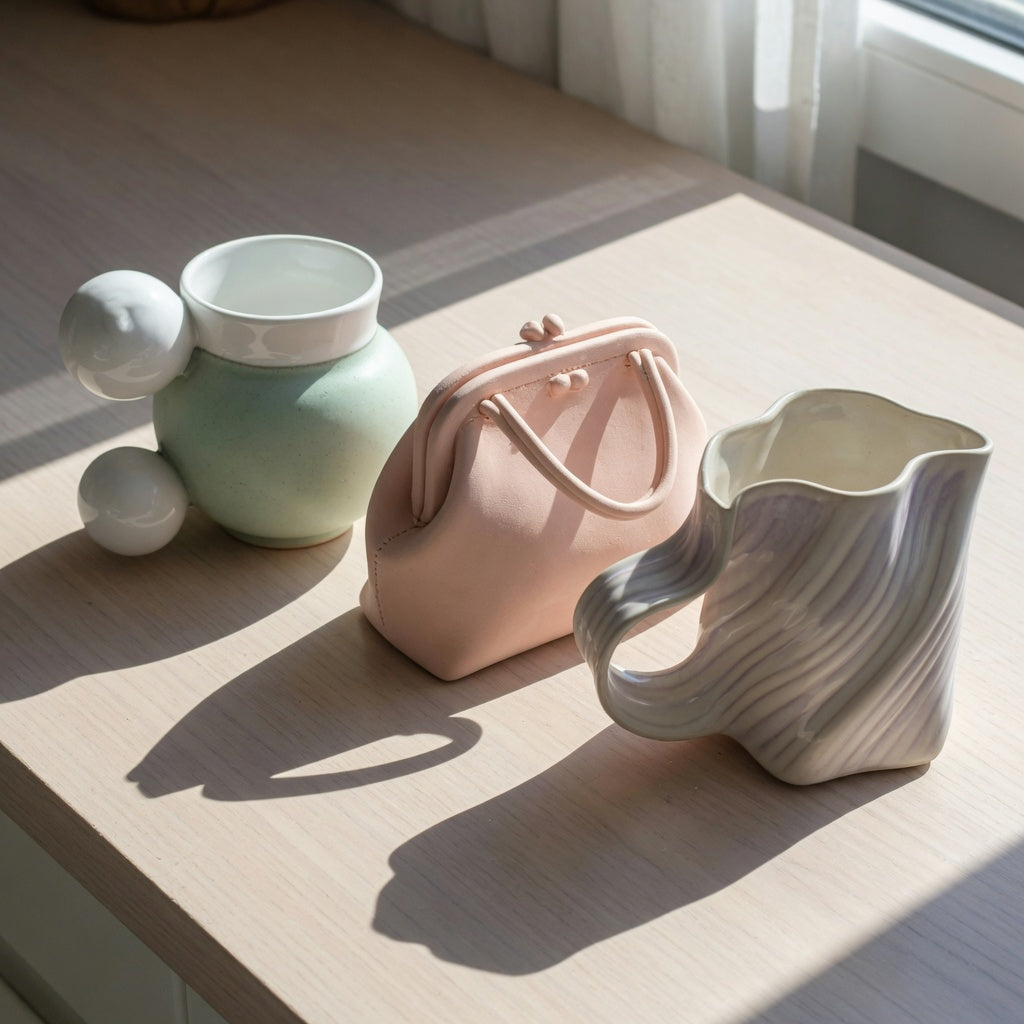
We pack, shelve, and answer questions about these pieces every day. Three of the sculptural forms in our catalog cover the main capacity range: the Flow at 400 ml, shaped by sculptural curves; the Ball Handle at 250 ml with its rounded sculptural handle; and the Handbag at 310 ml in a purse-shaped silhouette. Choosing between them comes down to five or six practical questions, and that is what this guide walks through. If you're shopping for a unique sculptural mug gift, work through the sections below in order — capacity first, then grip, then fit.
What makes a unique sculptural mug gift different from a printed mug?
A printed mug puts its personality on the surface: a graphic, a slogan, or a glaze pattern laid over a standard cylinder. A sculptural mug puts it in the form itself. The curves, the handle shape, the overall silhouette — that is the design, and it changes how the piece looks from every angle, how light moves across it, and how it feels in the hand.
The practical consequence is that form affects function. A rounded handle is held differently than a loop. A purse-shaped body occupies shelf space differently than a straight cylinder. Most sculptural pieces also can't be stacked the way a set of cylinders nests, which sounds trivial until your recipient opens an already-crowded cabinet. None of this makes sculptural forms worse — it just means the comparison points that matter are different from the ones you'd use for a printed mug.
250 ml, 310 ml, or 400 ml — matching capacity to the drinker
Capacity is the first filter we apply with customers, because the most common disappointment in novelty drinkware isn't the design — it's pouring a regular coffee into a mug that holds less than expected. Here's how the three forms divide up:
- 250 ml (about 8.5 oz) — the Ball Handle mug. This is espresso-drink territory: a double shot with steamed milk, a cortado, a flat white. The rounded sculptural handle is the defining feature. The honest trade-off: a 12 oz drip pour will not fit, so this is the wrong pick for a big-coffee drinker.
- 310 ml (about 10.5 oz) — the Handbag mug. Standard mug range — a normal cup of drip coffee, an americano, a bag of tea. The purse-shaped silhouette carries the design. Trade-off: it's a statement piece, and the right recipient has to genuinely want that.
- 400 ml (about 13.5 oz) — the Flow mug. The long-drink option: a large latte, a generous mug of tea, room for milk without sloshing over. Trade-off: it has the largest footprint of the three, so confirm it fits where it will actually live.
A quick sanity check that helps: look at what your recipient actually orders. Someone who drinks diner-style 12 oz coffees needs the 400 ml Flow; the 310 ml Handbag lands slightly under that; the 250 ml Ball Handle will feel like a sampler cup. For a side-by-side look at everything available, our unique coffee mugs collection lays out the full range of forms.
How the shape changes the grip — and who each grip suits
A conventional loop handle lets fingers pass through and carries the weight across the knuckles. Sculptural forms redistribute that weight, and the difference is bigger than most buyers expect:
- Rounded handles (Ball Handle). There's no loop to push fingers through; the hand holds the sphere itself. At 250 ml, a full mug's contents weigh roughly a quarter kilogram before you add the vessel, so the load stays light — but the grip feels unfamiliar for the first few days. We tell customers it's a feature for people who like distinctive objects and a learning curve for people who want zero surprises.
- Integrated silhouettes (Handbag). The purse shape builds the handle into the outline of the body, which shifts the leverage point compared with a high-mounted loop. It drinks fine, but anyone with limited grip strength or sore wrists may find a conventional loop easier to live with day to day — worth an honest think before ordering.
- Curved bodies (Flow). Sculptural curves invite a whole-hand grip or two-handed holding, which tea drinkers tend to like because you can feel the warmth through the ceramic. The flip side: if your recipient prefers pinching a small ear handle with two fingers, a curvy body gives them less to pinch.
Which form fits which drinker: a side-by-side comparison
Here's the decision compressed into one table, using the stated volumes from our catalog:
| Form | Stated volume | Defining feature | Best match | Think twice if |
|---|---|---|---|---|
| Ball Handle | 250 ml (~8.5 oz) | Rounded sculptural handle | Cortados, flat whites, espresso-based drinks | They drink 12 oz drip coffees |
| Handbag | 310 ml (~10.5 oz) | Purse-shaped silhouette | Everyday drip, americanos, tea bags | They want stackable, minimalist mugs |
| Flow | 400 ml (~13.5 oz) | Sculptural curves | Large lattes, generous tea servings | Cabinet or desk space is tight |
Will it fit the cabinet, the shelf, and the desk?
This is the section shoppers skip and later regret. Standard cylinders stack. Sculptural forms, in our experience, mostly do not — curved bodies and shaped bottoms don't nest securely, and stacking a sculpted piece is how chips happen. Plan on display space or single-row storage instead.
Three fit checks worth running before you order:
- Mug trees and hooks. Rounded handles and strap-style silhouettes don't always seat on a standard mug-tree hook the way a loop does. If your recipient dries mugs on a tree, treat that as a question to verify, not a given.
- Dishwasher racks. Any sculpted handle needs clearance so it doesn't knock against neighboring items during a cycle. Care instructions live on each product page and should be confirmed there — don't assume compatibility in either direction.
- Desk and shelf depth. The Handbag's silhouette reads visually wider than its capacity suggests. Compare the listed dimensions against the actual shelf or desk before checkout.
What to verify on each listing: capacity, material, and care
We'd rather hand you a verification list than a guess. Specifications can change between production runs, so the product page you're ordering from is the source of truth — not this article, not a photo, not a review. Before checkout, confirm:
- Exact capacity in ml or oz (the stated volumes above reflect our catalog, but the listing is authoritative)
- Material and any food-contact notes
- Dishwasher and microwave compatibility, if either matters to your recipient
- Exterior dimensions for shelf, cabinet, and desk fit
One habit from our own team: we handle any sculpted piece gently at the sink regardless of what the care label allows, because the handle geometry — not the glaze — is usually what suffers in a crowded rack. That's our handling preference, not an instruction; the listing's care section wins any argument.
Frequently asked questions
What capacity should a unique sculptural mug gift have for a daily coffee drinker?
Match the volume to their usual order. A 250 ml mug (about 8.5 oz) suits espresso-based drinks like cortados and flat whites; 310 ml (about 10.5 oz) covers a standard mug of drip coffee or tea; 400 ml (about 13.5 oz) handles large lattes and bigger pours. Confirm the exact capacity on the product listing before ordering.
Can sculptural mugs go in the dishwasher?
Care instructions vary by piece, and the listing is the only place to confirm what's officially recommended — we don't guess on this one. As a general handling point, sculpted handles are the part most likely to knock against other items in a crowded rack, so give the mug space wherever it sits.
Is a sculptural mug a good gift for someone who drinks 12 oz diner coffees every morning?
Only at the larger sizes. A 12 oz pour is roughly 355 ml, so the 250 ml Ball Handle will not hold it, the 310 ml Handbag runs slightly under, and the 400 ml Flow is the comfortable fit. If their routine is one giant coffee with refills, a plain oversized mug may honestly serve them better.
Which sculptural shape works for a recipient with a small kitchen?
Use stated volume as a starting point and confirm the listed dimensions rather than judging from photos — a smaller volume usually means a smaller footprint, but the silhouette can read wider than expected. Sculptural forms also generally can't be stacked, so plan for a hook, an open shelf, or a single row in the cabinet.
Are sculptural mugs practical for everyday use or mainly decorative?
They're fully usable drinkware, but "practical" depends on the match. The form changes how the piece is gripped, washed, and stored, so a recipient who values character and display presence tends to love them, while someone who wants a stackable, forgettable workhorse mug is better served by a classic set. Pick based on the person, not the photo.
Your pre-checkout comparison checklist
Run this list before you pay — it takes five minutes, and it's the same sequence we'd walk through with you in person:
- Write down their usual order. Espresso drinks point to 250 ml; everyday drip or tea points to 310 ml; large pours point to 400 ml.
- Watch how they hold their current mug. Fingers-through-loop people handle a ball handle differently; whole-hand holders tend to love the Flow's curves.
- Measure the landing spot. Shelf, desk, or mug tree — get the number, then compare it to the listing dimensions.
- Open the product page and verify. Capacity, material, and care instructions, straight from the current listing.
- Compare silhouettes side by side. Browsing our full range of sculptural coffee mugs is the fastest way to see all three forms next to each other.
Then pick the form that matches the person. That's the entire difference between a sculptural mug that gets used every single morning and one that migrates to the back of a cabinet by February.
More from our blog
Read more

Best Coffee Mugs for Coworkers: What Buyers Should Compare
A brand-side comparison for office gift buyers: desk ceramic vs. commuter tumbler, five coworker drinking personalities, spending bands that respect Secret Santa caps, and the listing checks — capa...
Read more
Home Office Coffee Mug Desk Setup: 7 Things Buyers Should Compare
A store-floor comparison for desk workers: where the mug should sit, which style keeps coffee hot through a full session, what fits a narrow or standing desk, and how to protect keyboards, wood fin...
Read more
Leave a comment
This site is protected by hCaptcha and the hCaptcha Privacy Policy and Terms of Service apply.