
Sculptural Ceramic Mug Gift: 7 Things to Compare Before You Buy
Reading time: about 9 minutes
Half the gift-buying emails we answer start with the same worry, and it is never about color: “It’s gorgeous — but will he actually use it?” That question is the whole category in one sentence. A sculptural ceramic mug gift succeeds or fails on practical detail, because the curves, ball handles, and shaped silhouettes that make a piece striking also change how it pours, how it weighs when full, whether it clears the spout of a coffee machine, and how it handles a Tuesday-morning dishwasher cycle. We handle these forms every day in our store, and this guide walks through the seven comparisons we go through with gift buyers before they check out. If you’d rather browse first, our unique coffee mugs collection lines every sculptural shape up side by side.
What makes a mug sculptural instead of just decorated?
A printed mug carries its design on the surface — a pattern or illustration wrapped around an ordinary cylinder. A sculptural mug carries the design in three dimensions: the body curves, the handle is itself a shape, and the silhouette reads as an object even when the mug is empty on a shelf. The distinction matters when you’re gifting, because you’re judging two things at once. Does it work as drinkware? And does it hold up visually from every angle, not just the one facing the camera?
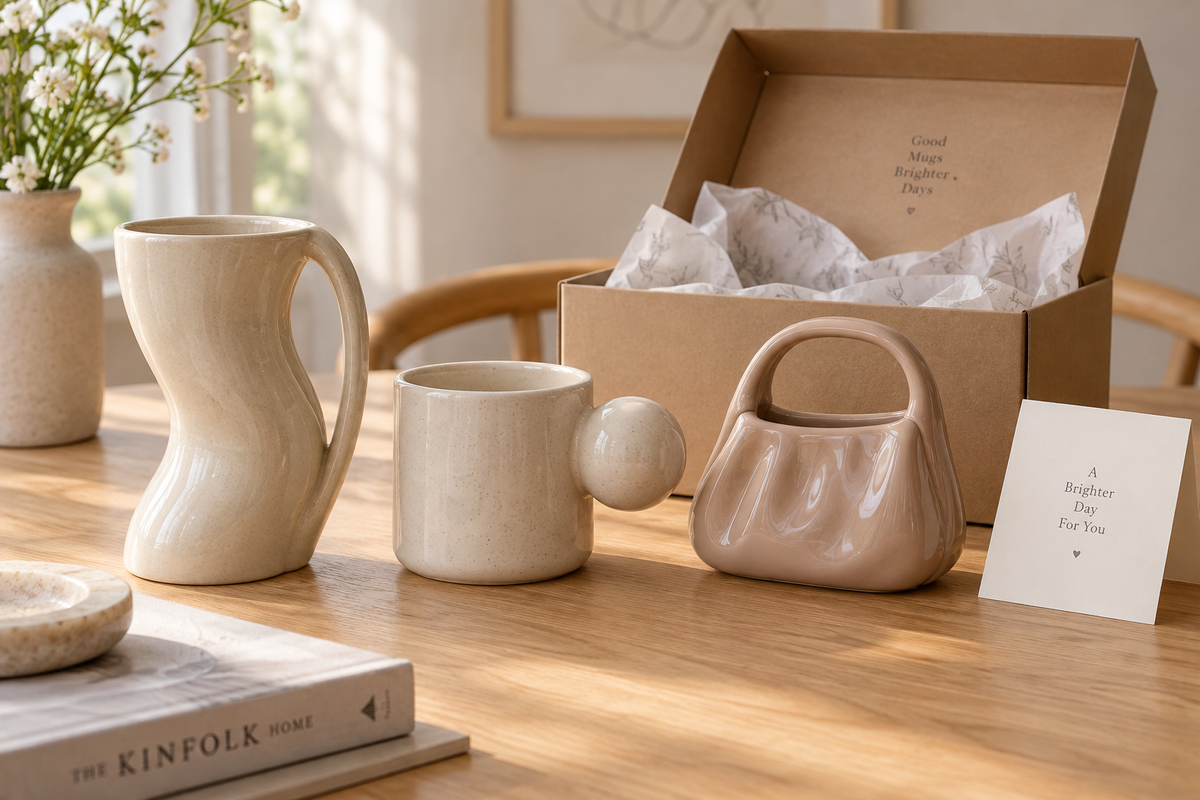
Our range answers that question three ways. The Flow coffee and tea mug runs continuous sculptural curves along a 400 ml body — the largest of our three sculptural forms. The Ball Handle mug swaps the loop grip for a rounded sculptural handle on a 250 ml body. The Handbag coffee and tea mug commits fully to silhouette: a purse-shaped, 310 ml form that announces itself from across the room. Same category. Three very different objects on a desk.
Which capacity fits the drinker you’re buying for?
Capacity is the spec sculptural listings bury and the one gift buyers most regret skipping. Sculptural forms run smaller or larger than the standard 240–350 ml kitchen mug, and the difference is easy to miss while the shape is doing all the talking. Here are the numbers, plain:
| Mug | Capacity | Form | Fits this drinker |
|---|---|---|---|
| The Flow | 400 ml (about 13.5 oz) | Continuous sculptural curves | Big morning pours, latte drinkers, all-day desk mugs |
| Handbag | 310 ml (about 10.5 oz) | Purse-shaped silhouette | A standard coffee or tea portion, style-first recipients |
| Ball Handle | 250 ml (about 8.5 oz) | Rounded sculptural ball handle | Tea, cappuccinos, espresso drinks, smaller portions |
Two warnings from our own customer conversations. First: a 250 ml mug is a tea or cappuccino portion. Hand one to someone who drinks 16 oz diner refills and they’ll be back at the machine every twenty minutes. Second: a 400 ml mug is a commitment in the other direction — 400 ml of coffee weighs roughly 400 grams on its own, a bit more than a full can of soda, before you add the ceramic. If the middle ground sounds right, the Handbag mug above is the shape most people mean when they say “sculptural but usable.”
Capacity should also follow the beverage — tea, drip coffee, and milk drinks don’t want the same volume. Our tea and coffee gift comparison breaks that down drink by drink.
Does a sculpted handle feel as good as it looks?
The handle is where sculptural design meets physics, and it draws the most follow-up questions. A loop handle gives fingers a hole to hook through. A ball handle — like the one on the Ball Handle coffee and tea mug — gives the whole hand a rounded sculptural grip to wrap around: no finger-through, more palm contact, different leverage when the mug is full. In our experience, the ball grip wins over people who cup a mug in their palm; someone who hooks a single finger through a loop may need a morning to adjust. Worth knowing before it becomes someone’s gift.
Three checks before you order any sculpted handle:
- Finger clearance. Large hands need to know whether the grip space actually fits. Compare against a mug your recipient already uses daily.
- Weight when full. The handle carries the entire load — liquid plus ceramic. A 400 ml pour adds roughly 400 grams of work on its own.
- Balance. Curved bodies shift the center of gravity compared with a straight cylinder. Ask how the mug feels full, not just empty.
We cover grip trade-offs, cleaning access, and shelf fit in more detail in our ball-handle grip, care, and fit guide — worth two minutes if a ball-style handle is on your shortlist.
Will a sculptural mug survive the dishwasher, microwave, and daily pours?
Care is where art-first mugs and busy kitchens collide, so get a direct answer before buying. Sculptural pieces deserve specifics, not a shrug:
- Dishwasher: many glazed ceramic mugs tolerate machine washing, but sculptural forms have more edges, curves, and proud handles to catch and chip. Check the specific listing — and if it doesn’t say, ask the store before you gift it.
- Microwave: as a rule across ceramics, any mug with metallic luster or a gold rim stays out of the microwave. If metallic accents are what you’re drawn to, read our gold-accented tea mug guide for what to verify first.
- Thermal shock: no ceramic enjoys going fridge-cold to boiling water in one move. Let a mug come to room temperature before pouring.
- Matte and textured glazes: they hide fingerprints beautifully but show coffee and tea staining sooner than glossy finishes, and harsh detergent can dull them over repeated washes.
“Is it dishwasher safe or a hand-wash situation?” — the single most common care question in our inbox, and one we answer listing by listing, never in general.
One more spec to verify: food-contact safety. A trustworthy listing states that its glazes are food safe and fired for daily drinkware. If a sculptural piece doesn’t state its food-contact status, treat that as a question for the seller — not a detail to assume.
What should you pay for a sculptural ceramic mug gift?
Sculptural pieces usually cost more than printed mugs of the same size, and the reason is structural, not branding. The shape is the design, so the body has to be formed and finished in three dimensions rather than decorated on a stock cylinder. Glaze has to pool correctly over curves instead of lying flat. Packaging has to cushion edges and handles a straight-sided mug doesn’t have. Across the handmade ceramics market, small-batch forming and extra firings push prices higher still. You’re also buying a mug that does double duty — drinkware on the desk, an object on the shelf when it’s empty. Price alone still tells you nothing about quality, though. Judge it against confirmed capacity, handle comfort, and care instructions, never against the photo.
Who should skip a sculptural mug entirely?
We’d rather talk a buyer out of a bad match than process the return, so here’s where these forms genuinely disappoint:
- Stackable-set households. Curved bodies and proud handles rarely nest. If the recipient wants four identical mugs stacked in a small cabinet, a sculptural piece is a one-off accent, not a set.
- Car commuters. Most sculptural proportions won’t fit a car cup holder, and commuting calls for a lidded travel tumbler anyway. If the gift lives in a car, this isn’t it.
- Guess-the-size gifting. A 250 ml piece can read as a “small” gift to a big-coffee drinker. Match capacity to habit first, shape second.
The better matches are the occasions we see succeed most often:
- Housewarming or host gift: the Handbag mug — a purse-shaped silhouette reads instantly as “present,” and 310 ml suits mixed coffee-and-tea households.
- Retirement or office desk: the Flow at 400 ml covers the big-morning-pour colleague who refills twice before lunch.
- Tea drinkers: the Ball Handle mug keeps the portion tea-sized at 250 ml, with a rounded sculptural grip that suits slow sipping.
- The person who has everything: any of the three — a dimensional form is far harder to duplicate than another printed mug.
Will the mug look like the photo when it arrives?
Photographs flatten sculpture. A curve that looks subtle on screen can be dramatic in hand, and glaze pools and thins over dimensional surfaces in ways a straight-on shot can’t show. Expect slight piece-to-piece variation on most sculptural mugs — it’s inherent to the category, and it’s part of the appeal once you expect it. If the exact look matters, ask the store for extra photos from other angles before ordering rather than being surprised at the unboxing.
Shipping is the other forgotten comparison. Before you send a gift anywhere, confirm three things: how the mug is packed (sculptural edges need far more padding than a straight cylinder), whether a gift note is an option, and what happens if it arrives cracked. We pack our sculptural pieces for exactly those edges and ask buyers to send a photo if anything shows up damaged. A store that can’t answer those three questions quickly is telling you something.
The 60-second check before you order
- Capacity in ml or oz, matched to their actual pour — 250 ml, 310 ml, and 400 ml are very different gifts.
- Handle shape versus hand size, with a mug they already own as the measuring stick.
- Dishwasher and microwave status confirmed on the listing — or asked directly.
- Brewer clearance and shelf height measured against the mug’s listed dimensions.
- Food-contact glaze status stated, not assumed.
- Gift packaging, note option, and breakage policy confirmed with the store.
- Expectations set: sculptural pieces vary slightly from their photos, and that’s part of the appeal.
Frequently asked questions
Is a sculptural ceramic mug gift practical for everyday use or just decorative?
Practical, if you match the specs to the drinker. Our sculptural range runs from a 250 ml ball-handle mug to a 400 ml curved form, all made as working drinkware. The caveats are care-related: confirm dishwasher and microwave status on the listing, and give any metallic-decorated piece a hand wash and a microwave pass.
How do I know a sculptural mug is food safe?
Ask the seller directly whether the glazes are food safe and fired for daily food contact — a reputable store answers without hedging. A California Prop 65 warning label means the item may involve exposure to a chemical on the state’s disclosure list; it’s a labeling requirement, not an automatic safety verdict, but it deserves a direct question before you gift the piece.
Will a 400 ml mug fit under a single-serve coffee machine?
It depends on two measurements: the mug’s height and the clearance under the machine’s spout. Check the mug’s listed height, measure your brewer, and if the listing doesn’t show dimensions, ask before ordering. A mug that fits the machine gets used daily; one that doesn’t becomes a shelf object.
Do sculptural mugs stack in a kitchen cabinet?
Usually not. Curved bodies and sculpted handles sit proud of the mug’s footprint, so they rarely nest the way straight-sided mugs do. Measure shelf height before buying and plan on these pieces claiming a little more room per mug.
How does a 250 ml sculptural mug compare to a standard coffee mug?
Standard kitchen mugs typically hold roughly 240–350 ml, so a 250 ml piece sits at the small end — a tea, cappuccino, or espresso-drink portion. If your recipient drinks full-size drip coffee, step up to a 310 ml or 400 ml form instead.
Ready to compare in person? Browse our unique coffee mugs collection, open the two or three shapes you’re torn between, and run the checklist above against each listing. The right sculptural ceramic mug gift is the one that matches the drinker — not just the shelf.
Read more

Elk Mug Gift: What Buyers Should Compare Before Ordering
Compare an elk mug gift the way we walk customers through it at the counter: elk vs moose antlers, 11 oz vs 15 oz capacity, ceramic vs enamel vs sculpted styles, packaging, and the six listing chec...
Read more
Unique Art Coffee Mugs Gift: 7 Things to Compare Before Checkout
How to judge a unique art coffee mugs gift the way a retailer does: compare decoration methods, verify a food-safe glaze, match capacity to the recipient's brewing habit, and sort out care, lead ti...
Read more
Leave a comment
This site is protected by hCaptcha and the hCaptcha Privacy Policy and Terms of Service apply.