
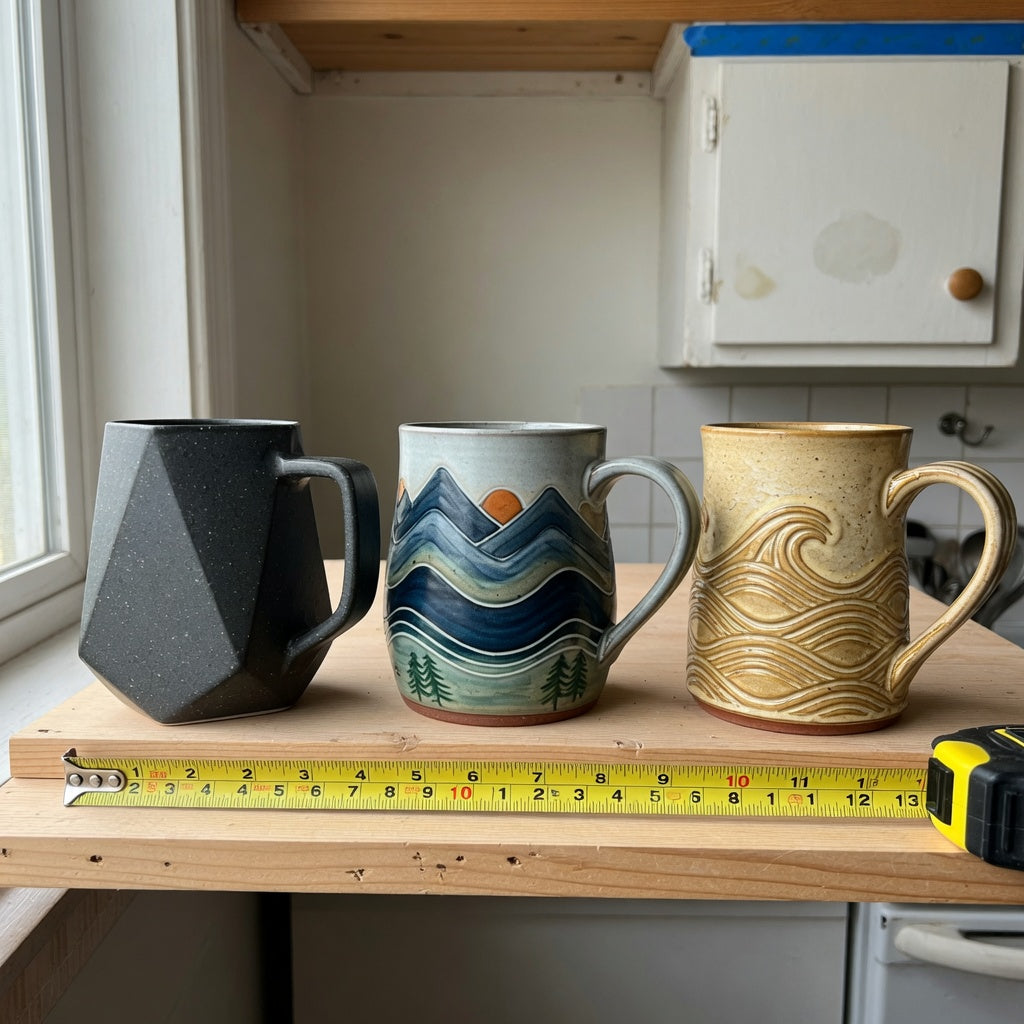
Unique pottery coffee mugs storage fit guide: Shapes and shelves
Reading time: about 9 minutes
A mug can sit flat on a cabinet shelf and still prevent the door from closing. The usual culprit is not the cup body; it is a handle, flared rim, or decorative edge extending beyond the usable shelf depth. Our unique pottery coffee mugs storage fit guide addresses that exact buying problem by comparing the visible forms of three current designs and showing which measurements matter before an order is placed.
At our packing table, we look at the widest and most exposed parts of a mug rather than judging fit from capacity alone. We also hear from shoppers working with shallow kitchen cabinets, narrow office shelves, and open displays where every piece needs its own space. Because listing details and product availability can change, any dimension shown on a live product page should take priority. We will not estimate missing measurements from photographs or imply that fluid capacity tells you the external footprint.
Unique pottery coffee mugs storage fit guide: four clearances
A useful fit check requires four separate measurements. Take them from the space where the mug will actually live, not from the outside of the cabinet.
- Usable shelf height: Measure from the shelf surface to the underside of the shelf above. Include any low frame edge or shelf support that the rim must pass beneath.
- Usable cabinet depth: Measure from the rear wall to the inside plane of the closed door. Door bumpers, raised trim, and items routed around plumbing can reduce the practical depth.
- Maximum body width: Use the mug's widest point, which may be below a flared rim or across an angular side rather than at the base.
- Overall footprint with handle: Check from the farthest point of the body to the outermost handle edge. A body-only diameter does not answer this question.
Do not substitute milliliters or ounces for these measurements. Two mugs can hold a similar drink volume while using shelf space very differently: one may be tall and narrow, while another may be low, broad, or strongly faceted.
Our fit rule: If a listing gives a width but does not say whether the handle is included, treat the handle-inclusive measurement as unconfirmed.
That boundary matters for closed cabinets. It is less critical on a deep open shelf, although side-to-side spacing still affects how easily you can lift one mug without knocking its neighbor.
How do the three current mug shapes compare?
Product-specific observations: The comparison below is limited to form and decoration visible on the linked CoffeifyMug pages. It does not assign unlisted dimensions, stackability, or care properties to any product.
| Current design | Visible form to consider | Storage question to resolve | Best next step |
|---|---|---|---|
| Rhombus Coffee Tea Mug | An angular, geometric profile rather than a plain cylindrical wall | Does the widest angled section require more side clearance than the rim or base suggests? | Check the current gallery and any labeled maximum dimensions, then reserve space for the full silhouette rather than only the base. |
| Mountain Sea Coffee Tea Mug | A landscape-led design with a more organic visual presentation | Which point sets the true width: the body contour, decorative form, or handle? | Compare front and side images and use only dimensions whose endpoints are clear on the live page. |
| Golden Waves Kio Coffee Tea Mug | A wave-focused exterior with visible surface detail | Can the decorated surface sit beside another mug without rubbing, and does the handle clear the cabinet door? | Plan a single-layer position where its full exterior and handle are not pressed against neighboring pieces. |
The table does not declare a compact winner because photographs cannot establish a reliable handle-inclusive footprint. That is a deliberate limitation. A camera angle can make one profile appear narrower, and capacity still would not settle the issue.
Use the current unique coffee mugs collection to compare the live galleries and listed details in adjacent tabs. Focus on side views, the widest body point, the base, and the complete handle before choosing by decoration.
Which shape suits a closed cabinet, open shelf, or office desk?
Storage location changes the recommendation. These are situation-based choices, not claims that one mug is universally easier to store.
- Open display shelf with room around each piece: Consider the Rhombus mug if angular geometry is the reason you are shopping. Its visible form earns the space on a shelf, but that same geometry is not the obvious choice for a tightly packed row. Review the Rhombus page and measure the maximum silhouette before ordering.
- Front-facing shelf or a gift for someone drawn to landscape designs: Start with the Mountain Sea mug because the decorative scene can remain visible instead of being buried behind other drinkware. Confirm its external fit from the live listing, especially if the recipient uses a closed cabinet.
- Desk, coffee station, or open shelf where surface detail can be seen: Inspect the Golden Waves Kio mug. A dedicated position keeps the wave-led exterior visible and reduces contact with adjacent handles or hard edges.
- Very shallow cabinet or a shelf packed edge to edge: Do not select any sculptural mug on appearance alone. Choose only after confirming complete external measurements. A simpler cylindrical style from the collection may suit the space better.
An office desk removes the cabinet-door issue, but it introduces a different constraint: the mug must coexist with a keyboard, notebook, monitor stand, or shared kitchenette shelf. Trace the available footprint on paper before buying. For a gift, ask the recipient for the height and overall handle-to-body width of a mug they already store comfortably; that gets useful numbers without revealing the exact design.
How does handle projection change cabinet fit?
General storage guidance: Handle projection is the distance from the mug body to the handle's outermost point. It affects both depth and width because a mug can be rotated. Turning the handle sideways may help a shallow cabinet door close, but it consumes more room along the shelf and can make the mug harder to retrieve from a crowded row.
We use a simple orientation test when evaluating shelf space:
- Mark the cabinet's closed-door line on the shelf with removable tape.
- Place a mug that already fits with its handle facing forward, then sideways.
- Measure the full footprint in both orientations.
- Note hinge hardware, door lips, and neighboring plate stacks that cross either footprint.
For an online purchase, make a paper or thin-cardboard footprint only when the listing provides both body and handle-inclusive measurements. Slide the template into the intended space and close the door gently. If the product page supplies only one ambiguous width, contact the store before treating the fit as settled.
Handle opening also matters if you use a mug tree or under-shelf hook. The opening must pass over the support, and the hanging mug must remain balanced without its body touching another piece. Do not assume that a decorative handle is intended for hanging merely because it has an opening.
Stacking, surface contact, and cleaning limits
Unique pottery mugs should not be assumed to stack. Stable stacking requires compatible rim and base geometry, adequate contact area, and enough clearance to prevent one base from loading a narrow section of another mug. Unless a current product page explicitly describes a mug as stackable, our practical recommendation is single-layer storage.
Never balance a base on a handle or raised decorative detail. On glazed pottery, the rim, base edge, and handle joint are common contact points; a hard knock can chip the surface or expose a hairline crack. A dry, non-abrasive shelf liner can reduce sliding, but it cannot make an unstable stack safe. Leave enough room to lift a mug vertically without scraping the shelf above.
Cleaning claims require the same restraint. Pottery should not automatically be labeled dishwasher safe, microwave safe, or suitable for sudden temperature changes. Follow the care instructions on the current product page and packaging. If dishwasher use is permitted, place the mug so spray movement cannot knock its handle against another hard item. If the instructions are absent or unclear, hand washing with a soft sponge is the cautious option; dry the mug before returning it to a closed cabinet.
These forms are not a strong match for nested storage, tall stacks, or a slim travel bag. Shoppers who need maximum density and repeatable stacking will usually be better served by a uniform, purpose-designed profile. The trade-off is straightforward: a more distinctive exterior often asks for more deliberate storage.
A 60-second fit check before ordering
- Measure usable shelf height, depth, and width inside the cabinet.
- Record the space lost to hinges, door trim, bumpers, or adjacent dishes.
- Open the product gallery and identify the widest body point and outer handle edge.
- Use only clearly labeled dimensions; do not scale the mug against a hand, saucer, or photo prop.
- Decide whether the handle will face forward or sideways in storage.
- Confirm care and stackability separately from size.
- Choose the design whose storage demands match the kitchen, office, or gift recipient's actual space.
This is also a useful check after gift unboxing. Keep the packaging until the intended shelf has been tested, and lift the mug in and out once without contacting the door, shelf above, or neighboring drinkware.
Frequently asked questions
Can a unique pottery coffee mugs storage fit guide help if dimensions are missing?
Yes, but it can identify uncertainty rather than manufacture a fit answer. Measure your available space, inspect every product angle, and ask whether the listed width includes the handle. Do not infer a measurement from image proportions.
Does mug capacity tell me how much cabinet space it needs?
No. Capacity measures the drink the vessel can hold, not its maximum exterior height, width, or handle projection. Use labeled external dimensions for storage decisions and treat capacity as a separate drinking preference.
Can I stack the Rhombus, Mountain Sea, or Golden Waves Kio mugs?
Do not assume any of these designs are stackable unless the current listing explicitly says so or shows a supported stacking method. Their distinctive silhouettes and surface details make single-layer storage the more cautious default. A soft separator does not correct incompatible rim and base geometry.
How much extra cabinet room should I allow for a pottery mug handle?
There is no reliable universal allowance because handle shapes and cabinet doors vary. Measure the product's full handle-inclusive footprint and compare it with the usable depth to the closed-door plane. Also test whether rotating the handle sideways creates a better fit without crowding neighboring mugs.
Are these unique pottery mugs dishwasher safe?
Check the care statement on the individual live product page or packaging; appearance alone cannot confirm dishwasher compatibility. If no clear instruction is provided, do not assume it. Hand wash cautiously with a soft sponge and store the mug only after it is dry.
Take the four cabinet measurements first, decide where the handle will face, and reject any option whose complete footprint remains unclear. Then compare the live photos and details in our unique coffee mugs collection, choosing the form that fits the space you use rather than the shelf you wish you had.
More from our blog
Read more
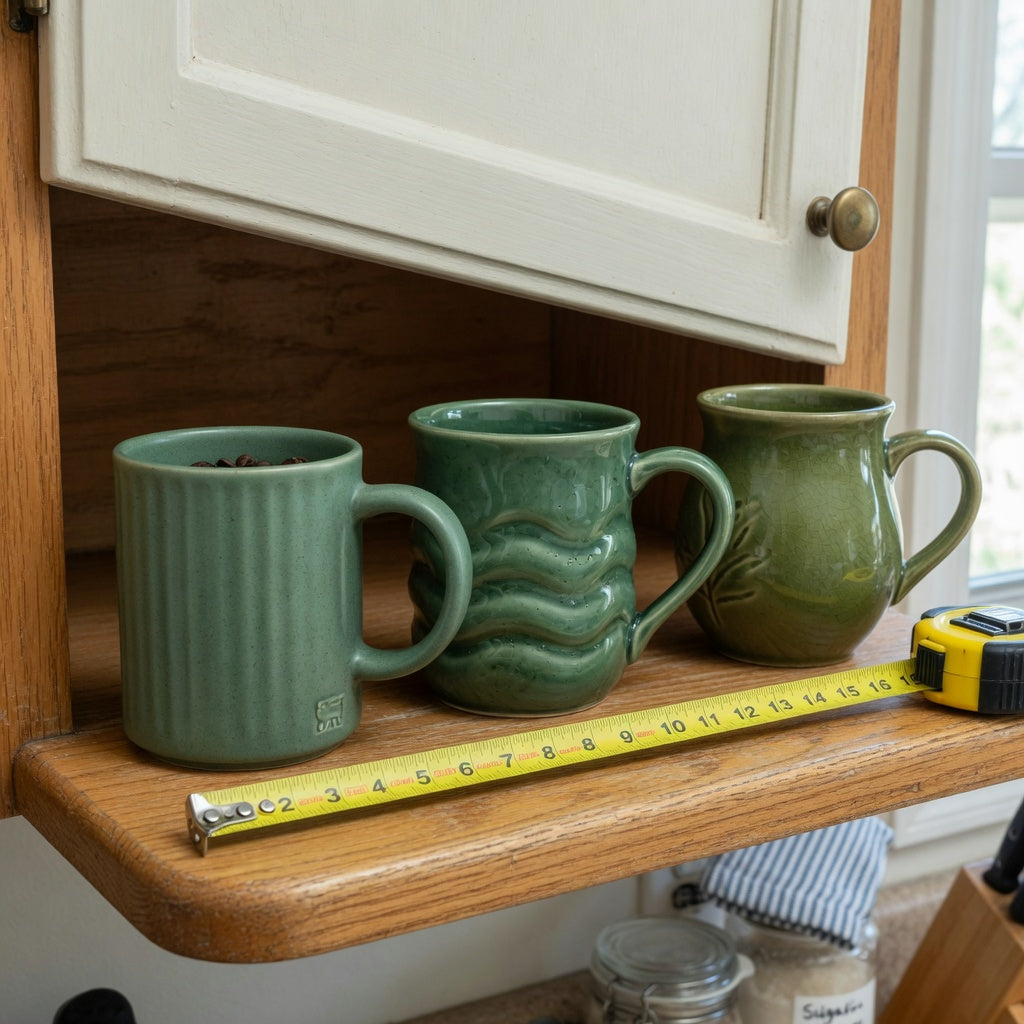
Green Ceramic Coffee Mugs Storage Fit Guide: Compare Shapes
Compare the visible shapes and handle needs of CoffeifyMug's Emerald, Green Waves, and Round ceramic mugs. Learn how to check cabinet depth, shelf height, side clearance, and stacking trade-offs wi...
Read more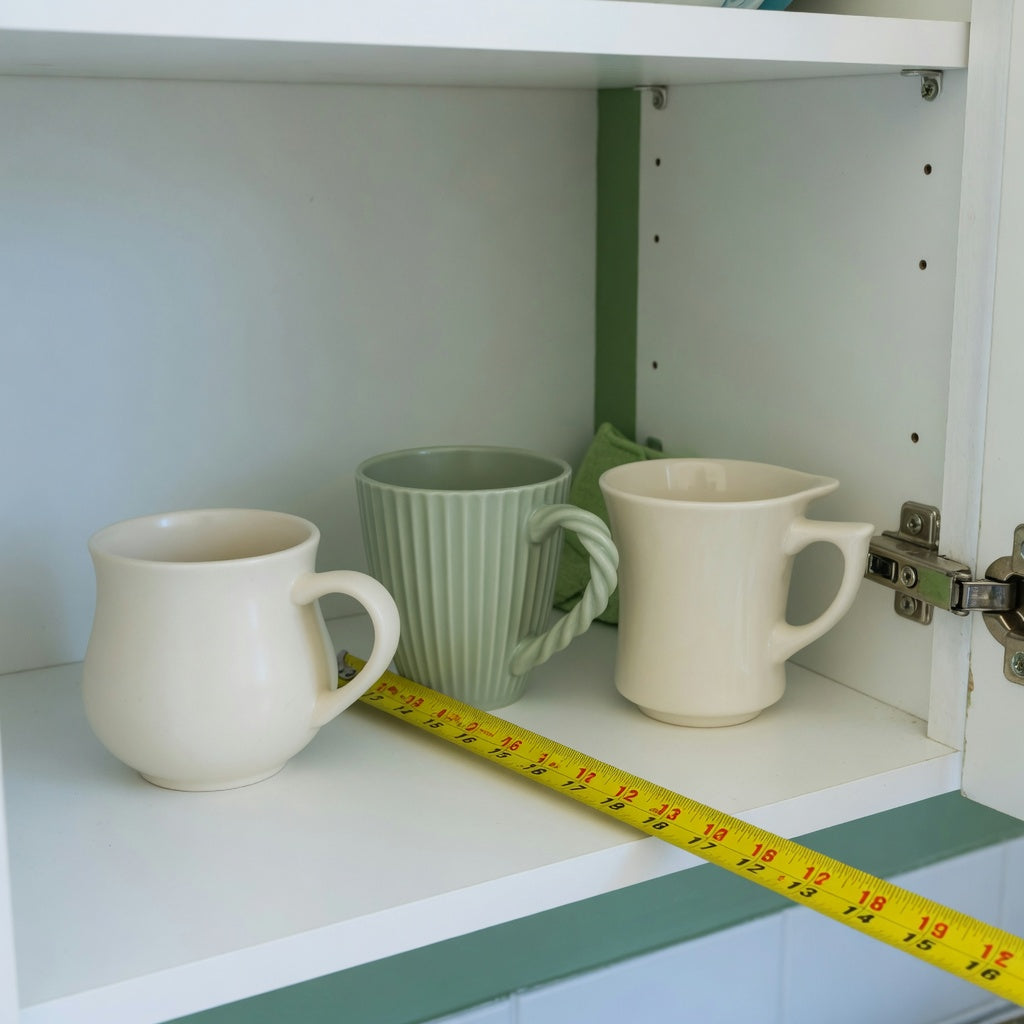
Minimalist Ceramic Mug Storage Fit Guide: Shape and Shelf Space
Compare round, pleated, and retro ceramic mug forms by outer footprint, handle projection, capacity versus dimensions, and cabinet layout. Includes a practical measuring method and honest limits fo...
Read more
Leave a comment
This site is protected by hCaptcha and the hCaptcha Privacy Policy and Terms of Service apply.