
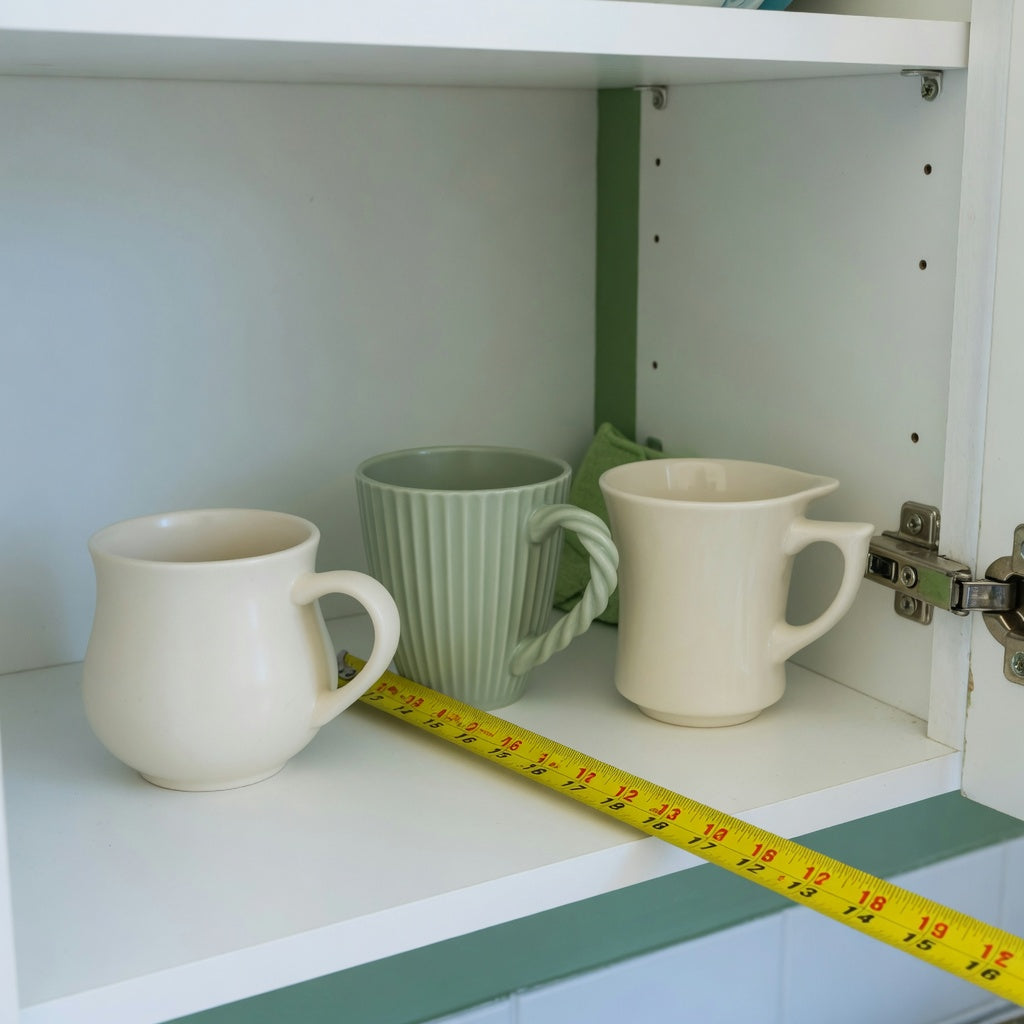
Minimalist Ceramic Mug Storage Fit Guide: Shape and Shelf Space
Reading time: about 10 minutes
A cabinet door that catches a mug handle by half an inch is enough to turn a good-looking purchase into a daily storage problem. We see the same issue with crowded office credenzas, narrow floating shelves, and drawers that close smoothly until a handle rotates toward the front. This minimalist ceramic mug storage fit guide is designed to help you check those practical details before choosing among our current round, pleated, and retro forms.
In our store, we handle ceramic mugs while packing, staging, and comparing products. The useful lesson is simple: capacity and visual style do not determine cabinet fit by themselves. You need the mug's full outer envelope, including its widest body point, rim, base, and fixed handle. We use listed product details where available and do not estimate missing measurements from photographs.
Minimalist ceramic mug storage fit guide: what should you measure?
Minimalist is used here as a shopper-facing style lens for relatively clean current forms, not as a formal design classification. Storage fit is more objective. Before comparing products, measure the usable space rather than the nominal size of the cabinet.
- Usable shelf depth: Measure from the rear wall or obstruction to the inside face of the closed door. Account for hinges, door lips, and shelf edging.
- Vertical clearance: Measure from the shelf surface to the shelf or cabinet structure above it. Do not rely only on the mug's body height because a handle may rise higher.
- Row width: Record how much horizontal space is available after plates, glasses, or existing mugs are in place.
- Full mug envelope: Use the widest external body point and the furthest edge of the handle. The base diameter alone is not a reliable footprint.
- Retrieval clearance: Leave enough room to grip and lift the mug without knocking its rim or handle against a neighboring ceramic piece.
Capacity answers a different question: how much coffee or tea the cup is intended to hold. If a current listing provides capacity but not complete external dimensions, do not convert ounces or milliliters into an assumed shelf footprint. Two ceramic mugs can hold a similar amount while using different widths and heights.
How do the round, pleated, and retro shapes compare?
The product names and visible forms provide useful comparison points, but they cannot establish which mug is smallest without complete external measurements. Here is how we would evaluate each option during a shelf-fit check.
| Current option | Visible form and material | Measurement that matters | Reader situation and next step |
|---|---|---|---|
| Round Coffee Tea Mug | Ceramic mug with a rounded body and fixed handle | Find the widest point of the curve and include the full handle projection rather than measuring the base alone | Consider it for an open shelf or cabinet with verified body clearance when you prefer a smooth curved silhouette |
| Pleated Coffee Tea Cup | Ceramic cup with visible vertical pleating and a fixed handle | Measure across the outer ridges, not the recessed grooves; pleating does not automatically mean a narrower footprint | Consider it for a visible coffee shelf when you want surface texture, provided its maximum outer width matches your shelf plan |
| Retro Coffee Tea Cup | Ceramic cup sold under a retro style name, with a shaped profile and fixed handle | Compare the rim, body, base, and handle separately to identify the furthest projecting point | Consider it for a coffee bar or less crowded display where the outline can remain visible and retrieval space is available |
We would not name a high-density cabinet winner from these shape labels alone. A rounded body can be compact or broad. Pleats change the surface contour but do not prove a smaller maximum diameter. A retro outline may place its widest point at the rim, body, base, or handle. Check the current listing, since product details can change, and use the actual external dimensions whenever they are provided.
For a broader visual comparison before opening individual pages, the unique coffee mugs collection lets you review the current shapes together. Use that view to narrow the style, then return to each product page for capacity, material, and any listed size details.
How much space does a fixed handle really add?
Handle projection is the distance from the mug body to the handle's furthest outer edge. It is easy to overlook because many product images are taken at an angle. At our packing table, rotating a handle can change how efficiently several mugs share the same rectangular space even though the mugs themselves have not changed.
- Closed upper cabinet: A handle facing the door uses front-to-back clearance. Turning it sideways may help with door closure but consumes more row width.
- Side-by-side row: Alternating handle direction can reduce interference, but only if there is enough room to retrieve one mug without moving the others.
- Drawer storage: A fixed handle can rotate into the drawer path or catch a divider. Check both mug height and the full arc of the handle.
- Office desk or credenza: Keep the handle inside the supporting surface. A handle extending into a walkway or past the desk edge is easy to bump.
- Under-shelf hooks: The internal handle opening matters as much as projection. Do not assume a hook will fit from a front-facing photograph.
There is a grip trade-off, too. A more open handle may provide extra finger room but can require more storage width. A compact loop can occupy less space while feeling restrictive for some hands. Because we do not have a universal handle measurement for every shopper, compare the listing images and dimensions against both your shelf and your preferred grip.
Why do capacity and ceramic material matter differently?
All three linked options are ceramic, so their bodies and handles remain rigid in storage. They will not compress around a hinge, divider, or neighboring mug. That makes a small clearance error more noticeable than it might be with a flexible storage item.
Capacity is still relevant because it helps you match the cup to your normal coffee or tea serving, but it is not a substitute for height, width, and depth. Use any capacity listed on the current product page for drink planning. Use external dimensions for shelf planning. If external measurements are not listed, allow a comfortable margin rather than estimating them from capacity or photography.
Ceramic rims, base edges, and handles are exposed contact points. A cabinet layout that forces mugs to knock together during every retrieval creates unnecessary opportunities for chips. We favor enough spacing to lift one mug cleanly rather than packing a row so tightly that two pieces must be moved at once.
Care instructions also need to come from the individual listing. If your routine includes microwave use or dishwasher cycles, confirm those points on the current product page instead of assuming every ceramic item has identical care requirements. After washing, store the mug only when it is clean and dry, particularly if you use an enclosed cabinet.
Which shape suits a closed cabinet, open shelf, office, or gift?
For a shallow closed cabinet: Do not choose by style name alone. Start with the option whose listed maximum depth and handle orientation fit your measured shelf. The pleated cup may look upright in a photograph, but its outer ridges and handle still define the footprint. If those measurements are unavailable, none of the three can be presented honestly as the guaranteed shallowest choice.
For an open floating shelf: Door clearance disappears, so visible form and safe edge placement become more important. The Round Coffee Tea Mug suits a shopper who wants a smooth curved profile. The Pleated Coffee Tea Cup adds visible vertical texture. The Retro Coffee Tea Cup provides a more shaped outline. Each is a reasonable next product to inspect if the complete mug, including its handle, stays inside the shelf edge.
For an office desk or credenza: Choose the product only after checking the clear landing area beside your keyboard, monitor stand, or paperwork. Orient the handle toward your dominant hand without allowing it to project into a walkway. A smaller beverage capacity does not guarantee a smaller desk footprint.
For a gift: The recipient's storage is the unknown variable. A mug can make a neat unboxing presentation and still end up permanently on the counter if the cabinet is full. For someone with open shelving, select the visible form that matches their kitchen. For someone with compact closed storage, confirm available shelf depth or consider a deliberately stackable or handleless style instead.
For a crowded mug drawer: These fixed-handle ceramic forms may not be the most efficient choice. A low, handleless cup or a product specifically described as stackable can suit that storage method better, provided it also meets the recipient's drinking needs.
How can you test fit without guessing from a product photo?
A simple shelf template is more reliable than comparing a mug photo with nearby props, which may not be shown to scale. Build the template only from dimensions stated on the current listing.
- Record the maximum external width, depth, and height when those measurements are available.
- Mark the full footprint on paper or thin cardboard, including the handle rather than drawing only the body.
- Place the template at the back, middle, and front of the intended shelf to check for hinges, trim, and door intrusion.
- Make one template for every mug you plan to store. Arrange them with handles facing forward, sideways, and alternated.
- Check vertical clearance separately, including any part of the handle that extends above the rim or body.
If the product page does not provide enough information to create that template, do not manufacture a measurement from the image. Either choose a shelf with generous clearance or postpone a tight-fit decision until the external dimensions can be confirmed. This is the central limitation behind any minimalist ceramic mug storage fit guide based on visible shapes.
Where are these mugs the wrong storage choice?
Round, pleated, and retro ceramic mugs with fixed handles are not designed to collapse or nest like some camping cups. They are also poor candidates for very narrow rails, tightly packed overhead stacks, or under-shelf hooks when the handle opening is unknown.
Do not assume that one mug will sit securely on another because their rims look similar in photographs. Stackability depends on the base, rim, taper, weight distribution, and intended design. Unless the current listing explicitly identifies a product as stackable, plan for a single layer. A specifically stackable cup, handleless tumbler, or dedicated mug rack is a more practical alternative for high-density storage.
Frequently asked questions
Does the minimalist ceramic mug storage fit guide identify the smallest mug?
No. The visible round, pleated, and retro forms support a useful comparison, but they do not establish the smallest footprint without complete maximum external dimensions and handle projection. Use current listing measurements rather than treating a shape name as a size specification.
How do I measure cabinet depth for a mug with a handle?
Measure from the rear obstruction to the inside surface of the closed cabinet door. Then compare that usable depth with the mug's furthest external point in the orientation you plan to use. Remember that turning the handle sideways shifts the problem from shelf depth to row width.
Can round, pleated, or retro ceramic mugs be stacked?
Do not infer stackability from the visible style. A secure stack requires compatible base and rim geometry, and that cannot be confirmed from the product name alone. Unless a listing specifically describes a mug as stackable, allocate single-layer storage.
Does mug capacity tell me how much shelf space I need?
No. Capacity describes internal beverage volume, while shelf fit depends on external height, width, depth, and handle projection. Compare both sets of details because two mugs with similar capacities can have different outer forms.
Which CoffeifyMug shape should I inspect first for an open shelf?
Start with the visual result you want: round for a smooth curved body, pleated for vertical texture, or retro for a more shaped profile. Open the relevant product page, confirm the listed capacity and material, and then verify that the full outer form stays within your shelf edge.
Use this final check before placing an order:
- The listed capacity suits your usual coffee or tea serving.
- The maximum body width fits the intended row.
- The handle clears the cabinet door, neighboring mugs, and your hand.
- The mug fits in one layer without relying on unconfirmed stackability.
- The current product page supports any care or compatibility requirement in your routine.
Once those five points are clear, compare the current options in our unique coffee mugs collection and open the round, pleated, or retro listing that best matches your measured space.
More from our blog
Read more
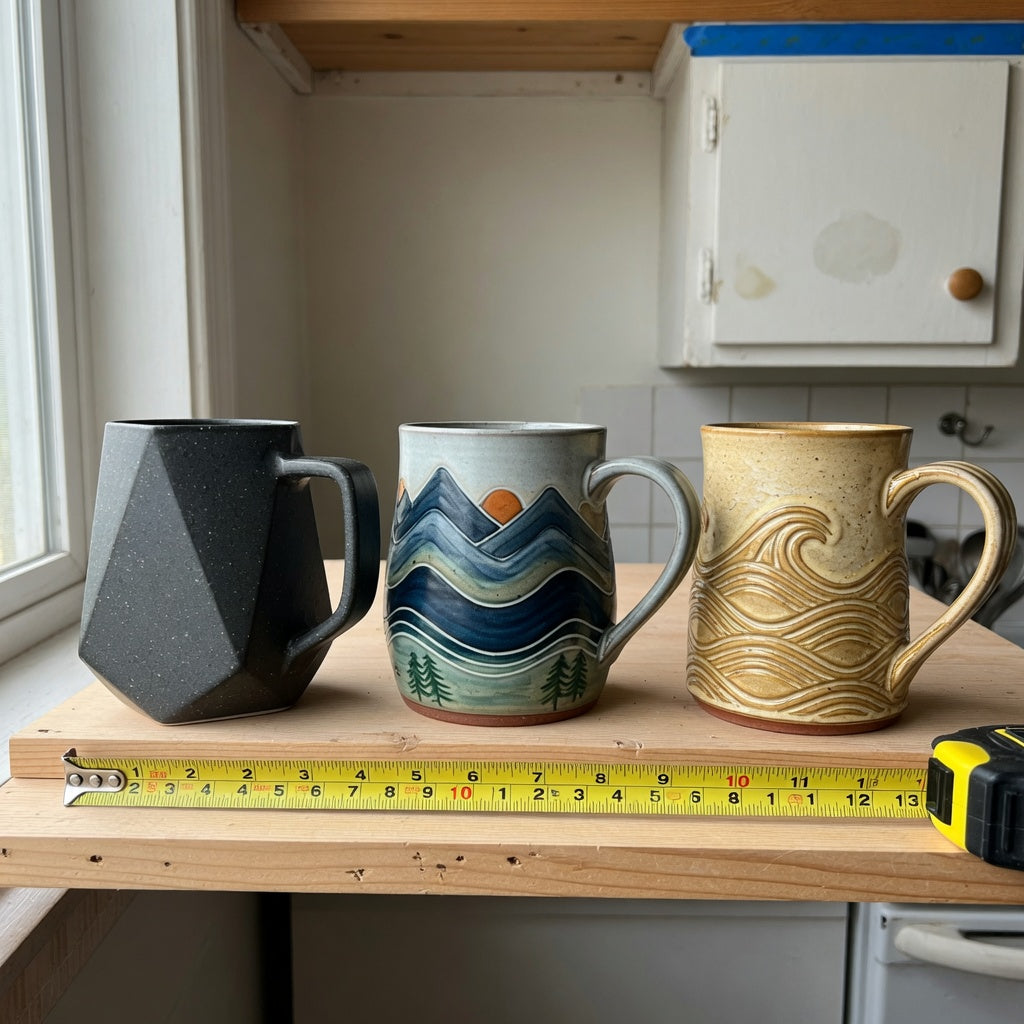
Unique pottery coffee mugs storage fit guide: Shapes and shelves
Compare the visible profiles of the Rhombus, Mountain Sea, and Golden Waves Kio mugs, then measure cabinet depth, shelf height, and handle clearance without relying on guessed dimensions.
Read more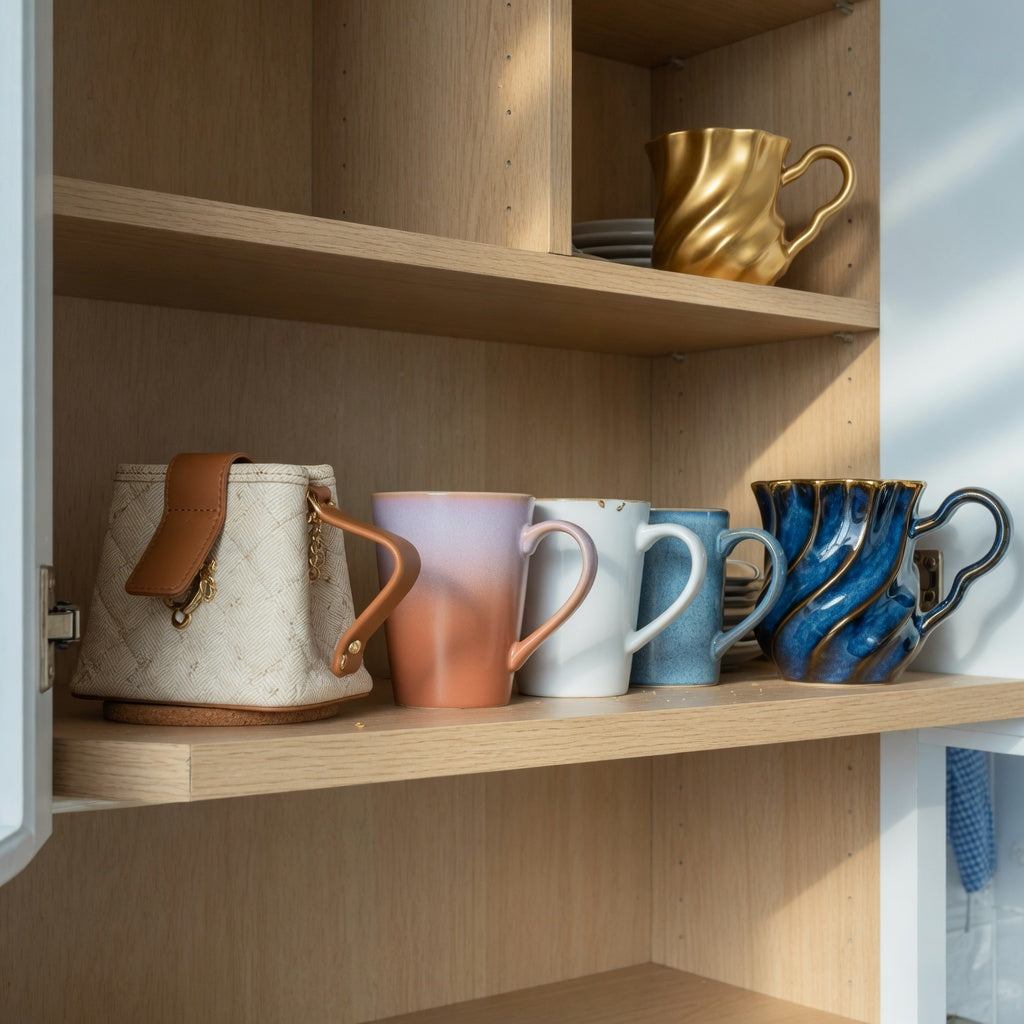
Coffee Mug Birthday Gift Ideas Storage Fit Guide: Shelf Match
Compare three current CoffeifyMug shapes by visible silhouette, handle clearance, stacking limits, and realistic cabinet use. Match a birthday mug to a crowded shelf, open display, office cupboard,...
Read more
Leave a comment
This site is protected by hCaptcha and the hCaptcha Privacy Policy and Terms of Service apply.