
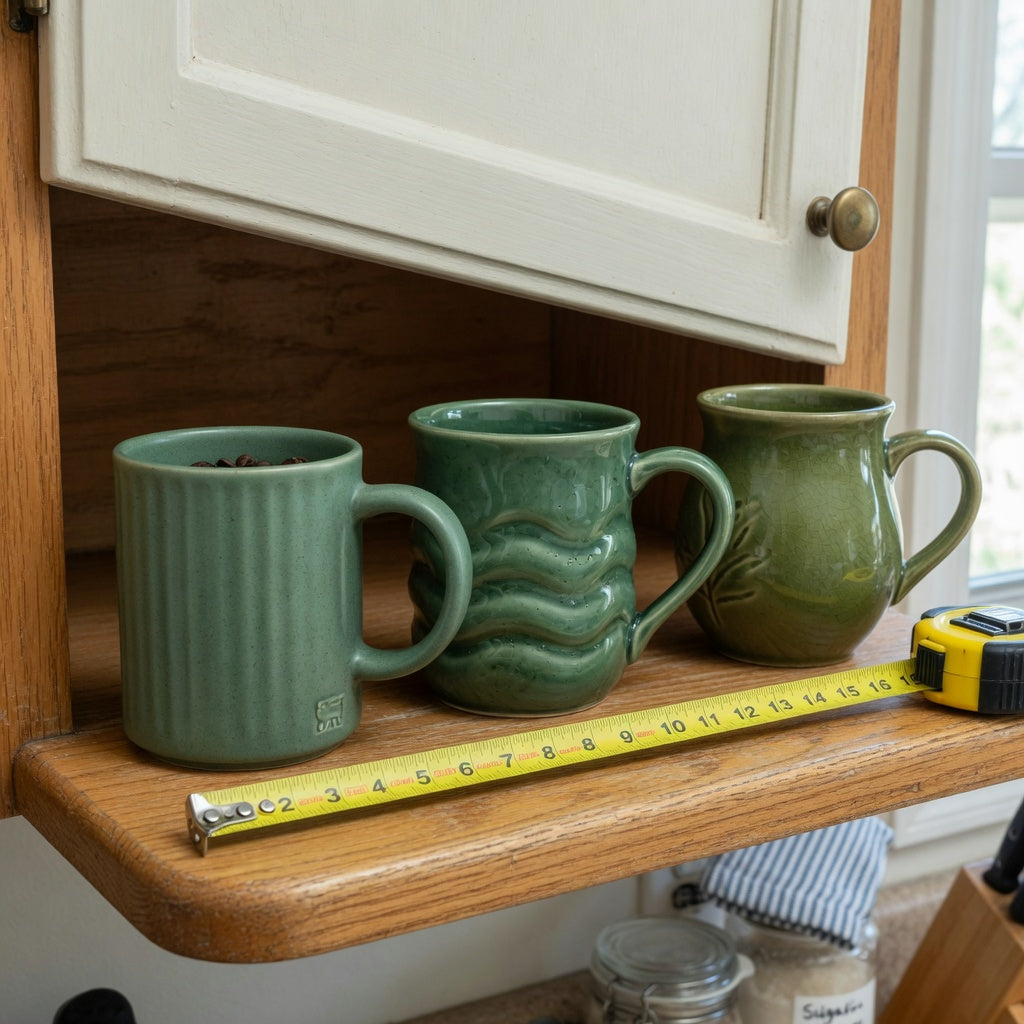
Green Ceramic Coffee Mugs Storage Fit Guide: Compare Shapes
Reading time: about 8 minutes
A mug can clear the shelf above it and still stop the cabinet door from closing. The usual problem is not height. It is the widest part of the ceramic body plus the handle projecting toward the door. We built this green ceramic coffee mugs storage fit guide around that practical issue, comparing three current CoffeifyMug shapes without turning product photos into invented measurements.
At our packing bench, we handle mugs by the rim, base, body, and handle, then see how differently shaped pieces occupy a row. An upright mug generally behaves differently from one that broadens through the middle. The same distinction matters in a crowded kitchen cabinet, an office cubby, or a gift recipient's small apartment.
How does a green ceramic coffee mugs storage fit guide prevent cabinet problems?
Storage fit is determined by the mug's full outside envelope, not its capacity or rim diameter alone. Four measurements or visual checks matter most:
- Clear shelf height: Measure from the shelf surface to the shelf, frame, or rack directly above it.
- Closed-door depth: Measure from the back wall to the inside of the closed door, accounting for a front lip or hardware that reduces usable space.
- Total outside width: Include the body and the outermost edge of the handle. Handle opening size tells you about finger room, not cabinet clearance.
- Widest body point: A rounded mug may be broader at its middle than at its rim or base, which affects how closely neighboring mugs can sit.
Capacity does not reliably predict any of these measurements. Two ceramic mugs can hold similar pours while occupying different amounts of shelf space. Where a product page provides dimensions, use those listed figures. Where it does not, we do not recommend estimating an exact size from photography alone.
How do Emerald, Green Waves, and Round compare by visible footprint?
The following comparison is based on the forms visible on the current product pages. These are relative storage observations, not substitute measurements for your cabinet.
| Current mug | Visible form | Storage implication | Best reader situation |
|---|---|---|---|
| Emerald Coffee Tea Mug | Upright body with comparatively straight sides and a familiar side handle. | The most straightforward of these three shapes for an orderly side-by-side row. Handles can be turned in one direction or alternated. | A shopper with a busy closed cabinet who wants predictable placement. |
| Green Waves Coffee Tea Mug | Handled ceramic form with a visibly contoured, wave-detailed exterior. | Still reads as a conventional mug, but its widest contour should be checked rather than treated as a perfect cylinder. | A shopper who wants more surface detail without choosing the broadest silhouette. |
| Round Coffee Tea Mug | Rounded body that broadens through the middle. | Needs more consideration for lateral spacing and may leave gaps between neighboring straight-sided mugs. | A shopper with a deeper cabinet or open shelf who values the curved form over maximum storage density. |
Product photography is useful for comparing proportions, but it cannot establish scale against your shelf. Open the relevant product page, check any currently listed specifications, and compare them with the usable space you measured rather than the cabinet's nominal outside dimensions.
Which shape fits a shallow cabinet, open shelf, or office cubby?
The right next step depends on where the mug will live. We map the three current forms to these common storage situations:
- Crowded closed cabinet: Start with the Emerald mug. Its upright visible form is the most natural candidate for a straight row, especially if you can rotate all handles toward one side.
- Cabinet with some side clearance: Consider Green Waves when you want a more decorative exterior but still prefer a familiar handled profile. Confirm the widest contour against the available row width.
- Open shelf or deeper pantry shelf: The Round mug makes more sense when the broader middle will not interfere with a door or neighboring pieces. It is a display-forward choice, not our first recommendation for maximum mugs per shelf.
- Very shallow shelf or true nesting requirement: None of these three should be assumed to solve that problem. A different silhouette from our unique coffee mugs collection may be a better match.
Office cubbies deserve the same caution as kitchen cabinets. Files, organizers, and a front shelf edge can reduce usable depth. On an open desk shelf, handle projection is less likely to block a door, but it can still catch a sleeve or sit beyond the shelf edge.
How should you measure shelf depth, body width, and handle projection?
Use the exact shelf where the mug will be stored. A measurement from another cabinet is only useful if both spaces have the same door, lip, and shelf position.
- Remove nearby mugs so you can measure the clear surface rather than the remaining gap in a crowded row.
- Measure usable depth from the back wall to the inside of the closed door. Do not stop at the face frame if the door closes farther inward.
- Measure clear height from the shelf surface to the lowest obstruction above it.
- Measure one of your current mugs from the far side of its body to the outer edge of its handle. This total outside width is more useful than handle opening alone.
- Compare the target mug's listed dimensions, where available, with your figures. If a listing does not say whether width includes the handle, do not assume that it does.
Test the door with a similar mug in place. Rotate its handle toward the back, toward the side, and toward the front. That quick check reveals whether your cabinet favors depth-saving handle orientation or easier daily access. Leave enough room to remove the mug without scraping its rim or knocking the mug beside it.
Can these ceramic mugs be stacked without risking space or damage?
None of the three products is presented here as a purpose-built nesting set. Their visible handles and individual body shapes make side-by-side storage the more realistic plan. The Round mug, in particular, should not be treated as a stackable shape simply because its rim clears another mug's base.
With ordinary ceramic mugs, stacking can place the upper base directly against the lower rim. That concentrates hard ceramic-on-ceramic contact, and twisting the upper mug during removal can scuff glazed surfaces or chip an exposed rim. A shelf riser is usually the cleaner storage solution if your cabinet has enough clear height.
After hand washing or a dishwasher cycle, let each mug cool and dry fully before returning it to a tight shelf or stacking anything above it. Follow the care directions on the individual listing; ceramic material alone should not be treated as automatic confirmation of a particular dishwasher setting.
Which trade-offs matter for daily use and gift storage?
Dense storage and easy retrieval pull in different directions. Turning every handle toward the back can help with door clearance, but it makes a daily mug slower to grab. Alternating handles left and right can reduce interference between neighboring mugs, although it needs more row width than tightly aligned bodies.
For a gift recipient with unknown cabinet space, the Emerald form is the more conservative choice among these three because its body appears easier to line up with conventional mugs. Green Waves suits someone who has a little room and wants visible texture. The Round mug is better for a recipient with open shelving, a display area, or enough cabinet width to give the curved body its own footprint.
These options are not ideal for shoppers who require true nesting, extremely shallow storage, or the highest possible mug count per shelf. In those cases, choosing by green glaze alone creates the wrong priority. Start with the available space, then select the color and surface treatment that fit inside it.
Which final checks should you make before ordering?
Use this green ceramic coffee mugs storage fit guide as a short pre-purchase check rather than relying on a product photo at phone-screen size:
- Confirm clear shelf height and closed-door depth.
- Account for the handle in total outside width.
- Check the body's widest point, not just the rim.
- Decide whether the mug will sit side-by-side, on a riser, or on an open shelf.
- Verify current dimensions and care instructions on the linked product page where they are provided.
Frequently asked questions
What should I measure before buying a green ceramic coffee mug?
This green ceramic coffee mugs storage fit guide prioritizes clear shelf height, closed-door depth, total width including the handle, and the body's widest point. Measure the actual storage location because a door, shelf lip, or face frame can reduce the usable space.
Which CoffeifyMug green mug is easiest to place in a crowded cabinet?
Based on the visible forms of these three products, the Emerald Coffee Tea Mug is the most straightforward starting point for a close side-by-side row. Its upright body should waste less lateral space than the visibly rounder option, but your cabinet measurements still decide the fit.
Will the Round Coffee Tea Mug work on a shallow shelf?
Only if your measured depth accommodates both the rounded body and the handle with the door closed. Its broader middle also needs side clearance, so we generally map it to deeper cabinets or open shelves rather than tightly packed shallow storage.
Can I stack the Emerald or Green Waves mug to save space?
Do not assume either mug nests unless the current product listing expressly says so. Standard handles usually prevent close nesting, and ceramic-on-ceramic contact can mark glaze or expose the rim to chips. A shelf riser is a more practical option when vertical clearance allows.
How much clearance should I leave around a mug handle?
There is no universal allowance because door position, handle shape, and neighboring mugs differ. Leave enough space for the door to close without touching the handle and for you to lift the mug out without scraping another piece. Testing the location with a similar mug is more reliable than guessing.
Next step: Measure the intended shelf, then match the result to the visible form. Choose Emerald for a conventional row, Green Waves for added surface detail with a familiar profile, or Round when open or generous storage makes density less important. If none fits comfortably, compare other silhouettes in the linked collection instead of forcing a poor cabinet match.
More from our blog
Read more
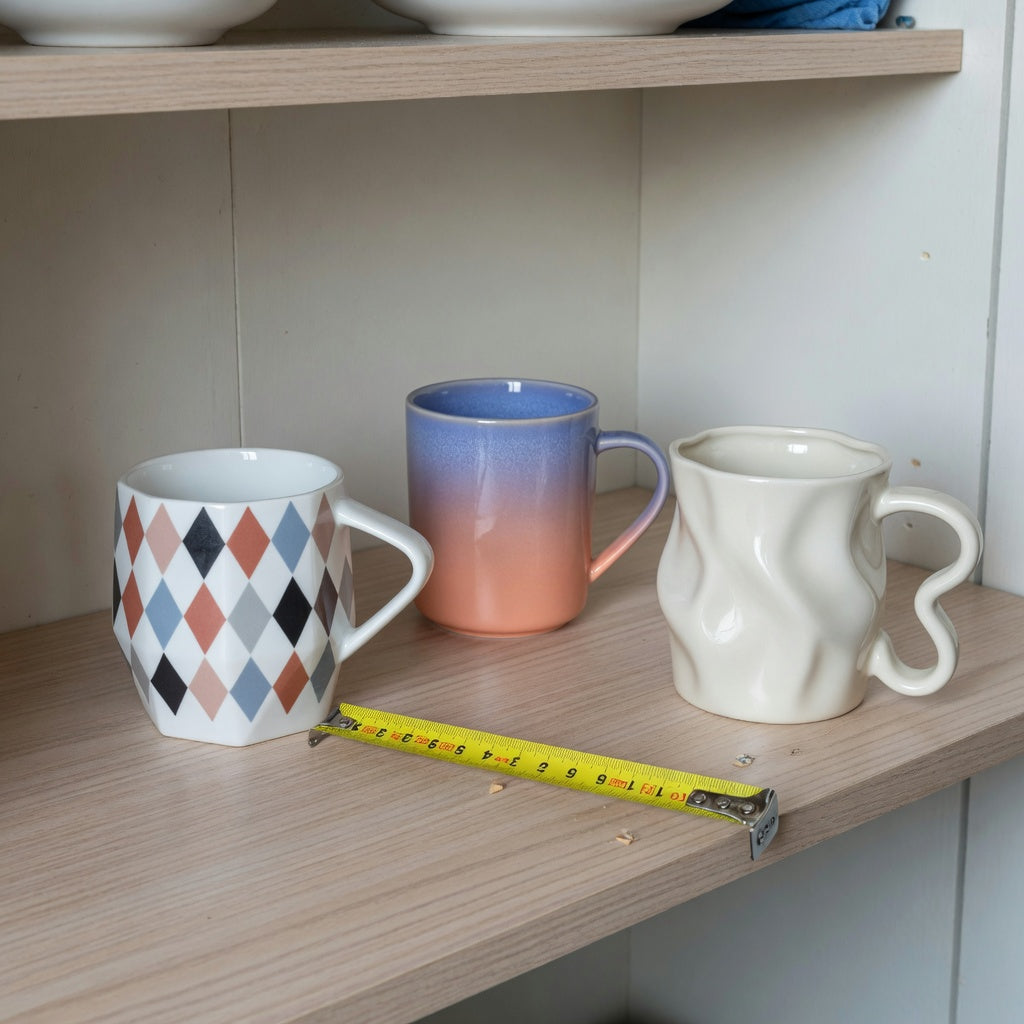
Abstract Coffee Mug Storage Fit Guide: Shapes and Shelf Space
Compare Rhombus, Gradient, and The Flow by verified capacity and visible form. Use practical shelf, cabinet, handle, stacking, and care checks without guessing at unlisted dimensions.
Read more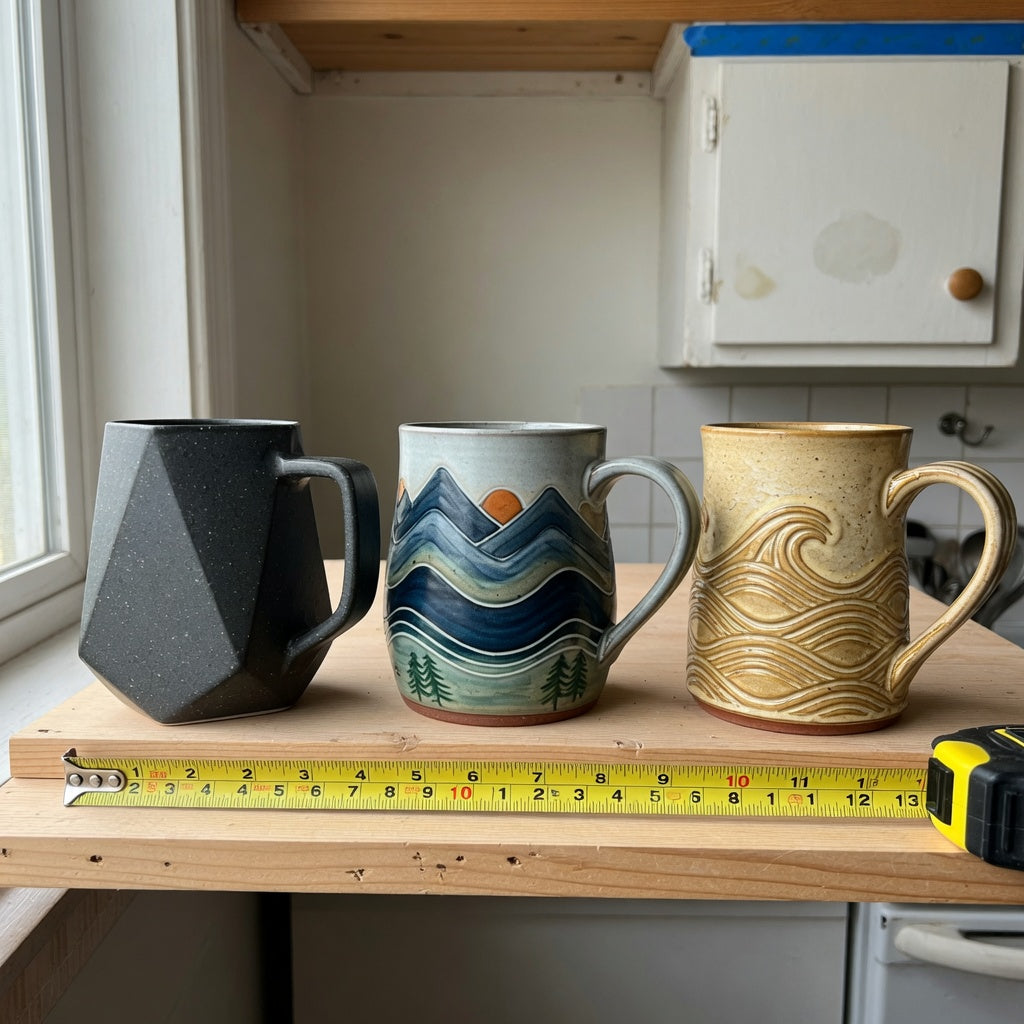
Unique pottery coffee mugs storage fit guide: Shapes and shelves
Compare the visible profiles of the Rhombus, Mountain Sea, and Golden Waves Kio mugs, then measure cabinet depth, shelf height, and handle clearance without relying on guessed dimensions.
Read more
Leave a comment
This site is protected by hCaptcha and the hCaptcha Privacy Policy and Terms of Service apply.