
Coffee Mugs Unique Shape Size Decision Guide: 10, 12 or 14 Oz
Reading time: about 10 minutes
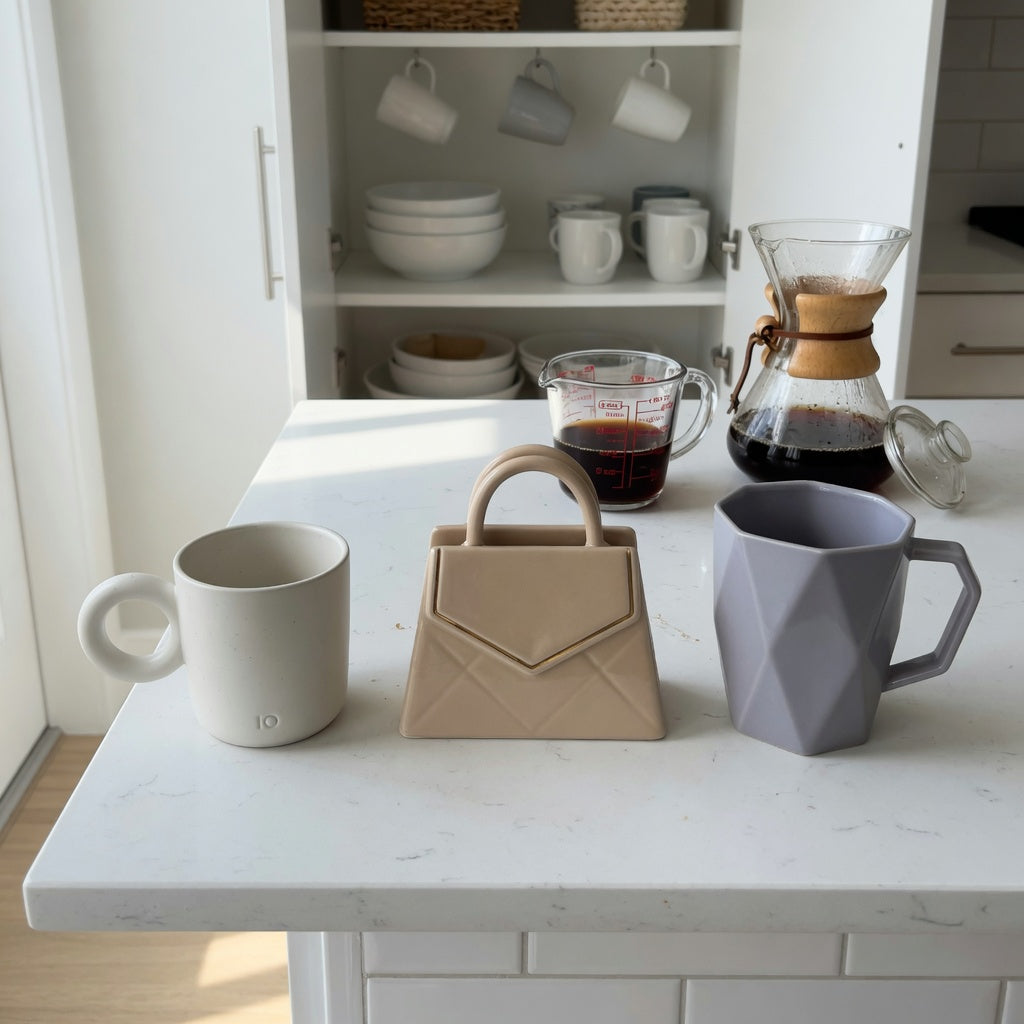
A mug can be the right shape and still be the wrong size. We see it on office desks where a sculpted mug competes with a mouse pad, and in gift orders where a distinctive cup does not match the recipient's normal pour. This coffee mugs unique shape size decision guide compares the listed 10, 12, and 14 oz options in our current ball-handled, handbag, and rhombus styles. The practical goal is to choose capacity from the drink and setting you already use, not from how large a mug appears in a product photo.
In our store, we handle shape questions separately from capacity questions. Capacity tells you how much the mug is listed to hold. Silhouette affects grip, cupboard clearance, coffee-machine clearance, and the space the mug occupies beside a keyboard or plate. One does not prove the other, so we use the product-page capacities as the comparison point and keep our measuring, storage, and care advice clearly identified as general guidance.
Coffee mugs unique shape size decision guide: what should you measure?
Start with your own pour rather than a supposed standard serving. Coffee habits differ too much for one number to work for every shopper. Milk, creamer, foam, tea infusers, and ice also use space that is easy to overlook while comparing an empty mug online.
- Fill your current mug to the level you normally use, including the milk or other additions you put in before drinking.
- Pour that amount into a fluid measuring cup and record the result in ounces.
- For an iced drink, repeat the test with your usual amount of ice because ice displaces part of the liquid volume.
- Compare the result with 10, 12, and 14 oz, leaving enough room for the way you carry and drink from a mug. A listed capacity is not a promise about your preferred fill line.
If your measured drink sits comfortably below 10 oz, the smallest listed option may be enough. A result close to 10 oz makes the 12 oz mug more practical if you add milk or carry the mug between rooms. If your routine already exceeds 12 oz, or regularly includes ice and additions, the 14 oz option deserves the first look. These are decisions based on your measured use, not invented coffee or tea serving standards.
What do 10, 12, and 14 oz mean across these shapes?
The three products form a straightforward capacity progression. They do not form a guaranteed progression in exterior width, height, base size, or empty weight. Those details depend on the individual design, so check the product-page images and any listed measurements before deciding that the lowest capacity must also have the smallest footprint.
| Current mug | Listed capacity | Situation it can fit | Trade-off to check |
|---|---|---|---|
| Ball Handled Coffee Tea Mug | 10 oz | Your measured pour fits below 10 oz and you do not need much spare volume | The ball-style handle differs from a conventional loop, and smaller capacity does not guarantee a smaller exterior footprint |
| Handbag Coffee Tea Mug | 12 oz | Your usual drink is too close to the 10 oz limit, or you want a middle-capacity gift | The sculpted handbag silhouette may store differently from straight-sided mugs |
| Rhombus Coffee Tea Mug | 14 oz | You make a larger pour or need room for milk, foam, or ice | More liquid means more filled weight, and the geometric profile still needs a cupboard-clearance check |
All three are ceramic coffee and tea mugs with visibly different shape treatments. The capacity numbers support a useful comparison, but they do not establish stability, hand comfort, dishwasher compatibility, or coffee-maker fit. We do not turn one listed specification into a performance claim it cannot support.
Is the 10 oz ball-handled mug the better desk choice?
The 10 oz option makes sense for a desk user whose measured drink fits below that capacity and who does not want a larger volume sitting through a short work session. It can also suit an afternoon tea or smaller second coffee when the 12 or 14 oz capacity would mostly remain unused. The relevant next step is to examine the 10 oz ball-handled mug and compare its visible proportions with the space beside your keyboard, monitor stand, or notebook.
There are two limits. First, the ball-style grip is not the same as a familiar open loop, so a shopper who prioritizes a conventional hold should inspect the side views carefully. Second, 10 oz may be too close to the limit if your measured drink is already 10 oz before milk or foam. In that case, we would move up to 12 oz rather than assume the full listed capacity will match a comfortable carrying level.
Does the 12 oz handbag mug make the safest middle choice?
The 12 oz handbag mug is the capacity midpoint of these three current options. It fits the shopper whose normal drink exceeds the practical space available in a 10 oz mug but does not justify the 14 oz alternative. That middle position is also useful for gift buying when you have checked the recipient's current mug and found that it falls near this range.
Choose the 12 oz Handbag Coffee Tea Mug for the combination of a clearly decorative silhouette and moderate listed capacity. Do not choose it because you assume a 12 oz mug will stack, fit a vehicle cup holder, or occupy the same shelf width as a cylindrical mug. A shaped ceramic mug is a poor substitute for a sealed travel cup, and a simpler conventional style will be more practical if stacking or commuting is the main requirement.
When is the 14 oz rhombus mug worth the extra capacity?
The 14 oz Rhombus Coffee Tea Mug is the larger-capacity choice in this three-product comparison. It is the logical option when your measured drink is above 12 oz, when additions bring a smaller pour close to that point, or when ice regularly takes up part of the mug. The extra capacity is useful only if you will use it. Bigger is not automatically better.
Before choosing the 14 oz rhombus mug, account for the added weight of more liquid and check the available space under your coffee machine and inside your cupboard. Capacity alone does not prove that the mug is taller or wider than the others, but it does confirm that it can hold more. It is not the best match for someone who deliberately makes a small drink, wants the lightest possible filled mug, or needs a conventional stackable shape.
How do ceramic care and cupboard clearance change the decision?
Unique ceramic mugs require a little more planning than interchangeable cylinders. At our packing bench, the practical inspection points are the rim, the handle attachment, and the foot ring. Those are also sensible places to check after gift unboxing or after a mug has received a hard knock. A visible chip or hairline crack is a reason to stop using the mug rather than continue filling it with a hot drink.
- Cupboard fit: Measure clear shelf height, usable depth, and the width available beside neighboring mugs. Do not use capacity as a substitute for exterior dimensions.
- Coffee-machine fit: Measure from the drip area to the tray, including any platform that cannot be removed. A mug can have the right capacity and the wrong height.
- Handle clearance: Compare the ball-style, handbag, and rhombus designs visually with the way you normally place your fingers. Decorative handles should not be assumed to feel like standard loops.
- Dishwasher loading: Follow the care statement on the individual product page. If dishwasher use is permitted, leave enough space to prevent a sculpted handle or angular edge from knocking another ceramic item during a cycle.
- Hand washing: If the listing does not expressly confirm dishwasher compatibility, hand washing with a soft, nonabrasive sponge is the conservative choice. Ceramic material alone does not establish dishwasher or microwave safety.
We also avoid treating an angular shape as automatically more stable or a rounded design as automatically easier to clean. Those conclusions require product-specific evidence. What we can say is that detailed silhouettes deserve more spacing in a cupboard and drying rack, particularly around protruding handles and edges where repeated ceramic-to-ceramic contact can cause damage.
Which current mug fits a desk, kitchen, or gift recipient?
- Short desk drink: If your measured pour stays below 10 oz, start with the Ball Handled Coffee Tea Mug. Its capacity avoids buying unused volume, but confirm its actual footprint and grip from the listing.
- Everyday kitchen use: If your pour is too close to 10 oz for comfortable carrying room, the 12 oz Handbag Coffee Tea Mug provides the middle step. Check cupboard space for its sculpted profile.
- Larger drink or iced preparation: If your complete drink exceeds 12 oz after ice or additions, the 14 oz Rhombus Coffee Tea Mug is the relevant option. Confirm care guidance before using any ceramic mug with large temperature changes.
- Gift recipient with unknown habits: Look at a mug the recipient already uses, measure its normal fill, and note the available cupboard space. A larger gift is not more thoughtful if it is awkward to store or heavier than the recipient prefers.
- Commuting or limited hand mobility: Consider a conventional handled or lidded mug instead. A unique silhouette should not override a need for predictable grip or spill protection.
Shoppers who want to compare more silhouettes before committing can open our unique coffee mugs collection. Use the collection to shortlist the shape, then return to each product page for the listed capacity and care information that applies to that specific mug.
What should you check before adding one to cart?
- Measure the drink: Include milk, foam, an infuser, or the amount of ice you genuinely use.
- Measure the setting: Check the desk, cupboard, drying rack, and coffee-machine clearance instead of relying on the product photo alone.
- Check the grip and care: Study the handle shape and use only the care methods supported by the individual listing.
The value of this coffee mugs unique shape size decision guide is the separation of capacity from appearance. A 10 oz ball-handled mug is the smaller-capacity decision, the 12 oz handbag mug is the middle step, and the 14 oz rhombus mug provides the most listed volume. Your measured routine decides which one is practical.
Frequently asked questions
Which option does the coffee mugs unique shape size decision guide suggest for a 10 oz pour?
A drink that measures a full 10 oz may leave little room in a mug listed at the same capacity, especially if you still add milk or carry it between rooms. The 12 oz Handbag Coffee Tea Mug is the more practical comparison unless your actual fill remains comfortably below 10 oz.
Is the 14 oz rhombus mug automatically wider than the 12 oz handbag mug?
No. Capacity measures volume, not exterior width, height, or base diameter. Use the listing images and any posted dimensions to check cupboard, machine, and work-surface fit.
Can these ceramic mugs go in a dishwasher or microwave?
Use the care instructions shown on the individual product page; do not infer dishwasher or microwave compatibility from ceramic material alone. If a care method is not expressly supported, hand washing is the conservative option.
Which unique mug size is the most practical gift?
Match the recipient's existing mug rather than defaulting to the largest option. The 12 oz handbag mug is the capacity midpoint, but the 10 oz ball-handled or 14 oz rhombus mug may be better if the recipient consistently uses a smaller or larger pour.
Is the ball-handled mug a good choice for every hand size?
No single decorative handle works for every shopper. Review the product's side views and compare the ball-style grip with a mug you already find comfortable; choose a conventional loop handle elsewhere if predictable finger clearance is more important than the unique shape.
Next step: Measure one normal drink and the space where the mug will live. Then compare those numbers with the 10, 12, and 14 oz product pages, or review the current unique coffee mugs collection if shape is still the deciding variable.
More from our blog
Read more
Yellow Ceramic Coffee Mug Storage Fit Guide: Retro vs Pleated
Compare the current yellow Retro 170 ml and Pleated 200 ml ceramic mugs by visible shape, handle clearance, and realistic cabinet use. We explain what the listings confirm, what they do not, and ho...
Read more
Peppermint Tea Mug Storage Fit Guide: 400, 440, and 480 ml Compared
Compare the verified capacities of The Flow, Morning and Night, and The Rock, then use practical cabinet checks for shelf depth, door clearance, handle orientation, and everyday access.
Read more
Leave a comment
This site is protected by hCaptcha and the hCaptcha Privacy Policy and Terms of Service apply.