
Unique Espresso Cups for Small Coffee Bars: 3 Ceramic Shapes Compared
Reading time: about 8 minutes
Forty centimetres of counter, a grinder eating half of it, and a machine spout that sits lower than the product photos suggested. That is the setup behind most of the messages we answer about unique espresso cups — shoppers who like the look of a pleated or patterned ceramic cup but cannot tell from a listing whether it will clear the group head, hold a double shot without drowning it, or survive a dishwasher cycle.
We keep three compact ceramic shapes in stock at 170 ml, 200 ml and 250 ml, and they behave very differently once there is actual coffee in them. Here is how each one fits a real routine, where the trade-offs sit, and which details to confirm on the listing before you commit.
Unique espresso cups at 170, 200 and 250 ml: matching capacity to your actual pour
Capacity confusion causes more returns in this category than breakage does. A certified Italian espresso is defined at roughly 25 ml, and the older specialty definition runs closer to 25–35 ml. Buying guidance for the cup itself usually lands between 50 and 100 ml of total capacity, with about 60 ml as a common demitasse reference. None of that makes a 170 ml cup wrong. It means the number on the listing describes the vessel, not the drink — the extra volume is headspace for crema, aroma, and a shot that ran longer than you planned.
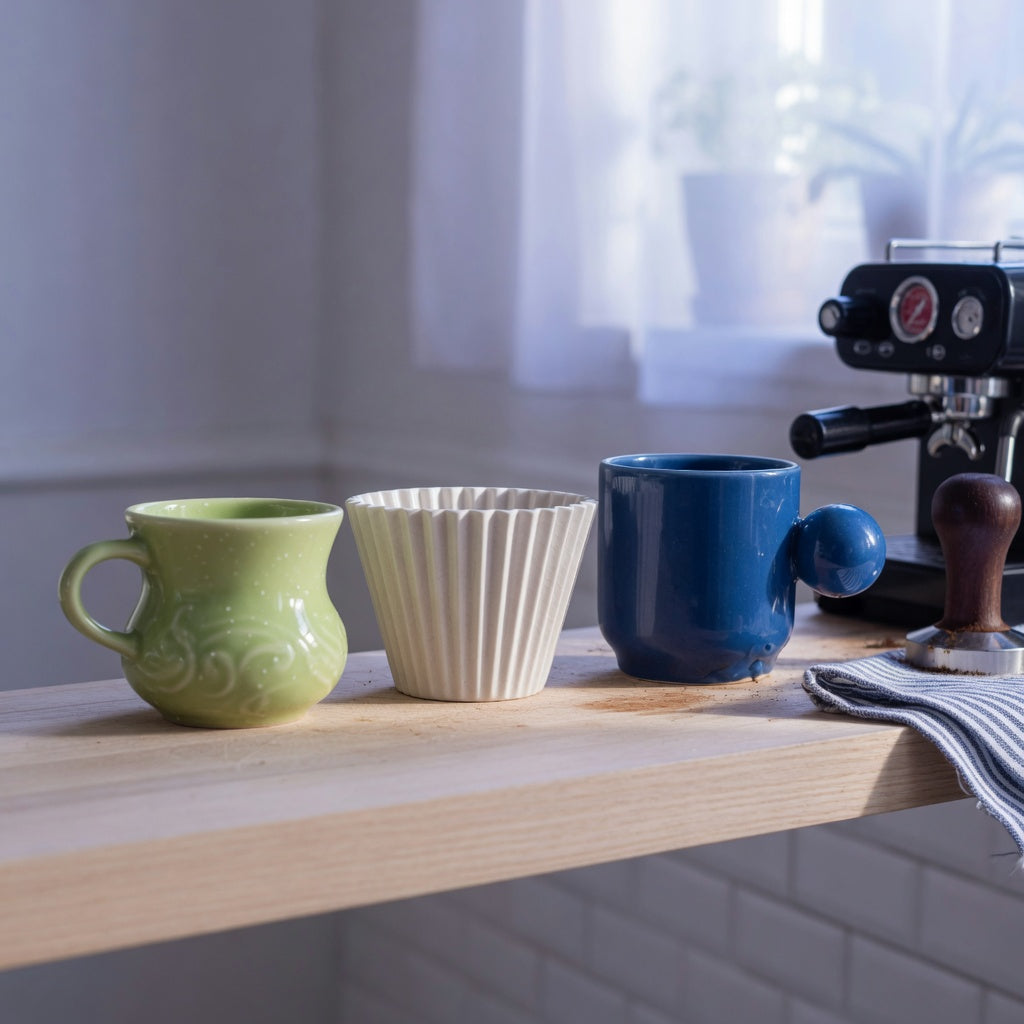
- 170 ml (Retro): a double shot with room to swirl, or a small cortado. A single ristretto will look lost in it.
- 200 ml (Pleated): the cortado end of the range — roughly equal espresso and milk without the liquid climbing toward the rim.
- 250 ml (Ball Handle): a longer milk drink, a strong tea, or a double for someone who wants surface area to cool on.
Measure your typical pour before you choose. An 18 g basket yielding 36 g gives you roughly 36 ml of liquid plus crema, and all three cups take that comfortably. If your everyday drink is a 150 ml latte, none of them will suit — that is a different cup class, and our guide to ceramic latte cups for small coffee setups picks up there.
Which shape suits a double shot, and which one is really a cortado cup?
All three are compact ceramic vessels with a visible, finished glaze, so the decision comes down to pour and footprint rather than material.
The Retro coffee and tea cup at 170 ml is the one we suggest first for a narrow bar. It gives a double shot enough room to breathe without asking for much counter. Because it is ceramic, preheat it with a short flush before you pull — a cool wall pulls heat out of a 36 ml pour fast, and you will taste the difference in the first thirty seconds.
The Pleated coffee and tea cup at 200 ml is the compromise shape, and the one most people should buy if their single daily drink is sometimes espresso and sometimes cortado. The pleated body gives the glaze some depth to catch light, and 200 ml leaves genuine headroom for a 1:1 milk ratio. It is not a cappuccino cup substitute — a 150 ml milk build will push close to the rim.
The Ball handled coffee and tea mug at 250 ml is the outlier. The ball handle is comfortable in a full grip, which helps if you have hot hands or a weaker grip, but a handle in that style adds width beyond the cup body. Check it against your drip tray and the gap under your shelf before ordering. At 250 ml it also earns its place for strong tea, which is why it tends to be the one that never goes back in the cupboard.
Does the inside of the cup change how you read a shot?
Yes, and it is the detail most buying guides skip. A white or light interior gives you contrast against the crema — you can see colour depth, the tiger striping, and the moment the stream goes blond. A dark, metallic or heavily patterned interior hides all of it. When you are dialling in a new bean, use a light-interior cup. Once the recipe is locked, the finish matters less, and the exterior glaze — the reason these are unique espresso cups rather than generically good ones — becomes the point.
If the listing photos only show the outside, ask about the interior colour before you buy. Many patterned cups are white inside, but that is not a safe assumption. Rim shape matters too: a slightly flared rim pushes liquid and aroma forward, while a thick rounded rim feels softer but can dribble. For neat espresso, thinner usually wins. With milk, the difference largely disappears.
Will it clear the group head, the drip tray and the shelf?
Fit is the unglamorous question that decides whether a cup gets used or lives in a drawer. Take three measurements before you buy anything:
- Height from the drip tray to the spout. Add the cup's listed height plus a few millimetres of clearance.
- Outer base diameter. A wide foot on a small drip tray can sit off-centre and send the stream past the rim.
- Handle width. A handleless or near-handleless cup is safest for tight space; anything with a full handle needs measuring first.
Stackability is the other small-bar variable. Compact ceramic cups often stack when the foot nests inside the rim below, but verify rather than assume — and remember that saucers roughly double a cup's footprint. Plenty of small-bar owners skip saucers entirely and store cups upside down on a folded cloth, which keeps dust out of the interior and takes a fraction of the shelf.
You can compare shapes and finishes side by side in our unique coffee mugs collection rather than guessing from one photo. If your corner is tighter still, the sizing logic in cute espresso cups for compact coffee corners goes deeper on footprint and glaze.
Are decorative or hand-finished ceramic cups safe for hot coffee?
We would rather lose a sale than wave this one through. The FDA notes that lead in ceramic glazes or decorations can leach into food and drink if the pottery is not properly fired, and that washing or boiling cannot remove lead from pottery. It also flags higher-risk ware: handmade pieces with a crude or irregular look, antiques, damaged or worn items, pieces from unknown makers or flea markets, and ware brightly decorated in orange, red or yellow.
For ceramicware cups and mugs, FDA's chemical-contaminants listing sets an action level of 0.5 µg/ml in leaching solution. Separately, 21 CFR 109.16 requires ornamental ceramicware that could plausibly be used for food to carry conspicuous "Not for Food Use" labelling or a hole through the food-contact surface.
What that means in practice:
- "Lead free" is a claim, not a test result. If a maker cannot say how they verified it, treat the piece as decorative.
- A bright reactive glaze or metallic lustre is a reason to ask a question, not an automatic no.
- If the base says "Not for Food Use" or "For Decorative Use Only", believe it.
- Chips and worn glaze are a stop-drinking signal on any ceramic.
For the three shapes we stock, confirm food-contact and care details on the current product page — that is the only place the specification is authoritative, and it is where we would point you if something changed.
Preheating, dishwasher cycles, and what these cups are not good for
Ceramic takes daily use well, but not everything. Hand-washing with a soft sponge keeps a glaze looking right far longer than a hot cycle with harsh detergent, and it removes the risk of a rim knocking against another dish. If a cup carries metallic or hand-applied decoration, assume hand-wash only until the listing tells you otherwise — and check the listing for microwave guidance too, because decoration and microwave safety do not always travel together.
Where these compact shapes fall short: large milk drinks, iced coffee with a straw, and any routine where you fill to the brim and carry the cup one-handed across a room. They are also a poor choice if you never preheat — a thick ceramic wall without a warm rinse takes noticeable heat out of a small shot. If you want a cup you can load and walk with, a handled mug or a travel tumbler is the better tool.
If you are outfitting a desk rather than a counter, our compact kitchen purchase checklist for a small ceramic coffee cup walks through the measuring steps in more detail.
Frequently asked questions
Is a 170 ml unique espresso cup too big for a single shot?
For a classic 25 ml shot, yes — it will look sparse and cool faster because there is more air above the liquid. A 170 ml cup suits a double shot or a small cortado. If you only pull singles, look for something nearer 60–80 ml.
Do unique espresso cups need preheating?
Thick ceramic walls absorb heat, so a short flush of hot water into the cup before you pull makes a real difference to how long the shot stays drinkable. Thin-walled cups need it less. It takes about three seconds.
Can these ceramic cups go in the dishwasher?
Check the individual product listing — care guidance varies by glaze and decoration, and we would rather you verify than assume. As a rule, hand-washing with a soft sponge protects the finish and reduces rim chipping.
Do I need a saucer on a narrow coffee bar?
Only if you have the shelf space. On a tight bar, saucers roughly double the footprint and often end up stacked separately anyway. A small folded cloth under the cups does the same job in less room.
How can I tell whether a reactive or patterned glaze is food safe?
Ask the seller for the food-contact statement and how the glaze was tested. A visible "Not for Food Use" mark means decorative only. The FDA treats brightly decorated, irregular or unmarked imported pottery as higher risk, and washing cannot remove lead from a glaze.
Start with the footprint: measure the height under your group head and the depth of your shelf, then pick the capacity that matches your usual pour — 170 ml for doubles, 200 ml for cortados, 250 ml if tea is in the rotation. You can compare all three shapes and their finishes in the unique coffee mugs collection before deciding.
Read more
Pottery Tea Cups for Daily Brewing: 170 vs 200 vs 250 ml
Three ceramic pottery tea cups, three capacities, three different jobs. What 170 ml, 200 ml, and 250 ml actually pour like, how to check the glaze before the first brew, and which size you will kee...
Read more
Coffee Mugs With Big Handles: 250–480 ml Grip and Capacity
A practical comparison of coffee mugs with big handles from 250 ml to 480 ml — the finger-clearance numbers that matter, how fill weight changes the lift, and the fit checks most buyers skip before...
Read more
Leave a comment
This site is protected by hCaptcha and the hCaptcha Privacy Policy and Terms of Service apply.