
Ceramic Latte Cups for Small Coffee Setup: What to Compare
Reading time: about 10 minutes
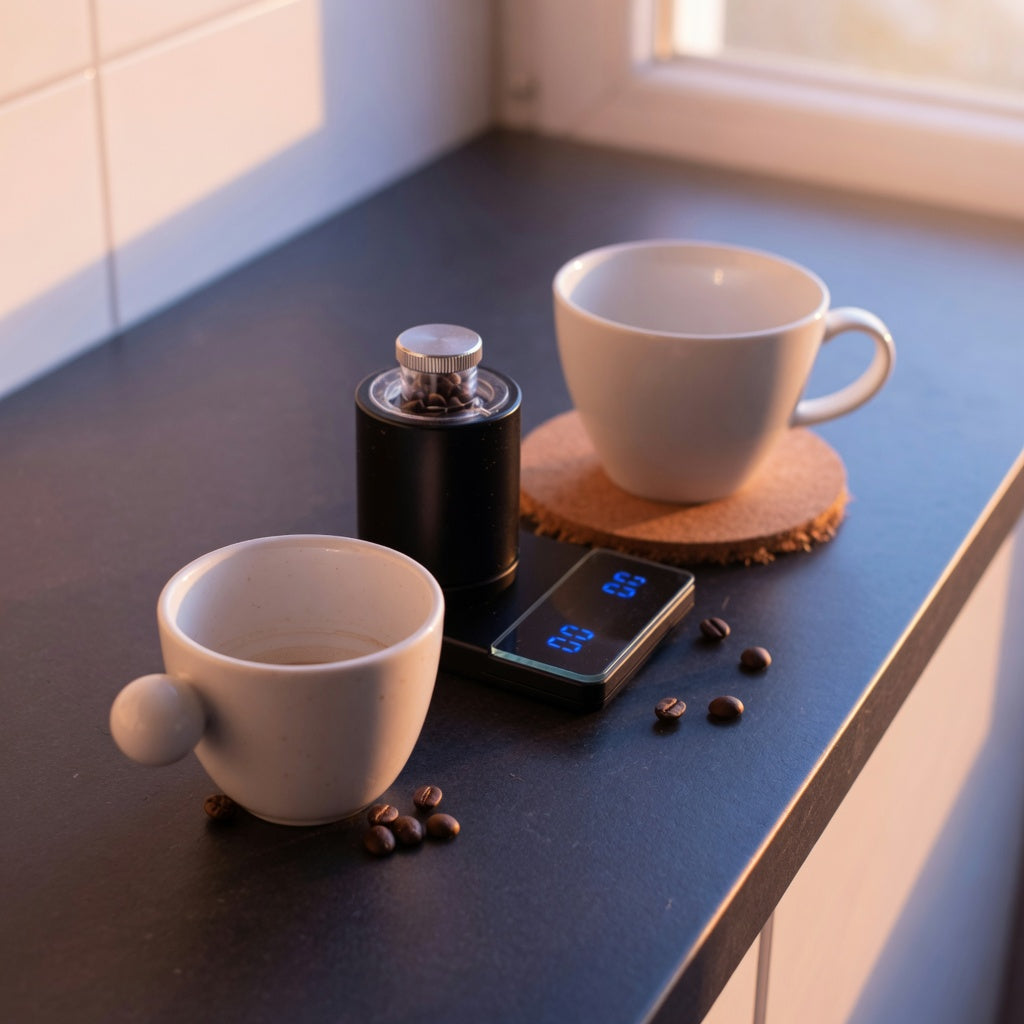
A 60 cm counter sounds generous until the grinder, scale, and kettle land. The strip that is left is where ceramic latte cups for small coffee setup decisions actually get made — beside the machine, next to the wall, under the shelf. We sell these cups, pack them for shipping, and hear back when a handle turns out to be wider than someone's shelf gap. So this is the comparison we walk buyers through: listed capacity versus what you actually pour, base and handle clearance, glaze safety, and the care habits that decide whether a cup stays in rotation.
Why a 10 oz ceramic latte cup rarely pours 10 oz of latte
Treat the number on the listing as vessel volume, not a promise about drink volume. Foam needs headspace. A cup can look full to the rim in a photo and still leave you short once steamed milk settles. Before you buy, measure your usual build once: pull your shot, steam the milk you normally steam, pour both into a measuring jug, and write the total in millilitres. Compare that number to the listed capacity, not to a picture of a full cup.
Our The Flow coffee mug is listed at 400 ml. That sits in the middle of the three cups we are comparing: more room than the 250 ml Ball Handle, less than the 440 ml Morning and Night. A 400 ml cup is a reasonable target for one standard latte, but it will not leave much slack for a very foamy pour. If your daily drink is smaller, the 250 ml cup is the closer match; if you routinely want a bigger, milk-heavy drink, the 440 ml cup gives you more volume to work with.
Which ceramic latte cups for small coffee setup earn their counter space?
Three current listings, three jobs. We state listed capacities plainly; for shape, handle geometry, and desk footprint, use the listing photos and ask us to check stock if a measurement decides the purchase.
| Cup | Listed capacity | Typical fit | What to verify on the listing |
|---|---|---|---|
| Ball Handle | 250 ml | Small milk drinks, cortados, tight shelf gaps | Handle loop opening and standoff; base diameter against your coaster |
| The Flow | 400 ml | Standard latte, one-drink setup | Rim diameter against shelf height; base width against drip tray |
| Morning and Night | 440 ml | Larger milk drinks, long morning cup | Footprint on a small tray; handle clearance at desk edge |
If you make a cortado or a small flat white most mornings, start with the Ball Handle mug — 250 ml is the smallest listed capacity here, and on a narrow counter that usually means less vessel to park. But it is the wrong buy if your regular drink is a full latte; you will be pulling a second shot or pouring short. The Flow mug at 400 ml is the neutral middle for a standard latte. The Morning and Night mug at 440 ml is for the buyer who knows they want a bigger drink and has the depth to give it. On a 30 cm deep desk, that extra capacity is the first thing you will notice when the cup crowds your keyboard.
You can see the rest of the shapes we keep for compact setups in our unique coffee mugs collection.
What separates a latte cup from the mug already in your cabinet?
FDA's guidance describes cups and mugs as small ceramic hollowware for hot drinks, normally about 240 ml (8 fl oz) and normally made with a handle. Cups get a base and curved sides; mugs get cylindrical sides. That is a food-safety classification, not a style rule, but it explains why the shapes diverge.
In use, the difference is surface. A latte cup is generally shorter and wider than a mug at the same volume, which gives foam somewhere to spread and shortens the drop from pitcher to crema. A tall cylindrical mug at the same capacity gives you a smaller surface and a deeper pour. If latte art is the goal, the interior shape and rim width matter more than the word latte on the box.
- Cappuccino cup: smaller, built around a heavier foam cap.
- Cortado or flat white cup: low and small, with minimal foam on top.
- Latte cup: wider bowl, more milk, more surface for a pattern.
- Mug: taller and narrower, built for volume rather than pouring.
One caution: there is no single standards-body definition of the ideal retail latte-cup volume. Published guides and cafe menus scatter across a wide range. Treat every capacity, including ours, as a starting point, not a rule.
How much counter does a ceramic latte cup really occupy?
Counter footprint is not base diameter. It is base diameter plus handle projection plus whatever the cup sits on, measured at the height where your kettle and grinder actually live. Three numbers decide whether a cup works on a cramped desk or a sliver of kitchen counter:
- Base diameter. A wide, low base is harder to knock over and sits on a standard coaster, but it eats depth on a shallow counter.
- Handle standoff. Some handles hug the body; others arc out. That arc is the difference between clearing the kettle and colliding with it every morning.
- Height under a shelf. A tall cup filled near the rim under a low cabinet is a spill waiting to happen.
Handle comfort matters more than buyers expect, because a full latte cup weighs noticeably more than the empty one in the listing photo. Handle geometry can shift slightly between production runs, so if the gap between handle and body is the deciding factor, ask us before ordering and we will check the stock on hand.
Stoneware, porcelain, and double-wall: what wall thickness can and cannot tell you
Material names sell cups; wall thickness is what you feel. A thick stoneware wall and a thin porcelain wall at the same 400 ml read completely differently in the hand, and they occupy the same counter either way.
What we can say with confidence is narrower than the marketing. Independent tests that rank commercial stoneware, porcelain, and double-wall ceramic latte cups for heat retention at realistic drink volumes are scarce, and the retail tests that do exist disagree. Treat wall thickness and overall mass as buying clues, not guarantees — and decide honestly whether you want a heavy cup, because a substantial wall gets tiring by the second latte.
Double-wall construction is a different animal. The design intent is a cooler outer wall, but the cavity creates a construction question. If you are considering a double-wall cup, ask the seller about leak testing, what happens if the seal fails, and whether the cup feels hollow in the hand. Porcelain is generally denser and thinner at the same volume, which matters when you are stacking two cups on one shelf.
Glaze safety: what a lead-free label proves, and what it does not
FDA's action level for leachable lead in ceramic cups and mugs is 0.5 micrograms per millilitre of leaching solution, applied to any one of six units tested. Cadmium has its own limit: 0.5 micrograms per millilitre for small hollowware. Those are the numbers behind a credible food-safety conversation about a ceramic latte cup, and FDA compliance guides point to ASTM C738 — an acetic-acid extraction method the standard describes as severe and unlikely to be matched in ordinary use.
A label tells you less than it sounds. FDA has reported traditional pottery labeled lead free that still contained extractable lead at or above action levels, and its guidance states that ceramicware containing extractable lead should not carry the Lead Free label at all. A lead-free stamp is a claim, not a test report.
Two more facts that change how you shop. Washing or boiling a piece cannot remove lead from pottery — if the glaze is a problem, it stays a problem. And decorative ceramics get their own rule: under 21 CFR 109.16, ornamental ceramicware that appears suitable for food use is treated as food use unless it carries both the required conspicuous Not for Food Use warning and a permanent version on the base, or has a hole bored through the potential food-contact surface. A pretty cup bought as decor should stay decor.
Risk concentrates in specific places. FDA flags handmade, antique, flea-market, damaged, and brightly orange, red, or yellow decorated pieces as higher concern, while describing everyday commercial factory pottery as much less likely to have lead problems. If batch-by-batch lead and cadmium test documentation decides your purchase, ask us before ordering and we will tell you exactly what we hold.
Care rules that keep a ceramic latte cup alive in a cramped kitchen
Tight setups put cups closer to the sink edge, the open dishwasher door, and the microwave. Care is where most of them die.
- Microwave plain ceramic only. FDA explains microwaves pass through ceramic rather than being absorbed, which is why it works as a container — but metal reflects them. Any metallic trim, gold band, or luster takes the microwave off the table, whatever the base says.
- Dishwasher tolerance is piece-specific. Read the marking on the cup you receive, not the category description. High-temperature cycles and aggressive detergent are the usual suspects behind dulled glaze and worn trim.
- Retire cracked or crazed cups. A chip or a web of fine glaze lines gives liquid a path into the body. That is a defect, not a patina.
- Store by nesting, not stacking. Rim-to-rim contact in a shallow cabinet is how chips start.
Frequently asked questions
Is a 400 ml ceramic latte cup big enough for a normal latte?
Usually yes, with less headroom than people expect. Steamed milk and foam take up volume, so 400 ml pours one comfortable latte rather than a generous one. If you like a tall, milk-heavy drink, the 440 ml Morning and Night gives you more slack; if you drink small, the 250 ml Ball Handle is the better match.
Do ceramic latte cups for small coffee setup need a saucer?
A saucer adds diameter, not capacity, and on a narrow counter that extra ring is often the difference between a cup that fits and one that overhangs the edge. Skip it if space is tight and use a coaster instead. If you have depth to spare, a saucer catches drips and protects wood.
Can a ceramic latte cup go in the microwave and dishwasher?
Plain ceramic generally can go in the microwave, because microwaves pass through it rather than being absorbed. The exception is any metallic trim, gold band, or luster — metal reflects microwaves, so those cups stay out. Dishwasher tolerance is piece-specific, so read the marking on the cup you receive rather than the category description.
How do I check whether a cup's glaze is actually food-safe?
Ask for the test basis rather than the label. The benchmark is FDA's action level of 0.5 micrograms per millilitre for leachable lead in cups and mugs, and 0.5 micrograms per millilitre for cadmium in small hollowware. A lead-free claim alone is not proof — FDA has found pottery labeled lead free that still leached lead at or above its action levels.
Is a wide cup or a tall cup more stable on a crowded desk?
A wider base with a lower centre of gravity is harder to knock over, which is why latte-cup shapes tend to feel steadier on a busy desk. A tall mug at the same capacity has a narrower base and a higher centre of mass. Neither changes how much surface you need to reserve — only how forgiving the cup is when you bump the desk.
Before you commit, run four checks: measure your free counter depth, confirm your usual pour fits the listed capacity with foam headroom to spare, check handle clearance against whatever sits beside it, and read the care marking on the piece you receive. Then buy the size that matches the drink you make most, not the one that looks best in a photo. If you are still torn, start with the 400 ml middle and see how it feels full — a cup only proves itself under the weight of actual coffee. You can compare the shapes we stock for compact setups in our unique coffee mugs collection.
More from our blog
Read more
Ceramic Latte Cups Shape and Handle Guide: 250, 400, 440 ml
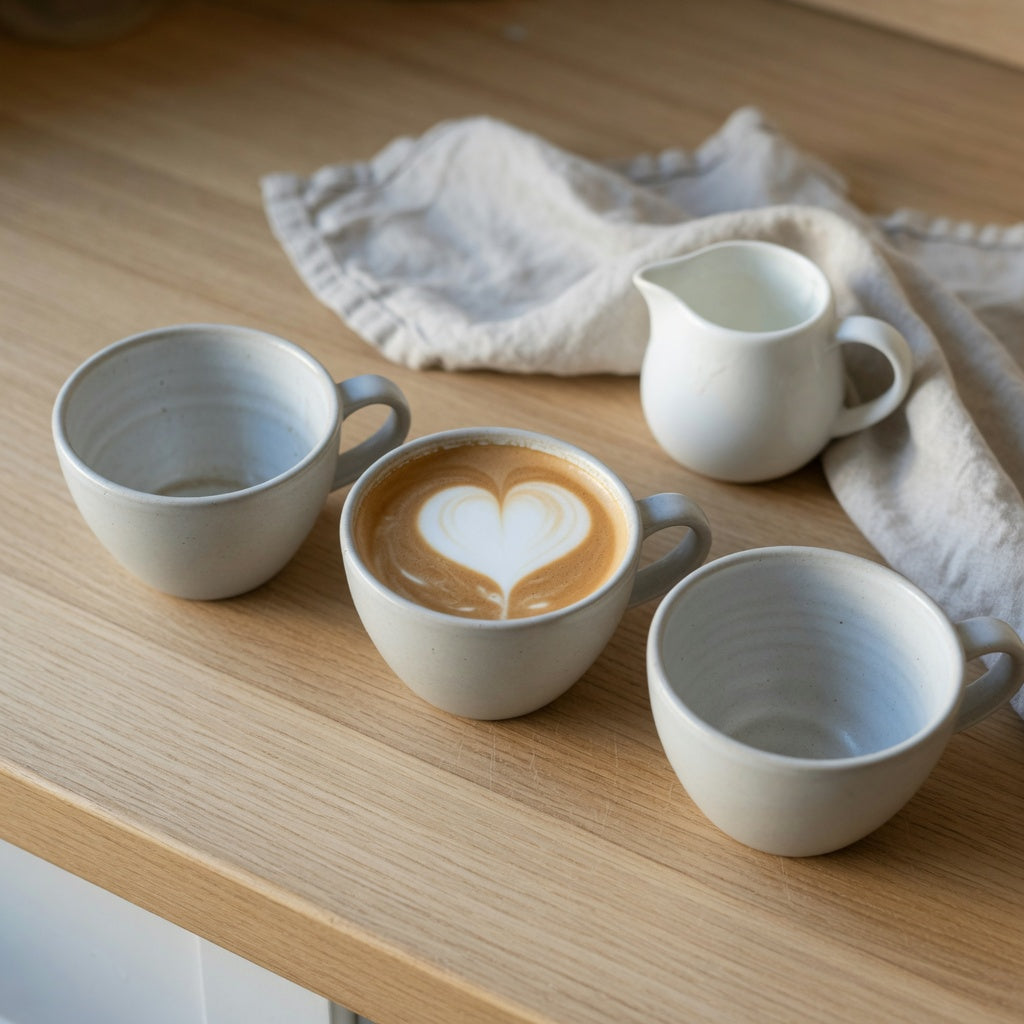
A close look at our three current ceramic latte cups — 250 ml, 400 ml, and 440 ml — covering what a listed capacity really measures, how rounded and straight interiors pour differently, handle fit ...
Read more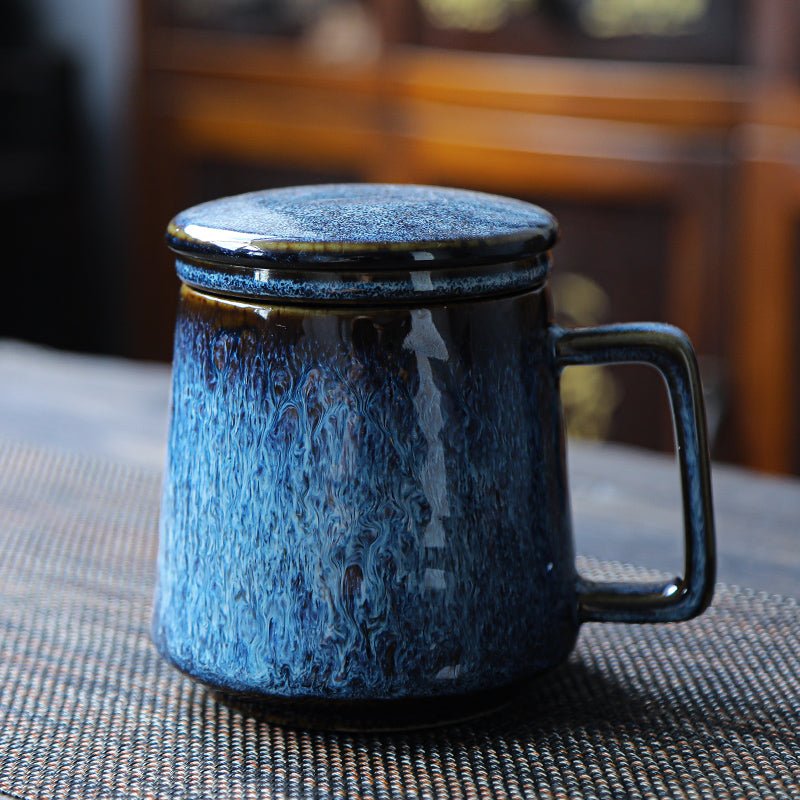
Ceramic Mugs Ideas for Desks and Gift Shelves: Capacity, Care, Fit
A practical way to sort ceramic mugs ideas by listed capacity, desk footprint, handle fit and care labels — plus the safety checks most gift guides skip entirely.
Read more
Leave a comment
This site is protected by hCaptcha and the hCaptcha Privacy Policy and Terms of Service apply.