

Coffee Mugs With Big Handles: 250–480 ml Grip and Capacity
Reading time: about 12 minutes
A customer once told us she had ordered four coffee mugs with big handles from different sellers and returned three. Not because the loops were small — because they were the wrong shape. Wide at the top, pinched near the base, and set so close to the wall that her knuckles scraped hot glaze every time she lifted. Her hands are broad. The photos looked generous. That gap between a handle that photographs big and one that actually lets fingers through is what this page is about.
The three handled mugs we compare here are the Ball Handle at 250 ml, The Flow at 400 ml, and The Rock at 480 ml. The emails we answer are rarely about colour. They are about grip: will it fit my hand, will it still feel steady when it is full, can I hook a thumb through it on a bad-joint morning. Here is how we would walk you through it if you were standing at our table.
Why does a handle that looks big in photos still pinch your knuckles?
A mug handle is a lever, and the loop you grip is only half of it. The other half is the gap between the loop and the mug wall. Two mugs can share an identical-looking loop and feel nothing alike, because one leaves a finger width of air between your knuckles and the ceramic while the other leaves none — and ceramic is exactly where the heat sits on a full, freshly poured mug.
Three measurements decide whether a big handle works for you, and none of them appear in a listing titled 'large':
- Opening area — the usable hole at its tightest point, not the outer silhouette. A thick, chunky-looking handle can hide a surprisingly small opening inside it.
- Set-off distance — how far the loop stands away from the mug wall. Too close, and your knuckles rest on the hot side.
- Vertical grip span — the height of the loop. A very tall handle stretches your hand wide, which costs more wrist effort than the extra room suggests.
None of that reads in a straight-on hero shot. A side-on photo with an actual hand in it tells you more than any bullet list, and a photo with a ruler beside the opening tells you more still.
How much opening actually clears two fingers, three, or a whole hand?
More research exists on this than most mug listings let on. A 2023 study of cups for care-home residents, published in ScienceDirect, named cup mass, cup diameter, handle length, and handle orifice area as the decisive dimensions for people with reduced strength and dexterity. Its focus group preferred the lighter cups with the larger handles.
The number worth memorising comes from earlier hand-clearance work that study cites: about 650 mm² of cross-sectional opening is the minimum for two fingers to pass, and about 950 mm² for three. Picture those as circles — an opening usually is not one — and you get roughly 29 mm across for the two-finger figure and about 35 mm for three.
Run the arithmetic on a real handle. A 30 mm × 20 mm opening gives you 600 mm². That is under the two-finger line, even though the handle may look substantial on a shelf. This is the trap with coffee mugs with big handles: the label describes a photograph, not a hole.
Our rule of thumb: two fingers through the loop is the floor for a normal grip, three is where a mug starts to feel genuinely secure, and a whole hand through the loop is what people usually mean by 'big' — even though it costs you leverage.
Do coffee mugs with big handles get harder to lift as capacity climbs from 250 ml to 480 ml?
Yes, and it is the part buyers underestimate hardest. The handle stays the same size while the load grows, so the same lift gets heavier even though your grip has not changed.
Liquid runs about 1 gram per millilitre. A 250 ml mug carries roughly 250 g of coffee. A 480 ml mug carries close to half a kilogram before the ceramic itself is counted. That weight hangs off the same loop, levered out from the same wrist. A wide loop makes the lever longer, not shorter — the further your hand sits from the load, the more wrist effort the lift demands.
| Mug | Listed capacity | Handle as named or listed | Best suited to | Watch out for |
|---|---|---|---|---|
| Ball Handle | 250 ml | Ball-style handle | Small hands, short black coffees, tea, espresso-based drinks, anyone who wants the lightest full-cup lift | Less liquid — a 350 ml-a-sitting drinker will be refilling |
| The Flow | 400 ml | Confirm opening dimensions on the listing | The everyday middle — a standard large pour plus a top-up | Check the opening before buying if your hands are broad |
| The Rock | 480 ml | Confirm opening dimensions on the listing | Long desk mornings, soup, one big brew that has to last | Heaviest when full; the least forgiving if grip strength is limited |
Notice what the table refuses to do: quote empty weights. We would rather you ask us for a current figure than have us guess at one on a spec line. If a weak wrist is why you are shopping, weight is the number to request before ordering.
One big C-loop, two handles, or a T-grip — which shape suits swollen knuckles?
For painful joints, diameter matters more than most people expect. A biomechanics study of people with rheumatoid arthritis using spoons, published via PMC, found larger handle diameters reduced finger-joint flexion compared with a standard slender handle, and most participants chose a 1.50-inch built-up handle over a 1.00-inch one. The principle transfers to a mug loop: a thicker grip surface spreads pressure across the hand instead of digging into one joint.
The four shapes are not interchangeable:
- One oversized C or D loop — the natural pour-and-sip motion, and the easiest to use one-handed. Fails if the opening is undersized or the filled mug is too heavy.
- Two handles — splits the load across both hands and suits soup, or anyone who cannot risk a one-handed lift. Awkward to drink from on a sofa, and bulky in a cupboard.
- T-handle — lets you grip with a closed fist instead of a pinch, which some people with tremor prefer. Harder to hook over a finger while your other hand is busy.
- Swivel or rotating handle — usually on insulated travel mugs and designed to fold flat. Rarely as rigid as a fixed loop, so test the lock before trusting it with hot liquid.
If your hands are simply large rather than painful, one generous loop almost always wins. If grip strength is the problem, two handles or a smaller, lighter mug is the safer call — even though it is the less exciting purchase.
Ceramic, stoneware, porcelain: how the body changes heat in the hand and life in the dishwasher
Handle comfort gets the attention, but the mug wall decides plenty. Thick-walled stoneware holds heat longer and stays hotter on the outside, which is why set-off distance matters more on a heavy mug than on a thin one. Thin porcelain warms fast and cools fast — pleasant for a quick espresso, less so for a 480 ml coffee you plan to nurse through a meeting.
Practical care points we have picked up from handling returns and answering care questions:
- Thick walls and thick handles are more prone to thermal shock. Do not run a hot mug straight under a cold tap.
- Handles fail at the joint more often than at the loop. Where the handle meets the body is worth inspecting on arrival.
- On a dishwasher rack, load big-handle mugs at the edge where the loop is not knocking against plates for two hours — that is how chips start.
- A wide, thick rim keeps the drink warm but feels different on the lip. If you sip tea slowly, a thinner rim often wins.
- Pre-warm a big mug with hot water before pouring. It does more for how long a 480 ml coffee stays drinkable than wall thickness does.
There is also a surface-area effect. A wide, high-capacity mug exposes more liquid to the air, so a 480 ml pour cools faster than a 250 ml pour from the same pot. That is physics, not a defect — but it is one reason people keep a small mug for the first cup of the day.
Which big-handle mugs should never go in the microwave?
Two things deserve a hard look before any oversized mug goes in.
Metallic bands, rims, and coatings. The U.S. Consumer Product Safety Commission recalled about 440,500 Starbucks-branded holiday gift-set mugs in March 2024, recording 12 incidents and 10 injuries — burns, blisters, and one cut. The hazard centred on metallic-coated ceramic overheating or breaking when microwaved or filled with very hot liquid. If a mug has a gold-painted rim, a mirror finish, or a metallic band, treat it as not microwave-safe unless the maker says otherwise in writing.
Lead in glaze. The FDA's guidance on lead-glazed pottery notes that lead can leach into food and drink from improperly made or fired glazes, and that washing or boiling will not remove it. Everyday factory-made commercial ware is described as far less likely to be affected than handmade, antique, damaged, brightly orange or red or yellow, or uncertain-source pieces. A 'lead free' claim on an imported mug is a seller statement unless a test report is linked.
For our own mugs, read the care line on the individual product page rather than inferring microwave or dishwasher suitability from a photo — and message us if a detail you need is not published. We will not answer a question we cannot verify.
The fit check before checkout: brewer height, warmer plate, rack, cup holder
Capacity tells you nothing about whether a mug works in your kitchen. Run these six checks:
- Height under your brewer. Measure drip tray to dispenser on your machine. Tall 480 ml mugs fail this more often than any other check.
- Base diameter against your warmer plate. The plate is usually the limiting dimension, not the mug's height.
- Stated versus usable capacity. A mug filled to a sensible level, not to the lip, holds less than its listed millilitres. Leave headroom or you will be wiping the counter.
- Handle clearance in the cupboard. Big loops eat vertical space and chip each other when stacked.
- Dishwasher rack position. Confirm the loop sits inside the rack rather than overhanging it.
- Cup holder, for handled travel mugs. Handled insulated mugs frequently miss car cup holders — measure the base before committing.
Which of our three sizes matches your morning?
We keep our unique coffee mug collection short on purpose. Each size exists for a different hand and a different pour.
The Ball Handle at 250 ml is what we point people toward when their hands are smaller or a full mug has felt unstable in the past. A ball-style handle is the whole design premise, and the modest capacity keeps the full-cup lift light. It is a poor fit for anyone who drinks 400 ml in a sitting — you will be back at the pot before the second email.
The Flow at 400 ml is the middle, and the middle is where most buyers land. It matches a standard large pour and stays comfortable to lift for most adults. If your hands are broad, this is the size where we would ask you to check the handle opening dimensions on the listing rather than assume the loop scales up with the body.
The Rock at 480 ml is the jumbo. Long desk mornings, soup, one fill that lasts the commute. It is also the one we would steer you away from if wrist pain or grip strength is why you are shopping: 480 ml of coffee is close to half a kilogram of liquid before the ceramic joins in, and no handle geometry fully compensates for that. Two hands or a smaller mug is the honest recommendation.
If none of those sizes quite matches your hand, the broader collection is where to compare silhouettes side by side.
How do you read a listing that never publishes the clearance?
Most listings will not hand you the numbers. Ask in this order:
- Interior handle opening in millimetres, measured at the tightest point — not the outer handle size.
- Empty weight of the mug.
- Whether the handle is cast with the body or attached after forming.
- Microwave and dishwasher status, stated explicitly.
- Height and base diameter.
If a seller cannot answer the first item, treat 'big handle' as a design description rather than a measurement. That is not dishonesty — it is how most catalogues are written — but it is not enough to buy on. Trace the opening onto paper, measure it, and compare before you check out. If you want a straight answer on any of the three mugs above, ask us first; we would rather talk you out of the wrong size than process the return.
Frequently asked questions
Will coffee mugs with big handles actually fit a large hand?
Only if the opening is big enough — the adjective on the listing tells you nothing. Look for an interior opening of at least 650 mm² to pass two fingers comfortably, and nearer 950 mm² for three. Ask the seller for the opening measured in millimetres at its tightest point before you order.
Is a 480 ml mug too heavy to lift one-handed when it is full?
For many people, yes. Liquid runs about 1 gram per millilitre, so a 480 ml mug carries close to 500 g of drink before the mug's own weight is counted. It is fine for a short lift or a two-handed carry to a desk; it is a poor choice if wrist strength is limited.
Are big-handle ceramic mugs safe in the microwave?
Not automatically. Metallic rims and coatings are a documented burn and breakage hazard — the CPSC recalled roughly 440,500 metallic-coated Starbucks gift-set mugs in 2024 after reported injuries. Check the care instructions on the exact product page, and skip the microwave entirely for anything with a metallic finish.
Which handle shape helps most with arthritis or swollen knuckles?
A wider-diameter grip reduces finger-joint strain compared with a slender one, and research on built-up handles found most participants preferred a 1.50-inch grip over a 1.00-inch version. If grip strength is the main issue, a smaller, lighter mug with a generous loop usually beats a big mug with a huge one.
Does a bigger mug keep coffee hot longer, or cool it faster?
Usually faster. A wide, high-capacity mug exposes more liquid surface to the air, so a 480 ml pour cools sooner than a 250 ml pour from the same pot. Pre-warming the mug with hot water makes a bigger difference than capacity does. If you have narrowed it down to the two larger sizes, the 400 ml Flow is the safer everyday starting point — and the rest of our unique coffee mug collection is there if you want to compare handle shapes before committing.
More from our blog
Read more
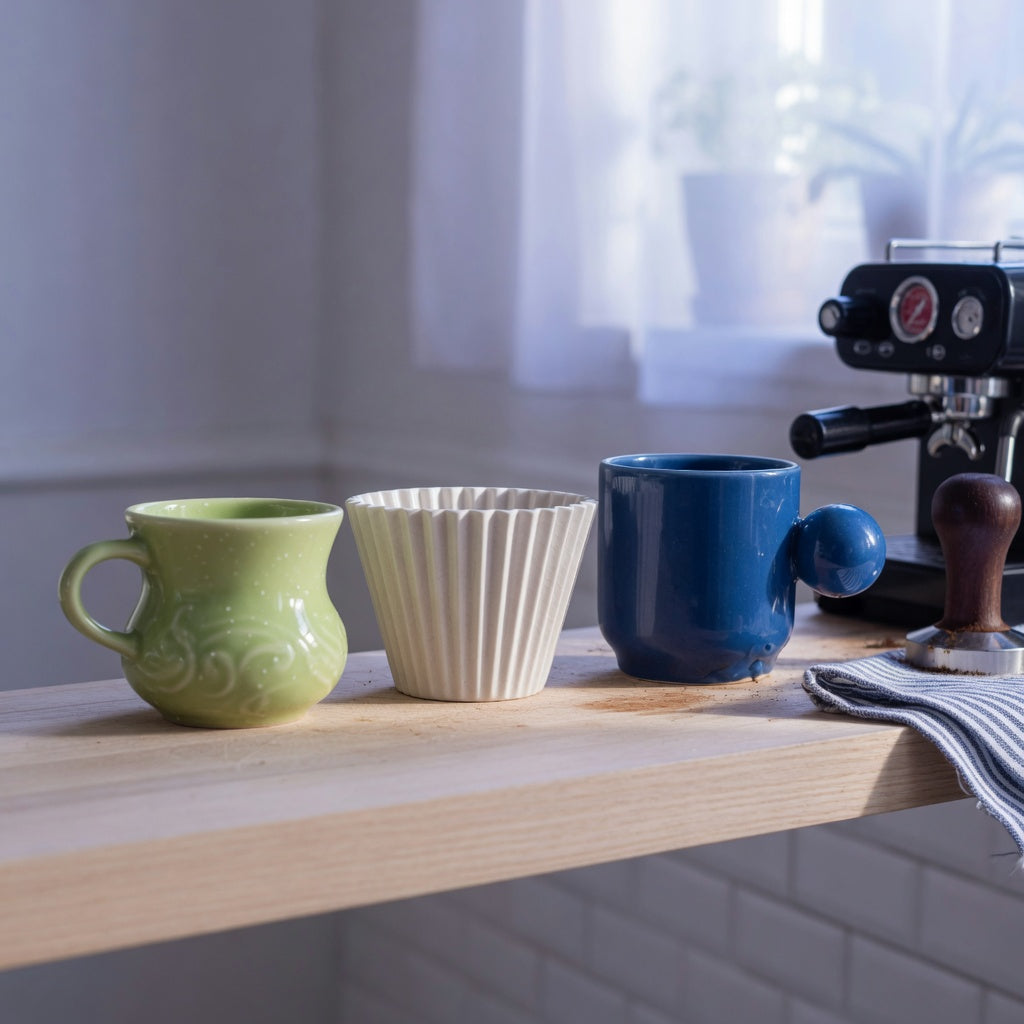
Unique Espresso Cups for Small Coffee Bars: 3 Ceramic Shapes Compared
A hands-on comparison of three compact ceramic espresso cups — 170 ml, 200 ml and 250 ml — covering which pour each one suits, how to check group-head clearance, and what to verify about glaze safe...
Read more
Latte Mugs Tall vs Wide: 400 ml vs 440 ml Ceramic Profiles
Two ceramic profiles 40 ml apart can pour completely differently. We compare what tall means in a latte mug, how 400 ml and 440 ml behave once foam takes up space, and which shape clears your machi...
Read more
Leave a comment
This site is protected by hCaptcha and the hCaptcha Privacy Policy and Terms of Service apply.