



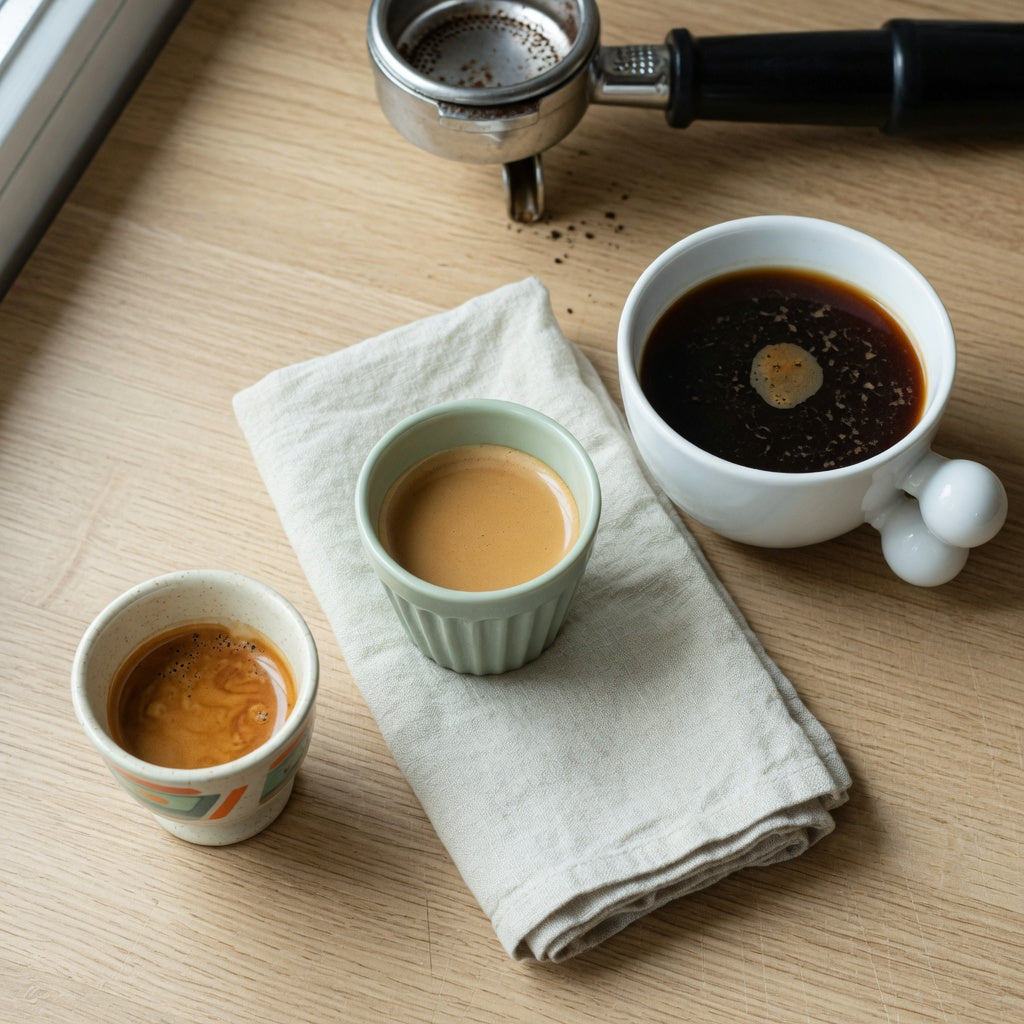
Unique Espresso Cups: Shared Household Product Shortlist Guide
Reading time: about 10 minutes
Two people, one espresso machine, one cupboard. One pulls a straight double and wants a cup barely wider than the portafilter basket; the other builds a cortado and needs roughly twice the room. Buy a matching four-piece set and somebody drinks from the wrong vessel every single morning. This unique espresso cups shared household product shortlist guide is built around that gap — fewer options, each matched to the person who will actually reach for it.
In our store, the questions we field about these cups are almost never about pattern. They are about capacity, clearance under the group head, and whether a cup survives a household where two people load the dishwasher very differently. So here is the short version, scenario by scenario, including the cases where you should skip a cup entirely.
Why capacity, not pattern, decides a shared-household shortlist
A certified Italian espresso is defined at roughly 25 ml, and older specialty definitions put a shot at 25–35 ml. The cup is deliberately larger than the liquid. Working capacity for an espresso cup is commonly cited around 50–100 ml, with a classic demitasse near 60 ml, because crema and headspace need somewhere to sit.
That gap between drink volume and cup volume is where most shared-household disagreements start. The three compact ceramic cups we carry are listed at 170 ml, 200 ml and 250 ml. None of them is a 60 ml demitasse. They are double-shot and cortado vessels — sized for people pulling 36–60 g of espresso, adding steamed milk, or topping up with hot water. If you want a 25 ml ristretto in a cup you can close one hand around, these are the wrong size, and we would rather say so now than process the return.
The unique espresso cups shared household product shortlist guide, sorted by drinker
Each cup below is matched to a person and a drink, not to a shelf aesthetic. Read the "skip it if" column first — that is the line that prevents a return label. All three sit in the same unique coffee mugs collection if you want to compare the ceramic finishes side by side before committing to a capacity.
| Cup | Listed capacity | Household role | Skip it if |
|---|---|---|---|
| Retro Coffee Tea Cup | 170 ml | Straight double with crema room; short cortado or macchiato | You want a 60 ml demitasse or a stackable matched service set |
| Pleated Coffee Tea Cup | 200 ml | Cortado, flat white, and tea for the non-coffee drinker | Nobody in the house drinks milk drinks or tea |
| Ball Handled Coffee Tea Mug | 250 ml | Americano, long black, latte, large tea | Group-head clearance or counter space is tight |
Scenario 1: the straight-double drinker who still wants crema room
Somebody in most two-person households drinks espresso without milk and resents a cup that makes a 40 g shot look like a puddle. That is the job the Retro Coffee Tea Cup handles. At 170 ml listed capacity, a double shot fills roughly a quarter of the cup — enough headspace to swirl without sloshing over the rim, and enough crema surface to actually see what you pulled.
- Fits: one person on straight espresso, the other on a macchiato or a short cortado in the same cup.
- Why it works: 170 ml sits close enough to cortado territory that a splash of milk does not look lost, but far enough below mug size that the shot does not go cold halfway down.
- Skip it if: your household pulls four or five shots a morning and wants them lined up identically on saucers. A one-off ceramic shape is not a stackable service set, and handles collide on a narrow shelf.
Scenario 2: one espresso drinker, one milk-and-tea drinker
Two hundred millilitres is where a cortado stops feeling cramped — and it is the capacity that quietly settles mixed households, because the person who never touches espresso can use it for tea without drinking from what feels like a doll's cup. The Pleated Coffee Tea Cup is listed at 200 ml, and the pleated ceramic profile is usually the reason it gets picked up in the first place.
- Fits: a household where one person pulls shots and the other drinks flat whites, cortados or tea.
- Why it works: there is enough volume for a double shot plus milk without the drink riding over the shoulder of the cup when it is carried across the kitchen.
- Skip it if: nobody in the house drinks milk drinks or tea. You would be buying headspace you never fill, and the 170 ml cup keeps a straight shot hotter.
One honest caveat: ridged and pleated exteriors take longer to dry by hand than a smooth wall, and water can sit in the grooves if the cup goes straight onto a draining board upside down. Wipe it rather than shaking it dry. Check the listing photos for the actual ridge depth and for the base width relative to your drip tray — neither detail reliably survives being guessed from a styled hero shot.
Scenario 3: espresso as a base, not a destination
Every shared kitchen has one: the person who pulls a double and then adds hot water, or builds a latte that is more milk than coffee. The Ball Handled Coffee Tea Mug is listed at 250 ml, which is the honest answer to that habit — an americano or long black fits in one pour instead of two.
- Fits: americanos, long blacks, lattes and large teas — the drinks that make a 170 ml cup feel like a sample.
- Why it works: the capacity matches the drink instead of forcing it into two pours, and a rounded ball handle reads as a fuller grip than a thin loop once the cup is full and hot.
- Skip it if: the machine sits under a low cabinet, or counter space is already tight. Two hundred and fifty millilitres of ceramic plus a protruding handle takes real estate, and a full cup is heavier to lift one-handed over a keyboard.
Does the interior colour change how a shot tastes, or just how it reads?
It does not change flavour. It changes how well you can judge what you pulled. A white interior shows crema colour, tiger-striping and the blonding at the edges; a dark or heavily patterned interior hides exactly those cues. If one person in the house is still learning to dial in a grinder, give them the cup with the palest interior and let the other person keep the decorative one. Rim geometry matters too — many drinkers find a thick, rounded rim feels softer on the lip, while a thin flared rim spreads the liquid across more of the tongue.
Three fit checks that decide whether a cup gets used or abandoned
- Group-head clearance. Measure from the drip tray to the underside of the portafilter with your tallest cup in place. A cup that only fits at an angle gets abandoned within a week.
- Outer base diameter versus the drip tray. A wide foot can overhang the grate and wobble; a very narrow one can tip mid-pour. Confirm the measurement on the current listing rather than eyeballing the photo.
- Storage and stacking. One-off ceramic shapes rarely nest, and handles collide on a narrow shelf. If three people want three different cups, plan the shelf before you plan the order.
For each of our three cups, the details worth confirming on the live product page are the outer base diameter, whether a saucer is included, and the exact care instructions. We keep those on the listing rather than in a blog post, because they are the details that can change between batches.
Glaze safety on handmade and brightly decorated cups
"Unique" often means handmade, imported or vividly glazed — which is precisely where food-contact questions belong. The FDA notes that lead in ceramic glazes or decorations can leach into food and drink if the pottery is not properly fired, that some traditional pottery labelled lead free has still shown extractable lead at or above FDA action levels, and that washing or boiling cannot remove lead from pottery. The action level for ceramicware cups and mugs is 0.5 µg/ml of leaching solution.
The FDA also names the higher-risk categories: handmade pieces with a crude or irregular look, antiques, damaged or worn ware, flea-market finds and unknown makers, and ware brightly decorated in orange, red or yellow. Under 21 CFR 109.16, ornamental ceramicware that could reasonably be used for food must carry a conspicuous "Not for Food Use" label or a hole through the food-contact surface. In practice, a vivid reactive glaze is a reason to ask the seller for lead and cadmium test results — not a reason to assume the worst, and not proof of safety either.
Care routines that quietly shorten a cup's life in a two-person kitchen
Decoration is the usual culprit. Gold rims, metallic lustres and hand-painted patterns are the finishes most often labelled hand-wash only, and the same decoration frequently disqualifies a cup from microwave use. Glass scratches against stacked ceramic, and unglazed feet trap water in the dishwasher and hold it against the shelf long after the cycle ends.
Thick ceramic has one honest drawback: it takes longer to warm, so a shot poured into a cold cup sheds heat fast. Fill the cup with hot water from the kettle while the machine comes up to pressure, tip it out, then pull the shot. Plenty of baristas simply park their cups on the machine's warming tray for the same reason — it is the cheapest upgrade in espresso, and it costs nothing.
Frequently asked questions
Is 170 ml too big for a double espresso?
It is larger than a classic 60 ml demitasse, but that is not automatically a problem. A 170 ml cup holds a 36–60 g double shot with room for crema and a swirl, and it still works for a short cortado. It is only too big if you specifically want the concentrated, fast-cooling experience of a narrow 50–60 ml cup.
Do these unique espresso cups arrive as matching sets with saucers?
Do not assume a matched set or an included saucer — check what is in the box on each product page before ordering three for a household. If visual uniformity on an open shelf matters to you, order from one style rather than mixing shapes and confirm the saucer question first.
Can two people with different coffee habits share one style of cup?
Sometimes, and 200 ml is the capacity most likely to satisfy both. The straight-espresso drinker gets headspace; the milk or tea drinker gets usable volume. If one person drinks americanos or large lattes, though, a single 250 ml mug for the whole household leaves the espresso drinker holding a cup that swallows the shot.
How do I check that a handmade or brightly glazed cup is safe for hot coffee?
Ask the seller for lead and cadmium test results, and look for a "Not for Food Use" mark on the base, which means decorative only. Be cautious with antiques, flea-market finds, unknown makers and heavily decorated orange, red or yellow pieces. Retire any cup whose glaze is worn, chipped or crazed — a damaged surface is not something to keep drinking from.
What is the fastest way to use this unique espresso cups shared household product shortlist guide?
Count the drinks, not the people. If the household pulls straight doubles, start at 170 ml. If milk drinks and tea are in the mix, start at 200 ml. If americanos and lattes dominate, start at 250 ml. Then confirm group-head clearance and base diameter before you order.
Still deciding? Open the full unique coffee mugs collection, shortlist two capacities instead of four lookalikes, and check the base diameter and care notes on the specific product page. One cup per drinker beats four matching cups that three people quietly avoid.
More from our blog
Ready to pick your mug? Two ways to save on today's order:
Ordering 1–3 mugs? Get an extra 10% off your 1st order with code 10_OFF Apply 10% Off & Shop Wooden-Handle Mugs →
Gifting 4+ mugs? Buy 3, Get the 4th Free applies automatically at checkout (no code needed; offers do not stack) · Free standard shipping (Nov pre-Christmas delivery: 15–20 calendar days US) · Free replacement if chipped in transit.
Popular mug buying guides: Ceramic Tea Cups & Infuser Mugs · Ceramic Mugs with Lids Compared · Wooden-Handle Tea Infuser Mugs Compared · Christmas & Secret Santa Mugs 2026 · Espresso & Cortado Cups Guide · Cup & Saucer Gift Sets · All 25 Mugs Spec Table · Mug Size Guide · Shipping & Promo FAQ
FIRST ORDER 10% OFF (CODE: 10_OFF) · OR BUY 3, GET THE 4TH FREE


Read more
14 oz Ceramic Coffee Mugs Shared Household Practical Purchase Checklist
A working checklist for buying 14 oz ceramic mugs when several people share one kitchen: what 414 mL really pours, which drinker each capacity suits, how care marks and lead claims should be read, ...
Read more
Unique Espresso Cups Weekend Coffee Practical Purchase Checklist
A weekend-focused checklist for choosing unique espresso cups by capacity, machine clearance, crema visibility, glaze safety, and care, with honest fit notes on our 170-250 ml ceramic cups.
Read more
Leave a comment
This site is protected by hCaptcha and the hCaptcha Privacy Policy and Terms of Service apply.