



Unique Espresso Cups First Time Buyer Practical Purchase Checklist
Reading time: about 10 minutes
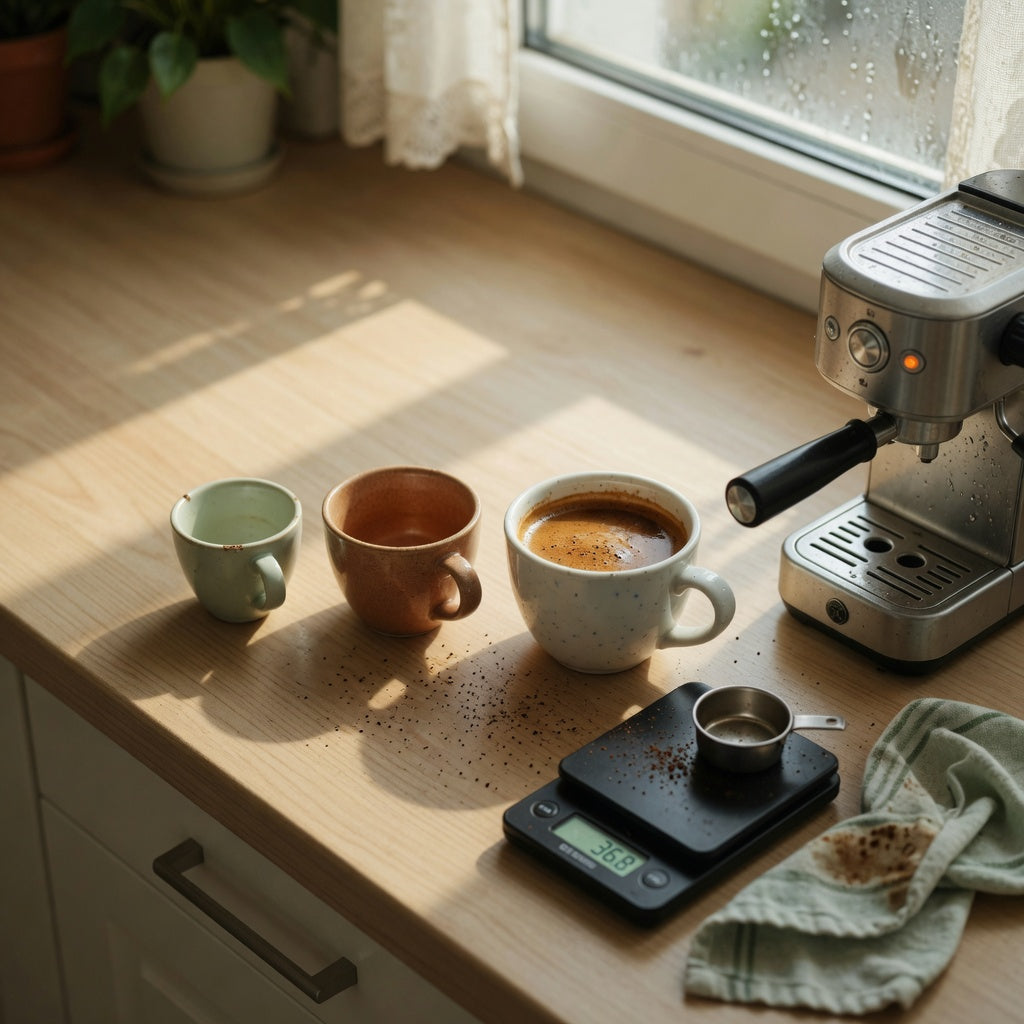
The photo shows a pleated wall in speckled sand glaze and a handle curled like a comma. What it does not show: whether a double shot will fill a third of the cup, whether that handle clears your drip tray, or whether the base is stamped “for decorative use.” We unpack, photograph, and repack these cups in our store most weeks, and the returns rarely come down to a glaze being the wrong shade. They come down to a detail the listing never printed.
So here is the short version of what we tell first-time buyers: treat the product page as a spec sheet with gaps, and know which gaps matter. This unique espresso cups first time buyer practical purchase checklist covers the nine details worth verifying before checkout, the ones to email about when the page stays silent, and how our three compact ceramic sizes map to a double shot or a cortado.
Why does a 25 ml shot need a cup that holds 50–100 ml?
Because the cup is not the drink. A certified Italian single espresso is a touch above 25 ml, older specialty definitions put it at 25–35 ml, and a demitasse cup generally runs 50–100 ml, with roughly 60 ml as a familiar middle. Crema, headspace, and the simple act of lifting a full cup without sloshing take up the difference.
That gap is where “unique” gets expensive. A 40 ml sculptural cup is technically a demitasse and practically a thimble for a double. A 250 ml cup makes a 30 ml shot look like a stain on the bottom. Read every number on a listing as capacity, never as pour size, then match it to what you actually drink.
| What you usually drink | Capacity that tends to work | What to verify first |
|---|---|---|
| Single espresso, 25–35 ml | 60–100 ml | Interior color, rim thinness, preheat habit |
| Double shot | 90–170 ml | Base diameter, height under the group head |
| Cortado (shot plus equal milk) | 150–200 ml | Handle clearance, wall thickness |
| Cappuccino or small latte | 200–280 ml | Whether it is an espresso cup at all |
The last row matters more than it looks. Plenty of cups sold as espresso cups are cappuccino cups wearing a smaller photo. If your morning is one 30 ml shot and nothing else, a 250 ml vessel changes the ritual more than the coffee does.
What belongs on a unique espresso cups first time buyer practical purchase checklist?
Nine items. Each one is either printed on a good listing or worth a message before checkout.
- Usable capacity versus brim capacity. Some sellers quote the volume to the very top, others the comfortable fill line. Ask which number you are reading.
- Interior color. White, off-white, or clear glass lets you read crema. Dark reactive glazes hide it — fine for taste, unhelpful while you are still dialing in a grinder.
- Rim thickness. A thick rolled rim feels soft on the lip and holds heat; a thin flared rim pushes coffee toward the front of your tongue faster. Square or novelty rims look striking and drink awkwardly because liquid funnels into a corner.
- Wall thickness. Thick handmade walls hold temperature but demand preheating. A cold thick cup pulls heat out of a 30 ml shot in seconds.
- Outer base diameter. This decides whether the cup sits flat on your drip tray grate or wobbles across the bars.
- Overall height. Measure from drip tray to the underside of the group head, then subtract a finger’s width for the spout.
- Handle clearance, or no handle at all. A generous-looking handle can collide with the machine body. Handleless cups dodge that and run hot.
- Saucer footprint and stackability. One-off pottery and double-wall glass rarely stack. If shelf space is tight, check the saucer, not just the cup.
- Food-contact and care statement. Look for an explicit glaze line and a dishwasher or microwave line. Absent both, treat both as unknown.
Seven of nine answered is a strong listing. Three of nine is a conversation. Silence about base diameter or glaze safety is not a “no” — it is an unknown, and unknowns belong in your email, not in your assumption.
Will the cup clear your machine, your scale, and your drip tray?
Three measurements cause nearly every fit complaint we hear:
- Group head to drip tray. A tall cup with a high handle can be blocked before it reaches the spout.
- Base diameter against grate spacing. Small bases slip between bars; wide bases overhang and tip.
- Scale clearance. If you weigh shots, cup plus scale must fit under the spout together, which usually rules out the tallest options.
With a bottomless portafilter, add a little more room — the basket sits lower and the stream is less forgiving of a cup you have to slide in at an angle. Write your three numbers down before you shop and the shortlist collapses fast. Our unique coffee mugs collection lists capacity on every piece, which is the number to solve first.
Do thick walls, dark glazes, and metal rims change what you taste?
Two small effects that add up.
Heat. A 30 ml shot has almost no thermal mass. Pour it into a cold, thick-walled cup and the temperature drops noticeably before your second sip. Baristas keep cups on the warming tray; at home, a ten-second fill with hot tap water does the same job. Thick ceramic rewards that habit and punishes skipping it.
Feedback. A white or clear interior shows crema color, your fastest read on whether a shot ran fast or slow. A deep green or charcoal reactive glaze is more interesting to look at and less useful to learn from. If espresso is new to you, buy the light interior first and the dramatic glaze second — we watch plenty of customers do it in that order.
Are handmade and brightly glazed cups safe for hot coffee?
This is the section most buying guides skip, and it matters more for unique cups than for plain white china.
The FDA’s guidance is blunt: lead in glaze or decoration can leach into food and drink if a piece is not properly fired, and washing or boiling will not remove it. The agency flags handmade pieces with a crude or irregular look, antiques, damaged or worn ware, flea-market and unknown-maker items, and pieces brightly decorated in orange, red, or yellow as higher-risk. It advises against food use if a lead test is positive, or if the base is marked not for food use.
Two reference points worth carrying to checkout. The FDA’s chemical-contaminants listing sets an action level of 0.5 µg/ml leaching solution for lead in ceramicware cups and mugs under CPG 545.450. And 21 CFR 109.16 requires ornamental ceramicware that could reasonably be used with food to carry conspicuous “Not for Food Use” labeling or a hole through the food-contact surface.
In practice: “lead free” printed on a listing is a claim, not a test result — the FDA notes some traditional pottery labeled lead free has still shown extractable lead at or above action levels. On a mass-produced cup from a known brand that is usually enough. On a one-off handmade piece with a bright reactive glaze, ask for the glaze supplier or a test result. If the answer stays vague, use it as a pen holder.
How do our three ceramic sizes map to a double shot, a cortado, or a latte?
Our ceramic espresso and tea cups come in three compact sizes, and each suits a different drinker. None is a 25 ml Italian demitasse. If you want a shot filled to the rim, keep looking. These are compact ceramic vessels sized for double-shot and cortado routines, with room for crema and a little headspace.
- Retro coffee and tea cup, 170 ml — the closest thing to a classic double-shot cup in our range. If your routine is one double espresso each morning and you want the cup to feel full rather than half-empty, start here. It is also the size most customers settle on for a small cortado without switching vessels.
- Pleated coffee and tea cup, 200 ml — more headroom plus a textured wall that catches light. The one for cortado drinkers, and for anyone alternating between espresso and a small milk drink in the afternoon.
- Ball handle coffee and tea mug, 250 ml — the largest of the three and the easiest for anyone who dislikes thin handles. It works for a longer black coffee, a small cappuccino, or tea. It is not the cup for a strict 30 ml shot; the coffee will look lost.
Two things we will not answer from a photo, and you should confirm on the current product page: whether the glaze is stated as food-safe, and whether the cup is dishwasher or microwave safe. Those are exactly the details we would not want a first-time buyer to assume.
Which care habits keep a decorative cup alive past month three?
- Metallic lusters and gold rims are the least dishwasher-friendly finish on any cup. Detergent and heat dull them over repeated cycles.
- Hand-painted decoration often survives machine washing but slowly loses crispness. Hand washing keeps linework sharp.
- Reactive and crackle glazes are usually fine but can craze further with thermal shock — avoid moving a cold cup straight into a hot rinse.
- Glass scratches against other dishes and clouds over time. Wash separately or by hand.
- Unglazed feet and recessed bases trap water and leave a residue ring if they go into the cabinet damp.
Microwave logic follows the same rules. Any metallic decoration rules a cup out. Thick ceramic heats unevenly and can be hot to the hand while the coffee is still lukewarm. When a listing states neither dishwasher nor microwave status, assume hand wash — that is the default we give customers who ask about a piece with no care line.
Frequently asked questions
Is a 170 ml cup too big for a single espresso?
For a 25–35 ml single, yes — the liquid sits in the bottom third. For a double shot, 170 ml is comfortable, with room for crema and headspace. If you only ever pull singles, look for something closer to 60–90 ml instead.
Should I buy a white interior or a colored one?
White or clear if you are still learning to judge a shot, because crema color is your fastest feedback. Colored and reactive glazes are more distinctive but hide that signal. Many of our customers end up owning one of each.
How do I know if a handmade cup is safe to drink from?
Ask the seller directly for a food-contact statement or a glaze test result. The FDA treats irregular handmade ware and bright orange, red, or yellow decoration as higher-risk, and washing will not remove lead from a poorly fired glaze. A vague answer is your answer.
Do I need to preheat a thick ceramic espresso cup?
With a 30 ml shot, yes — a cold thick wall pulls heat out fast. Fill the cup with hot water for ten seconds while the shot pulls, then empty it. It is the cheapest upgrade available to your coffee.
What is the first item on a unique espresso cups first time buyer practical purchase checklist?
Capacity, read as capacity rather than pour size. Interior color, base diameter, handle clearance, and care only matter once the cup is the right size for the drink you actually make.
If you are down to two cups and cannot decide, measure your group head clearance first and pick the one that clears it with room to spare. Then browse the rest of the unique coffee mugs collection for a second size — most people end up wanting one cup for shots and one for milk drinks. And when a listing leaves capacity, glaze safety, or care unstated, ask before you buy. A two-line reply beats a return.
More from our blog
Ready to pick your mug? Two ways to save on today's order:
Ordering 1–3 mugs? Get an extra 10% off your 1st order with code 10_OFF Apply 10% Off & Shop Wooden-Handle Mugs →
Gifting 4+ mugs? Buy 3, Get the 4th Free applies automatically at checkout (no code needed; offers do not stack) · Free standard shipping (Nov pre-Christmas delivery: 15–20 calendar days US) · Free replacement if chipped in transit.
Popular mug buying guides: Ceramic Tea Cups & Infuser Mugs · Ceramic Mugs with Lids Compared · Wooden-Handle Tea Infuser Mugs Compared · Christmas & Secret Santa Mugs 2026 · Espresso & Cortado Cups Guide · Cup & Saucer Gift Sets · All 25 Mugs Spec Table · Mug Size Guide · Shipping & Promo FAQ
FIRST ORDER 10% OFF (CODE: 10_OFF) · OR BUY 3, GET THE 4TH FREE


Read more
14 oz Ceramic Coffee Mugs: Compact Kitchen Product Shortlist Guide
A scenario-based shortlist for tight kitchens: separate brim ounces from a pour you actually finish, measure the cabinet slot and handle opening, then match our 400 ml, 440 ml and 480 ml mugs to th...
Read more
14 Oz Ceramic Coffee Mugs Weekend Coffee Practical Purchase Checklist
A checklist built for the slower Saturday pour: what 14 oz really means in milliliters, which of our three ceramic mugs lands closest, and the glaze, handle, and care details worth verifying before...
Read more
Leave a comment
This site is protected by hCaptcha and the hCaptcha Privacy Policy and Terms of Service apply.