



14 oz Ceramic Coffee Mugs: Compact Kitchen Product Shortlist Guide
Reading time: about 11 minutes
A mug can hold exactly the right amount of coffee and still be the wrong purchase. In a compact kitchen it fails in predictable places: the handle catches the cabinet door, the base is too wide for the brewer drip tray, or the mug gets heavy enough when full that you reach past it for something smaller. We handle these mugs on the packing bench every week, and the emails that arrive are rarely about colour. They are about fit. That is the problem this 14 oz ceramic coffee mugs compact kitchen product shortlist guide solves — three sizes, matched to real shelf space, with a plain reason to choose or skip each one.
Why a 14 oz label rarely means 14 oz in the cup
Fourteen U.S. fluid ounces is about 414 mL. Set that beside the FDA’s own working description of a cup or mug — roughly 240 mL, or 8 fl oz — and the 14 oz class is clearly a size up from a cafe cup. It sits closer to a generous drip serving, or a latte with room for a foam cap.
Nobody drinks from a brim-full mug. Most people stop a centimetre or two short, and a milk drink needs headroom on top of that, so the honest pour is always smaller than the number on the box. Shape decides how much you lose. A straight-sided mug and a bowl-shaped mug can both be labelled 14 oz and behave like two different cups, because one gives you usable height and the other flares wide and shallow.
Two questions settle the comparison faster than any capacity chart:
- Is the stated figure brim capacity, or the fill the brand expects you to drink?
- If the mug takes a lid, was capacity measured with the lid seated?
If you finish 10 to 12 oz in a sitting, a 400 mL mug often beats anything labelled 14 oz. You get the size without the last third going cold on the desk.
Cabinet math: what to measure before you trust a product photo
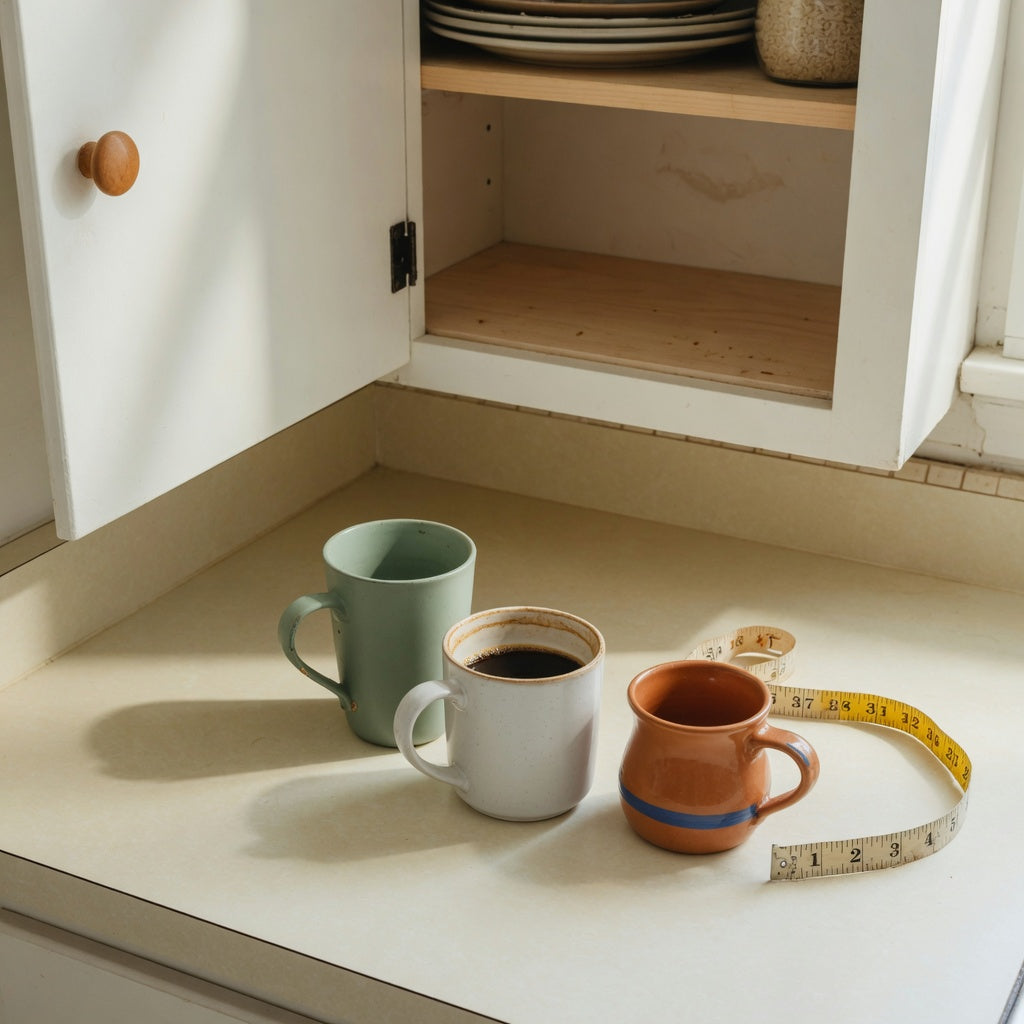
Capacity tells you nothing about footprint. A tall 14 oz mug and a wide 14 oz mug need different shelf heights even when the label matches. There is a tape measure on our packing bench for exactly this reason. When a customer asks whether a mug will clear their single-serve brewer, we ask for two numbers: the gap from the drip tray to the spout, and the mug’s exterior height. Capacity alone cannot answer that question.
Measure the slot, not the mug:
- Clear interior height from shelf to shelf with the cabinet door shut.
- Shelf depth with the mug pushed back, plus how far the handle projects.
- Handle opening — the clear gap between handle and body — and whether your knuckles miss the hot wall when the mug is full.
- Clearance under a brewer spout or drip basket.
- Base diameter if the mug has to sit in a cup holder or on a narrow desk coaster.
Photos are not measurements. A mug shot beside a coffee scoop is flattering by design, and a three-quarter angle hides how far a handle sticks out. If a dimension you need is missing from a listing, treat it as unknown rather than assuming the best, and ask the store to measure the actual piece. When we describe a mug in our own store, we would rather leave a number blank than publish a guess.
What earns a place in this 14 oz ceramic coffee mugs compact kitchen product shortlist guide
Our mugs do not all land on 14 oz, and we will not round the numbers to make the label tidier. Here are the stated capacities and the situation each one solves.
| Mug | Stated capacity | Choose it if | Skip it if |
|---|---|---|---|
| The Flow | 400 ml (about 13.5 fl oz) | Your real pour is 10 to 12 oz and you want headroom, or the shelf is shallow and you will confirm exterior height before ordering. | You need a full 14 fl oz plus a foam cap, or the number on the label has to read 14. |
| Morning and Night | 440 ml (about 14.9 fl oz) | You asked for 14 oz and want the smallest of our mugs that clears it, with margin left for milk. | You want a small cup for tea or a cortado, or you need the capacity to be exactly 14.0 fl oz. |
| The Rock | 480 ml (about 16.2 fl oz) | You drink 16 oz drip or iced coffee, or a latte that needs real foam room, and you have already measured the shelf. | You want a true 14 oz mug, your cabinet is tight, or you rarely finish 16 oz while it is still hot. |
Now match the scenario rather than the label:
- Tight shelf, one drip coffee a day: The Flow at 400 ml is the smallest of the three on stated capacity, which makes it the easiest to justify in a crowded cabinet. It sits just under 14 fl oz, so treat it as a 12 oz pour with headroom rather than a true 14. Confirm exterior height and handle clearance on the listing before you commit, because we do not publish a shelf-height claim here.
- The 14 oz brief is firm and you want margin: Morning and Night at 440 ml is the smallest of our three that clears 14 fl oz, at about 14.9. That extra fraction of an ounce is your milk splash and your safety gap. Skip it if you wanted exactly 14.0 and nothing more.
- Iced coffee or a genuine 16 oz habit: The Rock at 480 ml. Skip it for a small hot brew. A big mug cools a small pour faster because more surface area is working against you.
- Office desk or commute: capacity comes second. Check base diameter and handle shape first, and never assume a handled mug fits a car cup holder; cup holders are built around tapered travel cups, not straight ceramic walls.
- Gift for someone who asked for 14 oz: Morning and Night clears the number without tipping into 16 oz territory. Before you wrap it, read the care line and any glaze statement for that exact piece. A gift that cannot go in the dishwasher is a chore, not a present.
A mug that is half an ounce off the brief is a small compromise. A mug that does not fit the shelf is clutter. If you are still weighing shapes, browse the unique coffee mugs collection and filter by capacity before you fall for a glaze.
The full-mug test: weight, handle opening and stacked height
A 14 fl oz pour adds roughly 400 g of liquid before the mug’s own weight is counted. That is why a mug that feels balanced empty can feel like a different object full and hot, and why the handle matters more here than on a small cup.
- Body type: thick stoneware holds heat well but is heavier empty; thin porcelain is easier one-handed but sheds heat faster; double-wall ceramic buys insulation at the cost of usable volume, so a double-wall body of the same outside dimensions usually holds less than a single-wall one; a ceramic-lined steel tumbler is often lighter than thick stoneware, but you are buying a coating rather than a solid ceramic body, so check how that lining is rated for heat and washing.
- Handle opening: measure the clear gap, then picture two fingers plus a thumb. A narrow opening forces your knuckles toward the hot wall exactly when the mug is heaviest.
- Foot and stacking: handled mugs do not nest. If shelf or drawer space is the real constraint, measure stacked height, not the height of one mug.
- Rim glaze: decoration at the lip deserves its own look, separate from the interior glaze, because that is where your mouth sits every morning. Overglaze decals on the rim also behave differently in a dishwasher than glaze fired under the surface.
- Interior finish: a matte interior tends to show coffee-oil rings sooner than a glossy one in our experience, and crazing — the fine web of lines in an older glaze — is worth inspecting on any second-hand or handmade mug before you trust it with hot coffee.
Care marks, metallic trim and glaze questions to ask per mug
Two mugs with the same capacity and the same glaze colour can carry different care limits. A gold rim, a metallic handle or an overglaze decal can pull an otherwise microwave-friendly ceramic body out of the microwave entirely. A collection-level care note does not always cover every finish on that shape, so read the line for the exact mug in your cart. If the listing does not state microwave and dishwasher ratings for that finish, ask before ordering.
On glaze safety, keep the questions narrow. FDA guidance sets an action level of 0.5 micrograms of lead per millilitre of leaching solution for cups and mugs, judged on any one of six units, and 0.5 micrograms of cadmium per millilitre for small hollowware. The agency has also warned that some imported pottery sold as “Lead Free” still released extractable lead. Under 21 CFR 109.16, decorative ceramicware that looks drinkable is treated as food-use ware unless it carries a “Not for Food Use” warning or is physically disabled — a reminder that a mug-shaped object is not automatically a mug.
California’s health department adds the plain-language version: you cannot tell whether a dish contains lead by looking at it. Plain white ware is rarely a concern, while damaged or chalky glaze, decoration sitting on top of the glaze and bright colour on the food-contact surface are the higher-risk combinations — and coffee is acidic enough to matter. The same source draws the distinction buyers blur: lead-free means no lead, while lead-safe means it may contain some lead but does not leach above the state standard. A small peer-reviewed pilot study of ceramic mugs found lead concentrations in brewed coffee that varied widely from mug to mug, with one estimate above California’s daily maximum allowable dose level even though measured leaching stayed inside the FDA cup-and-mug limit. That is not a reason to distrust your cupboard. It is a reason to ask a seller for a test statement when the glaze is decorative or the origin is vague.
What this shortlist deliberately leaves out
- Exactness. If you need precisely 14.0 fl oz, none of our three mugs is that, and we will not pretend otherwise.
- Long heat retention. Ceramic outlasts thin glass, but it is not a vacuum flask. If coffee has to stay hot for two hours, a lined travel mug is the right tool.
- Deep drawer storage. Handled mugs waste vertical space. Measure stacked height if that is your real constraint.
- Car cup holders. A wide handled mug is not designed around one, whatever its capacity.
- Matching sets. Check what is actually available in the size you chose instead of assuming a four-piece set exists in every finish.
The 60-second check before you add a mug to your cart
- Measure cabinet height, shelf depth and door swing with an existing mug in the slot.
- Check brewer clearance and, if the mug travels, cup-holder diameter.
- Write down your real pour in millilitres, not ounces.
- Read the care line for that exact piece: microwave, dishwasher, metal trim, decals.
- Ask for a lead and cadmium test statement if the glaze is decorated or the listing is vague.
- Pick one mug for one scenario and skip the rest.
For most compact kitchens the answer is Morning and Night at 440 ml when the 14 oz brief is firm, The Flow at 400 ml when you would rather have a smaller pour that stays hot to the last sip, and The Rock at 480 ml only after you have measured the shelf and admitted you drink closer to 16 oz. Compare the full range in our ceramic mug collection, then confirm dimensions and care marks on the current product page.
Frequently asked questions
Is 14 oz the same as 400 ml?
No. Fourteen U.S. fluid ounces is about 414 mL, so a 400 mL mug holds roughly 13.5 fl oz — just under the target. Our Morning and Night is 440 ml (about 14.9 fl oz) and The Rock is 480 ml (about 16.2 fl oz). Compare stated millilitres, then ask whether that figure is brim capacity or a comfortable fill.
Will a 14 oz mug fit under my single-serve brewer?
Not by capacity alone. Height and body width decide it, and those numbers rarely sit next to the ounce label. Measure the gap between the drip tray and the spout, then check exterior height and base diameter on the listing. If either is missing, ask before ordering rather than guessing from a photo.
Does “lead free” mean the glaze was actually tested?
Not necessarily. California’s health department separates lead-free tableware, which contains no lead, from lead-safe tableware, which may contain some lead but does not leach above the state standard. FDA has found pottery labelled lead free that still released extractable lead, so a test statement is worth more than the phrase on the box.
Can I microwave a ceramic mug with a gold handle or metallic rim?
Treat metallic trim, gold rims and many overglaze decals as a stop sign until the care line for that exact mug says otherwise. A ceramic body does not guarantee microwave safety once the handle or decoration contains metal, and the same shape is often sold in both finishes.
How do I compare a 14 oz mug with the 12 oz one I already own?
Pour water from your current mug into a measuring jug and note the millilitres at your normal fill level, not at the brim. That single number settles most of the decision — it is the comparison this 14 oz ceramic coffee mugs compact kitchen product shortlist guide keeps returning to, because it reflects what you drink rather than what the box claims.
More from our blog
Ready to pick your mug? Two ways to save on today's order:
Ordering 1–3 mugs? Get an extra 10% off your 1st order with code 10_OFF Apply 10% Off & Shop Wooden-Handle Mugs →
Gifting 4+ mugs? Buy 3, Get the 4th Free applies automatically at checkout (no code needed; offers do not stack) · Free standard shipping (Nov pre-Christmas delivery: 15–20 calendar days US) · Free replacement if chipped in transit.
Popular mug buying guides: Ceramic Tea Cups & Infuser Mugs · Ceramic Mugs with Lids Compared · Wooden-Handle Tea Infuser Mugs Compared · Christmas & Secret Santa Mugs 2026 · Espresso & Cortado Cups Guide · Cup & Saucer Gift Sets · All 25 Mugs Spec Table · Mug Size Guide · Shipping & Promo FAQ
FIRST ORDER 10% OFF (CODE: 10_OFF) · OR BUY 3, GET THE 4TH FREE


Read more

Ceramic Mug Shapes Shared Household Practical Purchase Checklist
A shelf-tested way to assign ceramic mug shapes in a household that shares everything: measure the real pour, check rim and handle room, and know which glaze questions the silhouette cannot answer.
Read more
Unique Espresso Cups First Time Buyer Practical Purchase Checklist
Unique cups rarely fail on looks. They fail on capacity, clearance, or care — so we turned the details a listing should show into a nine-point checklist, plus how our 170 ml, 200 ml, and 250 ml cer...
Read more
Leave a comment
This site is protected by hCaptcha and the hCaptcha Privacy Policy and Terms of Service apply.