
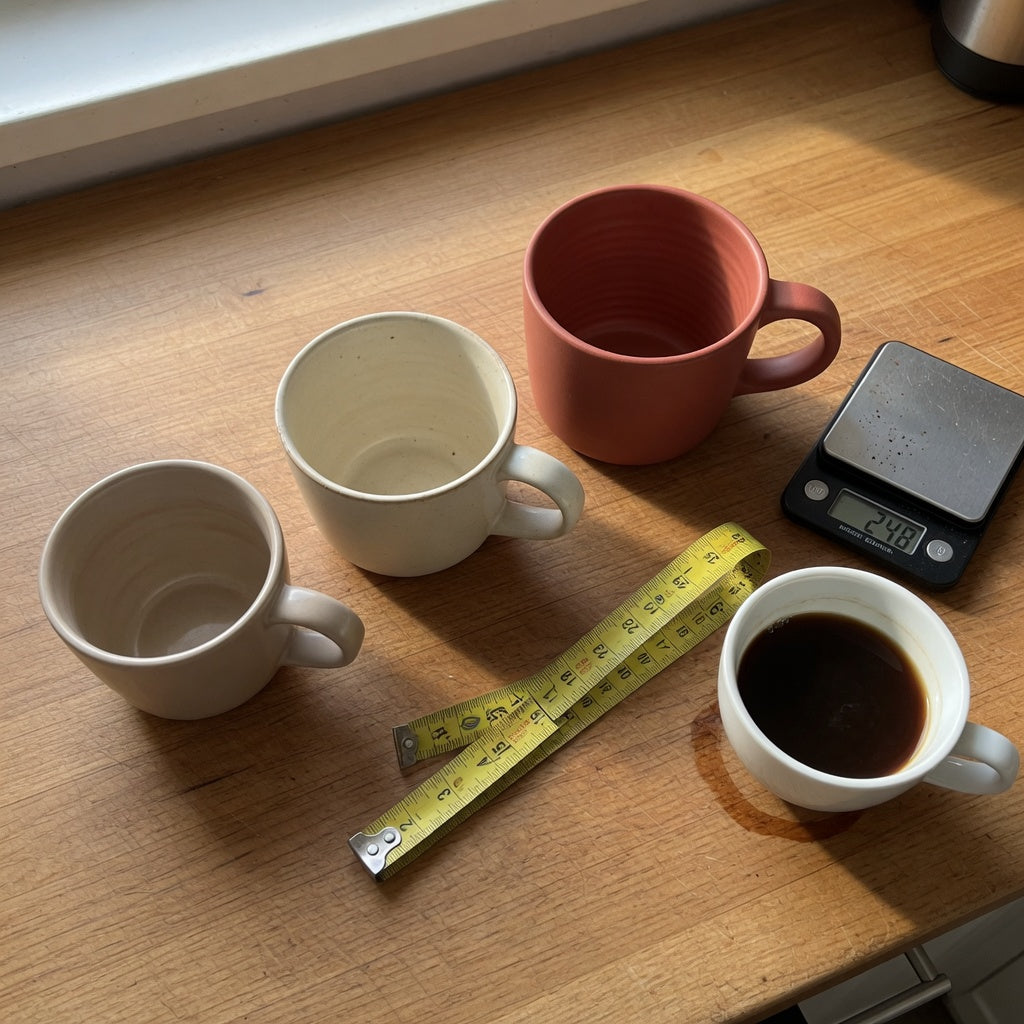
14 oz Ceramic Coffee Mugs Replacement Purchase Product Shortlist Guide
Reading time: about 11 minutes
The mug that finally gets replaced usually fails on something small — a chip on the rim you keep steering your lip around, a handle that pinches your knuckles when the mug is full, or a base that has gone permanently brown. That failure is the best starting point for a 14 oz ceramic coffee mugs replacement purchase product shortlist guide, because it tells you which spec to check first instead of which color looks nice.
So you order a replacement, and it fails on something else. It holds less than the one it replaced. Or it holds so much that your usual 10 oz pour looks like a mistake down in the bottom.
In our store, we walk buyers through this exact decision over email and at the counter: start from the failure, convert every capacity claim to millilitres, and only then compare candidates. The goal is three realistic options, not thirty.
Why does a 14 oz mug rarely pour 14 oz?
Fourteen US fluid ounces is about 414 mL; the US fluid ounce is defined as 29.57353 mL. That is well above the roughly 240 mL — about 8 fl oz — that FDA ceramicware guidance uses as its typical example of a cup or mug. A 14 oz mug is a deliberately large everyday cup, not a cafe default.
And the number on the listing is almost always a brim figure. Fill a 414 mL body to the very edge and you have 414 mL. Pour something you can carry across a room without sloshing and you are closer to 300–350 mL. Two practical consequences:
- If the old mug was sold as 14 oz and you always drank about 12 oz, buy a body that holds 14–15 fl oz so the fill line lands below the rim.
- If you want a genuine 14 oz of coffee, buy 16 fl oz or more. Headroom is not optional — it is where the crema, the milk foam, and the walk back to your desk live.
Capacity also gets muddled by material. Listings use 'ceramic mug' for solid stoneware, porcelain, double-wall ceramic, and steel with a ceramic lining. Those are not interchangeable: a double-wall body feels lighter and insulates differently, while a steel-lined mug may not be microwave-safe even when the interior is ceramic. For a replacement, match the material to how you use the mug, then match the capacity. If you need hours of heat, an insulated travel mug is a different category; a solid ceramic mug is for the cup you finish at your desk.
Start with the failure, not the catalog
Write the failure down before you open a single product page. It narrows the field faster than any filter, and it stops you from buying the same problem in a new colour.
- Chipped or rough rim. Check how thick the lip is and whether the glaze wraps over the rim edge or stops short of it. An unglazed rim edge is where chips begin.
- Grey ring or brown staining inside. Crazing — the fine web of cracks in a glaze — traps coffee oils. A tight, glossy interior glaze cleans out more completely than a matte or heavily reactive one.
- Knuckle burn. The handle opening was too small for the wall thickness. On a larger body, the full weight pulls harder against the top of the opening, so this tends to get worse as capacity climbs.
- Too heavy to lift one-handed. A 400 mL pour weighs about 400 g before you count the mug itself. Add stoneware thickness and you are lifting close to a full can of beans, one-handed, over a keyboard.
- Did not fit anywhere. Cabinet gap, brewer clearance, cup holder, dishwasher top rack. Measure the old mug's exterior height and base diameter while it is still in the house.
- The lid vanished. If the lid was the point, a lidless ceramic body is a downgrade, not a replacement.
Three replacement scenarios from this 14 oz ceramic coffee mugs replacement purchase product shortlist guide
We stock three mugs in this size range. Only one lands closest to a full 14 oz pour once headroom is counted, and the honest answer for most buyers is the middle capacity. Here is how they map to real pours.
| Mug | Stated capacity | Choose it if | Skip it if |
|---|---|---|---|
| The Flow | 400 ml (~13.5 fl oz) | your old mug was a 12–14 oz body and you pour 10–12 oz | you want a full 14 oz with headroom left over |
| Morning and Night | 440 ml (~14.9 fl oz) | you want a real 14 oz pour plus a little clearance | shelf height is tight or you only ever drink 8 oz |
| The Rock | 480 ml (~16.2 fl oz) | milk-heavy lattes, iced coffee with a full glass of ice, long tea sessions | you drink a small black drip — it will cool before you finish |
The Flow, 400 ml (~13.5 fl oz). The closest match to a standard 14 oz mug once you account for headroom. If the mug you are replacing was never actually filled to the brim, this is the capacity that will feel the same. At 400 ml it sits slightly under 14 fl oz — which is what many buyers actually want.
Morning and Night, 440 ml (~14.9 fl oz). This is the capacity to start with if you intend to pour a full 14 oz and still have clearance. 440 ml gives you roughly 414 ml of coffee plus about 25 ml of headroom — enough that a full mug does not spill on the walk from kitchen to desk. The trade-off: it is a large cup, so check the exterior height on the listing if your cabinet gap is tight.
The Rock, 480 ml (~16.2 fl oz). Overshoot on purpose. This is the one for iced coffee with a full glass of ice, for a latte that is more milk than espresso, or for a tea drinker who refills once and wants it to last an hour. It is a poor fit for a 6 oz black coffee: a small pour in a large body loses heat quickly and you will be reheating.
Want to see all three side by side before deciding? The unique coffee mugs collection shows the full range, and our team is happy to measure any of them for you before you commit.
Handle clearance and full-mug weight: what the listing leaves out
Two numbers decide whether a large mug is pleasant or irritating, and both are missing from most product pages: the handle opening and the empty weight.
On a 414 mL body the handle has to clear your fingers while the outside wall is hot. A handle that fits a 10 oz mug can be genuinely uncomfortable on a 14 oz one, because the full weight pulls harder against the top of the opening. If you have large hands, or you hold a mug with three fingers through the handle rather than two, ask before you buy.
Weight is the other one. Weigh your current mug empty on a kitchen scale, then add the weight of your typical pour — brewed coffee is close enough to water that 350 mL weighs roughly 350 g. That total is what your wrist actually lifts. If the old mug felt heavy at 300 mL, a 440 mL replacement will feel heavier still.
Do microwave and dishwasher ratings survive the trim?
A microwave-safe claim often belongs to a body, not to every version of it. The same shape with a gold-tone handle, a metallic rim band, or an overglaze decal is a different proposition from the plain-glaze version.
- Metallic trim. Gold and platinum handles or rims are decorative metal films. Treat them as not microwave safe, whatever the collection page says.
- Overglaze decals. Decoration sitting on top of the glaze rather than sealed beneath it is more exposed to heat, detergent, and abrasion.
- Dishwasher cycles. Detergent plus repeated hot cycles is the usual cause of dulled glaze and faded prints. If the print matters to you, hand-wash that piece.
Check the care line for the exact piece you are buying, not the collection. If a listing gives one care statement for a whole family of mugs, ask which version it applies to — especially when a metallic handle or rim is in the photo.
Is lead free the same as tested?
No, and this is where a replacement purchase deserves more attention than an impulse buy.
FDA guidance for ceramicware sets an action level of 0.5 micrograms of lead per millilitre of leaching solution for cups and mugs, judged on any one of six units using acetic-acid test methods such as ASTM C738. Cadmium carries its own 0.5 micrograms per millilitre action level for small hollowware. The agency has also warned that some imported traditional pottery labelled lead free still contained extractable lead, in some cases above those action levels — so the label alone is not evidence.
The California Department of Public Health makes a distinction worth borrowing: lead free means no lead, while lead safe means some lead may be present but does not leach above the state's Proposition 65 standards. The same guidance notes that you cannot tell by looking, that plain white interiors are rarely the concern, that decoration sitting on top of the glaze and bright colour on the food-contact surface deserve more scrutiny, and that coffee is acidic enough to encourage leaching. It also advises against microwaving ware that contains or might contain lead.
One more category trap: decorative ceramicware that looks like a mug but is legally ornamental. Under 21 CFR 109.16, a piece that appears suitable for food is treated as foodware unless it carries a Not for Food Use warning or has a hole bored through the food-contact surface. When you are replacing a mug, buy from a listing that describes the piece as drinkware.
We do not claim leach testing for a mug unless the listing or our supplier documentation states it. Ask us — and ask any seller — for the test statement rather than the phrase lead free on its own.
Will it fit your cabinet, brewer, and cup holder?
- Cabinet gap. Measure from the shelf to the shelf above. Add about 10 mm so your fingers can reach in.
- Brewer clearance. On a single-serve machine, measure from the drip tray to the brew head. A tall 14 oz body can fail to clear it even when the spout sits low.
- Cup holder. Base diameter matters more than capacity. A wide-footed mug will not sit in a car holder no matter how tall it is.
- Dishwasher rack. Top-rack height and tine spacing. Wide bodies eat rack space fast when you are washing four at once.
- Stackability. If you store mugs under a shelf, check whether the handle sits below the rim and whether the base nests inside the mug below. A tall body with a high handle may not stack at all.
If a measurement is marginal, size down rather than gamble. A 400 ml body that fits is more useful than a 480 ml body that lives in the cupboard.
Frequently asked questions
Why does my 14 oz mug only hold around 11 oz of coffee?
Because the listed capacity is usually a brim measurement. Leave 15–20 mm of headroom for a normal pour and a 414 mL body gives you roughly 300–350 mL of drinkable coffee. That gap between stated capacity and usable pour is why this 14 oz ceramic coffee mugs replacement purchase product shortlist guide starts with capacity math instead of glaze.
Is a 14 oz ceramic mug big enough for a latte?
A 12 oz latte fits comfortably in a 440 ml body with room for foam. If your latte runs 14–16 oz once the milk is in, go to 480 ml — a 400 ml mug will be filled to the rim and will spill on the first step you take.
Can I microwave a 14 oz ceramic mug with a gold handle?
No. Metallic trim is a decorative film, so treat any mug with a gold or platinum handle or rim band as not microwave safe, even when the plain-glaze version of the same shape is rated for it. Check the care line for that exact piece.
Does lead free on a mug listing mean it has been tested?
Not necessarily. FDA has found imported pottery labelled lead free that still leached lead above its action levels. Ask the seller for the test statement or the standard the glaze was tested to before you order.
Will a 440 ml mug fit under my single-serve coffee maker?
Measure from the drip tray to the brew head first. Capacity tells you nothing about height, and a wide 440 ml body can be too tall for a machine with a fixed spout even though it looks like a standard mug.
If you are replacing a mug this week, do this: measure the old mug's exterior height and base diameter, note your typical pour in millilitres, and decide whether you want a full 14 oz with headroom or a 12 oz pour that sits lower in the cup. Start with the Morning and Night if you want the full pour with clearance; choose the Flow if your old mug was never filled to the brim. The full collection lets you compare all three capacities in one place.
More from our blog
Read more

Unique Espresso Cups Home Coffee Station Practical Purchase Checklist
The checklist we actually walk shoppers through: capacity versus shot volume, preheating a thick ceramic wall, group-head clearance, glaze safety, and care — plus which of our 170 ml, 200 ml, and 2...
Read more
Unique Espresso Cups Everyday Mug Rotation Product Shortlist Guide
A three-cup shortlist for shoppers who want unique espresso cups that actually get used: 170 ml, 200 ml and 250 ml ceramics matched to shot volume, milk drinks and shelf space, with an explicit rea...
Read more
Leave a comment
This site is protected by hCaptcha and the hCaptcha Privacy Policy and Terms of Service apply.