
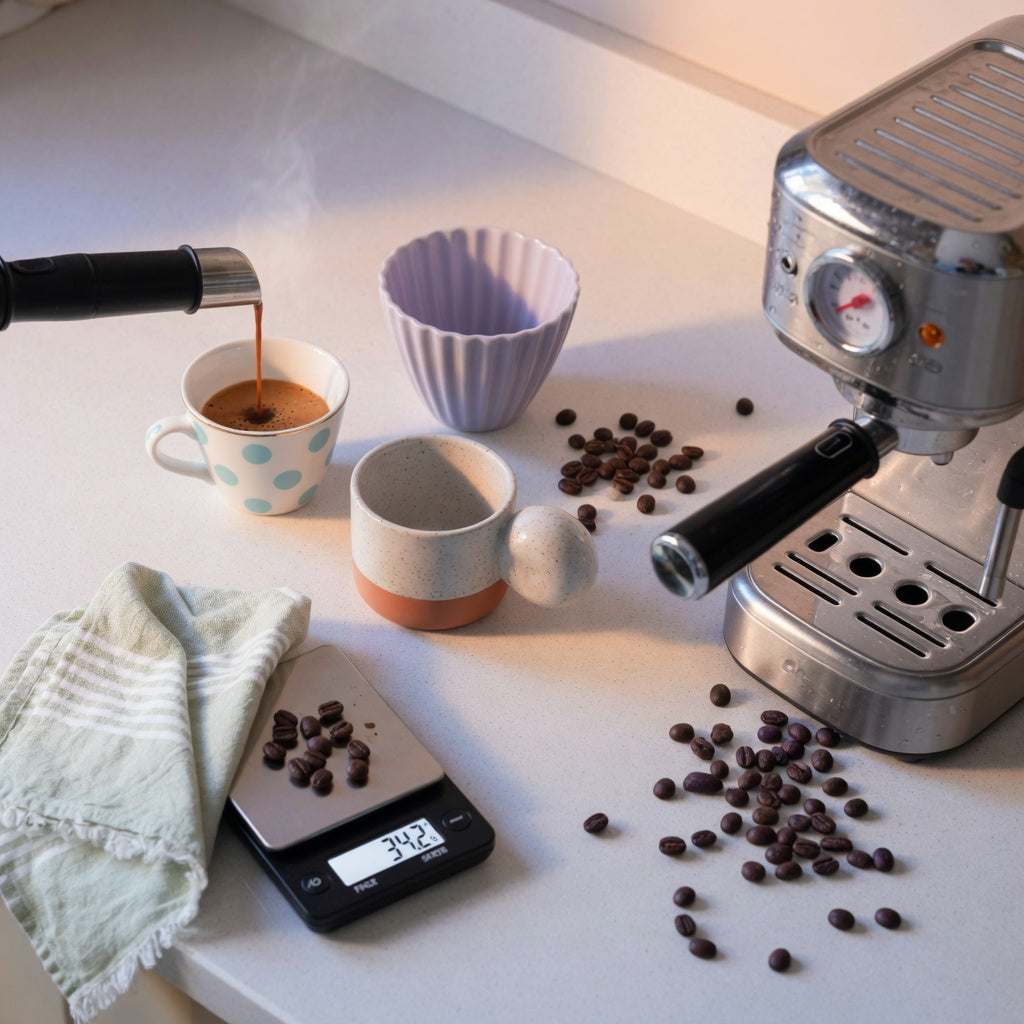
Cute Espresso Cups Comparison: 170 vs 200 vs 250 ml
Reading time: about 9 minutes
Someone emails us at least once a week with the same story: they bought a pretty little cup, loved it on the shelf, and then discovered it barely fits under the spout — or that a single shot disappears into it like a coin at the bottom of a jar. The cup was never the problem. The mismatch was.
That is why we have stopped presenting our cups as one interchangeable category. This cute espresso cups comparison covers the three current options in our catalog — the Retro Coffee & Tea Cup at 170 ml, the Pleated Coffee & Tea Cup at 200 ml, and the Ball Handled Coffee & Tea Mug at 250 ml — and explains which routine each one actually suits. All three are compact ceramic vessels. None is a traditional single-shot demitasse, and we would rather say that up front than have you find out after the first pour.
What does a 170, 200, or 250 ml ceramic cup actually change about your espresso?
Capacity is the whole story here, because these cups are larger than the cup you get at a café. That extra volume is a design choice, not a defect: it leaves room for a double shot, a splash of milk, or a tea bag. But volume changes three things you will notice every single morning.
- How the shot sits in the cup. A short pour in a wide 250 ml cup spreads thin across the base instead of pooling deep.
- How long it stays hot. More empty air above the liquid means more surface area giving heat away between the machine and your chair.
- How much you can pour before you worry. A larger cup gives margin, which matters if you pull a long double or add milk.
We keep our claims to what we publish: listed capacity, a ceramic body, and the visible form of each cup. We do not make heat-retention claims, and we will not tell you a 250 ml ceramic cup performs like a thick-walled demitasse. It does not, and we would rather you choose on honest grounds.
Which of the three current cups matches the drink you make most often?
Start with your default order, not with the color you like best. The mapping is fairly clean:
| Current option | Listed capacity | Routine it suits | The trade-off you accept |
|---|---|---|---|
| Retro Coffee & Tea Cup | 170 ml | Short espresso, doubles, small macchiato; the closest to a demitasse feel in this group | Still generous for a single-shot purist — a ristretto will look almost empty |
| Pleated Coffee & Tea Cup | 200 ml | Straight doubles, macchiato, a small milky coffee; the safest gift pick | Sits between two camps, so it satisfies neither the tiny-cup nor the big-mug preference fully |
| Ball Handled Coffee & Tea Mug | 250 ml | Double plus milk, longer coffee, tea, desk use | Least espresso-like of the three; a single shot looks shallow in it |
If you want the shortest, most concentrated experience here, the 170 ml Retro cup is where to start. If you pull doubles and occasionally add steamed milk, step to the 200 ml Pleated cup. If the espresso machine shares counter space with a tea habit and you want one cup that handles both, the 250 ml Ball Handle mug is the practical answer.
Will the cup clear your machine's spout and catch both streams?
This is the return reason we see most, and it has nothing to do with looks. There is no published standard for spout-to-drip-tray clearance, so the measurement is on you — and it takes about ninety seconds.
- Set the cup you use now on the drip tray and measure the gap from its rim to the group spout.
- Check the height of the cup you are considering on its own product listing, not on a lookalike. We list dimensions per product; we do not assume a size carries across the range.
- Look at the rim opening. If your portafilter has dual spouts, a narrow cup can catch one stream and miss the other.
- Confirm handle side room. The ball handle projects outward and needs more clearance than a straight wall.
- Brewing on a scale? Add the scale's height to the cup's height before you decide.
We do not promise machine compatibility for any of these cups. Machines vary too much and we would be guessing on your behalf. If a measurement is missing from a listing, message us and we will chase it down before you order rather than after.
Do the Retro, Pleated, and Ball Handle shapes behave differently day to day?
Yes, and mostly in small ways that only show up in week three.
The Retro profile is the most compact and reads most clearly as an espresso cup on the shelf. The Pleated cup's ridges are a visual feature first — in our experience they also collect dried coffee film in the grooves, so if you hand-wash, plan on a soft brush rather than a quick rinse. The Ball Handle is the most distinctive grip of the three, and also the most personal: some people love the rounded hold, others find a conventional loop easier with larger hands or a folded towel. Check the handle opening if that describes you.
One more thing worth knowing before you buy: crema reads differently depending on what is inside the cup. A light, plain interior shows the contrast between dark coffee and tan foam. A dark or heavily patterned interior can swallow that contrast. We do not publish interior glaze color as a performance claim, so look at the current product photos with that question in mind, or ask us.
Are these cups for daily pours, gifts, or small kitchens?
All three work for all three, but the logic differs.
For daily pours: match capacity to your usual shot volume and stop there. A daily cup does not need to be impressive; it needs to fit under the spout and feel right in your hand.
For gifting: match the cup to the recipient's drink, not to their kitchen color scheme. Someone with a machine and a straight-espresso habit will understand a 170 ml cup instantly. A tea drinker or milk-coffee drinker gets more use from the 250 ml Ball Handle. The 200 ml Pleated is the honest answer when you genuinely do not know — it is the least likely to be the wrong size.
For small kitchens: we do not claim these cups stack or nest, and we do not sell a stand with them unless a listing says so. If cupboard space is the deciding factor, verify stackability on the product page before buying a pair. Our unique coffee mugs collection shows the full range of shapes side by side if you want to compare silhouettes and storage footprints at a glance.
What should you check on the product page before you commit?
We would rather answer a dull question now than process a return later. Run this list against whichever cup you are considering:
- Capacity: 170 ml, 200 ml, or 250 ml. Do not estimate it from a photo on your phone.
- Material: these are ceramic cups — confirm the wording on the exact listing.
- Food-contact status: the U.S. FDA explains that lead in ceramic glaze is bound when pottery is fired correctly, but improperly fired glaze may leave extractable lead, and ceramicware intended only as decoration must be labeled so it is not used with food. If a listing does not state food-contact use, ask before you drink from it. The FDA guidance is worth reading at FDA.gov.
- Care instructions: do not assume dishwasher or microwave safety on any ceramic cup, ours included. If the listing is silent, hand-wash and avoid shocking a warm cup with cold water.
- What ships: a saucer or stand in a styled photo is not proof it is in the box. Check set contents.
- Spout clearance and rim width: the two measurements that decide whether a pretty cup becomes a shelf ornament.
Frequently asked questions
Is 170 ml too big for a single espresso?
It is bigger than a traditional demitasse, yes. A single shot will sit in the base with room to spare, while a double looks properly at home. If you only ever pull ristretti and want the cup to look full, a true demitasse is the better tool. If you pull doubles, the 170 ml Retro is the closest fit in this cute espresso cups comparison.
Can the 250 ml Ball Handle cup handle a cortado or macchiato?
It has the volume for a double plus a modest pour of milk. What it does not have is a cortado glass profile — the drink will look smaller and shallower than it would in a narrower vessel, and the ball handle changes how you tilt it. Check the current listing for dimensions and handle clearance before you commit.
Are these ceramic cups dishwasher safe?
We do not treat dishwasher safety as a default for any ceramic cup. Check the care instructions on the exact product page. If the listing does not state dishwasher or microwave suitability, hand-wash it and avoid sudden temperature changes — that is the safer habit with any glazed ceramic.
Do the cups come with saucers or a stand?
Check the product page for set contents. Do not assume a saucer, lid, or stand is included unless the listing says so. If a saucer matters to how you serve, confirm it before ordering rather than after the box arrives.
Which one is the best gift if I am not sure what they drink?
The 200 ml Pleated cup is the middle-ground pick — it is large enough for a milky coffee and small enough to still read as an espresso cup. If you know they drink straight doubles, the 170 ml Retro is the more thoughtful choice, and if they mostly drink tea or longer coffees, go with the 250 ml Ball Handle.
Pick by routine, then confirm the measurements
Here is the short version to carry with you: shortest drink, smallest cup — the 170 ml Retro. Espresso plus a little milk — the 200 ml Pleated. Longer coffee, tea, or a desk cup that also pulls the occasional shot — the 250 ml Ball Handle. Then do the boring part before checkout: measure your spout clearance, check the rim opening against your basket, and confirm care instructions and set contents on the listing itself.
If two cups still look equally plausible, open the full collection and compare them at the same scale. And if the answer is that a true demitasse would serve you better than any of these, we would rather tell you that than sell you the wrong cup.
More from our blog
Read more
Cute Espresso Cups Home Office Product Shortlist Guide: 3 Picks
A desk-routine shortlist of three ceramic cups at 170 ml, 200 ml and 250 ml — with the honest reason to skip each one and the two measurements to take before you order.
Read more
Cute Espresso Cups Capacity Guide: 170 vs 200 vs 250 ml
Three compact ceramic cups, three capacities, three quite different mornings. We compare our 170 ml, 200 ml, and 250 ml cups by pour size, refill pattern, and machine fit so you buy the one that ma...
Read more
Leave a comment
This site is protected by hCaptcha and the hCaptcha Privacy Policy and Terms of Service apply.