
Ceramic Latte Cups Comparison: 250 ml vs 400 ml vs 440 ml
Reading time: about 10 minutes
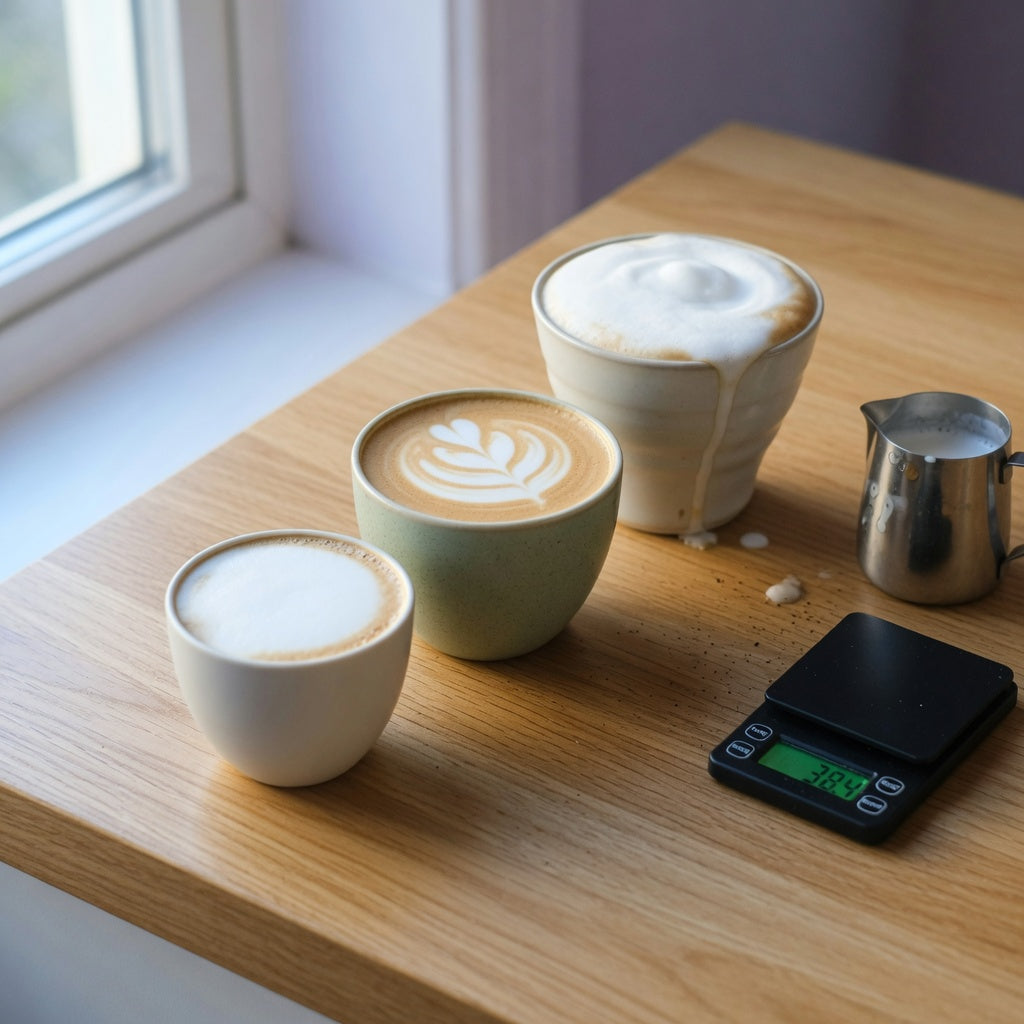
Three cups leave our packing bench most mornings: the 250 ml Ball Handle, the 400 ml Flow, and the 440 ml Morning and Night. Lined up, they read as small, medium, and large. Then you pour the same 240 ml latte into each one. The smallest sits near the rim, the largest looks half empty, and the middle one looks like the drink you had in your head.
That is what a ceramic latte cups comparison is actually for — not the prettiest silhouette, but the one you will still reach for in six months. We sell and pack all three, and the questions repeat: does the listed number mean brim-full or a comfortable fill, does a rounded interior matter more than the pour, and is the phrase "lead free" on a listing worth anything. Here is what we tell people, including the parts where a cup is simply the wrong tool.
Ceramic latte cups comparison: what 250 ml, 400 ml, and 440 ml each do well
Capacity is the only hard number in this comparison, and it decides more than material or color does. Everything else below is something to confirm on the listing for the exact piece you buy.
| Current cup | Listed capacity | The routine it tends to suit | What to verify on the listing |
|---|---|---|---|
| Ball Handle | 250 ml | Flat white, small latte, short tea | Handle opening and grip clearance |
| The Flow | 400 ml | Standard latte, iced drinks with room for ice | Base diameter against your desk and coaster |
| Morning and Night | 440 ml | Large milk-heavy drinks, long tea sessions | Height in the cabinet, weight when full |
Two notes on those numbers. Listed capacity is a vessel measurement, not a serving size: nobody fills to the rim, and foam, a steady-hand margin, and the pour itself all cost volume. Listings in this category almost never say which fill line the number refers to, which sits behind most "holds less than advertised" complaints for any brand, ours included. And capacity does not scale the way people assume. Going from 250 ml to 400 ml is a 60% jump — a different drink. Going from 400 ml to 440 ml is 10% — the same drink in a slightly heavier, taller vessel.
The 250 ml cup: for short drinks you actually finish
This is the cup for someone who pulls one flat white, drinks it at the counter, and does not want a cooling half-pint following them to the desk at ten. The build is tight: a double shot plus roughly 150 ml of steamed milk lands close to the top, and a generous foam dome will have you wiping the outside. That is not a flaw — it is what a 250 ml vessel does. Its advantage is footprint. On a desk already holding a laptop, a scale, and a notebook, small earns its place. Handle comfort is the one thing we cannot judge for you. Look at the Ball Handle mug and check the handle opening against your own fingers.
The 400 ml cup: where most kitchens land
Sometimes one cup has to cover a weekday latte, a weekend iced latte, and tea for whoever stops by. Ice is the argument: a full scoop displaces more volume than most people budget for, so a 400 ml cup lets you build the drink around the ice instead of pouring over the top and mopping up. It also absorbs a change of habit — bigger than a cortado, smaller than a diner mug, close enough to a café latte that a home pour looks right in it. The Flow is our 400 ml option, and it is the one we hand to people who say they are only buying one.
The 440 ml cup: long drinks and slow drinkers
440 ml is the largest vessel in the current lineup, and it is a specific tool. Filled, it holds close to 440 g of milk and foam before the cup's own weight is counted, so it wants a stable base and a counter or desk that is not already crowded. It suits someone working through one large drink across a meeting more than someone who wants a fast, hot shot. Worth saying plainly: more liquid in a wider vessel is not the same as staying hot. We do not publish heat-retention figures for any of the three, and we will not guess at them. Morning and Night is the 440 ml piece.
Does a rounded interior pour better than a straight-sided mug?
Less than your pour does; more than the glaze does. A rounded, bowl-like interior gives the milk stream somewhere to travel and softens the transition from base to wall, while a wide rim lets foam spread into a shape instead of bunching into a blob. Straight-sided mugs push milk up the wall faster, and patterns drawn in them read narrower and shorter. Three things worth judging from a listing photo:
- The base-to-wall transition. A soft internal curve beats a hard corner where the floor meets the side.
- Rim width. A wider rim gives foam room to spread; a narrow one caps how large the pattern can get.
- Tilt comfort. A cup you are nervous to tilt will not pour well, no matter how good the interior shape is — and that is a handle question as much as a shape question.
You can see the current silhouettes side by side in the unique coffee mugs collection.
Handle geometry and desk footprint: the specs buyers check last and regret first
In our experience, almost nobody chooses a latte cup on the handle. Plenty of people quietly stop using one because of it.
- Grip clearance. A sculpted handle can look roomy and still pinch at the knuckle once the cup is full and heavy.
- Balance point. Where the handle meets the body decides whether the cup hangs level as you lift it or tips forward.
- Base diameter. This sets coaster fit and whether the cup survives a crowded desk without being nudged twice a day.
- Height. A 440 ml cup can be tall enough to foul a shelf or catch a low cabinet door. Measure the gap before you commit.
We cannot measure your hand from a product page, and we would rather say that than send you a cup that pinches. Picture two fingers hooked through the handle with the cup at its heaviest, then decide.
What "lead free" on a ceramic latte cup actually proves
We get asked whether our cups are lead free at least once a week. Fair question, and the honest answer is that the phrase alone proves little — the number that matters is a leach limit, not a word on a box.
The FDA sets an action level of 0.5 micrograms per millilitre of leaching solution for leachable lead in ceramic small hollowware, the category that covers cups and mugs, applied to any one of six units tested. Cadmium carries the same 0.5 micrograms per millilitre limit for small hollowware. The agency also documents traditional pottery labelled "lead free" that still contained extractable lead at or above its action levels, and it notes that washing, boiling, or any other household process cannot remove lead from pottery that contains it. Lead in a glaze that is not fired properly may never fuse into the glaze at all, which is why firing quality matters more than the marketing line.
There is a related trap in decorative ware. The FDA treats ornamental ceramicware that looks suitable for food use as food-use ware unless it carries a permanent "Not for Food Use" warning on the base. And while the agency describes everyday factory-made commercial pottery as much less likely to have a lead problem, it flags handmade, antique, damaged, flea-market, and brightly orange-, red-, or yellow-decorated pieces as higher concern. If a batch-level test report is what closes the sale for you, ask before you order and our store will tell you exactly what documentation we hold — not what you would prefer to hear.
Microwave, dishwasher, and the metallic-trim trap
Microwaves are reflected by metal and pass through glass, paper, ceramic, and plastic, which is why the FDA lists those as the materials microwaves travel through and warns that metal in the cavity heats unevenly and can damage the oven. A gold rim, a metallic trim, or a lustre finish is metal. No amount of plain ceramic underneath changes that, and microwaving a decorated cup because "it's ceramic" is the most common mistake we hear about.
For the cups we sell, our answer is always the same: read the care note on the product page for the exact piece, and do not infer it from a cup that looks similar. Dishwasher safety is equally piece-specific, because glaze chemistry, trim, and decoration all change the answer, and a claim on one cup does not transfer to another in the same range.
One rule that is not piece-specific: retire any cup with a crack or a crazed glaze. Crazing is the fine web of cracks that can develop in older glazes. It gives liquid a path into the ceramic body, it stains, and no dishwasher cycle reverses it.
Where these three cups are the wrong choice
- Commuting. If a drink has to travel in a bag, a lidded travel tumbler is the right category, not an open ceramic cup.
- All-day heat retention. If your drink must be hot at the ninety-minute mark, buy an insulated vessel. We make no heat-retention claim for these three.
- Very small drinks. A 90 ml cortado looks lost in a 440 ml cup, and a small volume cools faster against a large surface.
- Weak grip or small hands. A full 440 ml cup is heavy enough that some buyers are better served at 400 ml or below.
Three questions to answer before you add to cart
- What is your most common drink, in millilitres? Measure it once in a jug. Most people overestimate by about a third.
- Does the cup need to take ice? If yes, size up one step from what you would choose for hot drinks only.
- Where does the cup live? Cabinet height, desk space, and coaster diameter eliminate options faster than color does.
Answer those three and the choice usually makes itself. If you would rather browse the current shapes first, start with the current mug lineup, then sort by capacity, interior shape, and handle — in that order.
Frequently asked questions
Is 400 ml enough for a normal latte, or should I move up to 440 ml?
For a standard home latte, yes. 400 ml leaves room for a double shot, milk, and a foam cap without reaching the rim. Move up if your drinks are milk-heavy, if you add ice, or if one cup has to last a long session. In this ceramic latte cups comparison the 40 ml difference is the smallest of the three steps and the least likely to change how the drink tastes.
Can I microwave a ceramic latte cup with a metallic rim or handle?
The plain ceramic body is not the issue, since microwaves pass through ceramic. Metal trim, gold rims, lustre finishes, and cracked glaze are the issue, because metal reflects microwaves and heats unevenly. Read the care note on the exact product page for the cup you are buying.
Are these cups dishwasher safe?
Treat it as piece-specific. Glaze type, trim, and decoration all affect the answer, and a dishwasher claim on one cup does not transfer to another in the same range. The care note on the individual product page is the version worth trusting.
How do I check that a ceramic latte cup is food-safe?
Ask for leach figures rather than the words "lead free." The FDA's action level for leachable lead in ceramic cups and mugs is 0.5 micrograms per millilitre of leaching solution, applied to any one of six units tested. If a seller cannot say anything about testing, that is an answer too.
If I only buy one of the three, which should it be?
400 ml, for most people: it covers hot and iced drinks and does not look half empty after a normal pour. If you already know your drink is small and you finish it fast, the 250 ml cup will feel better in the hand. Browse the unique coffee mugs collection and choose by capacity first, interior shape second, handle third.
More from our blog
Read more
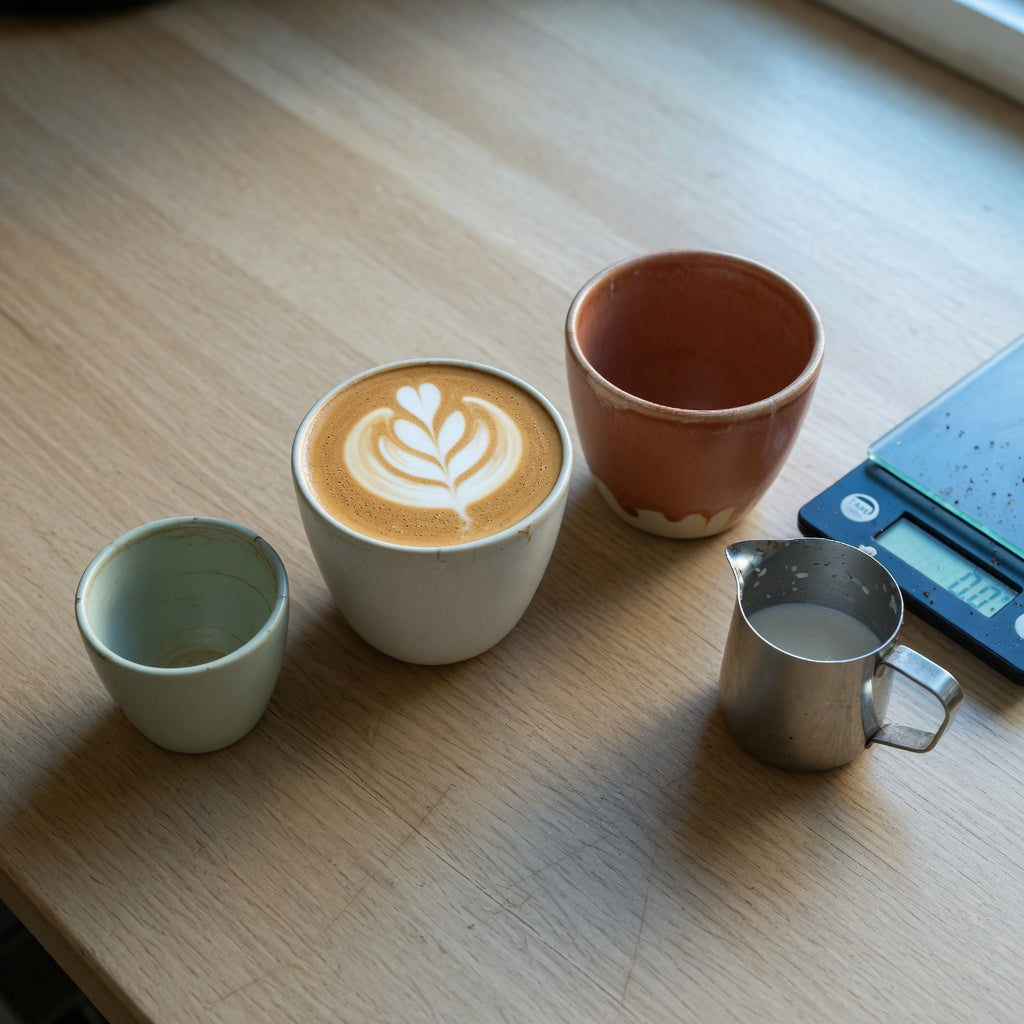
Ceramic Latte Cups Daily Use Guide: 250, 400 or 440 ml?
Listed capacity, foam headspace and handle fit decide whether a ceramic latte cup survives daily use. We compare our 250 ml, 400 ml and 440 ml cups, plus the glaze and care checks worth doing befor...
Read more
Cute Espresso Cups Daily Use Guide: 170 vs 200 vs 250 ml
A store-side cute espresso cups daily use guide: what 170, 200 and 250 ml ceramic cups actually mean at the machine, which pour each suits, and where these compact cups stop being the right tool.
Read more
Leave a comment
This site is protected by hCaptcha and the hCaptcha Privacy Policy and Terms of Service apply.