
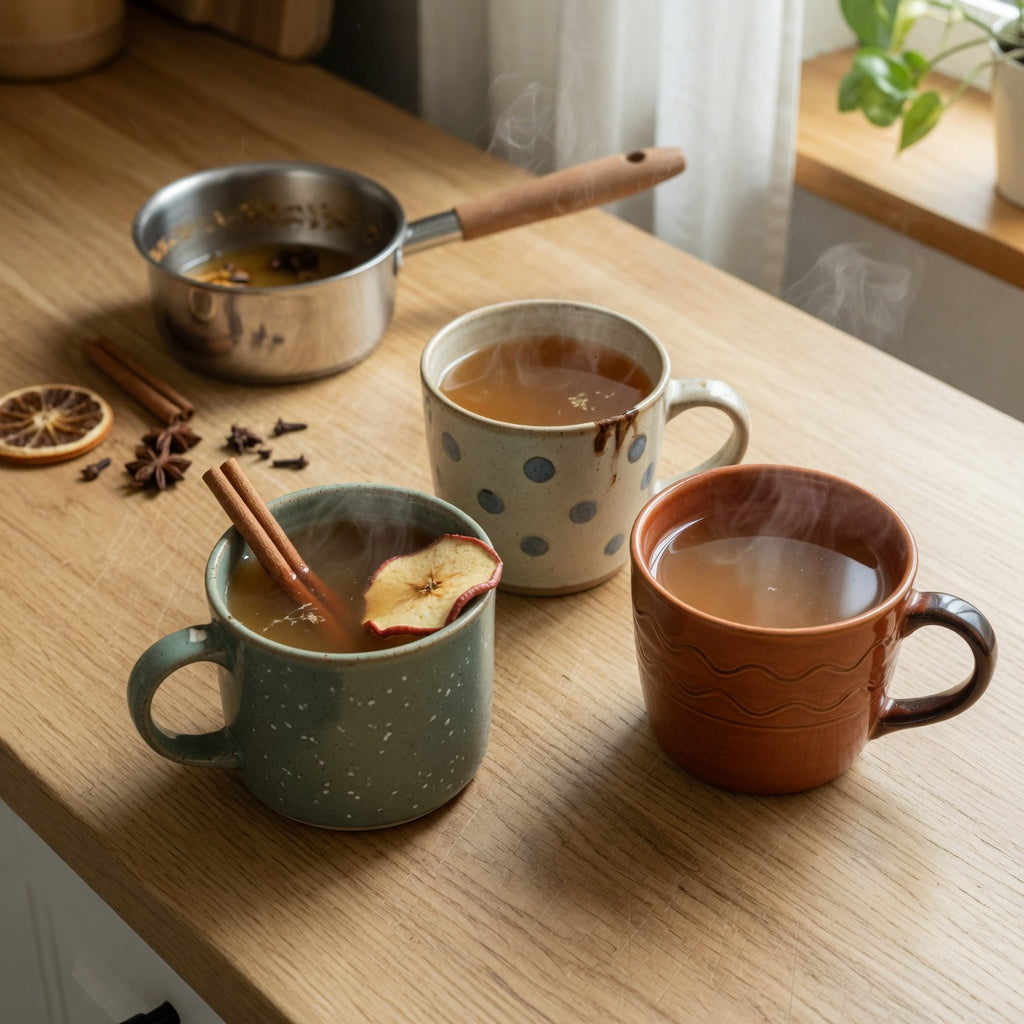
Ceramic Cider Cups: Capacity, Handles, and Glaze Compared
Reading time: about 8 minutes
Spiced cider punishes the wrong cup. Cinnamon sticks and apple slices eat your volume, a cold ceramic wall pulls heat from the first pour, and a handle that looked charming in photos turns out to fit exactly one finger. Most people who message our team about ceramic cider cups start with glaze color, and that's an understandable instinct — color is what sells a shelf photo. But after packing, inspecting, and drinking from these mugs at our own desks, we've landed on three variables that decide whether a cup earns daily cabinet space: confirmed capacity, handle clearance, and glaze care.
Everything below follows the approach we use with customers in our store: we state what we can confirm about our own catalog, and we flag exactly what you should verify on any listing before checkout. If you want to see the lineup first, all three mugs covered here live in our unique coffee mugs collection.
How much cider actually fits? Comparing 400 ml and 480 ml ceramic cups
Capacity is where most drinkware regret starts. A standard teacup usually holds 240 to 300 ml — fine for plain tea, cramped for cider, because a real pour rarely stays plain. A cinnamon stick, an orange wheel, a spoonful of whipped cream: each displaces liquid, so an undersized cup either gets underfilled or sloshes on the walk from stove to couch.
Before you compare anything, run this test. Fill your current favorite mug to your normal drinking line, pour that water into a liquid measuring cup, and write the number down. That figure, not the mug's shelf appeal, tells you what to order. For reference, a 12-ounce pour is about 355 ml.
- 400 ml designs — The Gradient and The Flow. Both are confirmed at 400 ml in our catalog. That covers a full 12-ounce pour with roughly 45 ml of headroom: enough for a cinnamon stick and a thin apple slice, not a loaded garnish pile.
- 480 ml design — The Rock. The extra 80 ml means about 125 ml of space above a 12-ounce pour, which is room for heavy garnish and fewer refills on a long evening.
One caveat before you shop anywhere, including here: listings don't always say whether stated capacity is measured to the brim or to a practical fill line. Assume brim-full and keep margin — discovering the difference with a lapful of hot cider is a bad way to learn. Buying for someone else? Our separate guide to comparing ceramic apple cider mugs for gifting applies the same capacity logic with a gift lens.
Which handle fits your hand? Clearance and loop height
Handle comfort is physics you can feel. A mug in this size class typically weighs somewhere around 350 to 500 g empty; once it holds close to half a liter of hot liquid, the filled weight can pass 800 g. Two details decide whether that weight sits in your palm or hangs off one straining finger:
- Finger clearance. The wall of a full mug of hot cider is hot. If the loop sits tight against the body, your knuckles ride the ceramic on every lift. You want enough stand-off that your fingers touch handle only — and side-profile photos reveal this far better than front-facing shots.
- Loop height. A single-finger tea loop turns the entire filled weight into torque on one knuckle. A loop deep enough for two or three fingers spreads the load across the hand, which matters most on larger 480 ml builds.
Our honest limitation: grip dimensions are exactly the spec that varies between designs, and we won't describe a handle from memory when the listing photos are right in front of you. If you want the long-form version, we walk through how we size up a 480 ml ceramic coffee mug for size, grip, and glaze in a separate breakdown.
Glaze, rims, and cleaning: the details most listings skip
Glaze is not only decoration. A smooth interior finish matters more for cider than for black coffee, because spiced, tannin-heavy drinks settle into rough or partially unglazed texture and stain over time — the same reason serious tea drinkers obsess over interior finish. On the outside, glossier glazes wipe clean easily, while textured or semi-matte clay gives wet fingers more friction on the carry from counter to couch. Neither is better. They're different trade-offs.
Rim profile is the sleeper variable. A rounded, slightly thicker lip feels soft on the mouth and passes less heat on first contact; a thin edge feels precise but transfers warmth to your lips faster. Few listings print this spec, so hold the mug you use now, notice which rim you prefer, and use that as your filter when you study product photos.
Care is the one area where we refuse to generalize. Dishwasher and microwave compatibility depends on the specific finish of the specific mug, and the only source we'll stand behind is the care section of the exact product page you're ordering from. If a listing doesn't state it, ask the store before you buy.
Where ceramic cider cups are simply the wrong tool
We sell ceramic, and we'll still tell you when not to buy it. Dense ceramic is excellent for sit-down drinking at a kitchen table, a desk, or a porch — and poor at anything involving motion or packing:
- Commuting and driving. No sealed lid, and wide bases often miss a car's cup holder. For anything in motion, a lidded travel tumbler is the better purchase.
- Camping and trail use. Packed weight adds up fast, and ceramic doesn't forgive a drop onto granite. Titanium or stainless wins outdoors.
- Crowded standing rooms. A heavy, open vessel of hot liquid plus elbows is a spill waiting to happen.
A ceramic cider cup is a sit-down drink. The moment the drink needs a lid, buy something with a lid.
One cold-months habit worth adopting: thick ceramic acts as a heat sink, so a mug straight from a cold pantry steals warmth from your first pour. Swirl warm tap water inside for ten to fifteen seconds before filling. It costs nothing, and it's a property of the material — not a feature we claim for any single model.
Gradient, Flow, or Rock? Matching the mug to your pour
All three sit in our everyday ceramic range, and capacity is the one spec we can confirm across the board — so the honest comparison starts there. We'd rather not paraphrase handle and glaze details that the listings can show you directly:
| Mug | Confirmed capacity | Choose it if… |
|---|---|---|
| The Gradient | 400 ml | Your usual pour is around 12 oz with light garnish, and you want a mid-size everyday cup. |
| The Flow | 400 ml | Capacity matters most and you're weighing two designs within the same 400 ml class. |
| The Rock | 480 ml | You pour big, garnish heavy, or hate getting up for refills. |
Notice what the table leaves out: per-mug handle measurements and glaze descriptions. That's deliberate — those details belong to the current listings, and secondhand paraphrasing is how buying guides go stale. Open the Gradient and Flow listings side by side; both hold the same 400 ml, so you're choosing on looks and feel rather than math. If your pour runs big or your garnish habit is serious, the Rock's extra 80 ml is the deciding number.
Frequently asked questions
What size should ceramic cider cups be for spiced drinks?
Between 400 and 480 ml covers most cider drinkers. A 12-ounce pour is about 355 ml, so a 400 ml cup leaves roughly 45 ml of headroom and a 480 ml cup leaves about 125 ml. Garnish heavily or sip for an hour? Go larger. Modest pours? The 400 ml class keeps the cup lighter in hand.
Are ceramic cider cups dishwasher and microwave safe?
It depends on the specific mug and its finish, and we don't generalize this answer. Read the care details on the exact product page before ordering, and if compatibility isn't stated there, ask the store directly. When in doubt, hand washing is the safe default for any decorated ceramic.
Do 480 ml ceramic mugs keep cider hot longer than 400 ml cups?
A larger volume of hot liquid holds its temperature longer in absolute terms, but ceramic itself is not an insulator, and we don't make heat-retention claims for individual models. What helps most is pre-warming: rinse the mug with warm tap water for about fifteen seconds so the clay doesn't pull heat from your first pour.
Can I use a ceramic cider cup for cold cider or iced drinks?
Yes, for kitchen-table or desk use — ceramic handles cold liquids without issue, though expect condensation on the outside because there's no insulated double wall. What it won't replace is a lidded tumbler with a straw for the car or a commute.
What's the real difference between The Gradient and The Flow?
Capacity isn't the difference — both are confirmed 400 ml mugs. The distinction is design, so compare the two current listings for the glaze and handle you prefer. If you genuinely can't decide between them on looks, either one gives you the same pour.
A two-minute pre-order checklist for ceramic cider cups
- Measure your real pour. Water, measuring cup, your normal fill line. Around 350 ml or less points to the 400 ml class; bigger or heavily garnished pours point to 480 ml.
- Assume brim-full capacity. Leave yourself margin instead of trusting that a stated volume is a practical fill line.
- Study the handle, not just the glaze. Check side-profile photos for finger clearance and loop depth, and compare against a mug your hand already likes.
- Read the care section on the exact listing. Dishwasher and microwave answers live there, or in a quick message to the store — not in a general guide, including this one.
- Plan the pre-warm. If hot cider is a winter ritual for you, adopt the warm-water swirl from day one.
Once you've settled on a size, the fastest next step is to browse our full unique coffee mugs lineup with capacity as your first filter and handle photos as your second. Ten minutes of comparing listings now is what separates the mug that gets used every morning from the one that migrates to the back of the cabinet by February.
More from our blog
Read more
Minimalist Ceramic Tea Mug: 6 Things to Compare Before Buying
Capacity, grip, wall thickness, and glaze finish decide whether a minimalist ceramic tea mug becomes your daily cup or a shelf ornament. This guide walks through the six comparisons our team runs b...
Read more
The Flow Mug Gift: 6 Things Buyers Should Compare First
The Flow mug gift works when a large ceramic format matches the person — their refill habits, hands, cabinet space, and dish routine. These are the six checks our team runs before recommending it, ...
Read more
Leave a comment
This site is protected by hCaptcha and the hCaptcha Privacy Policy and Terms of Service apply.