
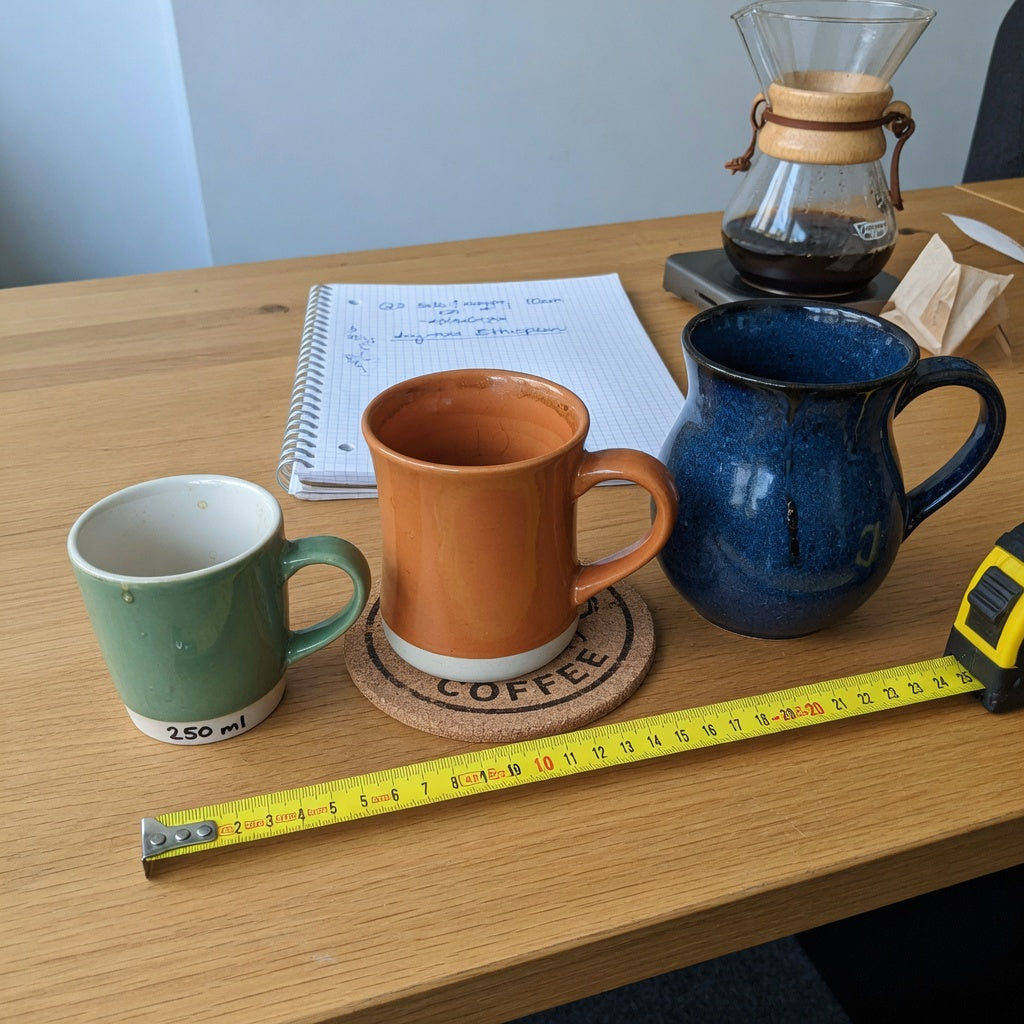
Wide Based Coffee Mugs: 250 ml, 400 ml, or 480 ml?
Reading time: about 11 minutes
A mug sitting beside a keyboard has a harder job than one placed in the middle of a kitchen counter. A forearm can catch the handle, a coaster can create an uneven edge, and a full cup can keep moving after the foot starts to rock. That is why shoppers look for wide based coffee mugs—but a broad foot is only one part of stability.
At CoffeifyMug, we compare mug profiles by the way people actually use them: a small pour beside a laptop, a full filter coffee carried from the kitchen, tea left on a desk during a meeting, or a large cup that must fit beneath a brewer. The current catalog gives us three useful capacity reference points: the 250 ml Ball Handle, the 400 ml Flow, and the 480 ml Rock. The practical decision is not simply which one is largest. It is how much liquid you need, how much desk area you can spare, and which dimensions still need checking on the live product listing.
Are wide based coffee mugs harder to tip on a desk?
Usually, a wider base gives a mug a broader base of support. In plain language, the mug has farther to lean before its combined center of gravity moves beyond the outer edge of the foot. A lower profile or a heavier lower section can also help, but base width alone cannot make a mug tip-proof.
We pay attention to four details when reviewing a stable desk mug:
- Height relative to the foot: a tall body can be more sensitive to a sideways push than a lower body with a similar capacity.
- Fill level: a cup filled close to the rim has more liquid sitting higher, and it can slosh when moved or bumped.
- Foot contact: the base should sit evenly rather than rock on a high point, rough glaze spot, or uneven desk surface.
- Handle direction: a handle extending toward a mouse, notebook, or chair arm creates a common place for accidental contact.
There is no broadly accepted minimum diameter that defines a wide base, and we did not find a public test that gives commercial mugs a comparable tip angle. Treat terms such as “tough to tip” as descriptive language, not as a guarantee. The useful comparison is visible geometry plus verified dimensions, capacity, and intended use.
How do 250 ml, 400 ml, and 480 ml profiles change daily use?
| Profile | Listed capacity | Could suit this routine | Check before ordering |
|---|---|---|---|
| Ball Handle | 250 ml | A smaller coffee or tea serving, a compact desk, or frequent fresh refills | Foot diameter, overall height, empty weight, and handle opening |
| The Flow | 400 ml | A standard larger coffee serving or a versatile everyday office cup | Base-to-rim proportions, coaster fit, brewer clearance, and full weight |
| The Rock | 480 ml | A large coffee, tea, or slower drinking session where fewer refills matter | Footprint, cabinet clearance, cup-holder fit, and how comfortable it feels when full |
The capacities above are the verified catalog facts. They do not tell you the actual foot diameter, wall height, empty weight, or handle clearance. Those details can change the way a mug feels on a desk, so compare the visible base geometry and confirm the current measurements on each listing rather than guessing from the product name or photographs alone.
When does the 250 ml Ball Handle make the most sense?
If your usual pour is around 250 ml, the 250 ml Ball Handle mug is the logical product page to inspect first. Its capacity keeps the comparison focused: you are not buying a large vessel and leaving most of it empty. That can be useful on a narrow office desk, a small bedside table, or a kitchen shelf where every extra centimetre matters.
The trade-off is refill frequency. A smaller capacity is not a substitute for a broad or weighted foot, and it may not suit someone who pours one large filter coffee before starting work. Check the listing for the actual base width, body height, empty weight, and handle opening. If you use a thick coaster, measure that setup too; the coaster can reduce usable desk space even when the mug itself looks compact.
This profile is also a poor choice for a commute in a moving car unless you have confirmed a secure, upright place for it. An open ceramic mug is not automatically splash-resistant or leakproof, and no broad base removes the need for careful transport.
Is 400 ml or 480 ml better for a long desk session?
The 400 ml Flow mug is the sensible comparison point if you want one everyday capacity without moving to the largest profile. It gives you more room than the 250 ml option while avoiding the assumption that a large mug will fit every coaster, cabinet, or brewing station. Choose it when your normal pour is close to 400 ml, then verify the actual footprint before buying.
The 480 ml Rock mug is the relevant listing when a large serving is the priority. More capacity can reduce trips to the kitchen, but it also means more liquid weight when full. If the additional volume is achieved through extra height rather than a wider body, the center of gravity may sit higher; if it comes through a broader body, the mug may occupy more desk area. The product page dimensions are the deciding evidence.
For a long work session, compare these practical points before choosing the larger option:
- Can the full mug sit entirely on your coaster without overhanging?
- Does the handle leave room for the grip you normally use?
- Will the body clear a drip machine, capsule brewer, AeroPress setup, or pour-over dripper?
- Can you lift it comfortably with the full amount of liquid inside?
- Will it fit the shelf where you store it after the dishwasher cycle?
You can place all three capacity options side by side through our unique coffee mugs collection. Use the collection to narrow the style, then open the individual product listing for the current specification details.
Which measurements matter more than the phrase wide base?
Product photos help you see the relationship between the foot and the body, but they rarely give enough information for a confident fit decision. We recommend measuring the place where the mug will live before ordering.
- Measure the coaster or desk zone. Record the widest usable area, including any raised coaster edge. A mug that technically fits the desk may still sit partly on the coaster rim.
- Measure brewer clearance. Measure from the drip tray to the lowest part of the spout. A 480 ml mug can be suitable for your drink volume and still be too tall or broad for the machine.
- Measure the cupboard gap. Check the vertical distance between shelves and allow room to lift the mug out. A handle can need more clearance than the rim.
- Measure a car cup holder at its narrowest point. Cup holders taper and vary by vehicle. Measure inside the well, not across the top opening. Many broad ceramic mugs are better kept at a desk than carried in a vehicle cup holder.
- Check the handle clearance. If you normally use three fingers, do not judge comfort from the handle outline alone. Confirm the opening and the distance from the body on the current listing.
A mug can have a wide foot and a relatively narrow mouth, or a broad rim sitting on a smaller foot. These are different design variables. The foot affects surface stability; the mouth affects sipping, aroma, cooling, and compatibility with some brewing methods.
What daily-use problems should you inspect after unboxing?
Before putting a new mug into regular rotation, place it empty on a flat counter and gently test whether it rocks. Do not force it or twist it against the surface. A stable-looking shape is less useful if a high spot prevents the foot from sitting evenly.
Inspect the rim and handle for chips, hairline damage, or rough areas that could affect handling. Look at the underside as well. A recessed or concave foot can hold rinse water after a dishwasher cycle, which may later drip onto a shelf or desk. If the base shape allows water to collect, dry it before storage.
Care instructions must come from the exact listing, especially for ceramic glaze, metallic decoration, decals, or special finishes. Do not assume that every mug is microwave-safe or dishwasher-safe simply because it is ceramic. If a product page does not clearly state the care instructions, ask before ordering.
Heat retention is another area where shoppers often overread the base shape. A wide foot can help with surface stability, but it is not evidence of longer heat retention. Temperature depends on factors such as material, wall construction, exposed surface area, starting temperature, and whether a lid is present. If keeping coffee hot is your main concern, compare those specifications directly or consider a purpose-built insulated travel mug rather than relying on a ceramic base profile.
What should you know about ceramic glaze and food use?
For a mug used every day, food-contact suitability matters more than a decorative finish. The FDA explains that lead can leach from improperly made or fired ceramic foodware into food or drink. Its guidance identifies handmade, antique, damaged, and brightly orange-, red-, or yellow-decorated pottery as situations that may warrant more caution, while ordinary commercial factory tableware is described as much less likely to have the same problem.
The FDA also states that washing, boiling, or other household processes do not remove lead from pottery. A piece marked not for food use should remain decorative. For the technical cup-and-mug action level and testing context, see the FDA guidance on lead and cadmium in ceramic foodware.
Our practical buying rule is simple: use a seller that identifies the product for food use and provides clear care information. If you are considering an antique, unmarked handmade piece, or a damaged mug with a questionable glaze, do not treat an attractive finish as proof of suitability for hot coffee.
Which profile fits a desk, gift, commute, or large serving?
| Your situation | Starting point | Why it may fit | Important limitation |
|---|---|---|---|
| Small desk or modest coffee serving | Ball Handle, 250 ml | The listed capacity keeps the decision aimed at a smaller pour and compact routine | It may require more refills and still needs a verified stable foot |
| General office use | The Flow, 400 ml | A middle capacity gives more flexibility for coffee or tea | Confirm its dimensions instead of assuming it fits every coaster or brewer |
| Large serving or slow drinker | The Rock, 480 ml | The listed capacity supports a larger pour with fewer refills | A full mug can be heavier and may take more desk, shelf, and brewer clearance |
| Car, boat, or dashboard use | Measure first; consider a travel-specific vessel | Vehicle holders and moving surfaces require secure fit and spill control | A wide ceramic foot is not a leakproof lid or a guarantee against motion-related spills |
| Gift for someone with a specific style preference | Browse the CoffeifyMug collection, then compare capacities | Capacity and visible geometry can be matched to the recipient’s routine | Do not guess handle size, care, or material from photographs alone |
Frequently asked questions
Are wide based coffee mugs actually harder to tip over?
A wider foot can give a mug a larger base of support, but it does not make the mug tip-proof. Height, fill level, center of gravity, handle position, and whether the foot sits evenly all affect stability. Compare the visible base geometry and verify dimensions rather than relying on the phrase alone.
Does a wider base mean a mug holds more coffee?
No. Base width and interior capacity are separate measurements. The verified catalog capacities in this comparison are 250 ml for the Ball Handle, 400 ml for The Flow, and 480 ml for The Rock; check each current listing for the footprint and height.
Will a 480 ml mug fit a car cup holder?
Do not assume it will. Measure the holder at its narrowest internal point and compare that measurement with the mug’s listed base dimensions. If the fit is uncertain, a travel mug designed for vehicle use may be a better choice than an open ceramic desk mug.
Are wide base ceramic mugs dishwasher and microwave safe?
There is no universal answer for every ceramic mug or finish. Check the care instructions on the exact product page, especially if the mug has metallic trim, decals, or a recessed foot that could retain water. If the listing does not state the care requirements, ask before using a dishwasher or microwave.
Does a wide base keep coffee hot for longer?
Not by itself. A wider foot is primarily a stability and footprint feature; heat retention also depends on wall construction, material, exposed surface area, starting temperature, and any lid. Choose based on verified insulation or care specifications rather than assuming a broad base provides thermal performance.
Start with your actual pour size, then measure the surface where the mug will sit. Choose the 250 ml Ball Handle listing for a smaller serving, compare The Flow at 400 ml for a middle-capacity routine, or inspect The Rock at 480 ml when a larger pour is the priority. Before checkout, verify base dimensions, height, handle clearance, care instructions, and brewer or cup-holder fit on the current product page. Then use the CoffeifyMug unique coffee mugs collection to make the final style choice without treating a wide base as a promise of spill-proof performance.
More from our blog
Read more
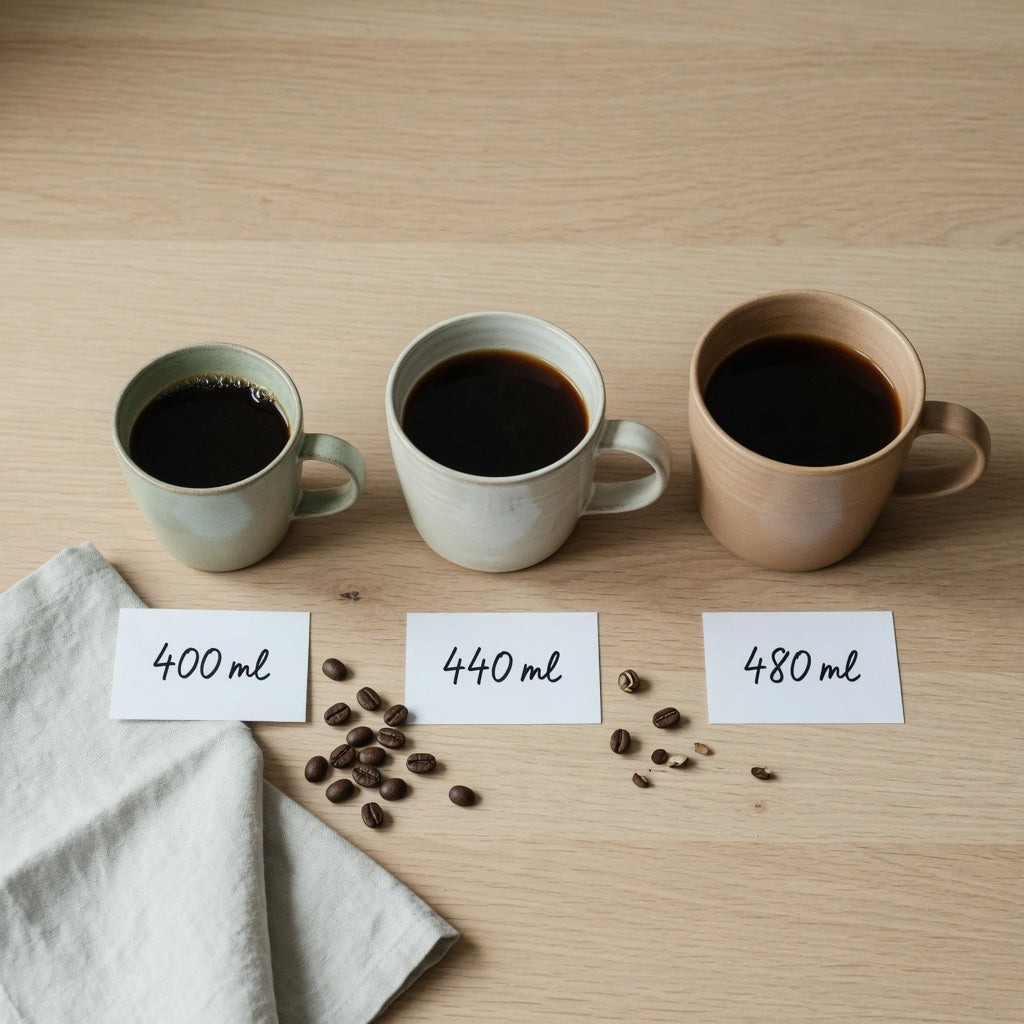
15 oz Ceramic Coffee Mugs: 400 ml vs 440 ml vs 480 ml
Fifteen ounces works out to about 444 ml, which is why our 440 ml mug is the closest thing we stock to a 15 oz ceramic coffee mug. Here is how 400 ml, 440 ml, and 480 ml differ in usable pour, hand...
Read more
Unique Ceramic Espresso Cups: What to Compare Before Buying
A practical comparison of unique ceramic espresso cups: capacity in milliliters, clay body, glaze and food-contact checks, heat behavior, rim and handle fit, and realistic care. We map our 170 ml, ...
Read more
Leave a comment
This site is protected by hCaptcha and the hCaptcha Privacy Policy and Terms of Service apply.