
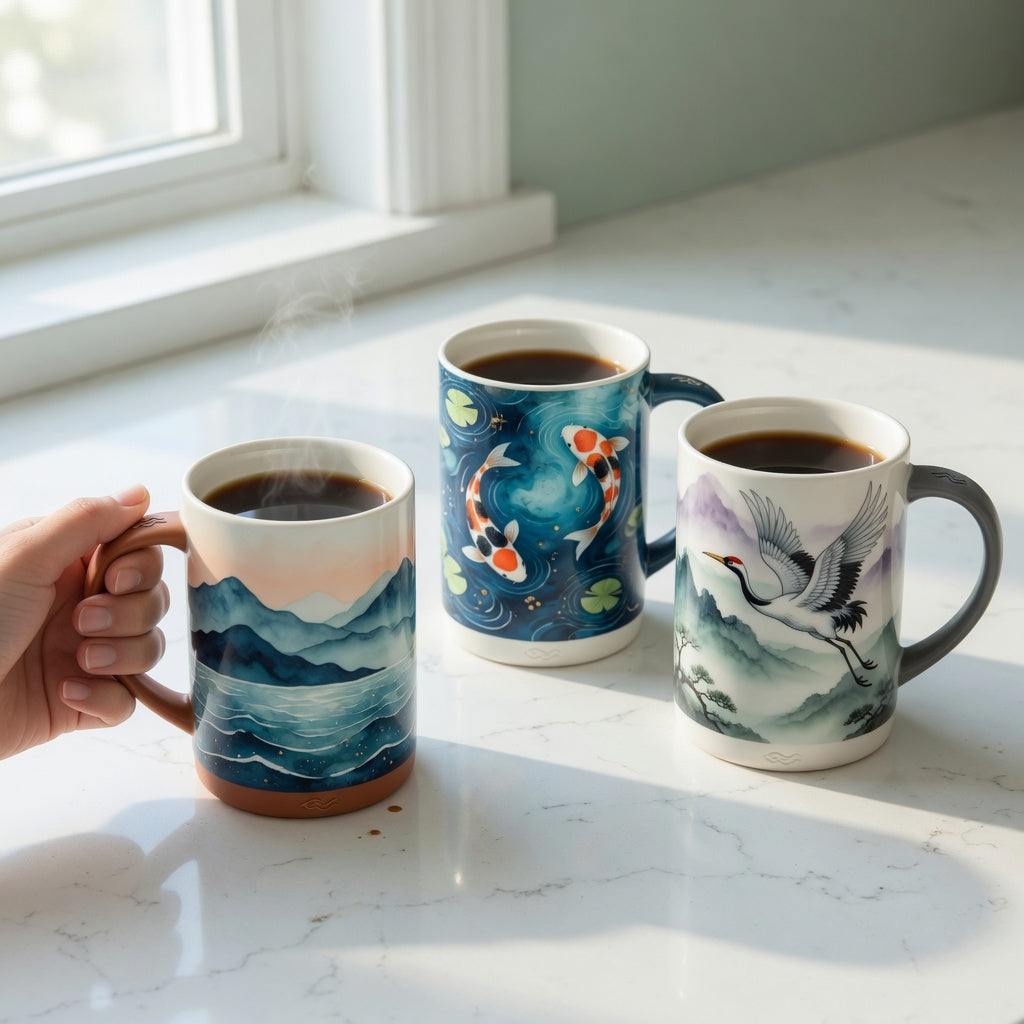
Unique Art Coffee Mugs: Compare Fit, Safety, and Care
Reading time: about 11 minutes
The mug looks balanced in the product photo. Then the handle presses into a knuckle, the design turns under the palm, or the base rocks beside a laptop once the cup is filled. Those first few seconds at a desk tell us more than a styled shelf. In our store, we compare unique art coffee mugs as drinkware first and visual objects second.
Start with the imagery that caught your attention, but separate what is visible from what the listing actually confirms. A distinctive motif does not prove that a mug is handmade, hand-painted, artist-designed, or one of a kind. As you browse our unique coffee mugs collection, compare handle fit, current material wording, listed capacity, care instructions, and food-use details before deciding that the art makes it right for daily use.
Which unique art coffee mugs hold up in a daily routine?
For samples we handle, our team repeats a simple routine: grip the mug empty, fill it to a normal drinking line, carry it from a kitchen counter to a desk, take a sip, and set it on a hard, level surface. That sequence exposes pressure points, awkward wrist leverage, rim problems, and base wobble that a front-facing image can hide.
- Check art orientation. Look for photos from both handle sides. A one-directional motif may face the room in one hand and disappear under the drinker's palm in the other.
- Study handle clearance. The opening must suit the recipient's preferred grip. A one-finger handle can be intentional, but it is a poor surprise for someone who normally uses three fingers.
- Inspect the rim. Look for an even drinking edge and clear close-ups. A strongly sculpted rim may feel distinctive but can change where the liquid flows as the mug tilts.
- Find a base view. A flat counter reveals rocking that fabric, hands, and styled props conceal. Also check the visible foot for rough areas or chips that could mark a desk.
- Think about full-cup balance. A generous body paired with a short handle may load the fingertips once the drink is added. Empty product photos cannot demonstrate that balance.
Listed capacity needs context too. If volume matters, find out whether the stated figure represents a brim-full measurement or a comfortable drinking fill. Those are different quantities. We do not let an appealing motif substitute for missing measurements when a mug must fit a brewer, shelf, or established morning pour.
Is the art in the image, the form, or a verified making process?
Shoppers often use unique for three different attributes. The picture can be distinctive, the mug's physical form can be unusual, or the listing can document a particular maker or production method. Each has a different buying trade-off.
| What the listing shows or states | What makes it distinctive | What to verify |
|---|---|---|
| Artwork on a conventional mug silhouette | The motif supplies the visual identity while the familiar form may be easier to store | Image placement, decoration method if stated, and finish-specific care |
| Raised texture, an unusual handle, or a sculpted rim or body | The physical form contributes to the art | Grip comfort, cleaning access, stability, and whether it can stack |
| Handmade, hand-painted, one-of-a-kind, or artist-designed wording | The seller makes a specific authorship or production claim | Exactly which claim applies, expected variation, and replacement or return terms |
Do not infer the third row from the first two. Brush-like marks can be part of a reproduced image, and an irregular-looking outline can come from a repeatable mold. The best unique art coffee mugs are honestly described, even if their uniqueness comes only from imagery you enjoy.
Mountain, koi, or crane: which motif fits the recipient?
Use the visible subject as the selection tool rather than inventing a backstory, artist, art movement, or symbolic meaning that the product page does not provide.
- For someone drawn to landscape imagery: the Mountain Sea Coffee Tea Mug is the relevant next comparison. The mountain-and-sea subject fits a buyer who wants scenery on a desk or breakfast table. Confirm the current material, listed capacity, dimensions, and care details on the product page before ordering.
- For someone who regularly chooses fish imagery: compare the Koi Fish Coffee Tea Mug. Inspect every current image to see where the koi sit relative to the handle and which part of the design remains visible in the recipient's dominant hand.
- For a recipient who prefers bird imagery: open The Crane Coffee Tea Mug. The listing-backed reason to choose it is the visible crane motif. We would not assign cultural symbolism, provenance, or an artistic connection unless the current page explicitly supports it.
If you do not know the recipient's preferred subject, return to the art-motif mug collection and compare the current product images side by side. For a daily drinker, eliminate poor capacity or care matches before using motif as the tiebreaker.
Material, capacity, and cabinet fit: which listing details matter?
A photograph cannot reliably establish a mug's material, wall thickness, weight, or capacity. Read the current listing and keep its terminology exact. If a page says ceramic, do not silently rewrite that as porcelain or stoneware; those are more specific descriptions that require listing support.
- Listed capacity: compare it with the amount the buyer normally pours, including room for milk or foam. Ask how the measurement is taken if a small difference would affect the purchase.
- Height and width: use actual listed dimensions when the mug must clear a coffee machine, sit under a pour-over dripper, or fit a shallow cupboard shelf. Lifestyle images are poor measuring tools.
- Opening and shape: a wider opening may accept ice or a tea infuser more easily, while an unusual rim can complicate sipping or cleaning. Verify dimensions rather than estimating from the handle.
- Weight: compare listed weight only when the page supplies it, then remember that the drink adds more. Buyers with limited grip strength may prefer a lighter, conventional form even if a sculptural mug looks more distinctive.
Do not predict heat retention from the artwork or a broad material label alone. Wall thickness, opening size, starting temperature, and the amount poured all affect the experience. If those details are absent, treat heat performance as unknown instead of filling the gap with a promise.
What evidence shows a ceramic art mug is intended for food use?
For U.S. shoppers, the FDA compliance policy guide for ceramic foodware establishes action levels for extractable lead. Ceramicware that exceeds those levels when tested may be considered adulterated under the Federal Food, Drug, and Cosmetic Act. That is a regulatory threshold, not a claim that can be verified from glaze color or a product photo.
Separate FDA guidance on decorative pottery labeling explains that ceramicware appearing suitable for food use is considered food-use ware unless it has both a conspicuous stick-on label and a permanent base statement identifying it as ornamental or decorative and not for food use. This labeling rule does not turn an unmarked base into a laboratory test result.
Before drinking from an art mug, verify four points:
- The current product page clearly presents the exact item as drinkware or suitable for food contact.
- Any food-safe or lead-free statement is made by the seller for that item, rather than inferred from appearance.
- No decorative-only warning appears on the package, label, or base.
- The seller can answer a direct food-use question if the listing is vague.
Food-safe, lead-free, dishwasher-safe, and microwave-safe are separate claims. Do not borrow one from another. We would rather direct a shopper to a clearly documented mug than suggest that a decorative object is suitable for coffee.
Dishwasher, microwave, and finish care: what should the listing confirm?
Dishwasher and microwave instructions are model-specific. A smooth, glossy surface does not prove either one, and a care statement for a similar mug does not automatically apply to the item in your cart.
- Match the care line to the exact product. Read the current listing and any packaging or base markings after delivery.
- Treat dishwasher approval separately. If allowed, load the mug so its rim and handle cannot knock against another hard item during the cycle.
- Use conservative care when instructions are absent. Hand-wash with a soft, nonabrasive sponge and avoid assuming that silence means dishwasher-safe.
- Require explicit microwave guidance. Metallic-looking rims, decals, or accents deserve particular caution; do not microwave the mug unless the seller approves that exact model.
- Inspect the mug after cleaning. Check for rim chips, a crack near either handle joint, changes inside the glazed surface, or a newly unstable base.
Fine lines in a glaze may be an intentional crackle effect or a condition that appeared later. A photo alone cannot diagnose the difference. If an interior line changes, traps a stain, or appears with a chip, stop using the mug and ask the seller for item-specific guidance.
How should you inspect a shipped art mug before gifting it?
Gift unboxing is the wrong time to discover a damaged handle. Ceramic handles, rims, and feet are exposed points, so schedule enough time to inspect the delivery and resolve a problem before the office exchange, birthday, or housewarming.
- Photograph obvious box damage before removing the packaging.
- Check both handle joints, the full rim, and the foot under bright light.
- Place the empty mug on a dry, level counter and confirm that it sits as the listing led you to expect.
- Keep the packaging until the inspection is complete and review the store's current damage-reporting instructions.
If you are mailing the mug onward, use a rigid box, protect the mug on every side, and prevent movement inside the package without forcing packing material through the handle. Good packing reduces risk, but it does not make a fragile ceramic piece suitable for loose luggage or an unpadded gift bag.
Who is better served by a standard mug or travel tumbler?
An art mug is not the best tool for every routine. Choose a sealed, insulated travel tumbler for cup holders, backpacks, or walking commutes. A conventional straight-sided mug is usually a better target for shoppers who need a uniform set, dependable stacking, easy replacement, or a shape that works for many different hands.
Care expectations matter too. If every cup in the household must go through the dishwasher and the art mug has no clear dishwasher guidance, skip it. If the image matters more than a sculptural form, a conventional silhouette with a distinctive motif may deliver the better balance of visual interest and daily convenience.
Frequently asked questions
How do I compare unique art coffee mugs online?
Start with photos showing both handle sides, the rim, interior, and base. Record the exact listed material, capacity, dimensions, weight if provided, and care instructions instead of estimating them from a lifestyle image. Ask the seller about any missing detail that could change how you use the mug.
Are artistic coffee mugs dishwasher and microwave safe?
Only the current instructions for the exact mug can answer that. Dishwasher-safe and microwave-safe are independent claims, so do not assume that one implies the other. If no care guidance is provided, hand-washing is the conservative choice, and microwave use should wait for seller confirmation.
Can I tell if an art mug is food-safe by looking at the bottom?
A permanent decorative-only warning on the base is a clear reason not to drink from the piece, especially when paired with the required stick-on warning for ornamental ceramicware. The absence of that wording is not proof of testing or a food-safe glaze. Confirm food-use claims on the listing or directly with the seller.
Which CoffeifyMug art motif makes a practical gift?
Match the visible subject to something the recipient already chooses: Mountain Sea for landscape imagery, Koi Fish for a fish motif, or The Crane for bird imagery. Then check capacity, handle orientation, and care requirements against the recipient's routine. The motif earns the smile; practical fit determines whether the mug gets used.
Is a handmade art mug always better than a printed motif mug?
No. A handmade or sculptural form may offer more physical variation, but it can be harder to stack, replace, clean, or fit to an unfamiliar hand. A conventional mug with art on its surface can be the better daily choice, and neither production method should be assumed unless the listing states it.
A seven-point check before adding a mug to cart
- Copy the current material and listed capacity from the page.
- Confirm the dimensions fit the brewer, shelf, and preferred pour.
- Check where the motif faces in the user's dominant hand.
- Inspect handle clearance, rim shape, and base photos.
- Verify food-use, dishwasher, and microwave wording separately.
- Choose imagery that fits the recipient rather than an invented artistic backstory.
- Leave time to inspect a shipped mug before using or gifting it.
Use this checklist across the CoffeifyMug unique coffee mugs collection, remove any option that conflicts with the drinker's routine, and then choose the motif they will enjoy seeing on the kitchen counter. The right mug should still make sense after the product photo is closed.
More from our blog
Read more
Ceramic Hot Toddy Mug: Compare Size, Handle, and Care
Compare 400 ml and 480 ml ceramic mugs by actual pour size, handle clearance, glaze and care labeling, and second-use value for coffee or tea. We also explain when a smaller footed glass is the bet...
Read more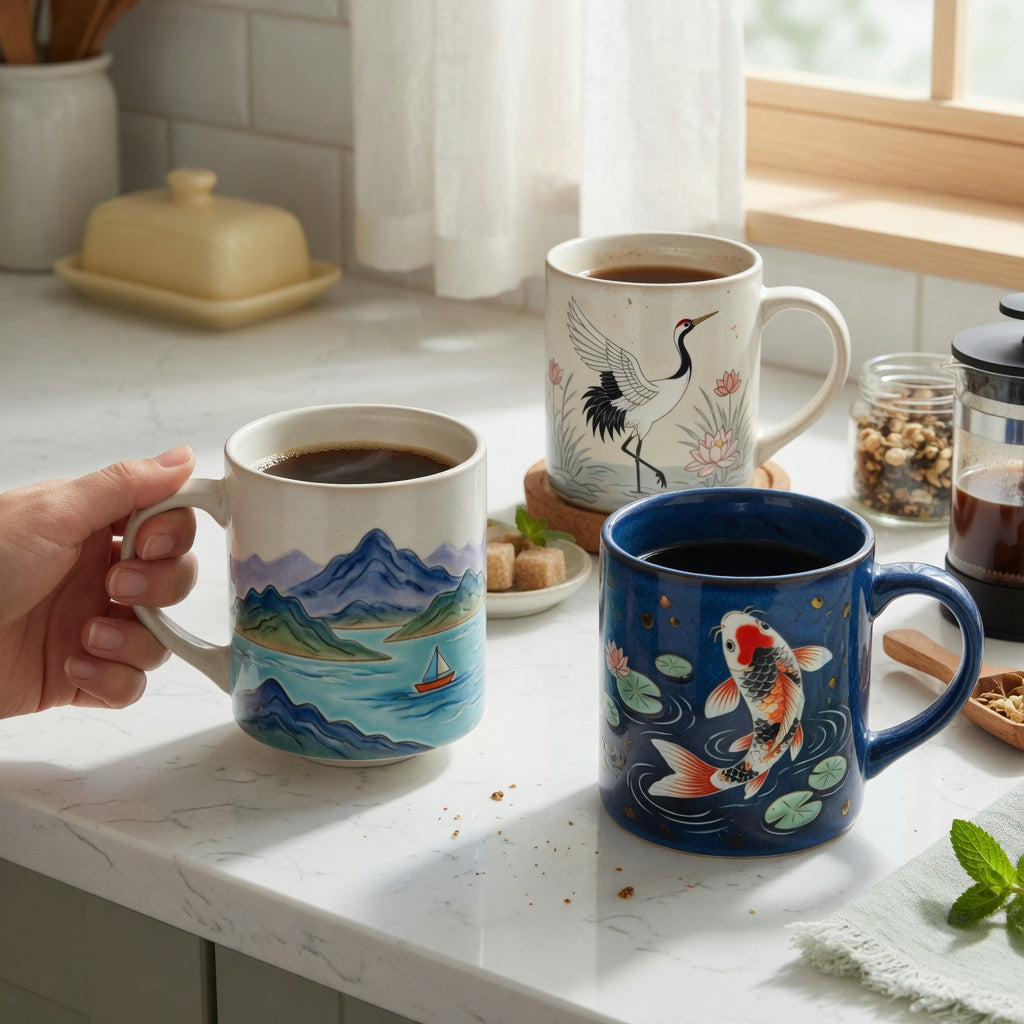
Ceramic Art Coffee Mugs: Compare Motif, Size, and Care
Compare ceramic art coffee mugs by visible motif, current listed capacity, handle and rim clues, interior finish, care terms, and gift fit. The guide also explains which claims a product photo cann...
Read more
Leave a comment
This site is protected by hCaptcha and the hCaptcha Privacy Policy and Terms of Service apply.