
Ceramic Art Coffee Mugs: Compare Motif, Size, and Care
Reading time: about 10 minutes
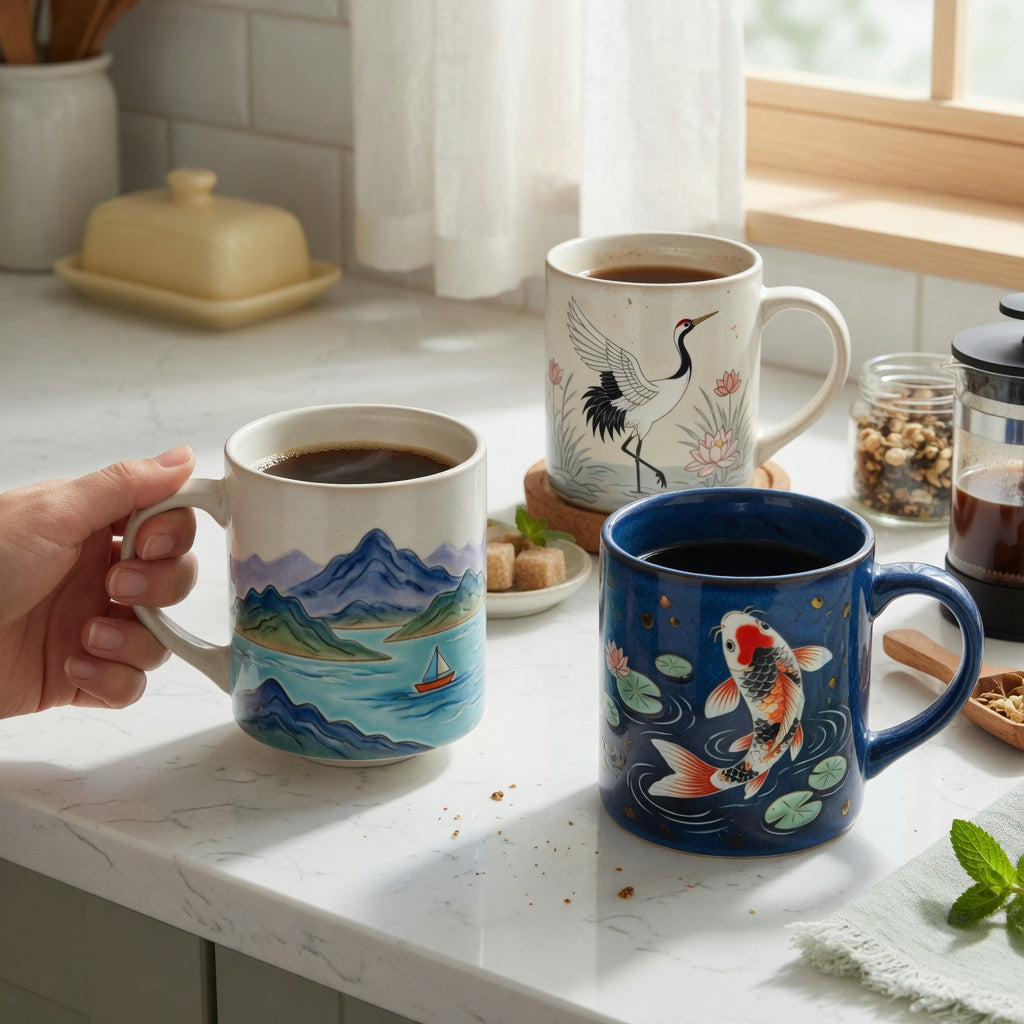
At our packing table, a mountain scene, a koi, and a crane can look equally giftable until we picture each mug in daily use. That is the real test for ceramic art coffee mugs: the image earns the click, but listed capacity, handle room, rim profile, interior finish, and care terms decide whether the mug stays on a kitchen counter or gets left on a display shelf.
We sell this category as functional drinkware with visible artwork, and we keep our comparisons inside what current product pages can support. That means ceramic material, listed capacity, visible body and handle shape, and the motif shown. It does not mean a named artist, hand-painted process, wheel-thrown construction, provenance, firing temperature, or edition status unless a listing explicitly says so.
What does art tell you, and what does it leave unproven?
Art is a useful style description, not a manufacturing grade. Search results often mix pictorial catalog mugs with handmade studio pottery, even though the two categories offer different buying information. A visible brush-like mark, uneven color, or sculptural-looking handle does not prove how a mug was made.
- Read the product type. Confirm that the piece is presented as a coffee or tea mug rather than an ornament or decorative vessel.
- Use the listed material name. Ceramic should not be relabeled as porcelain, stoneware, or earthenware without a listing-backed statement.
- Check motif coverage. Look for photos of both sides and the area beneath the handle. Do not assume that an image wraps around the full body.
- Read any variation language. Do not assume every mug is identical, and do not assume each one is unique, unless the seller states it.
Our collection of unique coffee mugs is the practical starting point for comparing visible themes. If you specifically need an artist-signed one-off, documented handmade production, or a perfectly uniform restaurant set, choose a seller or product line that makes those promises explicitly.
Mountain, koi, or crane: which motif fits the recipient?
The best motif is the one the buyer or recipient will still want to see after the gift-box moment has passed. Match the subject to an existing preference instead of inventing a story around it.
| Reader situation | Why the image fits | Relevant next step |
|---|---|---|
| You want a landscape rather than one central subject | Mountains and water provide a visible scene to compare across the mug body | Review the Mountain Sea coffee and tea mug |
| You or the recipient already likes koi or fish imagery | The koi is the identifiable subject, making the style choice direct | Open the Koi Fish coffee and tea mug |
| You are buying for someone who prefers bird imagery | The visible crane motif gives you a specific subject without relying on an unlisted meaning or origin story | See The Crane coffee and tea mug |
| You are still deciding among the three subjects | A category view makes it easier to compare current photos and listing details without relying on memory | Browse the ceramic and unique mug collection |
Also check which direction the artwork faces. If a motif appears mainly on one side, a right-handed grip may present it differently from a left-handed grip. That detail matters on an office desk, where the owner may want to see the image, and in a gift photo, where the artwork may be intended to face outward.
How do ceramic art coffee mugs differ in capacity, shape, and grip?
A styled photograph can make a mug look larger or smaller than it is. Start with the current listed capacity, then compare that number with the amount the buyer actually pours. Capacity alone does not reveal height, opening width, handle clearance, or how heavy the mug will feel when full.
- Measure a comfortable pour. Fill a favorite mug to the normal drinking level, then transfer the liquid to a measuring cup. This is more useful than guessing from an ounce label.
- Allow room for the actual drink. Milk, foam, and ice take up space. A capacity that works for black coffee may feel cramped for an iced drink or a foamy latte.
- Check appliance and cabinet clearance. If dimensions are listed, compare height and width with the coffee maker, shelf, and usual storage space.
- Match the handle to the preferred grip. Some people use two fingers and support the base; others want a fuller grip. Look for an in-hand or straight side photo rather than judging from an angled hero image.
- Consider filled weight. More drink plus a substantial ceramic body can be comfortable during a long desk session but inconvenient for someone who dislikes carrying a heavy cup.
A larger mug is useful for fewer refills, tea with room for an infuser, or iced coffee with plenty of ice. It is not automatically better for short drinks, limited cabinet space, small hands, or a workstation where an open cup is moved frequently.
Which product photos expose rim, interior, and handle issues?
When we handle mugs, the deciding details are often the ones hidden by the main product angle. We look for a clean side profile, a top-down interior view, and close photos of the rim and handle connections.
- Handle opening: Look for visible space between the mug wall and the fingers. Large hands need knuckle clearance, while a compact grip may suit someone who supports the mug from below.
- Handle joins: Inspect the upper and lower attachment areas. A visible crack or gap should not be dismissed as part of the artistic design.
- Rim profile: A thinner lip can feel more direct while sipping; a rounded or thicker rim feels more substantial. Neither is universally better, but a chip or sharp point at the drinking edge is a clear problem.
- Interior color: A light interior makes the drink level and residue easier to see. A dark interior can put more visual attention on the exterior motif but may hide what remains in the cup.
- Motif placement: Check both sides, the area near the handle, and the lower body. A close crop can hide where the artwork begins or ends.
Photos cannot fully prove lip feel, balance, or grip comfort. If handle dimensions or a critical angle are missing, compare the visible proportions with a mug you already own or ask the seller before allowing the artwork to make the decision by itself.
What should you verify about glaze safety, dishwasher use, and microwaving?
A product name identifying a coffee or tea mug establishes its intended category, but it does not create an unlisted certification. A glossy surface, bright color, or traditional-looking motif cannot prove food-contact safety or reveal the firing process.
The FDA guidance on lead-glazed traditional pottery explains that lead may be present in the glazes or decorations of some traditional pottery and may leach into food or drink if the pottery is not properly manufactured and fired. That warning does not establish that a specific CoffeifyMug product contains lead. It explains why shoppers should rely on the seller's stated intended use and safety information instead of judging a mug by its color or style.
- Dishwasher use: Follow the exact care statement on the current listing. If dishwasher use is approved, load the mug where it will not knock against heavy plates or cookware.
- Microwave use: Do not infer compatibility from a plain ceramic appearance. Metallic-looking decoration is an extra reason to seek an explicit instruction because a photo cannot confirm its composition.
- Unlisted care: Hand washing with mild dish soap and a nonabrasive sponge is the conservative choice when no care guidance is available. Avoid microwaving until compatibility is confirmed.
- Interior condition: Look for an intact liquid-contact surface without chips, sharp areas, open cracks, or unexplained pinholes.
Crazing is a network of fine lines in a glaze. A product photo cannot promise how a mug will age, so inspect the interior under good light when it arrives. If crazing, a crack, a chip, or a sharp spot appears on the interior or rim, pause before use and contact the seller rather than treating it as artistic variation.
Which mug fits a kitchen counter, office desk, or gift box?
For daily use, ceramic art coffee mugs work best when the motif and the routine agree. The same image can be a good fit in one setting and inconvenient in another.
- Kitchen counter: Prioritize listed capacity, cabinet clearance, and care instructions. A mug that requires more careful washing may be a poor choice in a household that runs every cup through the dishwasher.
- Office desk: Check base proportions, handle grip, and filled weight. If the buyer needs a sealed lid, insulation, or cup-holder fit, an open ceramic art mug is not the right category unless those features are explicitly listed.
- Personal gift: Start with a known preference for landscape, koi, or crane imagery, then confirm the recipient's usual drink size and cleaning habits.
- Matching pair: Order from the same product page and read any variation statement. If exact uniformity is essential, choose a listing that promises it.
- Art collector: A visible motif is not a substitute for documented authorship, provenance, studio process, or edition information.
We also inspect a gift mug before wrapping it. The unboxing is easier to fix before the gift date than after the recipient finds a rim chip or a handle crack.
What should you inspect after delivery and before first use?
- Unpack the mug over a clear, stable counter and keep the shipping materials until inspection is complete.
- Use bright light to examine the rim and interior. Do not run a finger across any area that already looks sharp.
- Check both handle attachment points for a hairline crack, gap, or movement.
- Set the empty, dry mug on a flat surface and confirm that the base sits steadily.
- Compare the received motif, material description, and size information with the order page.
- Photograph any damage and contact the seller before washing or using the mug.
Once the mug passes inspection, wash it according to the listing instructions. Keep it separated from heavy utensils in the sink so the rim and decorated exterior are not struck during routine cleanup.
Frequently asked questions
Are ceramic art coffee mugs practical for everyday use?
They can be, provided the listed capacity matches your normal pour, the handle suits your grip, and the care instructions fit your routine. A highly specific motif is less suitable for matching office sets or for recipients whose taste you do not know. For commuting, choose a mug with explicitly listed travel features.
Can I put an art-motif ceramic mug in the dishwasher?
Only rely on the care statement for that specific mug. If the listing confirms dishwasher use, position the mug so it cannot knock against heavier items. If no dishwasher guidance is shown, hand wash it with mild soap and a nonabrasive sponge.
Can I microwave a ceramic mug with artwork on it?
Use the microwave only when the current product instructions confirm compatibility. Do not assume that every ceramic body or decorative finish responds the same way. If the design looks metallic or the care information is missing, ask the seller instead of testing it with a full drink.
How can I know whether a ceramic mug is lead-free?
You cannot verify lead content from the motif, color, or glossy appearance. Look for a clear statement or testing information from the seller or manufacturer, especially for unmarked pottery or an item sold mainly as decor. The FDA warning concerns some traditional pottery that is not properly manufactured and fired; it does not describe every ceramic mug.
Is a ceramic mug with crazing safe to keep using?
Appearance alone is not enough to make a food-contact safety judgment. If fine glaze lines appear inside the mug, stop using it and ask the seller or manufacturer for product-specific guidance. Replace a mug with a sharp chip, open crack, unstable handle, or an interior condition the seller cannot verify.
A 60-second comparison before checkout
- Choose the visible subject: mountain and sea, koi, or crane.
- Confirm that the listing identifies the item as coffee or tea drinkware.
- Read the current material and listed capacity instead of estimating from photos.
- Compare the handle opening with the grip you or the recipient prefers.
- Find a clear view of the rim and interior.
- Check both sides for motif placement and hand orientation.
- Read the dishwasher and microwave instructions.
- Choose another category if you need travel features, exact set uniformity, or documented artist provenance.
Open the unique coffee mugs collection, place the relevant product pages in separate tabs, and compare them in that order. The motif should settle the final preference, not replace the practical checks that determine how the mug will be used.
More from our blog
Read more

Unique Art Coffee Mugs: Compare Fit, Safety, and Care
A practical comparison of motif placement, handle comfort, listed capacity, material wording, food-use details, care, and shipping. It also shows when a standard mug or travel tumbler is the better...
Read more
Ceramic Americano Mug: Compare Capacity, Headroom and Care
A ceramic americano mug has no single standard capacity. Compare CoffeifyMug's listed 200 ml, 270 ml and 350 ml options, then check headroom, glaze care, grip and daily-use trade-offs before ordering.
Read more
Leave a comment
This site is protected by hCaptcha and the hCaptcha Privacy Policy and Terms of Service apply.