



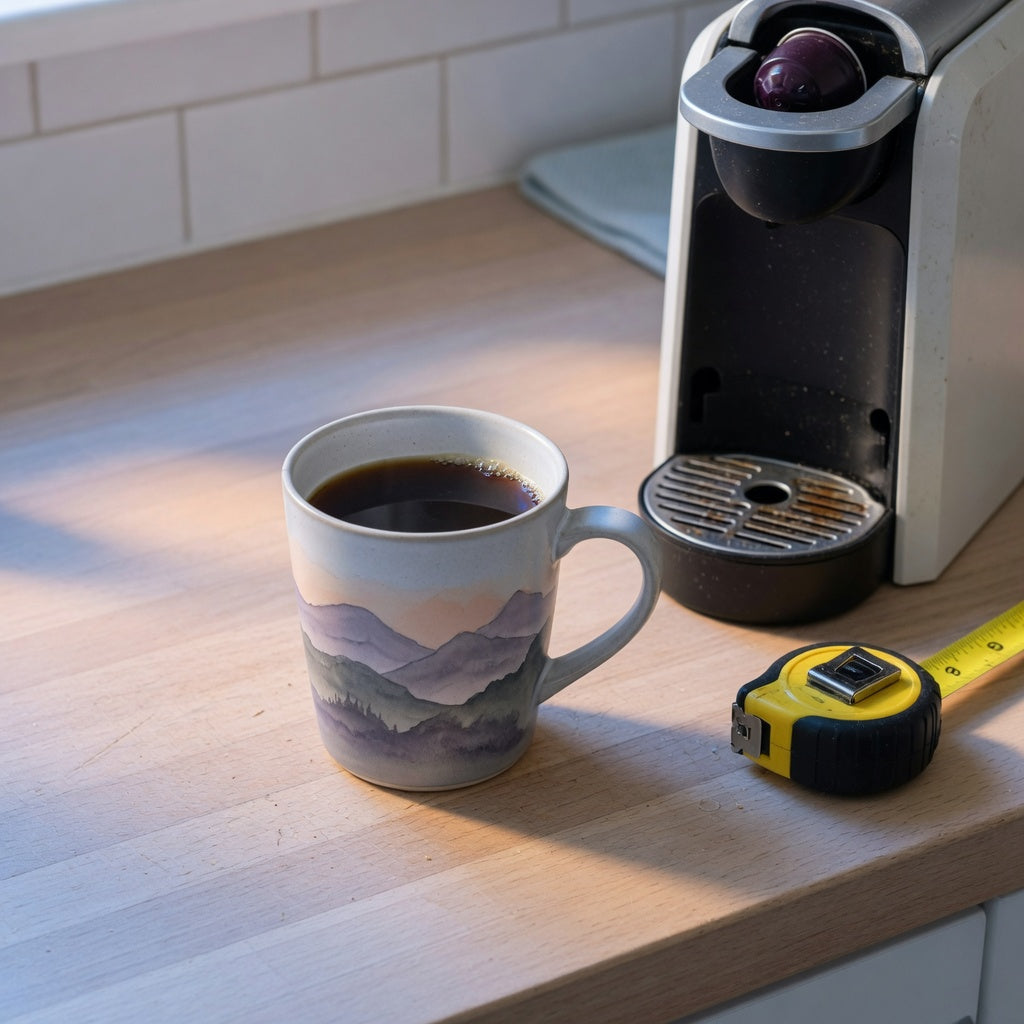
Tall Landscape Ceramic Coffee Mug Checklist: Fit and Care
Reading time: about 14 minutes
A scenic mug can look right in the product photo and still fail on a Tuesday morning. The ridge line wraps the body, the color matches the kitchen, and then the rim will not slide under a single-serve spout once the drip tray is clipped in. Or the handle looks open until a full pour puts a hot wall against your knuckles. In our store those are the two notes we hear after the unboxing. That is why a tall landscape ceramic coffee mug checklist has to treat height and artwork as two separate problems.
The piece shoppers usually mean for that mix is our Landscape Tall Coffee & Tea Mug. The catalog title lists it at 350 ml. Convert that figure and you are a little under 12 US fluid ounces, not a 16 or 20 ounce cafe pour. Confirm the number on the current page before you order, because listings change. The title does not settle overall height, rim width, base width, empty weight, handle opening, clay body, or how the landscape was applied. Those blanks decide a daily cup versus a shelf piece.
If the tall profile is already wrong for your machine or your hand, look through other silhouettes in our unique coffee mugs collection. Forcing a scenic tall cup into a low gap is how a nice scene becomes a mug you only fill at the sink.
Tall walls, or a landscape on a shorter cup?
The same search covers two wants. Some people need a physically taller ceramic cup than a standard diner mug. Others want a mountain, winter, or countryside scene and do not care how tall the walls are. A useful buy starts when you know which problem you are solving.
Extra height gives a drink more vertical room and gives artwork a longer canvas. You spend that advantage on clearance, balance, and grip. A shorter, wider mug often fits more brewers, stacks under a low shelf, and feels less top-heavy, but the scene has less uninterrupted wall. If the picture is the point and your brewer gap is tight, choose a shorter scenic cup. If you want the height and your machine and shelf can take it, judge the landscape second.
Porcelain, stoneware, and earthenware are all sold as ceramic, and they are not the same tool. Wall thickness, empty weight, and how easily a rim chips depend on the clay and the firing. Follow what this listing actually claims. If it never names the body, leave that blank empty. Do not copy a clay type from a similar photo on another site. In our experience, assuming every white scenic mug is porcelain is how people also assume the wrong wash rules.
The tall landscape ceramic coffee mug checklist: clearance, capacity, and grip
Run the checks in this order. A strong scene does not rescue a cup that tips, cooks your fingers, or never reaches the spout you own.
- Capacity versus your pour. Match the listed volume to black coffee, tea, or a milk drink. Tall is not a promise of a huge ounce count.
- Overall height against a real gap. Measure from the drip tray to the outlet, and from the mug shelf to the cabinet above. Leave room so the rim does not scrape on the way in.
- Rim width and base width. A small foot under a tall wall is the usual tip risk beside a laptop or on a nightstand.
- Empty weight, then full weight. Ceramic already has heft. Liquid adds more. If grams are missing, weight is unknown, not light.
- Handle opening. Count fingers, check knuckle clearance, and assume the body beside the handle will run hotter than the handle.
- Artwork method and care line. A design fired under glaze and a surface print do not age the same way in detergent.
- Food-use wording. You want a cup for coffee and tea, not an ornament with a warning label.
- Microwave mark. Ceramic is not automatically safe to heat. The listing has to say so for this piece.
Our team uses that order on pre-purchase questions. Photos answer the scene. They rarely answer the gap under your spout.
Will the height clear the brewer, the shelf, and the rack?
Single-serve machines are where tall cups fail. People with Keurig-style and Nespresso-style brewers often find a favorite mug fits only after the drip tray comes out, or does not fit at all. The fix is a measurement, not a guess from a styled photo.
Put the tray in the position you actually brew with. Measure to the outlet. Compare that number with the mug height on the page. If height is not published, do not invent one from the crop of the picture. Ask, or pick another cup. Use the same tape for the cabinet where you store mugs rim-down, and for the top dishwasher rack, where a tall wall plus a handle can block the spinner or the door.
Count the handle in that rack check. A cup that clears the shelf on the counter can still sit too high once the handle is turned outward. We would rather you catch that with a tape before the box arrives than after the first wash cycle.
This tall scenic style is a poor match under a low cabinet, in a commute bag, or in a short stack. It is also the wrong pick if you will not remove a drip tray and the page never states height. No print is worth a mug you cannot get under the machine. A lidded travel tumbler is a different tool, and this open ceramic cup is not that.
Is 350 ml a full drink once milk or ice goes in?
There is no single trade definition of tall, so the word cannot do the math. Shoppers often sort home mugs into roughly a 12 fl oz cup, a 16 fl oz cup, and 20 fl oz and up. The catalog title we are using lists the Landscape Tall Coffee & Tea Mug at 350 ml, which lands near the smaller end of that range. Read the live listing and make sure the number has not changed.
- Black coffee or straight tea. 350 ml is a normal sitting for many people. It is not a full pot you nurse all morning without a refill. The liquid alone is a real handful once the clay is in your hand.
- A latte or milky tea. Milk and foam occupy the same cup. You get a smaller coffee dose than in a large milk-drink mug. If your usual order is a big latte, this listed size will feel short.
- Iced coffee. Ice spends the 350 ml quickly. A tall wall does not create hidden volume. For a large iced drink, you need more capacity, and you should accept the clearance cost that often comes with it.
A tall cup with a modest rim is also a weak stand-in for a wide cafe bowl. Less open surface means a hot drink cools more slowly, and there is less room for a broad cap of foam. Confirm rim width on the listing. If it is absent, do not guess from the camera angle. We would not sell this shape as a latte-art bowl.
Handle room, full weight, and a base that does not rock
Large hands are the second complaint we see, just after height. A handle can look roomy online and still admit only two fingers, or it can press your knuckles into the hot wall. Look for a stated opening. If none is listed, treat the photo as a hint, not a measurement. Wide-angle shots make gaps look bigger.
A workable grip has four parts. Two or three fingers pass through without a twist. There is daylight between knuckles and the cup wall. The handle stays easier to hold than the body once the drink is hot. The grip still feels secure if the glaze is smooth and your hand is wet from the sink. A thick rounded handle can be comfortable or clumsy. A very thin one can feel sharp, and chips often start at the upper or lower join where the handle meets the body.
Weight sits next to grip. A full ceramic mug is not a light object, and a tall form holds that liquid higher. On a desk, that is how cups get knocked into a keyboard. Look for a flat foot and a base that is not tiny next to the height. An unglazed foot ring should be smooth enough that it will not scratch wood. A rough foot is something we would rather catch in the photos than after a week on a desk.
If a full everyday mug already tires your hand, do not add height for the sake of a panorama. A shorter cup with a generous handle will serve you better. Also check the rim when it arrives. A warp that makes the mug rock is a defect, not a quirk to live with, unless the maker told you to expect it.
Will the landscape survive the dishwasher or only the sink?
Scenic mugs often fail quietly. The ridge line looks sharp on day one. Months later the lip is pale, because that is where mouths, spoons, and detergent meet. What matters is how the image was put on the clay.
Ask which of these you are holding, and treat a vague printed design as unfinished information:
- Underglaze, or a scene fired under a clear glaze. You are washing the glass layer, not bare ink. We trust this more for daily cycles only when the maker actually states that construction.
- A kiln-fired decal or in-glaze image. Often tougher than a surface coat, but only the care line on that listing says whether a dishwasher is expected.
- Sublimation on a coated mug, or a surface print. Heat, alkaline detergent, and abrasion are harder on the image. A hand-wash line is a limit, not a suggestion to ignore.
We do not assume every landscape mug in the catalog shares one method. On the Landscape Tall Coffee & Tea Mug, read the current care notes. If they are silent, plan on hand washing until you know otherwise. A soft sponge, no scouring pad on the scene, and no long soak in harsh detergent are gentler on glaze and artwork than a hot, aggressive cycle.
Watch for color loss at the lip, fine crazing that traps coffee stain, a crack where the handle joins, and chips from a knock on the tap. Any of those on arrival is a reason to stop using the piece for hot drinks until it is replaced. A cracked or worn glaze is not only a cosmetic issue. Stain sitting in crazing is also a reason to retire a cup you already own.
Food-use glaze, lead questions, and the microwave mark
If you drink from it, the mug is food-contact ware. The FDA has said there is no known safe level of lead exposure, and lead from pottery can move into food or drink. High exposure before birth and in early childhood is linked with learning and behavior difficulties and lower IQ. In adults, ongoing exposure is linked with kidney dysfunction, high blood pressure, and effects on thinking.
For cups and mugs, FDA compliance guidance uses a lead guideline of 0.5 micrograms per milliliter of leaching solution, and a result on any one of six units can miss that line. The guide describes this ware as small hollow pieces commonly used for coffee or tea, usually with a handle, and a mug as having fairly straight sides. The size it calls typical is about 240 ml (8 fl oz), though that example is not the only size covered. A taller scenic cup is still a drinking cup. Ask whether it was made and sold for food.
When a glaze is underfired, lead can stay loose instead of locking into the glass, then move into the drink. Washing or boiling at home will not pull it back out. Be more cautious with rough handmade ware, antiques, chipped or worn glaze, flea-market finds, unknown makers, and traditional pieces decorated in bright orange, red, or yellow. The FDA describes everyday commercial factory pottery as much less likely to have a lead problem. In our experience, the risky buy is a vivid vintage or handmade scenic piece with no maker behind the glaze, not a plain commercial cup sold for drinking.
Anything marked decoration only, including a not-for-food-use warning, does not belong in a coffee rotation. A lead-free or cadmium-free slogan is not the same as a cited leach test. Look for food-use intent and for a named method, lab, or limit. If this listing is silent, notice the silence. We would rather you pick a plainly food-use commercial mug than an unknown glaze with a prettier ridge line.
Microwave use needs its own mark. In guidance on melamine dishes, the FDA says not to heat food or drinks on melamine in a microwave, and to heat only in ceramic or other cookware specified as microwave-safe. Do not microwave a landscape mug just because it is ceramic. Check this listing. A metallic rim or metallic paint is a reason to keep it out. If the page never mentions microwave use, pour coffee that is already hot. This is a drinking cup, not a pot.
Daily cup, or a gift that should stay out of the harsh cycle?
Some buyers want a Monday-to-Friday mug. Others want a winter scene for someone who likes mountains, or one good-looking cup for a desk. Those orders are not the same.
For daily use, published height, a handle that fits the drinker, care wording you believe, and a capacity that matches the real pour matter more than the panorama. A listed 350 ml tall mug can be that daily cup when the machine clears and the person likes a modest coffee or tea. It is a weak gift for someone who lives on extra-large lattes, needs a lidded travel cup, or brews in a machine with almost no vertical room.
For a gift, add shipping and replacement. Ceramic chips. The damage we actually see on arrival is usually a rim nick or a crack at the handle root, not a smear through the middle of the mountains. Open the box, check the rim and both handle joins, and do not wrap a hairline crack for later. If one mug in a pair breaks, a one-off scenic shape may not have a match. Confirm that before you buy a single hero mug for someone who wants a set. It is fine to buy the scene mainly to look at. Do not pretend a decorative or hand-wash-only cup is an easy everyday mug for someone who runs every dish through a hot cycle.
| Buyer situation | What has to be true | Next step |
|---|---|---|
| Daily coffee or tea at a roomy machine | Height fits, handle fits, the care line matches how you wash, and about 350 ml is enough | Read the current tall scenic listing and confirm the blanks |
| Large latte, lots of ice, or a low spout | You need more volume or less height than a tall 350 ml cup offers | Leave this silhouette and compare other mug shapes |
| Gift for someone who likes mountains | They will accept the wash rules, and you can inspect for chips on arrival | Order only if the scene and the limits both fit that person |
Frequently asked questions
What belongs on a tall landscape ceramic coffee mug checklist?
Start with listed capacity, overall height versus your coffee maker and shelves, rim and base width, handle opening, and how heavy the cup will feel once it is full. Then check how the landscape is applied, whether the page says hand wash or dishwasher, whether the mug is sold for food use, and whether it is marked microwave-safe. If height or handle size is missing, you are not done comparing.
Will a tall ceramic mug fit under a Keurig or Nespresso?
Sometimes, and often only with the drip tray removed. Measure the gap you actually brew in and compare it with the height on the listing. If height is not stated, do not assume a tall scenic cup will clear the spout. A shorter mug is the direct fix when that gap is small.
Is 350 ml enough for a latte or only for coffee and tea?
The catalog title lists the Landscape Tall Coffee & Tea Mug at 350 ml, a little under 12 fl oz, so confirm that number on the live page. That holds a normal black coffee or tea. A milky latte fits only as a modest drink, because milk takes part of the same volume. It is not a large cafe milk drink, and ice shrinks the sip further.
How do I know if the landscape will fade in the dishwasher?
See whether the scene is under the glaze, kiln-fired, or a surface print, then follow the care line on that exact listing. Hand-wash wording means we would not promise the artwork through years of hot cycles. Silence is not a yes. If the mug must live in the dishwasher, pick a page that says so in plain language.
Does ceramic mean I can microwave a landscape mug?
No. Use the microwave only when the maker marks that mug microwave-safe. Metallic rims or metallic decoration are a reason to keep it out. If the listing never mentions microwave use, pour coffee that is already brewed instead of testing a scenic cup.
Write down your brewer gap, the finger room you need, and whether this cup will be washed by hand. Then open the Landscape Tall page and see which of those answers are actually printed. If the tall scenic shape loses on clearance, capacity, or care, move through the wider mug collection and pick a profile that fits the kitchen you have.
More from our blog
Ready to pick your mug? Two ways to save on today's order:
Ordering 1–3 mugs? Get an extra 10% off your 1st order with code 10_OFF Apply 10% Off & Shop Wooden-Handle Mugs →
Gifting 4+ mugs? Buy 3, Get the 4th Free applies automatically at checkout (no code needed; offers do not stack) · Free standard shipping (Nov pre-Christmas delivery: 15–20 calendar days US) · Free replacement if chipped in transit.
Popular mug buying guides: Wooden-Handle Tea Infuser Mugs Compared · Christmas & Secret Santa Mugs 2026 · Espresso & Cortado Cups Guide · Cup & Saucer Gift Sets · All 25 Mugs Spec Table · Mug Size Guide · Shipping & Promo FAQ
FIRST ORDER 10% OFF (CODE: 10_OFF) · OR BUY 3, GET THE 4TH FREE


Read more

The Rock ceramic coffee mug gift: what buyers compare
Shoppers searching for The Rock ceramic coffee mug gift often land on a university novelty, a fan gag, or a rock-textured cup. We walk through identity, capacity, care labels, print, licensing, and...
Read more
Round Ceramic Coffee Mug Size Guide: What to Compare
Matching ounce labels can hide very different round mugs. Compare capacity, outside height, belly width, handle clearance, and a comfortable pour before a listing photo decides the size.
Read more
Leave a comment
This site is protected by hCaptcha and the hCaptcha Privacy Policy and Terms of Service apply.