



Round Ceramic Coffee Mug Size Guide: What to Compare
Reading time: about 13 minutes
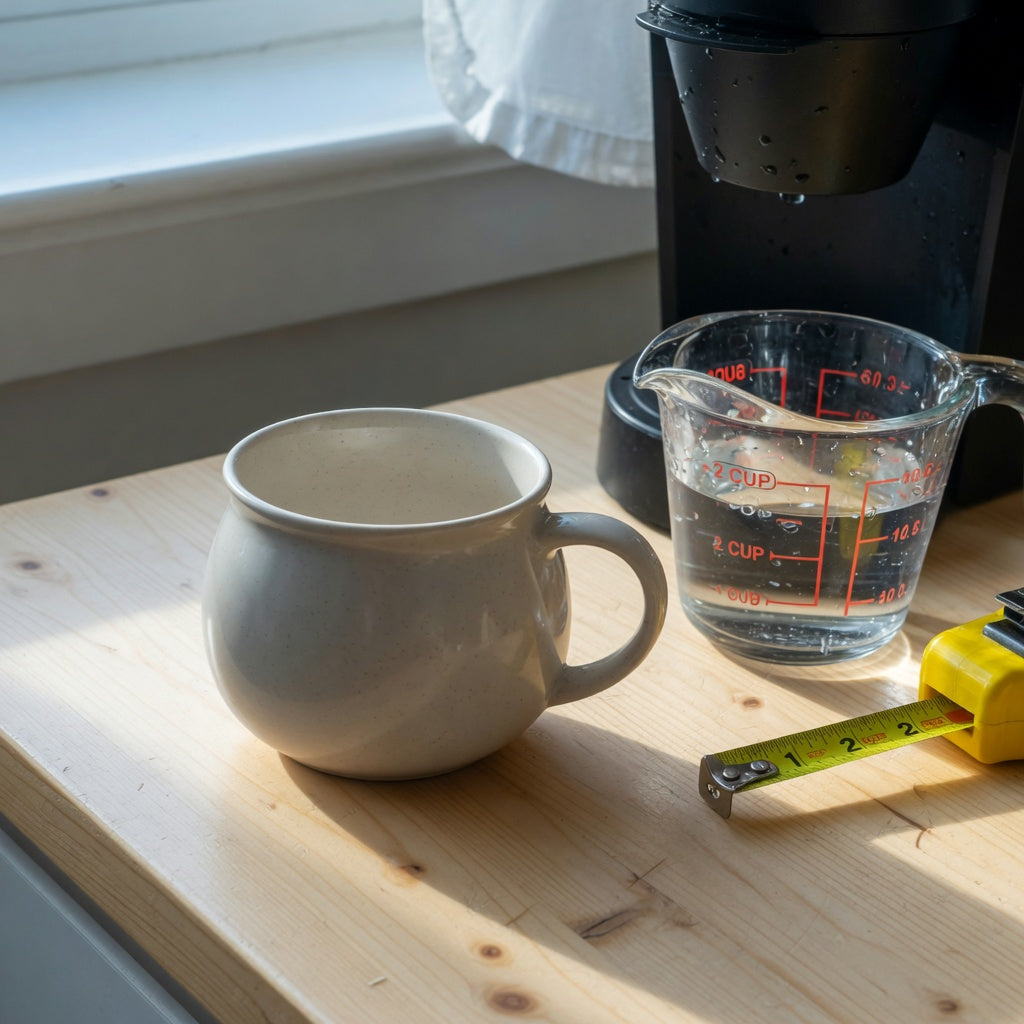
A customer once held two ceramic mugs up to the same phone camera and asked which one was the larger pour. Both listings used a similar ounce line. One stood tall enough that the handle nearly brushed a compact brew basket. The other sat low, round through the middle, and looked almost modest until the belly spread past the saucer. Same nominal number. Different kitchen. That mismatch is why a round ceramic coffee mug size guide lives next to the tape on our packing bench. No agency publishes a retail chart for this shape. What we can compare, every time, is the curve that holds the drink versus the outside that has to clear a shelf, a rack, and a hand.
If the mug in front of you is ours, open the current listing for the Round Ceramic Coffee Mug and copy only the figures that page actually prints. Height, rim width, belly width, handle reach, empty weight, brim capacity, and care rules are listing facts. If one of them is absent, leave it blank. A glaze photo is not a measuring cup. When you are still deciding whether a round body is the silhouette you want, set it beside other forms in our unique coffee mugs collection before the ounce number wins the argument.
Why do matching ounce labels still describe different round mugs?
The U.S. Food and Drug Administration groups cups and mugs as small ceramic hollowware used for drinks such as coffee and tea. In that guidance they normally, though not exclusively, hold about 8 fluid ounces, or 240 milliliters, and they are made with a handle. The same text pictures a cup with a base and curved sides, and a mug with cylindrical sides. Small hollowware means capacity under 1.1 liters. Large hollowware starts at 1.1 liters. Read that as a regulatory description, not as the mug you should expect to unwrap. A round belly is curved, so it will not look like the cylinder in that definition. Even a 20-fluid-ounce pour is about 591 milliliters, still under the 1.1-liter line. A product title that says large and a lab manual that says large hollowware are not the same phrase.
Photos make the confusion worse. A short, wide round mug reads as small because the rim is low in the frame. Much of the volume sits in the swell below that rim. Two mugs can share a nominal capacity and still differ in lip diameter, widest belly, foot, and handle span. Makers are free to pick those proportions. In our store we see shoppers dismiss a rounded mug from a thumbnail, then prefer it once they notice the belly is where a milky coffee actually lives. We also see the reverse: someone buys the wide bowl and cannot slide it out from under the brewer without catching the swell on the basket.
The first questions we ask are not whether 14 ounces sounds like a lot. They are where the mug will sit, what you pour, and how many fingers you use on the handle. A black coffee you finish quickly and a latte you top with foam do not want the same headspace. A mug you walk from the machine to a desk punishes a sloppy full brim. A mug that lives on a saucer can be wider, as long as the shelf agrees. If you are sizing a gift and the photo is doing the selling, our notes on what buyers should compare on large unique coffee mugs cover the unboxing problem: the box looks generous, and the kitchen still has to accept the belly.
How do U.S. ounces, milliliters, and the 8-ounce reference line up?
Use the NIST factor when a listing mixes units. One U.S. fluid ounce equals 29.57353 milliliters. For ordinary kitchen math, NIST also points to about 30 milliliters per fluid ounce and about 240 milliliters per cup. Those household figures are estimates. Do not correct a printed milliliter claim by forcing it onto the 30-milliliter shortcut. The FDA wording of about 240 milliliters for 8 fluid ounces follows that kitchen rounding. The exact factor puts 8 U.S. fluid ounces nearer 236.6 milliliters.
| U.S. fluid ounces | Milliliters at 29.57353 | Kitchen estimate at 30 mL |
|---|---|---|
| 8 | 236.6 | 240 |
| 10 | 295.7 | 300 |
| 12 | 354.9 | 360 |
| 14 | 414.0 | 420 |
| 16 | 473.2 | 480 |
| 20 | 591.5 | 600 |
A printed 12 U.S. fluid ounces is 12 times 29.57353, or about 354.9 milliliters. The kitchen shortcut puts that same label near 360. Close enough for a grocery estimate. Not close enough to call a 350-milliliter mug a confirmed 12-ounce U.S. mug. The British fluid ounce is smaller. NIST lists it as 28.412 milliliters, equal to 0.961 U.S. fluid ounce. Twelve British fluid ounces are about 341 milliliters, roughly 11.5 U.S. fluid ounces. If a gift listing does not say which ounce it means, ask before you assume the pour. We have watched that gap show up when a mug ordered from an overseas maker arrives shorter than the U.S. cup the buyer pictured.
The 8-ounce description is a useful floor for the conversation, not a standard we stock against. Many home brewers want more than a formal cup once milk or a second splash enters the mug. A smaller vessel is not a defect. It is the wrong tool if your dose is built around a bigger serving, and it is the right tool if you drink a short cup and hate leftovers that sit and cool. For how a stated ounce becomes the coffee you actually drink, our practical guide to ounces in a mug of coffee separates the label from the serving.
Round ceramic coffee mug size guide: which measurements beat the ounce claim?
Capacity is the volume inside. Everything else is the object you have to live with. On a round mug those are different problems, because the wall is not a straight tube. Multiplying an outside diameter by height counts clay thickness and pretends the belly, the lip, and the foot are one cylinder. They are not. A wide middle and a narrower lip can hide ounces. A thick base can steal them. If a page gives only outside width and outside depth, you still cannot prove the mug holds 12 ounces. We have had buyers do that cylinder math on a packing slip and then be surprised when a water pour stopped short of the number they expected.
These are the measurements we want on a listing before we call a size comparable:
- Brim capacity and comfortable fill. Brim capacity is the mug filled to the lip. A comfortable pour leaves room for milk, foam, or the walk to the table. Some makers separate a practical fill from a maximum. If the page gives one number, do not assume which one it is.
- Interior widths at the rim, the widest belly, and the base. Outside width tells you the footprint. Interior width tells you the drink. A round body is widest in the middle, so one diameter is not enough.
- Outside height, including the rim. Clearance cares about the tallest ceramic point, not the liquid line in a styled photo.
- Overall length with the handle, plus the opening inside the handle. A two-finger grip and a three-finger grip are different products even when capacity matches.
- Empty weight. Then add the liquid. Water is about one gram per milliliter, so a pour near 355 milliliters adds roughly 355 grams before the clay. Coffee is close enough to water for a hand-feel estimate. It is not a density test, and it does not replace a printed empty weight.
Ounces without a silhouette are a serving note, not a fit check.
Will a wide round belly clear the brewer, the shelf, and the rack?
Ounces do not answer clearance. Outside height and the handle do. On our packing table, the mug that surprises people is often the one whose handle adds more length than the belly. The carton looks reasonable. The cabinet does not.
For a drip brewer, measure from the counter to the lowest part of the basket or spout you must slide under. Compare that gap with the mug's outside height. Leave room to lift the mug straight out. A round belly often cannot tilt out the way a tapered diner cup can, because the widest point catches first. A tall straight mug fails a low basket. A short wide mug can fail the same machine if you cannot angle it free. That is a shape problem, not a capacity problem.
Cabinets care about more than rim height. The belly plus the handle is the depth that hits a door or a stack of plates. Dishwasher racks care about tine spacing and whether the handle hooks a prong. A heavy round foot on the top rack is also a balance problem once the jets hit it. We have pulled mugs that walked forward into the door because the foot was wide and the rack was shallow. None of that appears in an ounce claim.
| Constraint | What to measure | Why ounces fail |
|---|---|---|
| Drip brewer | Counter to lowest basket or spout, versus outside height | A short wide mug and a tall narrow mug can share a capacity and miss the gap in different ways |
| Cabinet shelf | Opening height, plus belly depth with the handle | Volume does not describe the door swing |
| Dishwasher rack | Outside height, handle hook, and how stable the foot is | A large pour does not predict tine fit |
| Car cup holder | Base diameter | A wide round foot usually will not seat in a tapered holder |
Skip the car-cup-holder hope unless you enjoy a mug that rattles and tips. This shape belongs on a table, a desk with a coaster, or a tray. It is not a commuter cup. If the real limit is how much ceramic you are willing to lift once it is full, the oversized ceramic mug capacity guide is about daily fit, not about chasing the biggest number in a title.
When is a full round ceramic mug the wrong daily cup?
A large ceramic mug feels fine empty and less fine once it is full. Thick walls add weight you notice halfway through a meeting. Buyers tell us they sized up so they would not refill, then left the last third because they were still sipping long after the drink had gone dull. That is a pace problem. It is not proof that a round wall holds heat better or worse than a straight wall of the same capacity. We do not treat belly shape as a thermal upgrade. A maker description is not a side-by-side test, and we will not pretend we have one.
Handle comfort scales with that weight. On a swollen body the clay curves toward your knuckles, so finger clearance matters more than it does on a slim cylinder. Hook the full mug on one finger and it torques. A handle opening that honestly fits three fingers feels calmer at the same capacity. Listings rarely print that opening. If they do not, you do not know it yet. In our experience, the people who return to a round mug are the ones who wrap a hand around the belly and set it down often, not the ones who carry it across an office on a fingertip.
This style is a weak choice if you need a light travel bottle, a lid, a cup-holder fit, or a small pour inside a vessel you will never fill. It is also the wrong assumption if you need microwave or dishwasher language to be universal. A ceramic body can still carry a metallic handle or a decorated rim that changes the care card. Metal on a handle is a common reason a mug becomes hand-wash only. Confirm that on the specific page. Do not borrow care instructions from a similar-looking mug, including ours, unless the current listing says so.
Match usable fill to the drink rather than to the biggest number in the title. A tea drinker who wants a modest cup is not the same buyer as someone building a milky coffee or a soup-sized pour. If the round belly fails that test, a straighter cup in the same collection may be the better daily tool.
What should you verify on the listing before you check out?
Use this pass on the current Round Ceramic Coffee Mug page, and on any other round mug you are cross-shopping. If a line is missing, the honest score is unknown, not a guess from the glaze photo.
- Does the capacity say brim-full, a practical pour, or neither?
- Are outside height, rim diameter, widest body, and base diameter listed separately?
- Is interior volume distinguished from outside dimensions?
- Is empty weight listed?
- How wide is the handle opening, and does the copy mention a two- or three-finger grip?
- Is the clay body named, or does the page only say ceramic?
- Do microwave and dishwasher statements cover the handle and any metallic decoration, or only the body?
- Is there a food-contact or glaze note you can actually read?
On lead, keep the regulatory line separate from marketing. FDA guidance for cups and mugs uses a lead guideline of 0.5 micrograms per milliliter of leaching solution for any one of six units, with ceramicware methods such as ASTM C738. That is an action level for enforcement. It is not a badge we can paste onto a mug that does not document testing, and it is not something you can see in a product photo. If the rim chips, we stop using that piece for hot drinks. A worn lip is a reason to retire the mug, not a mark to keep pouring over.
Write the eight checks on a note, fill in only what the Round Ceramic Coffee Mug listing states, and do the same for the runner-up. If the round belly fails the brewer gap, the shelf, or the way you actually hold a full cup, go back through the unique coffee mugs collection and compare a straighter cup on those same lines. The size that works is the one whose usable pour, height, belly, handle, and weight all survive your kitchen.
Frequently asked questions
How many ounces is a normal ceramic coffee mug, and is 8 ounces too small for a home brewer?
FDA language describes cups and mugs as usually about 8 fluid ounces, or 240 milliliters, but not exclusively that size. There is no separate retail law that makes 11 or 12 ounces the normal mug. Eight ounces is small if your brewer dose plus milk needs more room. It is plenty if you want a short cup you will finish while it is still hot.
Are 11-ounce and 15-ounce ceramic mugs the same height and diameter?
No. A nominal capacity does not lock the silhouette. A round mug can be short and wide or taller with a milder curve and still carry a similar ounce label. Compare outside height, rim, widest body, and handle length. Treat any dimension the listing does not print as unknown.
Is 14 ounces a lot bigger than a usual mug, and will I only fill it halfway?
Fourteen U.S. fluid ounces is about 414 milliliters, well above the FDA's about-8-ounce description, but it is not a universal oversized class. If you only ever fill that mug halfway, you bought capacity you are not using, and you are carrying clay sized for a pour you skip. Check whether the listing means brim-full or a comfortable serving before you decide it is too much.
Why does a short, wide round mug look smaller in photos than its ounce capacity?
The camera reads rim height more easily than belly volume. Liquid in a rounded body sits in the swell, which a straight-on thumbnail flattens. Judge a stated fill line or interior dimensions, not the outline in the lifestyle photo. If those interior numbers are missing, the photo cannot answer the size question.
What should a round ceramic coffee mug size guide include when the listing prints only one number?
Include interior volume, whether that volume is a brim fill or a practical pour, outside height, rim and belly width, handle reach, and empty weight. One ounce figure cannot tell you if the mug clears a brewer, fits a shelf, or feels balanced when full. Confirm those points on the current listing rather than inferring them from a similar mug.
Ready to pick your mug? Two ways to save on today's order:
Ordering 1–3 mugs? Get an extra 10% off your 1st order with code 10_OFF Apply 10% Off & Shop Wooden-Handle Mugs →
Gifting 4+ mugs? Buy 3, Get the 4th Free applies automatically at checkout (no code needed; offers do not stack) · Free standard shipping (Nov pre-Christmas delivery: 15–20 calendar days US) · Free replacement if chipped in transit.
Popular mug buying guides: Wooden-Handle Tea Infuser Mugs Compared · Christmas & Secret Santa Mugs 2026 · Espresso & Cortado Cups Guide · Cup & Saucer Gift Sets · All 25 Mugs Spec Table · Mug Size Guide · Shipping & Promo FAQ
FIRST ORDER 10% OFF (CODE: 10_OFF) · OR BUY 3, GET THE 4TH FREE


Read more
Tall Landscape Ceramic Coffee Mug Checklist: Fit and Care
Compare height, handle room, full-cup weight, and artwork care with this tall landscape ceramic coffee mug checklist. Our Landscape Tall Coffee & Tea Mug is listed at 350 ml. Confirm clearance ...
Read more
Unique ceramic mug gift for home office: what buyers should compare
A unique ceramic mug gift for home office has to work beside a laptop, not only in a photo. We cover capacity, handle fit, rim drip, wooden-handle care, lid wording, and glaze claims to verify on t...
Read more
Leave a comment
This site is protected by hCaptcha and the hCaptcha Privacy Policy and Terms of Service apply.