



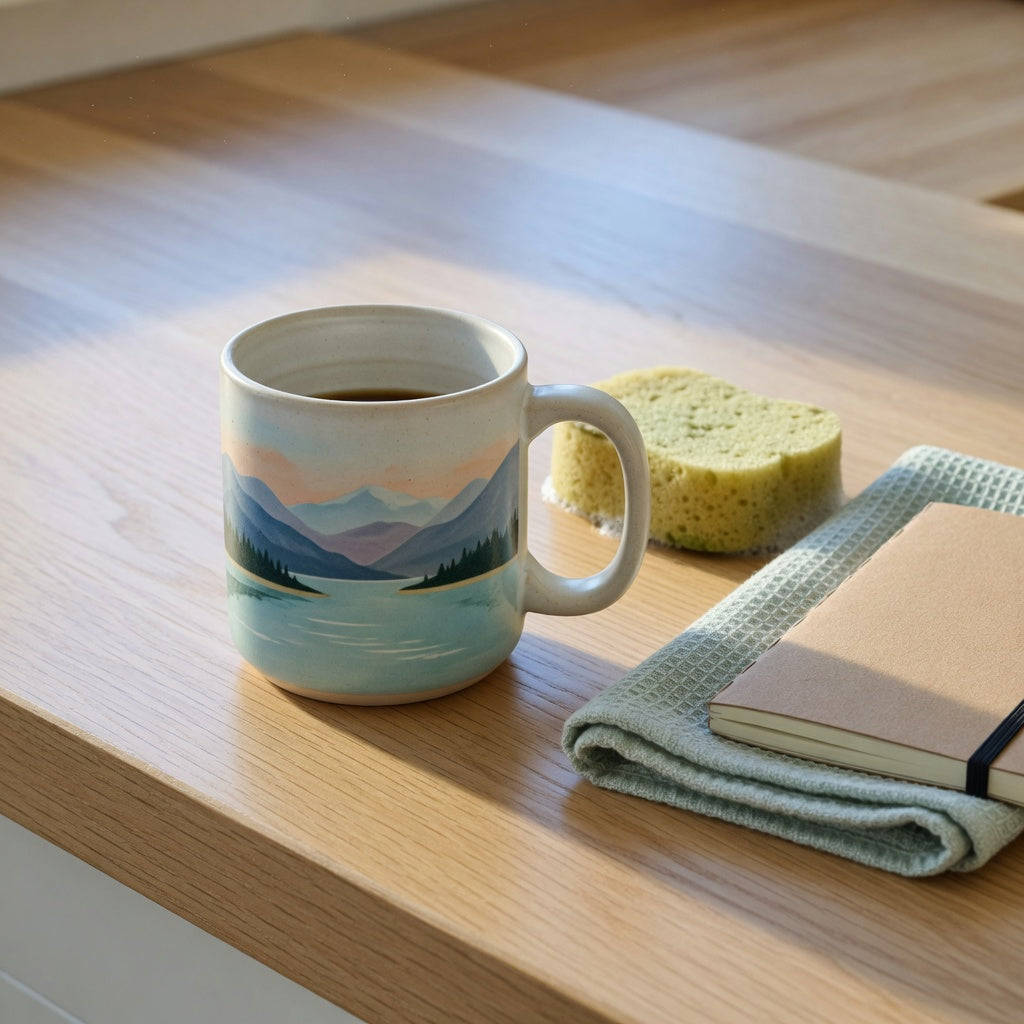
Landscape Ceramic Coffee Mug Buying Checklist: Fit and Care
Reading time: about 12 minutes
Shoppers set the scenic mug beside the plain one they already use. The mountain view wins the glance. Then the handle clears only two fingers, a gold line sits in the hills, and the cabinet above the dishwasher is too short for the height. We watch that sequence on the packing table often enough to know the print is half the decision. A landscape ceramic coffee mug buying checklist puts the drinking job first: coffee or tea at home or a desk, not a commute, and not a piece that should have stayed on a shelf.
Desk pour, crowded cabinet, or a shelf piece only?
Start with where the cup will actually live. An open ceramic mug belongs on a table, a nightstand, or an office desk, where a spill is a paper towel rather than hot coffee in a lap. There is no lid. Heat moves through the wall into the hand. A bag on a train or in a car will tip it. If the drinker is on the move, an insulated traveler matches that routine better than scenic ceramic.
For home and desk use, split the workhorse from the display piece. A daily cup takes hot liquid, a sponge, and usually a dishwasher cycle next to plates. A display piece can carry a metallic line, a delicate surface color, or a shape that fights a short shelf, as long as everyone in the house knows it is not the morning mug.
| Situation | What actually matters | Next step |
|---|---|---|
| Coffee or tea at a home counter or desk | Stated capacity, handle gap, rim, stable foot, care lines on the listing | Start with the scenic cup, then read the current facts |
| Short cabinet or a packed dishwasher rack | Height, a handle that blocks upside-down storage, how busy the artwork is | Compare other silhouettes before you commit to one scene |
| Commute, camp bag, or a cup that gets knocked around | Lid, insulation, and whether ceramic will survive a drop | Skip an open ceramic mug |
| Gift that may live on a shelf | Metallic or luster detail, overglaze wear, any not-for-food-use mark | Treat it as display unless the listing says otherwise |
In our store, the Landscape Ceramic Coffee Mug is the scenic cup we pull when someone wants that landscape view for coffee at home or beside a laptop. The photo is not a spec sheet. Capacity, clay body, dishwasher or microwave marks, and any metal in the decoration have to be confirmed on the current listing before you call it a daily driver.
If the scene is right but the height or handle is wrong for the shelf you own, look through the unique coffee mugs and compare silhouette against the cabinet, not against the lifestyle photo.
Porcelain, stoneware, or earthenware: what you can actually check
Clay names get used loosely online. Without a kiln log, the useful checks are weight in the hand, whether the wall looks opaque, whether glaze covers every surface that touches the drink, and what the maker states about care.
- Porcelain is usually lighter. A thin rim held toward a window can look slightly translucent. That lip feels refined, and it can also feel hotter against the mouth. Chips show up as bright nicks.
- Stoneware is typically heavier and fully opaque. A thicker wall sits steadier on a desk and takes more shelf depth. The trade-off is wrist fatigue if you carry a large scenic mug from the kettle several times a morning.
- Earthenware is porous and needs a glaze to hold liquid. Lead may be present in the glaze or decoration on some traditional pottery. Fired at the proper temperature for the proper time, essentially all the lead is bound into the glaze. If it is not properly fired, lead may get into food.
We do not guess the body from a styled photo. If the listing does not name the clay and does not state dishwasher or microwave limits, those facts are unknown. The word ceramic, by itself, is not a care instruction. Heat retention is the same kind of gap: a thin wall often feels hotter in the hand than a thick one, but a product image cannot prove how long a pour stays warm.
Lead, cadmium, and when a bright scenic glaze stays off the coffee shelf
Some ceramic foodware can leach significant lead from surfaces that touch food or drink. Foods can extract that lead, and continued use of a leaching piece can contribute to chronic lead poisoning. The FDA action level for lead in ceramic cups and mugs is 0.5 µg/mL of leaching solution.
Cadmium is separate. Imported and domestic ceramic ware has been found with significant extractable cadmium. Acid foods can pull it out, and continued food use of a leaching piece could contribute to chronic cadmium poisoning. FDA cadmium action levels are 0.5 µg/mL of leaching solution for flatware and small hollowware, and 0.25 µg/mL for large hollowware.
Washing, boiling, or other home processing does not remove lead from pottery. Give extra scrutiny to handmade ware with a crude or irregular look, antiques, damaged or heavily worn pieces, pots from flea markets, street vendors, or an unknown maker, and bright orange, red, or yellow decoration. Pottery made in commercial factories for everyday use is much less likely to have a lead problem. That is a risk filter, not a lab result for any one mug on a website.
A lead-free line should describe a test, not a mood. Ware that shows extractable lead under the FDA pottery method should not carry that label, and such labeling may be considered false or misleading. Ware whose extractable lead exceeds the action levels may be considered adulterated. Where a child might sip from an adult mug, do not fill that gap with hope. The FDA links lead poisoning in children to learning disabilities, developmental delays, and lower IQ scores, and a child with lead poisoning may not look or act sick.
Ceramic that looks suitable for food is treated as foodware unless it bears both a conspicuous stick-on not-for-food-use warning and a permanent version of that message on the exterior of the base. A hangtag by itself does not meet that rule. A landscape with no food-use statement is not proof of testing, and it is not proof the cup is only decorative. Read the listing, or choose a cup that states it is meant for food contact.
Landscape ceramic coffee mug buying checklist for capacity, handle, rim, and foot
The print does not tell you whether the mug drinks well. Once the scene has done its selling, these are the checks we walk through:
- Stated capacity. Confirm ounces or milliliters on the current listing. A larger scenic mug can look generous and then refuse to stand upside down on a short dishwasher rack, or block the shelf above it. Match the number to one coffee pour or a smaller tea serving. Do not invent the size from the photo scale.
- Handle opening. Two fingers and a thumb is the minimum most people will live with at a desk. A tall, narrow handle looks delicate beside a landscape and then pinches. Online, you want a side photo of the gap between handle and wall, not only the front of the scene. Also check whether that tall handle stops the mug from storing upside down.
- Rim. In person, run a finger along it. A smooth, slightly rounded rim is more comfortable and less likely to trail coffee down the outside. A sharp or wavy lip is a common reason a pretty mug gets retired after a week of desk use.
- Balance when full. A heavy decorated side, or a handle set too high, tips the mug toward the artwork as you set it down. On a desk, that is a keyboard problem, not a styling detail.
- Foot and base. Look for glaze skips, cracks hiding under the trim, and a wobble on a flat counter. An unglazed foot ring is normal on many pots. A cracked foot, or a foot that rocks, is not. Hairline cracks are not cosmetic. The CPSC has recalled ceramic mugs because hot liquid can seep through hairline cracks and pose a burn hazard.
Will underglaze, overglaze, or a metallic line survive the sink?
Separate the clay from the decoration. Underglaze color sits under a clear glaze, so the glassy surface is what a spoon and a sponge touch. Overglaze enamel and decals sit on top of that glaze and usually wear first at the rim, the handle joints, and the base, where the mug rubs a rack. Metallic and luster paints are a third group. They make many landscape scenes pop, and they change how you heat the mug.
Dishwasher-safe and microwave-safe are claims about one product, not a property of ceramic in general. If the listing does not say it, hand wash. Even a marked scenic mug loses contrast faster if the printed face sits against a heating element, or if another foot grinds the scene in a stack. In our experience, fade shows first on raised edges and along the lip, not in the middle of a printed sky. Our gift care notes for a landscape ceramic mug walk through washing and drying without treating every scenic cup as the same.
Metallic coatings are the hard stop. On March 21, 2024, the CPSC announced a Nestlé USA recall of metallic mugs sold in Starbucks-branded gift sets after the mugs overheated or broke when microwaved or filled with extremely hot liquid. The notice cited 12 overheating or breaking incidents and 10 injuries. A gold rim, a silver wave, or a luster highlight is a reason to heat the drink in another vessel and pour it in. Do not assume every ceramic mug is microwave safe.
Before daily use, set a mug aside if you see any of these:
- Crazing, a fine crackle through the glaze. It can be intentional on decorative pots, but coffee stains it and it is harder to keep clean. We would not hand a crazed cup to someone who wants a low-maintenance daily mug.
- A chipped rim, which puts a sharp edge at the mouth and can expose the clay body.
- Pinholes or popped glaze bubbles on the inside. They trap coffee and fight every sponge.
- A hairline crack in the wall, the handle joint, or the foot.
Coffee film on a sound glaze usually lifts with warm water, a drop of dish soap, and a soft sponge. Skip steel wool and gritty powders. They haze the glaze, and the next stain sticks faster. Dry the mug fully, including under the handle, before it goes into a closed cabinet.
When the landscape gift fits the person, not just the unboxing
A landscape mug is an easy gift because the scene does the talking when the tissue comes off. It is a weak gift when the person lives on a travel tumbler, has no open shelf, or will resent hand washing a souvenir they were expected to drink from every morning.
- Desk or kitchen drinker who likes a view on the cup. Open the landscape coffee and tea mug and confirm capacity plus care lines the photo cannot prove.
- Scenic ceramic, but a shorter handle or a quieter print for a packed cabinet. Compare shapes in the unique coffee mug collection instead of forcing one silhouette.
- Commuter, camper, or anyone who needs a cup that can bounce in a bag. Skip open ceramic. It breaks. A landscape mug on tile is a shard, not a story.
- Children who might drink from the adult mug, and no clear food-contact statement. Do not guess. Pick a cup that states it is for food use, or keep the scenic piece as display.
What this style is not good for: commuting, microwaving a metallic design, unsupervised use when glaze safety is undocumented, or a lightweight camp cup.
If the listing is silent on food-contact use, dishwasher limits, microwave limits, or metal in the artwork, those are open questions. Silence is not a yes.
Run this pass before you order:
- Home or desk drinking, not a commute.
- Clay body and care limits stated, not inferred from the photo.
- No paired not-for-food-use warnings, and no mystery orange, red, or yellow glaze from an unknown maker.
- Capacity, handle gap, rim, and a foot that sits flat, confirmed on the listing or in hand.
- Artwork described clearly enough to know whether color is under the glaze, on top of it, or metallic.
- No crazing, rim chips, pinholes, or hairline cracks.
- Microwave only if the maker says so and there is no metal or luster.
Frequently asked questions
What belongs on a landscape ceramic coffee mug buying checklist before checkout?
Confirm the job first: home or desk drinking, not commuting. Then check stated capacity, handle clearance, rim shape, a stable foot, glaze covering the inside, and whether any metallic or luster detail is called out. Read dishwasher and microwave lines on the current listing. If those lines are missing, plan to hand wash and heat the drink in another cup.
Should scenic artwork on a ceramic mug go in the dishwasher?
Only when that specific mug is marked dishwasher safe. Color sitting on top of the glaze wears at the rim, handle, and base before the clay fails. If the listing is silent, wash with a soft sponge, skip abrasive pads, and dry under the handle so water does not sit in the joint.
Can I microwave a landscape mug with a gold or silver accent?
No. Keep metallic coatings and luster paints out of the microwave. A March 2024 CPSC recall of metallic mugs sold in branded gift sets linked microwaving, or filling the mug with extremely hot liquid, to overheating, breakage, burns, and cuts. Heat the coffee elsewhere, then pour.
How can I tell a ceramic mug is marked not for food use?
Ceramic that looks like a food cup is treated as foodware unless it has both a conspicuous stick-on not-for-food-use warning and a permanent version of that message on the outside of the base. A paper tag alone does not meet that rule. Antique, badly worn, or unknown handmade pots with bright orange, red, or yellow glaze belong off the daily coffee shelf.
Does crazing or a small rim chip mean I should stop drinking from it?
Retire a chipped rim from daily sipping. The edge is where your mouth sits, and the chip can expose clay. Crazing stains and is harder to keep clean, so we would not pick a crazed scenic mug as a workhorse. A hairline crack in the wall or handle is a burn risk because hot liquid can seep through, and that mug should come out of service.
When those checks are honest, the scenic cup earns the spot next to the kettle. Open the landscape listing, confirm the care lines the photo cannot prove, and use the unique coffee mugs collection if the handle, height, or scene is close but not the daily fit.
More from our blog
Ready to pick your mug? Two ways to save on today's order:
Ordering 1–3 mugs? Get an extra 10% off your 1st order with code 10_OFF Apply 10% Off & Shop Wooden-Handle Mugs →
Gifting 4+ mugs? Buy 3, Get the 4th Free applies automatically at checkout (no code needed; offers do not stack) · Free standard shipping (Nov pre-Christmas delivery: 15–20 calendar days US) · Free replacement if chipped in transit.
Popular mug buying guides: Ceramic Tea Cups & Infuser Mugs · Ceramic Mugs with Lids Compared · Wooden-Handle Tea Infuser Mugs Compared · Christmas & Secret Santa Mugs 2026 · Espresso & Cortado Cups Guide · Cup & Saucer Gift Sets · All 25 Mugs Spec Table · Mug Size Guide · Shipping & Promo FAQ
FIRST ORDER 10% OFF (CODE: 10_OFF) · OR BUY 3, GET THE 4TH FREE


Read more

Coffee Mug vs Tea Mug Difference Morning Night Guide
The coffee mug vs tea mug difference morning night is shape, cooling, and caffeine timing, not a regulated category. We explain heat, brew habits, and what to verify on the listing.
Read more
Morning Night Coffee Tea Mug for Coffee Lovers Home Decor: Compare
Buyers comparing one mug for morning coffee, later tea, and open-shelf decor need drink-safety, appliance, and handle checks the print will not answer. Here is the comparison we use before a mug le...
Read more
Leave a comment
This site is protected by hCaptcha and the hCaptcha Privacy Policy and Terms of Service apply.