
Tall Ceramic Coffee Tea Mug Checklist: What Buyers Should Compare
Reading time: about 14 minutes
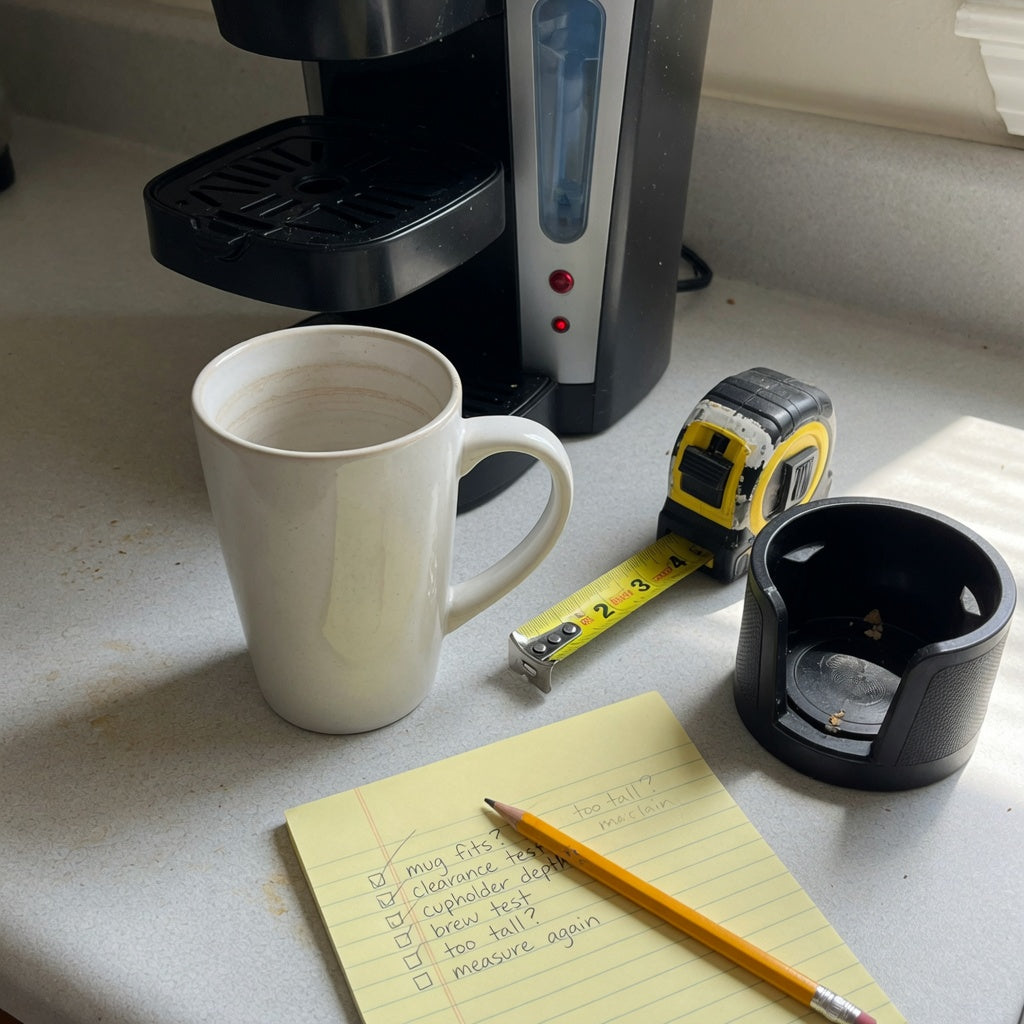
A buyer stood at our packing table last week with a tape measure and a photo of her single-serve brewer. The mug looked generous in the product shot: a long wall, a real handle, room for a morning pour. She asked if the rim would clear the dispenser. The page never printed a height. We would not guess from a styling shot. That is why we keep a tall ceramic coffee tea mug checklist at the counter, covering height, opening, foot, handle, usable fill, and the care lines that belong to that exact piece.
In our store we pack ceramic coffee and tea mugs every day, including the Mountain Tall Ceramic Coffee Mug. The catalog title names the silhouette. It does not give millimeter height, usable ounces, or say whether a lid, a print, or a glaze line is appliance-safe. Those answers sit on the current listing, and listings change. In our experience, the questions before checkout cluster around the same gaps: brewer clearance, cup-holder fit, brim versus usable ounces, a handle that pinches when the mug is full, a lead-free line with no test behind it, and a microwave claim that forgets the lid. If you are comparing more than one shape, start with our unique coffee mugs and run the same measurements on each page.
What belongs on a tall ceramic coffee tea mug checklist before the photo counts?
There is no retail standard that separates a tall ceramic mug from a large one by height, rim, or ounces. Shoppers use tall for a higher silhouette, a bigger pour, or both. Many pages print one of those ideas and skip the numbers that decide fit.
Measure your space before you compare a product page:
- Brewer gap. Distance from the mug platform up to the dispenser, on the machine where you actually brew. A lid or a raised insert can steal that gap.
- Shelf or cabinet. Clearance above the rim, including a lid if the mug lives under a cabinet.
- Cup holder. The top opening and how fast it narrows. A foot wider than the holder will perch and tip.
- Hand. How many fingers you want through the handle when the mug is full, not empty.
Then record these figures from the listing. A blank is an open question, not a yes.
| Check | What to record | What it decides |
|---|---|---|
| Height to the rim | Inches or millimeters, with and without a lid | Brewer, shelf, and cabinet fit |
| Rim diameter | Inside opening, not only outside width | Sip, aroma, cleaning, and infuser fit |
| Base or foot | Diameter of the part that must enter a holder, and whether the foot is flat | Cup-holder seating and tipping |
| Handle opening | Height and depth of the gap, and distance from the hot wall | Finger room when the mug is full |
| Empty weight | Ounces or grams, if the listing states it | Starting point before the drink |
| Stated capacity | Fluid ounces and milliliters, and whether the figure is brim-full | Usable pour versus the number on the page |
A lifestyle photo plus an ounce claim is not a finished comparison. If height, inside rim, and foot are missing, mark them unknown. Work this tall ceramic coffee tea mug checklist on paper before you trust the photo.
Stated ounces versus the fill line you can actually carry
Brim capacity and a drinkable fill line are not the same number. Filled to the lip, a mug spills on the walk from brewer to desk. Tea needs headspace for the leaves. Coffee usually stops short of the rim so the first step does not slosh.
Listings mix U.S. fluid ounces and milliliters. NIST Handbook 44 defines 1 U.S. fluid ounce as 29.573 milliliters, and the NIST metric conversion card uses 29.57 milliliters as the approximate factor. When a page prints only one unit, that is the conversion we use:
- 8 fl oz is about 237 mL using 29.57.
- 16 fl oz is about 473 mL.
- 20 fl oz is about 591 mL.
FDA guidance written for cups and mugs describes that hollowware as normally, but not exclusively, about 240 mL, which the guide also writes as 8 fl oz. The 240 mL figure is that rounded household description, not proof that every 8-ounce claim was measured the same way. A mug sold around 16 or 20 fl oz is a different object, and the word tall still does not say which object you are holding. Convert the printed number, then account for the band you will not fill. If the page never says whether the ounce claim is brim-full or a comfortable fill, leave that box blank.
A tall narrow interior can hold the same volume as a shorter, wider mug. One may clear a cup holder and fail under a brewer. The other may sit under the brewer and never enter a car holder. Volume alone does not pick the winner.
Coffee aroma, tea steep space, and a lid that is not a thermos
Coffee and tea punish the same tall shape differently. For black coffee or a latte, we look at the drinking rim and the inside opening. You want enough width to smell the cup and to reach the wall with a sponge or bottle brush. A narrow throat looks neat on a shelf and becomes a chore once milk film dries inside.
Tea adds checks coffee-only pages skip:
- Infuser diameter versus the interior, so the basket is not wedged or lost in a wide gap.
- A lid that can sit as a saucer under a dripping infuser, not only as a cover.
- Steep space above the leaves, so you are not brim-full before the tea opens up.
- A drinking rim you can use after the infuser comes out, instead of a bottle-tall body with a tiny sip hole.
A lidded ceramic mug is still not a travel thermos. If the listing shows no locking lid, seal, or leak note, do not commute with it. If you want an infuser, a normal handle, and a lid on a body that is not bottle-tall, confirm all three on the current page. Miss one, and it is a different product than the search suggested.
Shoppers also ask whether a tall narrow shape stays hotter than a wide mug. A wider mouth leaves more surface open to the air, and a large open cup can cool before you finish it. That observation is not a minute count. We do not treat stoneware, porcelain, a double wall, or a thicker wall as a hold-time guarantee unless the listing actually states one. If it does not, choose the shape for fit and for how you drink.
Foot diameter, handle opening, and weight once the mug is full
Empty mugs lie. A handle that feels fine on the shelf can pinch once the pour is in, and a narrow foot can rock on a grout line or tip in a holder.
Check three handle points. The opening should clear the fingers you use, often two or three, without knuckles on the hot wall. Both joins should look substantial, not pinched where they meet the body. The handle still has to work if the mug sits in a holder. Some tall narrow cups drop in and leave the handle jammed on the console. You can lift them. You cannot drink comfortably while they stay seated.
On the base, look for a defined foot that sits flat, not a rounded belly on a small point. Tall mugs tip more readily when the foot is small relative to the height and the liquid sits high. There is no universal foot diameter for every car. Measure your holder and compare it with the listed foot. If the diameter is missing, you do not know.
Ceramic is heavier than a light insulated tumbler. A full tall mug is the clay plus every milliliter you poured. A weak grip, or a long walk across an office floor, may make a shorter mug the better daily driver. This shape is a poor match for dashboards, strollers, and one-handed commuting unless the listing shows a secure lid. It is also a poor match for a shallow drawer. Stack height is rarely printed. If you stack, you need rim and foot geometry, not a guess from a side photo.
Lead, cadmium, and a Not for Food Use mark you should not ignore
A lead-free line is not a leach test on that SKU. Published results for one consumer mug are uncommon. We do not treat a badge on a photo as a lab report.
Regulators publish action levels, not a ranking of mugs. FDA Compliance Policy Guide Sec. 545.450 sets 0.5 micrograms of lead per milliliter of leaching solution for ceramic cups and mugs, judged on any one of six units, using the methods named in that guide. That guide is aimed at cups and mugs: small hollowware commonly used for coffee or tea above room temperature, usually with a handle. It also says some ceramic foodware has leached significant quantities of lead from food-contact surfaces, and that extractable lead can cause adverse health effects, including chronic lead poisoning, with continued food use.
FDA guidance on imported traditional pottery says those action levels also apply to ceramicware that is not lead-glazed. Ware labeled lead-free that still shows extractable lead under the CPG method may be considered misbranded, because the claim can be false or misleading. Read a lead-free sentence as a claim to verify, not as a result you can quote.
Cadmium limits sit in FDA Compliance Policy Guide Sec. 545.400. For ceramicware used with liquid foods, the action level is 0.5 micrograms per milliliter for small hollowware on any one of six units, and 0.25 micrograms per milliliter for large hollowware, also on any one of six units. Flatware, ware with an internal depth not over 25 mm, is an average of six units at 0.5 micrograms per milliliter. Hollowware is deeper than 25 mm. A drinking mug is hollowware, not a plate, but the guide does not give a height that puts every tall mug into the large-hollowware bucket. Do not assume which cadmium number applies until the piece is defined. The guide also says extractable cadmium from acid foods could cause chronic cadmium poisoning with continued food use.
Ornamental pieces are a separate trap. Under 21 CFR 109.16, lead in glazes and decorative decals can leach into food if decorative ware is used to prepare, serve, or hold food. Ware that looks fit for food is treated as foodware unless it carries a required Not for Food Use warning both as a stick-on label and as a permanent statement on the base, or a hole is bored through the food-contact surface. A mug sold for coffee is being sold as foodware. If you see the ornamental warning, do not drink from that piece.
A 2017 pilot study measured lead in coffee and tea from five mugs already screened as containing lead. Coffee ranged from 0.2 to 8.6 micrograms per liter, and tea from below 0.2 to 1.6. The spread followed the cup, not the drink and not a 10-minute versus 60-minute hold. For one of the five mugs, the estimated daily dose exceeded California's 0.5 microgram-per-day lead Maximum Allowable Dose Level. That study is not a survey of typical new mugs, and it is not a reading for any mug we sell. Use it as a reason to care which cup you drink from, not as a number to paste on a listing.
On our pages, read any glaze note, food-contact line, or warning that is actually there. If it is absent, mark the checklist not stated. Not stated is not the same as safe.
Microwave trim, dishwasher prints, and the lid as a separate piece
Appliance claims fail in the footnotes. A mug body, a metallic rim, a decal, and a separate lid are four different objects. If the listing says dishwasher safe or microwave safe and does not say the print and the lid are included, do not assume they are.
FDA microwave guidance is the practical test here. Microwaves pass through glass, paper, ceramic, and plastic, and metal reflects them. Those containers are not heated by the microwaves themselves, but they can get hot from the food. Metal pans and aluminum foil are generally a poor idea in the oven, because reflection can cook food unevenly and may damage the oven. Use ware the maker calls microwave-safe, and follow the oven manual. A metallic band, gold paint, or a metal-trimmed lid is a reason to keep that piece out even when the clay body looks ordinary.
The same FDA page warns that water heated alone in a clean cup can superheat and erupt, causing serious burns. Adding something such as instant coffee or sugar before heating greatly reduces that risk. Reheat a real drink, not a mug of plain water.
Dishwasher wording has the same hole. Heat, detergent, and a rattling rack are what fade prints and stress glazes and lids over repeated cycles. If you care about a printed scene, confirm the listing covers the decoration. Hand washing is the conservative path when the page is silent. Silence is not permission.
When the box arrives, inspect the food-contact surface before the first pour. When we unbox a gift order, the rim and the foot get a look before the outside print does.
- Chips or cracks at the rim, the interior, or the foot. Stop using a mug whose food-contact surface is chipped or cracked.
- Crazing, the fine crackle in the glaze. The 2022 FDA Food Code, a model for retail and foodservice, expects multiuse food-contact surfaces to stay smooth and free of cracks, chips, and similar defects, and resistant to crazing, pitting, and scratching. That code is not a consumer certification for a home mug. At home, a crazed interior is harder to clean, and a crack you can feel is a reason to retire the piece.
- A foot that does not rock on a flat counter.
- A handle that clears the wall so your fingers are not on the hot clay.
None of that inspection replaces a leach test. It does catch the damage that makes an ordinary mug a bad daily cup. Do not assume every ceramic piece is appliance-safe, and do not treat one heat story as a rule for clay body or wall thickness.
Desk mug, brewer gap, or commute: which listing fits your setup
Open the Mountain Tall coffee mug page when you want the tall ceramic coffee mug we list under that catalog name, and you will match the live description against the measurements above. Confirm, in the current text, whatever it actually states for height, capacity, materials, handle, lid, glaze notes, and microwave or dishwasher wording. We will not fill those blanks from a similar mug, a marketplace lookalike, or an old photo.
That listing is a sensible next step if:
- Your brewer gap and shelf are taller than the mug height printed on that page, lid included if you will use one.
- You drink coffee or tea from a ceramic cup at a desk or kitchen counter, not on a commute.
- You want this one tall mug rather than a stack of small diner cups, and the listed shape matches the space you measured.
It is the wrong next step if you need a proven cup-holder foot and the listing does not print a base diameter, if you need an infuser and the current listing does not include one, or if you need a lab report rather than a product description. A shorter, wider ceramic mug can be the better daily cup when clearance is tight. A real travel bottle is the better cup when the drink leaves the building.
If that design is not the shape you measured for, go back through the rest of the unique mug collection and run the same checks on each candidate. Write down brewer gap, holder diameter, usable fill, handle fingers, and whether appliance wording covers the lid. Order the listing that answers those lines, not the one with the tallest photo.
Frequently asked questions
What should a tall ceramic coffee tea mug checklist include before I order?
Record brewer gap, shelf clearance, and cup-holder size first. Then compare listing height, inside rim, foot diameter, handle opening, empty weight, and stated capacity in both fluid ounces and milliliters. Finish with glaze wording, any Not for Food Use mark, and whether microwave or dishwasher claims cover the print and the lid, not only the clay body.
Does a tall ceramic mug hold more than a standard mug?
Not by height alone. There is no standard retail definition of tall. Convert stated U.S. fluid ounces with the NIST factor of about 29.57 milliliters per fluid ounce, then ask whether that number is brim-full. A tall narrow mug and a short wide mug can share the same usable pour and fail in different places.
Will a tall ceramic mug fit under a single-serve brewer?
Only if the mug height, including any lid you use, is shorter than the gap you measure on your machine. The listing does not know your brewer. Measure from the platform to the dispenser, and leave a little room so the rim does not scrape. If the product page omits height, you cannot answer this yet.
Are tall ceramic coffee mugs microwave and dishwasher safe?
Some are and some are not, and the claim has to match the exact piece. Metal trim reflects microwaves and does not belong in the oven. A lid, a decal, or metallic paint may be excluded even when the mug body is allowed. If the current listing does not say, do not guess. Plain water heated alone in a very clean cup can superheat and erupt, so reheat an actual drink rather than water by itself.
How do I judge a lead-free claim on a ceramic mug?
Treat it as marketing until you see a test tied to that product. The FDA action level for lead in ceramic cups and mugs is 0.5 micrograms per milliliter of leaching solution on any one of six units. A lead-free label on ware that still leaches lead under that method can be misleading. Pieces marked Not for Food Use are not drinking mugs.
More from our blog
Read more
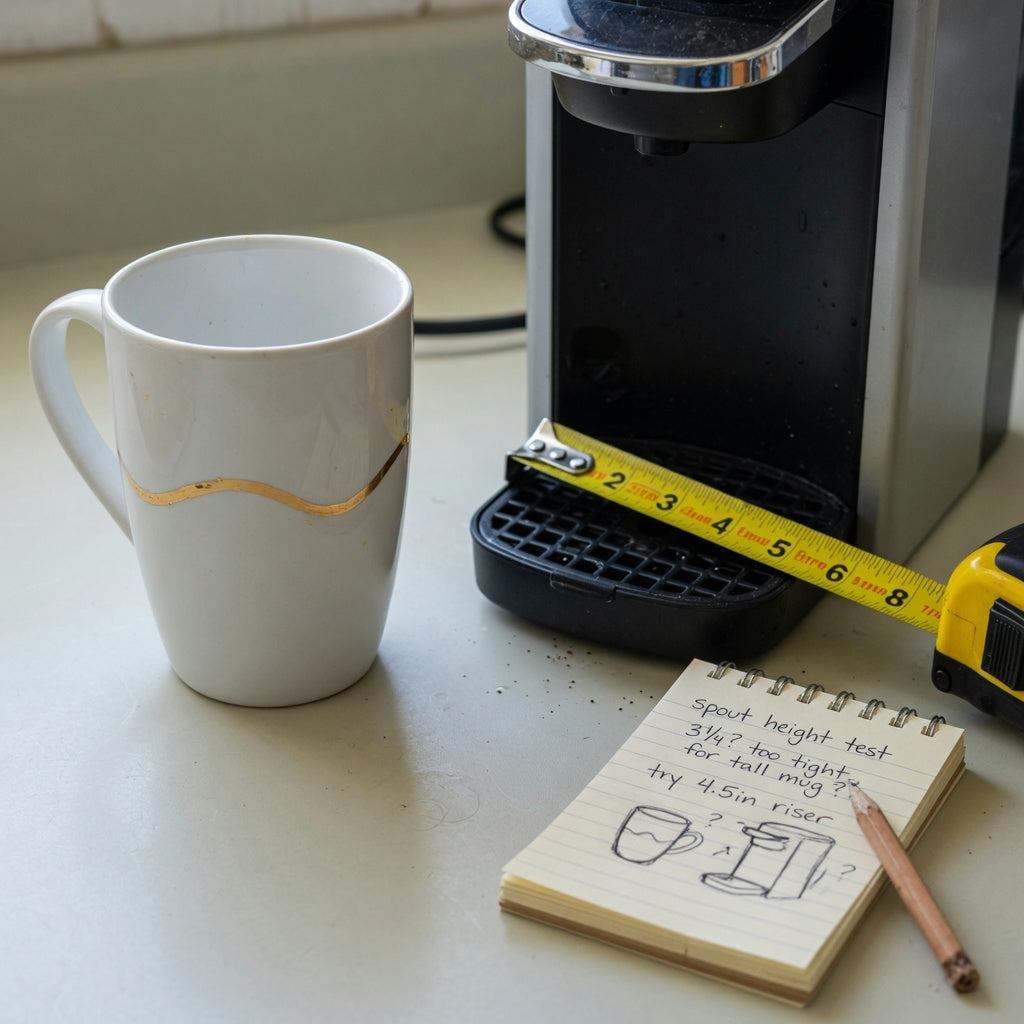
White Golden Waves Tall Coffee Tea Mug Buying Checklist
Separate the wave design, locate any gold, and verify capacity, brewer clearance, and food-contact care on the current listing before you buy. We also say when a plain mug is the better daily cup.
Read more
Office Mug for Loose Leaf Tea: Capacity and Opening
An office mug for loose leaf tea is easier to live with when listed capacity and the visible opening come first. We put 250 ml, 390 ml, and 400 ml drinkware side by side and spell out what is not i...
Read more
Leave a comment
This site is protected by hCaptcha and the hCaptcha Privacy Policy and Terms of Service apply.