
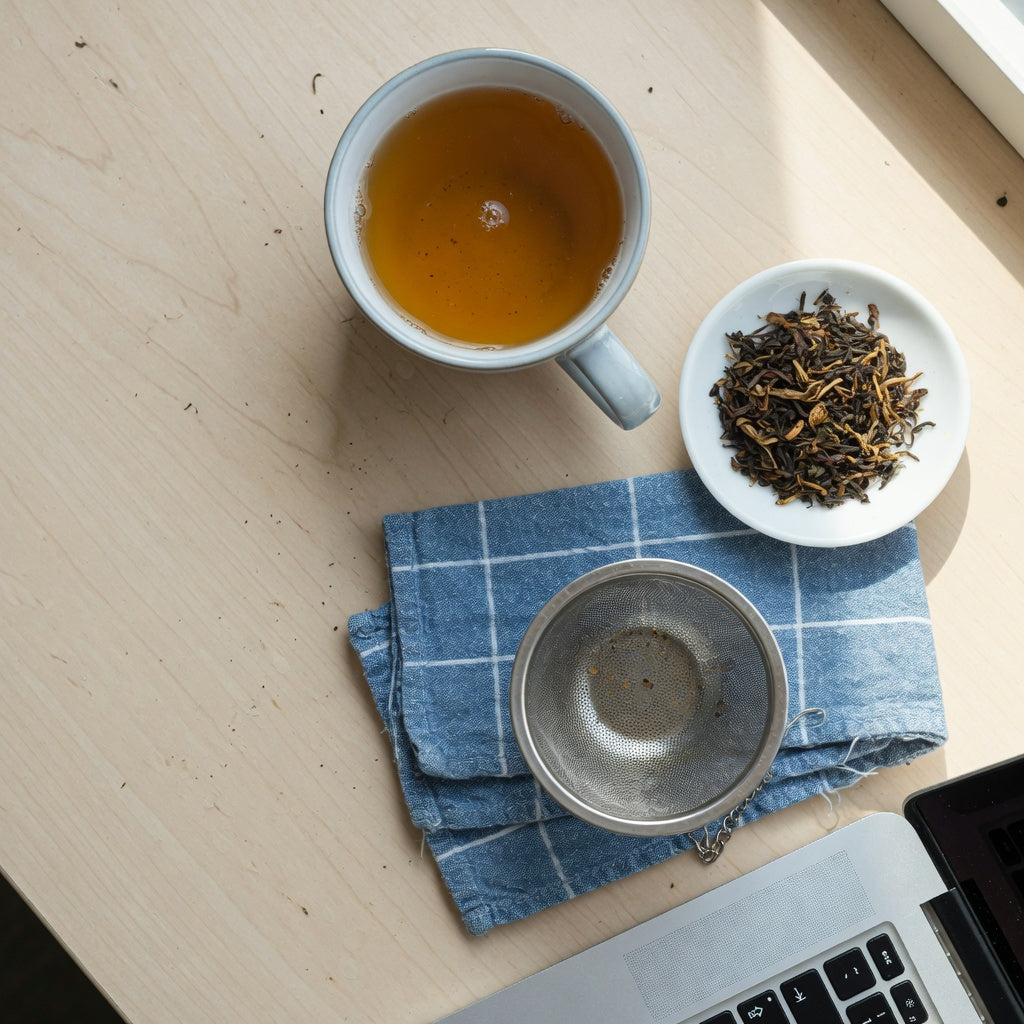
Office Mug for Loose Leaf Tea: Capacity and Opening
Reading time: about 14 minutes
The kitchenette dispenser hisses, a coworker pours over a spoon of whole leaf, and a calendar alert pulls them into a call. Forty minutes later the liquor is dark, the rim is sticky, and a few fragments have settled against their teeth. In our store, that is the usual start when someone asks for an office mug for loose leaf tea. They want one cup at a desk and a shared sink, plus a way to end the steep before it turns harsh. They do not want a teapot. The three options we line up for that job are open cups. Listed capacity and the visible opening are the facts worth comparing. Baskets, paper filters, lids, and drip rests are not part of these listings.
What should an office mug for loose leaf tea actually hold?
Listed capacity is the volume printed with the mug, not the line you should fill to the lip once the leaves are wet. Whole leaves swell. A basket you already own takes space of its own inside that volume. Brim-fill a small cup and you get a short drink plus a crowded steep. Pick a larger cup and only half-fill it, and you still have more wall to rinse and less free space on a crowded desk.
Our team matches the workday to the number first, then checks the mouth on the current listing. These are the catalog facts we will stand behind, and nothing past them:
| Desk situation | Listed size | Opening we can cite | Skip it if |
|---|---|---|---|
| One short cup you will finish | Ball handle, 250 ml | Listed diameter 11.2 cm | You need a deep basket under a full pour of bulky leaf |
| More water around the same spoon of leaf | Round, 390 ml | Check the current listing photo and specs | You assumed a filter comes in the box |
| Largest single work cup of the three | Spittoon, 400 ml | Check the current listing photo and specs | You need a sealed travel tumbler |
- 250 ml, ball handle mug. The catalog lists a diameter of 11.2 cm. Use that figure together with the listing photo as your opening check. We are not relabeling it as an inner-rim measurement the page did not spell out. It suits one focused pour you intend to finish, such as a modest spoon of green, white, or a lighter oolong. It is a poor fit if a tall basket and swollen leaves have to live under a full 250 ml. The ball handled coffee and tea mug is still only the cup.
- 390 ml, round mug. More water around the same spoon of leaf, or a longer sip after the first steep is done and you are still at the desk. Extra volume does not add a strainer. The round coffee and tea mug is drinkware. The mouth is not a number we can quote, so judge the visible opening on the current page before you assume leaves will lift out cleanly.
- 400 ml, spittoon mug. Largest listed capacity of the three, useful for one generous sitting rather than a tasting-size cup. The shape name is not a width. Those milliliters are not a travel seal and not an infuser. Confirm the mouth on the spittoon coffee and tea mug from the photo and any spec line before you buy it for easy rinsing.
None of these belongs in a commute bag. A sealed tumbler hides the liquor, often keeps leaves in the water for the whole ride, and can leak if the strainer was meant for a still desk. If the problem is a train or a walk between buildings, do not force a desk mug to solve it. In our experience, people who try that end up with a bitter cup and a damp sleeve.
Dosing without a scale is where capacity changes the recipe. Keep one spoon in the tin and use the same spoon every day. Dense pellets and fluffy whole leaves do not fill that spoon the same way, so taste is the adjustment, not a gram figure you half remember from a weekend brew. A modest spoon has more room to move in 390 or 400 ml. The 250 ml mug wants a slightly smaller spoon, or a tea that does not balloon. The mug does not measure the leaf for you.
Does a listed 11.2 cm diameter beat a tighter rim at the sink?
Capacity gets the argument. The rim decides the mess. The ball handled mug is the only one of the three with a diameter we will quote: 11.2 cm. That is the width we point to when someone must drop in a separate basket, watch the color from above, and lift the basket without dragging wet leaf down the outside onto laminate.
A tight mouth hides the steep. It also slows rinsing, which matters when the kitchenette sink is shared and you have a few minutes between calls. Fragments stick where your fingers cannot reach. A wide visible opening is how the cup stays usable on day ten, not just in the unboxing photo. The 11.2 cm figure is a listed diameter. Pair it with the photo. If the photo shows a thick wall, the drinking hole is smaller than the outside number, and that is the hole you have to work in.
For the round 390 ml mug and the spittoon 400 ml mug, a shape name is not a measurement. We are not assigning them a diameter. Open each listing, read the spec line, look at the mouth in the photo, and set that visible opening next to 11.2 cm. A bigger cup with a narrower mouth can be harder to clean than the smaller wide one. If the volumes are close enough for your dose, buy the opening you can actually work in.
The same two checks, printed milliliters and then the mouth, apply if you want other desk shapes before you decide. Our unique coffee mugs collection is the place to scan those shapes. Still read each listing. A different silhouette does not smuggle in a filter.
Which strainer belongs with an open desk cup?
The next question is which strainer the mug uses. These three use none. If a filter, basket, or lid is not written on the product page, it is not in the box. Bring your own, or accept that some leaf will reach the drink. Worry about plastic or silicone in a lid lives on that accessory too, because these cups do not include one.
- Deep fine-mesh basket. The practical add-on for broken leaf, rooibos, and herbals that shed dust. Grit stays off your teeth. Tannin film locks into fine holes, and a workplace rinse rarely clears it. Soak the basket at home.
- Punched ceramic, porcelain, or glass insert. Easier to see and wipe, and some drinkers want no metal in the steep. Larger holes pass more sediment. Match the holes to the smallest bits in your tin, not to a photo of perfect whole leaves.
- Tea ball. Easy to carry, weak with whole leaf. Leaves that cannot expand make a thin cup, and a coarse ball still leaks dust. Treat a ball as a backup, not the setup you plan the desk around.
- No insert, leaves in the mug. Workable with a wide opening if you do not mind a few leaves, or if you pour off through a separate strainer. Pouring off needs a second vessel. Most desks do not have one.
Metallic taste is a basket issue, not a capacity issue. Some people notice steel. Others never do. Food-equipment language in the FDA 2023 National Shellfish Sanitation Program guide points to AISI type 304 stainless, or another corrosion-resistant metal that is nontoxic and nonabsorbent, for specified product-contact parts. It also expects that metal not to pass odor, color, taste, or toxic material into food. That is a rule for named equipment. It does not certify the infuser in your drawer, and it does not prove every steel basket is taste-neutral. If the tea tastes metallic, change the basket. The 250, 390, or 400 ml cup is only holding the water.
An open cup versus a purpose-built infuser is the fork most first purchases hit. We walked through that in what beginners should compare on a loose leaf tea mug, including the plain fact that a good-looking cup with no basket is still just a cup.
How do you cut the steep when the call runs long?
Harsh office tea is usually time, not a defective mug. One published trial steeped Turkish green tea at 75, 85, and 95 degrees C for anywhere from 1 minute to 45. In that set, 85 degrees C for 3 minutes produced the highest EGCG reading, 50.69 mg per 100 ml, and the highest scores for color, taste, aroma, and overall liking. Steeps of 30 and 45 minutes at 85 and 95 degrees C scored very low on those same points, which the researchers linked to bitterness and a dark cup. One green-tea test is not a clock for every oolong or black tea. It is a clear warning against the forgotten cup.
What we tell people who only have a dispenser or a microwave:
- Start the steep when you can see a clock. Do not start it on the way into a meeting.
- When your planned minutes are up, lift the basket or get the leaves out of the water. These mugs have no valve. Extraction keeps going while leaf and hot water stay together.
- Park the wet basket on a saucer or a lid you already own. A hot lid or a dripping basket on bare wood or thin laminate can mark the desk. A drip rest is not part of these listings.
- Resteep with fresh water if the leaf still tastes lively. The 390 and 400 ml mugs give that second pour more room. The 250 ml mug works better as one careful cup than as an all-afternoon session.
Temperature is the other compromise. Leaf type, water heat, steep time, and how much room the leaves have all move flavor. If the only source is a rolling dispenser, pour and let the water stand briefly before delicate leaves go in, then taste and adjust the wait the next day. A microwave can warm a smaller amount if you stop early and stir, but you will not hit a degree on the nose. Aim to avoid a long stew, not to copy a variable kettle you do not have at the office.
Shared sink, tannin film, and the jobs these cups will not do
An open mug rinses faster than fine mesh. Swirl, tip spent leaves into the trash rather than a shared drain that clogs, and wipe the wall while the cup is still warm. A tannin film still builds after a week of black tea or strong herbals. That film comes off at home with a soft sponge and warm water. A scouring pad between meetings is how a finished surface goes dull, and we would not reach for one at the office sink. Fine mesh is the opposite problem: the cup is easy, the basket is not. Plan to take the basket home if the holes are tight.
We will not call these mugs dishwasher safe or microwave safe. Appliance compatibility is not among the capacity facts we are using. Read the current page. If it is silent, the answer is unknown, not yes. The same goes for material. Do not decide glass versus a glazed body from the product name alone. If you want to watch the liquor through the wall, confirm that on the listing before you buy. A clear body can also show every splash on a desk that gets bumped, which is a fair trade only if you like seeing the color change.
They are a bad buy if you need a basket or lid in the box, a leakproof train cup, a tiny bowl for many quick steeps, or a printed lab result for lead. Shelf space is the quieter limit. A higher listed capacity often means a taller or wider body, but that is not a footprint we are quoting. Set the listing photo next to a notebook before you size up for water you may not finish. Handle clearance works the same way. If the handle would stick into a keyboard, the larger cup can be the worse desk neighbor even when the water volume sounds right. Footprint and handle clearance are part of what we cover in living with a mug at an office desk, which is about the work surface rather than about filters.
Glaze claims, lead limits, and labels that do not transfer
Decorative cups sometimes carry a lead-free line on another seller page, and shoppers stop there. FDA states there is no known safe level of lead exposure, and lead used in pottery may leach into food. For ceramicware cups and mugs, the action level in CPG 545.450 is 0.5 micrograms of lead per millilitre of leaching solution. That guide describes cups and mugs as small hollowware commonly used for hot drinks such as coffee or tea, often about 240 ml or 8 fl oz, and usually with a handle. An action level is an enforcement line for that category. It is not proof that any particular desk mug was tested, and it is not a result inside the capacity facts for the 250, 390, or 400 ml cups.
If you will steep every workday in glazed drinkware, read the current listing for material and any test language. A badge on a different marketplace listing does not transfer, and neither does a 304 stainless note on a basket brand we do not sell. If our page does not say, ask before you treat it as certified. We would rather you confirm a gap than assume a result the product facts never state.
A short desk checklist before one of these goes in the cart
Match the situation, then the mug:
- You want one short cup and a listed diameter you can quote. Start with the 250 ml ball handled mug at 11.2 cm, and judge the mouth from the photo as well as the number.
- You want more water per steep so a separate basket is not jammed against the leaf. Compare the 390 ml round mug, then confirm its visible opening yourself.
- You want the largest listed capacity for a single sitting. Look at the 400 ml spittoon mug, and do not buy it for a commute.
- You need the basket, lid, and drip rest included. None of these three. Those parts are unlisted, so they are not included.
If the setup is a home office rather than a shared floor, the home-office loose leaf mug shortlist is a useful next read once capacity and opening are settled. Then put the three cups next to each other on the listing pages and keep only the one whose mouth you can rinse on a busy morning.
Frequently asked questions
Does an office mug for loose leaf tea from your store include an infuser?
No. The ball handled 250 ml mug, the round 390 ml mug, and the spittoon 400 ml mug are drinkware only. Baskets, filters, lids, and drip rests are not part of these listings. If you want leaves held out of the drink, bring a strainer you already trust, or buy one whose own page lists the mesh.
Is 250 ml enough when whole leaves need room to open?
It is enough for one careful cup if you keep the dose modest and do not cram a tall basket under a brim-full pour. Whole leaves swell, so a crowded 250 ml steep can taste weaker and is harder to fish clean. Step up to the listed 390 or 400 ml when you want more water around the same spoon of leaf, and still check that the mouth is wide enough to lift them.
How do I stop the cup going bitter if a meeting runs long?
Get the leaves out of the water when your timer ends. A study of Turkish green tea found the highest EGCG reading in that test, and the best taste scores, at 85 degrees C for 3 minutes. Sensory scores were very low after 30 and 45 minutes at 85 and 95 degrees C because the liquor went bitter and dark. That clock is not universal, but leaving tea sitting is what usually ruins the desk cup. These mugs will not stop the steep for you.
Can I put these mugs in the dishwasher or the microwave?
We cannot say yes or no from capacity and diameter alone. Check the current listing for care and appliance language. If the page does not say, do not guess from the shape name or from a similar mug you owned before. An open cup is at least easy to rinse by hand at a shared sink, which is the clean most office days actually allow.
Will the stainless basket I already own make the tea taste like metal?
Sometimes drinkers notice it, and sometimes they do not. A 304 stainless reference in FDA food-equipment guidance is not a certificate for your basket, and it does not guarantee a neutral taste. If a metallic note shows up, swap the infuser. It is not something the 250, 390, or 400 ml cup adds by being larger or wider.
Read more
Tall Ceramic Coffee Tea Mug Checklist: What Buyers Should Compare
A store-side checklist for tall ceramic coffee and tea mugs: height, usable fill, foot and handle, glaze limits, and whether appliance claims cover the print and the lid. Measure your brewer and cu...
Read more
Filled Coffee Mug Gift Idea: What Buyers Should Compare
A filled coffee mug gift idea only works when the cup, the filler, and the wrap match one person. Compare fit, food-contact checks, shelf-stable fillers, caffeine, and allergens before you buy the ...
Read more
Leave a comment
This site is protected by hCaptcha and the hCaptcha Privacy Policy and Terms of Service apply.