
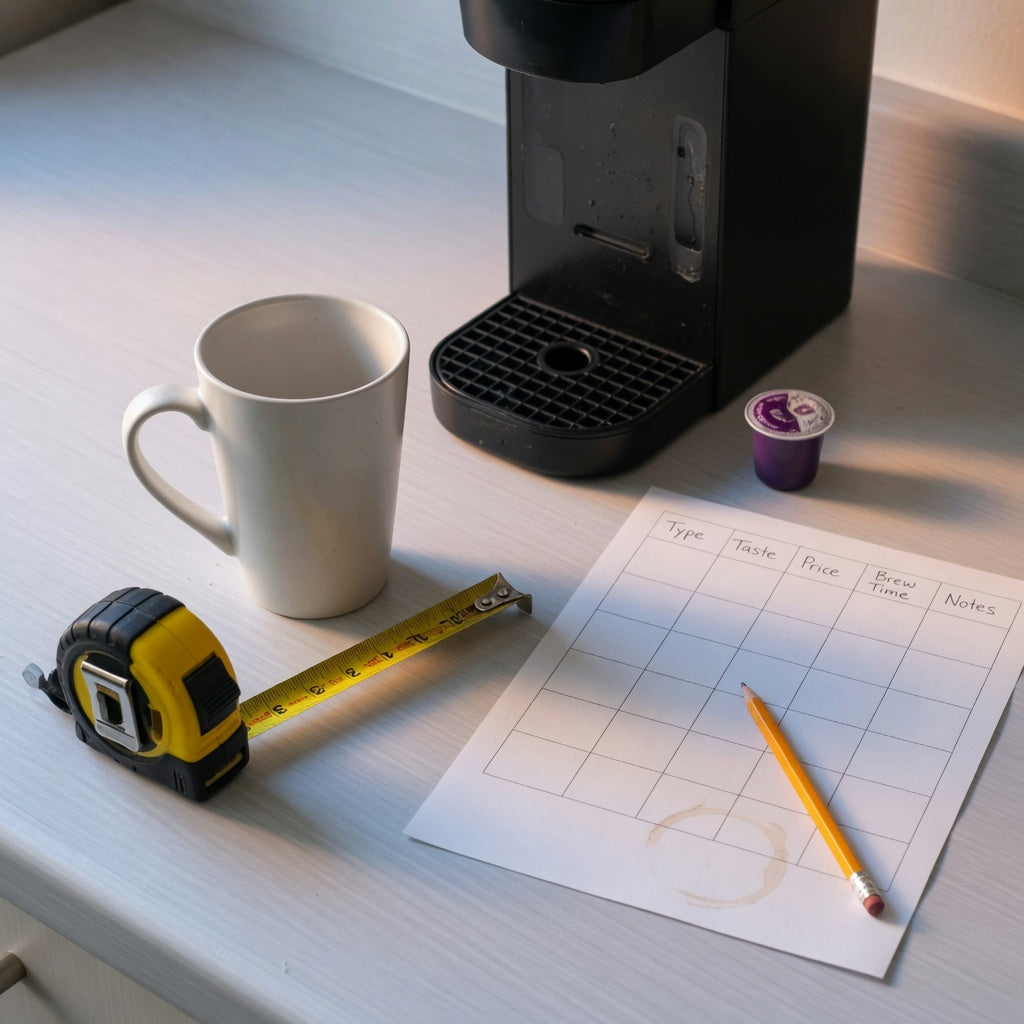
Tall Ceramic Coffee Mug Buying Checklist: What to Compare
Reading time: about 13 minutes
A customer sent a photo of a tall ceramic mug jammed under a single-serve brew head. The drip tray was pulled out, the lid was off, and the handle still caught the machine on the way out. Later the same base rocked in a car cup holder. In our store, those fit misses show up more often than chipped rims. A tall ceramic coffee mug buying checklist is the comparison we want finished before a box leaves the packing table.
Will this tall mug clear the brewer, the shelf, and the cup holder?
There is no single industry line that turns a large mug into a tall one. Some listings mean a narrow silhouette. Others mean anything bigger than a standard cup. Treat tall as a fit problem, not a style word.
Measure the tight spots in your own kitchen and car before you compare a listing:
- Brewer clearance. With the drip tray in its normal position, measure from the tray surface up to the underside of the spout or brew head. That gap has to beat the mug's overall height. Add a lid knob only if you will leave a lid on.
- Shelf or cabinet gap. Measure the open vertical space where the mug will actually live, not the full cabinet interior. A stacked pair often fails even when one mug would fit.
- Cup-holder opening and depth. Measure the diameter of the holder you use and how deep it is. A tall body on a wide base, or a handle that sticks past the holder, tips at the first turn. We do not quote a universal holder size. Cars, office caddies, and sofa cup wells are not the same.
If the listing omits overall height, rim diameter, or base diameter, do not guess from the photo. When we point shoppers to the Mountain Tall Ceramic Coffee Mug, we tell them to copy only the measurements on the current listing. The catalog title is a name. It is not a height, a capacity, or a dishwasher promise. Add lid height only if that page actually includes a lid you will leave on.
A tall mug is a poor match for a low espresso machine, a shallow cabinet, or a holder you trust on the commute. It is also an awkward gift when someone stacks cups under a short shelf. We have packed pieces that looked generous in the box and then lived on top of the fridge. If your measured gap is tight, compare a lower profile in our unique coffee mugs collection and run the same measurements. A bigger ounce number is not a win if the mug cannot sit where you brew.
What belongs on a tall ceramic coffee mug buying checklist?
At CoffeifyMug we keep the same short list we wish every product page printed in full. Copy it into a note before you open a second tab.
- Drink and usable capacity. Black drip coffee, a milky drink, or tea you plan to refill once. Listed ounces are often brim-full, not the level you can carry across a room.
- Overall height against the brewer gap and the shelf gap you just measured. Count a lid only when the listing sells one and you will leave it on.
- Rim diameter and base diameter. The rim controls sip, splash, and drip down the outside. A sharp lip can send coffee down the wall of the mug. The base controls holder fit and how easily the piece tips.
- Handle opening. Interior height and width, not the curve in a lifestyle photo. You need room for the fingers you actually use once the mug is full.
- Empty weight, if the listing gives it, plus the liquid. A taller wall does not make the clay lighter. Many pages skip this number. A blank is not zero.
- Food-contact wording versus a decorative-only mark, plus any lead, cadmium, or Proposition 65 language on the page.
- Dishwasher and microwave statements on the product page and, if a base photo is shown, on the base itself. An icon floating over a styled scene is not a care label.
Why the same ounce count can be short and wide or tall and narrow
Shoppers ask us about 12, 16, 18, 20, or 24 ounce labels as if the number described a shape. It does not. The same listed capacity can sit low and wide, which slides under a brew head, or rise into a narrow column that looks generous and then fails a shelf.
Two capacity traps show up in the messages we get before an order ships:
- Brim capacity versus a practical fill. Many listings state the volume filled to the lip. Leave a gap so coffee does not slosh when you turn or set the mug down. The serving you can drink is smaller than the headline ounce count. There is no shared labeling rule that forces a seller to print that lower, usable line.
- Milk and foam versus black coffee. A milky drink needs headroom. Pour to the listed capacity and then add milk, and you are past a comfortable line. Foam needs still more room.
A tall ceramic mug is the wrong tool if you want a wide surface for a big latte, or if you sip slowly and dislike a large volume sitting in the cup. It fits better when you want fewer refills and you have already confirmed the height. On an office desk, that tall body also sits in elbow range. The same ounces in a shorter, wider cup stay lower and are harder to clip.
We will not quote a heat-retention time for a tall silhouette. Wall thickness, a lid, a preheated mug, and how full you pour all change how fast the drink cools. A narrower opening can mean less exposed surface. A listing photo is not a timed test.
Handle opening, full weight, and a base that tips
Large handle on a product page is not a measurement. If the listing gives an interior opening, compare that gap with the fingers you use on a full mug, not with an empty one in a photo. A tall body holds more liquid higher up, so the handle works harder. An opening that looks fine can pinch once your grip shifts under the weight.
Balance is the other half. Extra height on a narrower base raises the center of gravity. The mug is not defective because it tips on a laptop edge or a console that is not a real holder. That shape is a poor match for that surface.
Skip a tall, narrow ceramic mug if you:
- Drink one-handed while walking, or you depend on a car holder for the commute.
- Have a holder that only catches the bottom of a wide base, so the tall body leans.
- Need a light cup. Clay plus a full pour is a real load, and you cannot compare empty weight when the listing left it blank.
- Need several mugs to share a crowded dishwasher. A tall body often takes a full rack slot, and the handle can hook the spray arm.
What a dishwasher or microwave label leaves out on ceramic
Ceramic, stoneware, and porcelain are fired clay with a glaze. The words are not interchangeable care instructions. Stoneware is often the heavier everyday body. Porcelain can be finer, and a thin rim chips when it meets a steel sink. A listing that only says ceramic has not told you which body you are buying. In our experience, the useful line is the care statement, not the marketing clay name. We will not quote a firing temperature either. That number is maker-specific and usually unpublished.
Read microwave and dishwasher claims as limits from that maker, for that exact piece:
- Metallic trim, a gold rim, or a metallic decal is a common reason a maker says not to microwave the piece. If the page is silent and you can see a metal band, do not assume the mug is microwave-safe.
- A dishwasher-safe claim belongs on the listing or on the base. Set a tall mug so the handle does not catch a spray arm. Do not crowd the rack until rims knock. One aggressive cycle is enough to mark a soft glaze.
- Crazing, a fine crackle in the glaze, can hold tea and coffee stains and can worsen with thermal shock. That is a reason to hand-wash, not a rustic feature you have to live with on a daily drinker.
- An unglazed foot ring can scratch a glass rack or a wood desk, and it can hold water. Dry the base before you put the mug away.
Hand-wash when the listing does not promise a dishwasher, when the glaze is crackled, or when the exterior is decorative and you are unsure about the interior. Skip the microwave unless the maker has marked that exact piece microwave-safe and you see no metal. A full tall mug can leave the handle very hot even when the clay is allowed in the microwave. Use a towel the first few heats until you know how that piece behaves.
On the current Mountain Tall listing, check whether any dishwasher or microwave line is actually printed. We will not answer that from the catalog title. Silence means not confirmed. It does not mean yes.
Food-contact glaze versus a mug you should not drink from
Pretty exterior art does not tell you whether the interior is meant for hot coffee every morning. On an order note, the useful questions are plain. Is this sold as food-contact ware? Is there a permanent not-for-food warning? Does the page treat a slogan as a test?
U.S. Food and Drug Administration guidance on ceramic foodware sets an action level for lead in cups and mugs of 0.5 micrograms per milliliter of leaching solution in any one of six units tested. For that guidance, cups and mugs are small ceramic hollowware commonly used for drinks such as coffee or tea above room temperature, normally but not exclusively about 240 milliliters (8 fluid ounces), and manufactured with a handle. A taller mug is still a drinking vessel. The definition follows how the piece is used, not one ounce size.
FDA states that some ceramic foodware leaches significant quantities of lead from food-contact surfaces. Food can extract that metal, and continued food use can cause a wide variety of adverse health effects, including chronic lead poisoning. Cadmium guidance for ceramicware suitable for liquid foods sets an action level of 0.5 micrograms of cadmium per milliliter of leaching solution for small hollowware under 1.1 liters, and 0.25 micrograms per milliliter for large hollowware of 1.1 liters or more, in any one of six units. Compliance guides specify the current edition of ASTM C738, among other listed methods. ASTM C738 is an acetic-acid extraction from glazed ceramic surfaces and is described as a severe test. A shopping page almost never shows those figures. A missing figure is not a pass.
Three labels get mixed together. Keep them apart:
- Lead free as a slogan. FDA guidance says ceramicware should not be labeled lead free if it contains extractable lead when tested by the method in the lead compliance policy guide. That labeling may be considered false or misleading. A banner on a photo is not a report you can read.
- Decorative ware. Federal rules recognize that lead used in glazes and decorative decals on ceramicware, including ornamental pieces, may leach into food if those items are used to prepare, serve, or hold food. Ornamental or decorative ceramicware that appears suitable for food use must carry a conspicuous permanent warning such as "Not for Food Use. May Poison Food." If you see that warning, do not drink from the piece.
- A California Proposition 65 warning. The state's Office of Environmental Health Hazard Assessment publishes safe-harbor levels and lists lead at 15 (oral) and 0.5. Exposures below established safe-harbor levels are exempt from the warning requirement. A Proposition 65 notice is not an FDA action-level result, and a missing notice is not proof the glaze was tested to ASTM C738.
For a daily hot drink, we look for ware sold for food contact, with a glazed interior you can see, and without a not-for-food warning. We cannot turn a lifestyle photo into a lab result, including on mugs we sell. If the listing is vague on food contact, that is a no for every-morning coffee. Display-only ceramic belongs on a shelf, not under a brew head.
Fill this side-by-side table before you order
Open two listings and write the numbers down. This is the tall ceramic coffee mug buying checklist in a form you can compare. Leave a blank where the seller did not publish a fact. A blank is information. You cannot score what they hid.
| Check | Your limit | Mug A | Mug B |
|---|---|---|---|
| Overall height, plus a lid only if you will use one | Brewer and shelf gap you measured | ||
| Rim diameter | A sip you can control, not a wide bowl | ||
| Base diameter | Your cup-holder opening and depth | ||
| Listed capacity and a fill below the rim | Drink type and headroom for milk | ||
| Handle interior opening | Fingers you use when the mug is full | ||
| Empty weight, if stated | What you can lift one-handed | ||
| Dishwasher and microwave statements | Your actual washing and reheating routine | ||
| Food-contact wording or a decorative warning | Daily hot drinks, or display only |
Frequently asked questions
What should a tall ceramic coffee mug buying checklist include before I order?
Measure brewer clearance, shelf gap, and cup-holder diameter and depth first. Then compare overall height, rim diameter, base diameter, listed capacity versus a fill below the rim, handle interior opening, empty weight if it is published, dishwasher and microwave statements, and whether the piece is sold for food contact or marked not for food use. If a number is missing, leave it blank. Do not invent it from the photo.
Will a tall ceramic mug fit under a single-serve coffee maker?
Only if the mug's full height is shorter than the gap from your drip tray to the brew head. Machines differ, and the word tall does not include that measurement. Add a lid only when you will leave one on. If the listing does not publish height, you cannot confirm the fit.
Is a tall ceramic mug dishwasher-safe and microwave-safe?
Only when the current listing, or a mark on that exact base, says so. Metallic rims and metallic decals are a frequent reason to keep a mug out of the microwave. Crackled glaze is a reason we prefer hand-washing. Do not copy a care icon from a similar-looking mug, and do not treat a silent product page as a yes.
How can I tell whether the glaze is meant for daily coffee?
Choose a piece sold for food use, not an ornamental object with a drink-shaped body. FDA lead and cadmium action levels, and the ASTM C738 acetic-acid test, are lab checks a shopping page rarely shows. A permanent "Not for Food Use. May Poison Food." warning means do not drink from it. A lead-free slogan, or a missing Proposition 65 notice, is not that lab result.
Does a taller, narrower mug keep coffee hotter than a wide mug?
Not by a time we can promise. A smaller opening can mean less exposed surface, but wall thickness, a lid, preheating, and how much you pour all change the result. No silhouette we sell comes with a minute-by-minute heat claim. If staying hot matters, look for a lid the listing actually includes, then judge fit and balance first.
Measure the brewer gap, the shelf, and the cup holder, then fill the table from the live listing. Put the Mountain Tall Ceramic Coffee Mug in column A only with facts that page states today. If a lower body fits the clearance better, run the same rows through the unique coffee mugs collection. The mug that wins is the one with fewer blanks against your measured limits, not the one with the tallest photo.
More from our blog
Read more
Emerald Ceramic Mug Gift: What Buyers Should Compare
An emerald ceramic mug gift is a green ceramic present, not a gemstone cup. Compare capacity, handle fit, food-contact labels, and care lines with the drink they actually pour.
Read more
Home Decor Ceramic Mug Wooden Handle: What to Compare
A wooden handle changes how a ceramic mug should be washed, heated, and trusted with hot coffee. We compare capacity, grip, the joint, appliance limits, and glaze questions to settle before you buy...
Read more
Leave a comment
This site is protected by hCaptcha and the hCaptcha Privacy Policy and Terms of Service apply.