
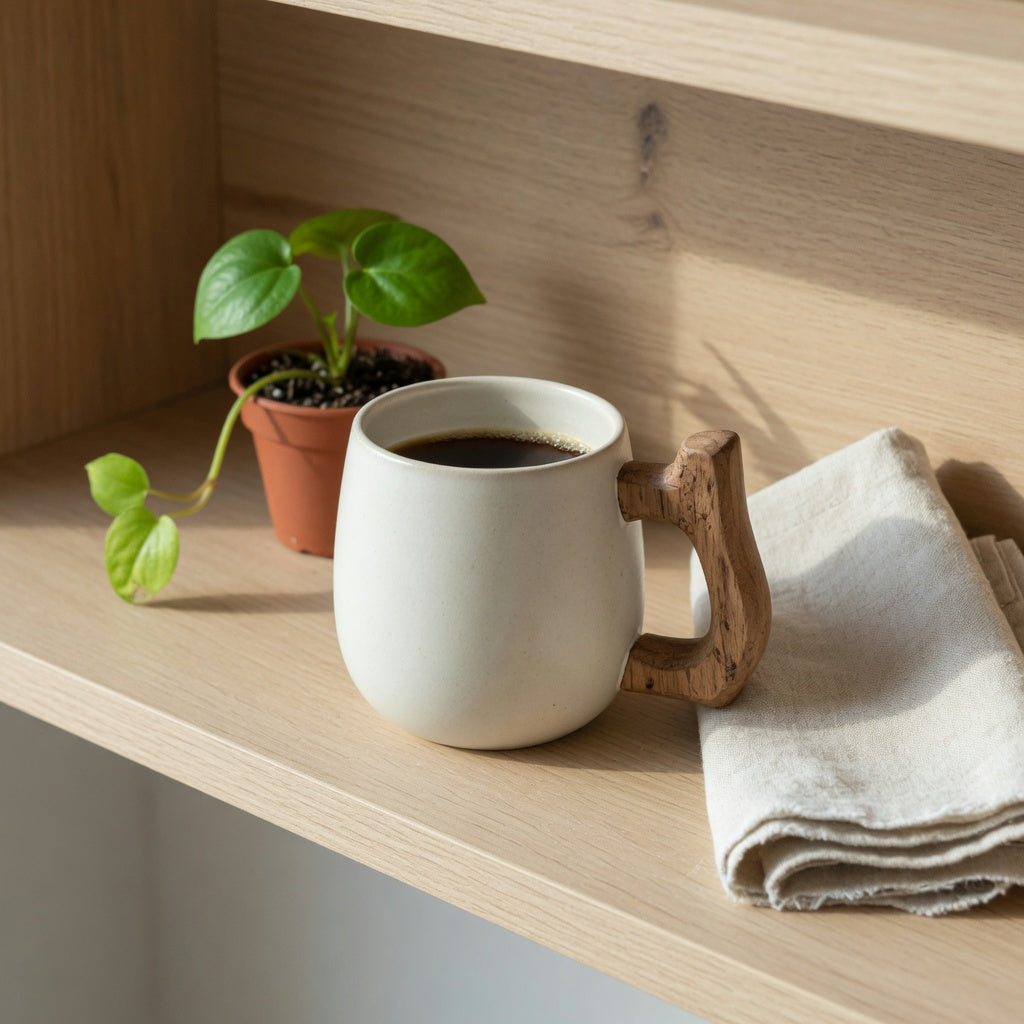
Home Decor Ceramic Mug Wooden Handle: What to Compare
Reading time: about 14 minutes
Someone sets the new mug on the shelf beside a small plant, likes how the wood reads against the wall, and only hesitates the next morning, when the cup is full. That pause is the purchase. A home decor ceramic mug wooden handle has to decorate a room and carry hot coffee, and those two jobs do not always agree.
In our store we see the split in questions before checkout, in how an order is packed, and in what people ask after the first week. Shoppers want rustic, Japandi, wabi-sabi, or a spare minimalist line. They also want a joint that will not let go over a laptop, and they do not want a vague dishwasher sentence. A photo can settle the look. It cannot settle the ounces, the attachment, or whether the glaze is meant for daily tea.
Is a home decor ceramic mug wooden handle for the shelf or the weekday sink?
Start with the job, not the glaze color. If the mug will live on a shelf, a sideboard, or a styled tray, silhouette and how the wood reads against oak, stone, or white plaster matter more than a quick reheat. If it will be the weekday cup, the wood is a limit you plan around. It is not a detail you can ignore after checkout.
These pieces are a poor fit for setups we hear about constantly:
- A household that microwaves every refill and will not remember an exception.
- An office kitchen where mugs go into a shared dishwasher at the end of the day.
- Anyone who soaks cups overnight in a sink of soapy water.
- A commute bag, or a full cup set down hard on a desk.
They can suit a slower routine. Pour from a kettle or a carafe, hand wash, dry the handle, and put the mug back where it also works as decor. That is a real use. It is narrower than a plain stoneware mug whose ceramic handle was joined with slip and fired as part of the body.
When someone wants the wood-and-ceramic look and might actually drink from the cup, we send them to the Mountain Sea II coffee and tea mug with a wooden handle. Treat that page as the source of truth. Capacity, wood species, how the handle is fixed, and any microwave or dishwasher line have to be read there. Our team will not guess those from a photo, and we will not borrow them from a similarly named mug.
If the kitchen needs a different silhouette, or a fully ceramic handle you can treat like the rest of the cupboard, look through our unique coffee mugs and weigh that daily-use trade-off before you commit to wood.
Match the kitchen you actually have:
- You pour from a kettle and will hand-wash. A wooden-handle cup can live in that rotation if the listing is specific. Open the Mountain Sea II page and confirm every line before you rely on it.
- You reheat in the mug or share a dishwasher. Wood is the wrong constraint. Compare ceramic-handle options among the unique coffee mugs instead.
- The gift is for someone who will not read a care card. Say that the piece may be hand-wash only. If that will annoy them, do not wrap it.
- You brew loose-leaf and need a lid and basket. Buy that setup only if the listing states the infuser, the lid, and the wood care separately. Do not assume a coffee mug includes them.
Why do the ounces and the photo disagree?
Capacity is where these mugs disappoint people after the box is open. A cup styled like a generous cafe mug can drink more like a small tea bowl once it sits beside a diner mug you already own. Height, belly, and foot diameter change the pour, the grip, and whether the piece fits the cabinet you pictured.
When U.S. regulators describe cups and mugs for lead limits, they mean small ceramic hollowware commonly used for coffee or tea served above room temperature. Those pieces normally, though not always, hold about 240 milliliters (8 fluid ounces) and are usually made with a handle. That is a regulatory category. It is not a promise that the mug in your cart holds 8 ounces. Sizes in this style run wider than that shorthand, and some handmade cups are intentionally smaller. A complaint we hear is that the piece looked larger in the crop.
Before you buy, write down three figures from the listing and set them next to a mug you already like:
- Stated capacity in ounces or milliliters, filled to where you would actually stop, not to a thin rim you would never trust.
- Height and widest diameter, so you can tell a tall narrow cup from a low wide one that only looks large in a cropped photo.
- Whether a lid, infuser, or spoon is included. Those parts change usable volume, and they often bring separate care rules.
If the listing gives a range, an approximation, or only a lifestyle photo, assume you might be surprised. A clear return window matters more here than it does for a mass-market mug with a molded size on the base.
Which wooden grip stays steady when the mug is full?
The handle is often picked for the picture. The four shapes shoppers describe to us behave differently once the ceramic is heavy with coffee.
| Handle shape | How it feels when full | Where it gets awkward |
|---|---|---|
| Slim dowel | Light in the hand and easy to style | A short or slick dowel torques your fingers |
| Vertical bar | You pinch or cradle it, not a classic finger hook | Tight clearance on a wide belly clips a knuckle |
| T-shape | The crossbar gives more purchase | The bar can bump knuckles or a saucer |
| Sphere or ball | Sits in the palm as a small object | Little natural hook when you set a full cup down |
Shoppers often notice that the wood grip stays more comfortable than a thin ceramic handle while the drink is hot. That does not cool the wall. Lips and the other hand still meet hot ceramic. If you cradle the body out of habit, the handle will not save you from a hot glaze.
On the listing, look for a side view and a sense of clearance between handle and body. Tight clearance plus a wide belly is how people clip a knuckle and spill on the way to the table.
Glue, a hidden pin, or a metal band: what holds the wood?
This is the line we would rather see on every product page, and it is the one most pages skip. A potter's clay handle is joined with slip and fired as one piece. A wooden handle is a second material added after the ceramic is finished. Sellers who disclose a method usually mention one of three:
- Adhesive alone, often described only as glue, with no note on whether it is meant for hot water near a food-contact area.
- A hidden pin or dowel that locates the handle, often still with adhesive in the joint.
- A metal band, ring, or bracket that clamps wood to ceramic so the glue is not the only thing working.
None of those labels, by itself, tells you the joint will last. People ask us whether a handle can let go mid-sip and send hot coffee across a lap or a keyboard. The worry is reasonable. Moisture, heat, and a knock against the faucet are hard on a wood-to-ceramic joint, and we have not seen independent bond-strength numbers published for this category. A confident word on a product tile is not a test. If a listing will not say how the handle is fixed, treat that silence as a reason to slow down.
A wooden-handle mug is not the right daily driver if you need something you can knock around a crowded sink. For a piece you will keep in a careful rotation, read the construction line, then read the return window in case the joint flexes on arrival. Check it before the first pour. A loose handle with hot coffee already in the cup is a bad time to discover the policy.
Will a microwave or a dishwasher loosen the wood?
Plain ceramic is often sold as microwave-safe or dishwasher-safe. A wooden handle takes this kind of mug out of that assumption. Care lines in the category contradict one another. One page says hand wash only. The next says the dishwasher is fine. A third never mentions the handle.
We have not seen an FDA or USDA method written for glued, pinned, or metal-banded wooden handles on ceramic drinkware, so those claims stay with each seller. USDA cutting-board notes cover bamboo and moisture, mineral oil on boards, and whether solid or laminated boards survive a dishwasher. That guidance is not a care standard for a handle fixed to a cup. Do not copy it over. Follow the wording on the specific listing. If the wording is missing, do not decide that a ceramic-safe mark covers the wood.
The habits that match how these pieces get into trouble are stricter than a normal mug:
- Hand wash. Do not soak the mug, and do not let water stand in the joint.
- Dry the wood and the attachment point before the mug goes back on a shelf or into a closed cabinet. Trapped moisture is what dulls the handle and swells the joint.
- Skip the microwave unless the current listing clearly says the whole mug, handle included, is microwave-safe. FDA tableware guidance says to heat food and drink only in ceramic or other cookware specified as microwave-safe, and it tells people not to heat food in melamine dinnerware. A decorative glaze plus a wood handle is not that specification by itself.
- If the maker names a finish for the handle, use that product as directed. Do not wipe a furniture oil or a cutting-board treatment up near the lip.
Hand-wash only is a fair trade for decor you also drink from a few times a week. It is a bad trade for a gift meant as a no-thought office mug. In our experience, the present that disappoints is not the quieter glaze. It is the cup given to someone who reheats coffee in whatever is already on the desk. Tell them before you wrap it.
Is the glaze for daily coffee and tea, or only for the shelf?
A handsome surface is not the same thing as a food-contact surface. Lead can sit in the glaze or the decoration on some traditional pottery. Fired at the right temperature for the right time, FDA says essentially all of that lead is bound into the glaze. If the firing is off, lead may leach into food or drink. Washing the mug, or boiling it, does not remove lead already in the glaze.
For ceramic cups and mugs, FDA's action level for lead is 0.5 micrograms per milliliter of leaching solution. Regulatory action may be considered if any one of six tested units exceeds that level under ASTM C738, a specified AOAC method, or an FDA laboratory method. FDA has also published an action level of 0.5 micrograms per milliliter for cadmium in small hollowware. The agency has reported extractable cadmium in imported and domestic ceramic ware and treats cadmium that moves into acid foods as a chronic-poisoning concern if that use continues. FDA likewise treats lead that leaches from a ceramic food-contact surface as capable of a wide range of harm, including effects associated with chronic lead exposure when use continues. Those figures are enforcement benchmarks. They are not a home kit, and they are not a certificate that the mug in your cart has passed.
What we tell shoppers who want a plain reading:
- A printed lead-free line is not a leach test. FDA has reported traditional pottery labeled lead free that still released lead at or above action levels for ceramic tableware.
- Higher-concern examples in that FDA guidance include handmade ware with a crude or irregular look, antiques, damaged or worn glaze, pieces of uncertain origin, and ware brightly decorated in orange, red, or yellow. Handmade is not automatically unsafe. It is a reason to ask what was tested.
- If a ceramic piece looks like you could drink from it, it is treated as foodware. It is set aside from food use only with specified conspicuous Not for Food Use warnings, both a temporary label and a permanent statement, or with a hole bored through the surface that would hold the drink. A permanent Not for Food Use mark on the base means decor only. Believe the mark.
Ask the listing for lead and cadmium results, the wood species, and the finish on the handle. Many pages publish none of those. Missing paperwork does not prove a problem. It does mean you should not tell a guest the mug was lab tested when all you saw was a styled photo.
Lidded tea versions split the question again. A basket can leave leaf bits in the last sip, and the lid, infuser, spoon, and wooden handle may not share one care sentence. If loose-leaf is the job, confirm each part on the current page. Do not let a line about the ceramic body cover the wood or the basket.
Where should the mug sit once it is home?
Matte, speckled, and reactive glazes read as rustic or wabi-sabi against linen, pale wood, and stone. A cleaner body with a slim wood handle leans minimalist or Japandi. It nearly disappears on a white shelf until the handle catches the light. A gift box makes the unboxing neater. The box does not repair a care routine the recipient will ignore. We do not treat packaging as a substitute for the appliance lines.
Keep a daily drinker near the kettle and a dry towel. Keep a display piece where a half-asleep hand will not grab it and run it under a hot tap. Mixing those two spots is how handles go dull, swell at the joint, or loosen enough to make you nervous.
If you cannot name the capacity, the attachment method, and the appliance limits from the listing, you are still shopping. A pretty glaze is not the last step.
Frequently asked questions
Is a home decor ceramic mug wooden handle microwave safe?
Do not assume it is. The ceramic body and the wooden handle are different materials, and heat is one of the things shoppers worry will stress the joint. Use the microwave only if the current listing says the whole mug, handle included, is microwave-safe. If that line is missing, reheat the drink in a vessel specified as microwave-safe and pour it in.
Can the wooden handle go in the dishwasher?
Only if that exact listing says so. Even then, expect the wood to age faster than the glaze. Detergent, heat, and leftover moisture sit on the joint. When the page is vague, hand wash, keep water out of the attachment, and dry the handle before the mug is stored.
Will a glued wooden handle fall off with hot coffee in it?
It can, which is why the attachment method belongs on your checklist. Glue alone, a hidden pin, and a metal band are not the same build, and many listings skip the detail. If the joint flexes when the mug arrives, return it rather than hoping the next hot drink will be fine.
Why does the mug look smaller than the product photo?
Cropped styling shots hide scale. Compare stated capacity, height, and diameter with a mug you already own before you order. Talk of an 8-ounce cup in regulatory guidance is a category description, not the size of every wooden-handle mug on the market.
Does a cool wooden handle mean the cup will not burn me?
No. The grip is often more comfortable than a thin ceramic handle while the drink is hot, but the cup wall can still be hot against your lip or your other hand. Hold the handle, not the body, and do not treat a stays-cool line as a temperature claim for the whole mug.
Mark these seven lines before you check out
Keep the product page open. A blank is an answer: you do not know yet.
- Stated capacity, height, and diameter, compared with a mug you already use.
- Handle shape, and whether your hand has room when the mug is full.
- Attachment method: glue, pin, metal band, or not stated.
- Microwave and dishwasher wording that mentions the wood, not just the ceramic.
- Any lead or cadmium leach note, plus the base. A Not for Food Use mark means display only.
- Wood finish, and whether you will actually hand wash and dry the joint.
- The return window if the piece arrives smaller than the photo or the handle feels loose.
Run that list on any home decor ceramic mug wooden handle, starting with the Mountain Sea II listing, and confirm the seven lines on the current page. If the handle style is wrong for how you actually drink, step back to the unique coffee mug collection and choose a piece whose care rules match the kitchen you have, not the kitchen in the photo.
More from our blog
Read more
Tall Ceramic Coffee Mug Buying Checklist: What to Compare
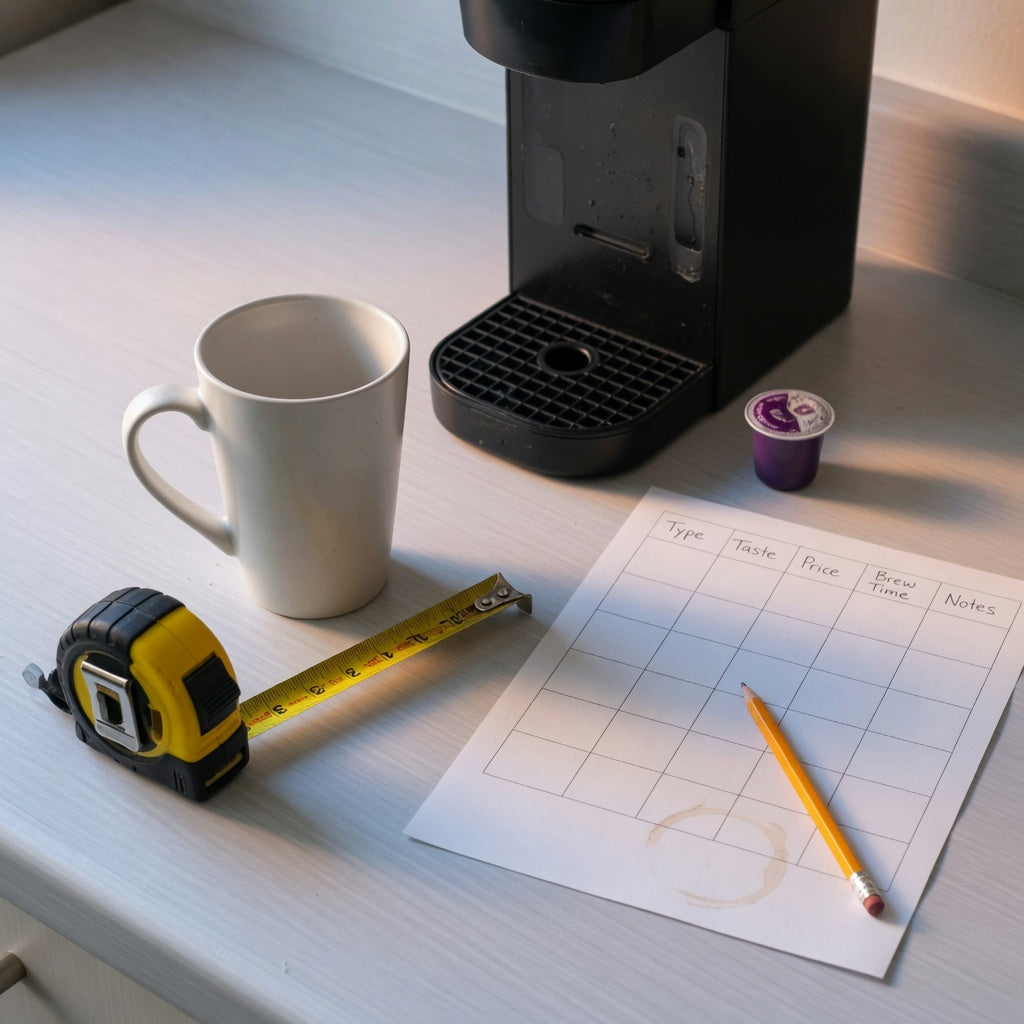
Measure brewer, shelf, and cup-holder gaps, then compare usable fill, handle opening, tip risk, care labels, and food-contact wording before you buy a tall ceramic mug.
Read more
Emerald Ceramic Coffee Tea Mug Comparison: Buyer Checks
Shoppers comparing emerald ceramic mugs need more than a green photo. We sort open cups from lidded travel cups, then capacity, reactive glaze, metallic trim, microwave limits, and the food-contact...
Read more
Leave a comment
This site is protected by hCaptcha and the hCaptcha Privacy Policy and Terms of Service apply.