



Emerald Ceramic Mug Gift: What Buyers Should Compare
Reading time: about 14 minutes
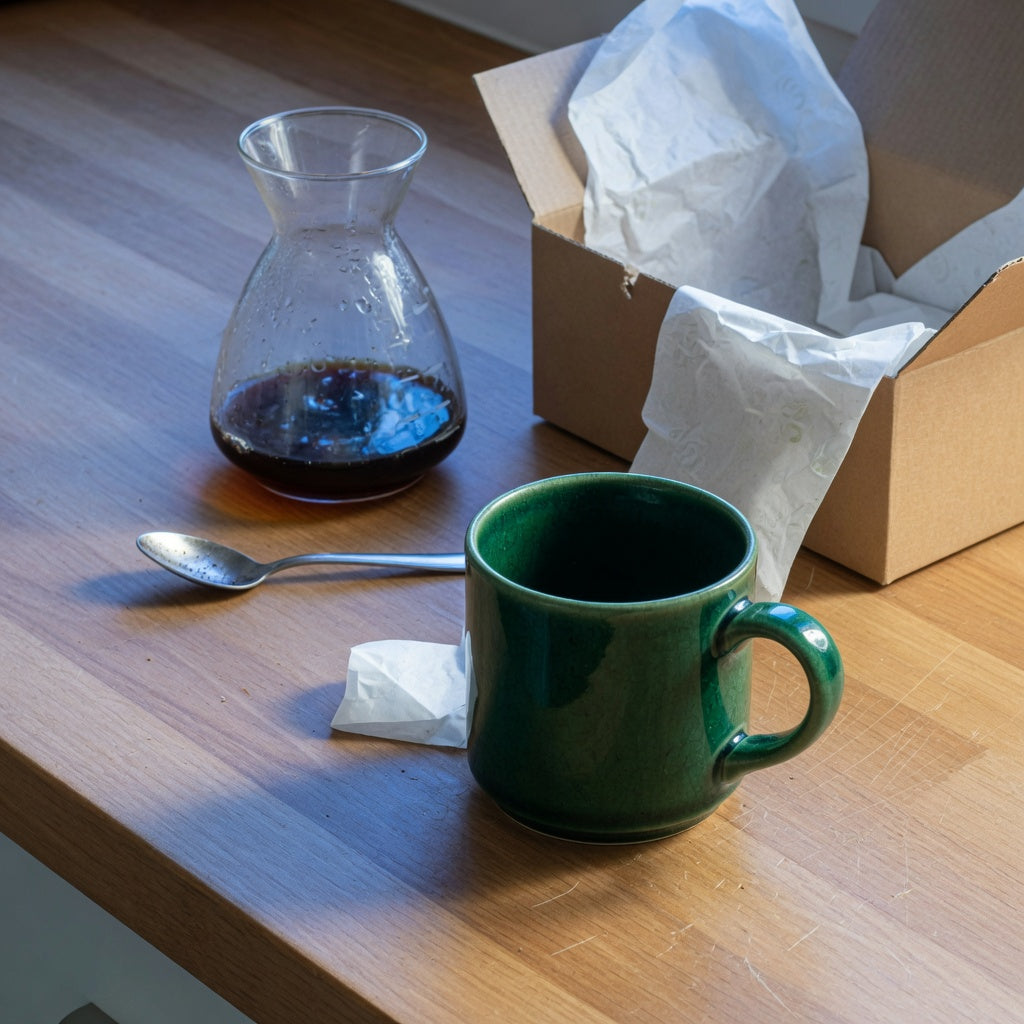
The tissue paper comes off, the green glaze catches the kitchen light, and the new owner pours a normal weekday coffee. The mug is already full. The carafe still holds a second cup. That shortfall is the miss we see most often with an emerald ceramic mug gift. People using that phrase are not shopping for a cup cut from the gemstone. They want a green ceramic piece sold as a present. Results jumble everyday glazed mugs, pairs, lidded travel cups, wide matcha-style bowls, personalized prints, and boxed sets sold around a 55th anniversary. Same color family. Different jobs.
In our store, the comparison starts on the live listing, not on the adjective. Our catalog lists this piece as the Emerald Small Ceramic Coffee Mug. Small is already in the name, so we will not promise a large cafe pour from the title. Capacity, interior color, microwave and dishwasher wording, any lid or gift box, and a food-use or decorative-only mark all sit on the current page. Those lines can change. A green mug from another maker cannot fill them in.
What does emerald mean on a ceramic mug gift?
On a ring, emerald is the green gemstone, a variety of the mineral beryl. On drinkware it is a glaze color, a speckle, a print, or an anniversary theme. Forest gloss, speckled china, a two-tone green, a gold-trimmed cup, and a printed anniversary pair can share a search page and still be the wrong gift for each other.
We sort the form before we talk about shade:
| Type | Fits | Poor fit |
|---|---|---|
| Single glazed coffee or tea mug | Hot drinks at a desk or kitchen counter | Commutes, sealed travel, matcha whisking |
| Pair or stoneware set | A couple, a housewarming, a shared cabinet | One person who wanted a single daily cup |
| Ceramic travel cup with lid and sleeve | A closed sip and a car cup holder | Open-rim tea where aroma matters |
| Wide matcha-style cup | Whisking in a low, broad bowl | A narrow espresso or a tall latte |
| Personalized or photo mug | A name, initials, wedding, or graduation | Buyers who want an even studio glaze, not a print |
| Boxed anniversary pair | A labeled emerald-anniversary keepsake | An unmarked cup meant for Tuesday coffee |
If the cabinet needs more than one green option, start with our unique coffee mugs and compare form first. A handsome exterior still does not tell you whether the rim suits tea or whether the bowl leaves room for milk.
Is 12 oz, 16 oz, or a small cup the pour they actually want?
Gift listings in this color cluster around two everyday volumes, about 12 oz and about 16 oz. Neither is right for every kitchen. A mug near 12 oz fits tea, a short coffee, and people who reheat what is left. A mug near 16 oz fits a full filter pour and many cafe lattes. Drop much below 12 oz and you are in modest tea-cup or demitasse territory. Thoughtful for an afternoon guest. Stingy for someone who fills a diner mug before work.
A different number trips buyers up. FDA guidance on lead in ceramicware describes cups and mugs, for leach testing, as small hollowware commonly used for coffee or tea above room temperature. They normally, though not only, hold about 240 mL (8 fl oz), and they are normally made with a handle. That figure is a testing description, not a gift-size recommendation. A retail 12 oz or 16 oz mug is still a cup or mug in that framework. It is simply larger than the about-8-fl-oz example.
Because this catalog title says small, confirm the ounce or milliliter figure on the product page before you wrap it. Do not borrow 12 oz or 16 oz from a travel cup, a matcha bowl, or another open green cup. If the page never states volume, ask. Do not guess in the gift note.
Interior color and rim shape sit beside volume. A pale interior shows tea strength. A dark emerald interior looks deep in photos and hides a low fill. Some people like that mystery. Others resent it when they are judging a brew. A wide, low bowl is the usual matcha shape. A taller wall is the usual coffee and tea mug. Our notes on choosing a ceramic mug for both tea and coffee walk through that split. If the photo crops the opening, you cannot tell which form you are buying.
Will the handle and the weight feel right on a weekday morning?
Handle comfort is where a pretty gift gets quietly retired. We hear it after the holidays: the color was loved, the grip was not. On the packing bench we still do the check we suggest to buyers. When a sample is in hand, we slide fingers through the opening and picture that gap with a full, hot cup and a half-awake hand. A thick wall plus a tight handle crowds larger hands. A thin, sharp handle looks delicate on a table and digs into a knuckle once the mug is full.
Weight is a trade-off, not a grade. Heavier ware sits stably beside a laptop and keeps a little warmth in the wall. It also tires a person who carries the cup from the kitchen several times each morning. Lighter ceramic is easier in the hand and easier to tip if the foot is narrow. Listings rarely print weight. Use stated height, diameter, and handle clearance when the page gives them. Silence means unknown, not fine.
When a glazed gift mug disappoints after the first week, the complaint is rarely the color. It is a hairline where the handle meets the wall, a chip on the foot from a thin box, or tea stain sitting in crazed glaze. Those are the spots worth a close look before you tape the parcel.
Travel is a separate purchase. Shoppers asking about a lidded emerald travel cup are really asking whether it leaks in a bag, how long the drink stays hot, whether a sleeve protects the hand, and whether the base fits a car cup holder. An open coffee mug answers none of those. If the commute is the point, do not dress a countertop mug up as a tumbler. If the point is a quiet cup at the table, a lid hides the glaze and changes the sip. Confirm travel claims only on the travel listing in front of you. We do not treat this small ceramic coffee mug as a commuter cup.
Food-contact checks before you give an emerald ceramic mug gift
Color is not a safety test. We would not hand someone a glazed mug as a drinking gift unless the listing presents it for food contact. If the base, hangtag, or description says for decorative use only or not for food use, do not drink from it, and do not cook, serve, or store food or drink in it. Washing, boiling, and similar home tricks do not remove lead from pottery.
FDA compliance policy notes that some ceramic foodware leaches significant lead from surfaces that can touch food. Food can extract that lead, and continued use can cause a wide variety of adverse health effects, including effects of chronic lead poisoning. For cups and mugs, the guideline is 0.5 micrograms of lead per milliliter of leaching solution, in any one of six units tested. The agency has also found significant extractable cadmium in some imported and domestic ceramic ware. Acid foods can extract it, and continued food use of that ware could cause chronic cadmium poisoning. The cadmium guideline is 0.5 micrograms per milliliter for flatware, as an average of six units, and for small hollowware, in any one of six units. Large hollowware, 1.1 liters or more, is held to 0.25 micrograms per milliliter in any one of six units. A normal mug is small hollowware: under 1.1 liters.
A few boundaries keep this practical:
- A properly fired glaze can bind lead so migration into food is insignificant. Improper firing can leave lead able to move into food. A published glaze recipe does not show how that finished mug was fired.
- Some traditional pottery labeled lead free has still shown extractable lead comparable to lead-glazed ware, sometimes above FDA action levels. A badge on a product page is not a laboratory result for that finished cup.
- FDA flags higher concern for handmade pieces with a crude or irregular look, antiques, damaged or heavily worn ware, flea-market or unknown-maker pottery, and pieces brightly decorated in orange, red, or yellow. Everyday commercial factory pottery made for daily use is described as much less likely to have a lead problem.
- Emerald-named gift listings rarely publish product-specific lead or cadmium lab results. Treat safety lines as seller statements unless the page shows a test, and read them on the listing you are actually buying.
Pinholes and crazing show up once the wrapping is off. A pinhole is a tiny pit in the glaze. Crazing is a fine crackle network. Neither mark, by itself, proves the mug is unsafe, and neither should be brushed off on a drinking surface. Crackled or pitted glaze stains faster and is harder to wash. On a handmade green glaze, some shift from the photo is normal. Pinholes that open onto bare clay inside the cup, a gritty lip, or a base marked not for food use are reasons to send the piece back or keep it off the table.
We are not stating a lead or cadmium number for this mug. A color name cannot supply that result. Read the current page. If food-use status is unclear, ask before you call it a daily cup.
Microwave labels, metal trim, and why dishwasher advice conflicts
Gift pages often skip the detail that decides a Tuesday reheat: gold or silver decoration. A metallic band or a bright illustrated rim is a common reason a mug should stay out of the microwave. If the photo shows a metal line and the text never mentions it, do not assume the piece can be reheated. Check the images and the care line on our listing the same way. Do not guess from the green glaze alone.
Dishwasher language conflicts across this category, and both sides can be telling part of the truth. One maker may mark a glossy green stoneware mug dishwasher and microwave safe. Another allows the machine and still suggests hand washing so the gloss stays even. A machine rating means the piece is built to survive those cycles under that maker's test. It does not promise a showroom sheen after years of detergent and rims knocking other dishes. In our experience, deep glossy greens show fine utensil haze and hard-water spots sooner than a matte, speckled surface. If the recipient runs everything through the dishwasher, choose a mug whose listing clearly allows that, and accept that gloss may soften. If they already hand-wash favorite cups, a more delicate glaze is a fair gift.
Skip abrasive pads on a dark gloss, and do not leave a spoon soaking in the cup for hours. Coffee and tea mark a crazed surface faster than a smooth, fully fired one. Vitrification is the point in firing where the clay body tightens and takes up less water. That more closed surface is simply easier to rinse. If the listing says hand wash only, believe it. One dishwasher experiment is a poor surprise on someone else's present.
For a person who lives on coffee rather than the occasional guest tea, the checks we use for a daily coffee-lover mug are the closer brief: repeated heat, a handle used half-awake, and cleaning that matches the real sink.
Packaging, names, and gifts this mug is not
A green ceramic mug suits specific, ordinary moments. A birthday for someone whose kitchen is already full of neutrals. A housewarming. A holiday stocking when you already know their drink. A thank-you for a host. An anniversary when green is simply their color. Some boxed pairs are marketed for a 55th anniversary and printed as an emerald anniversary. A single unboxed small coffee mug does not automatically become that gift. If they want a keepsake box, a matching pair, or anniversary wording on the ceramic, shop that set. If they want a cup that will meet Tuesday coffee, shop the drinking mug and skip the commemorative print.
Personalization is its own product type. Names, initials, and short messages show up on printed green mugs for weddings and graduations. Do not assume a glazed studio mug can take a name unless that listing offers it. A vinyl letter added at home can interfere with food contact and with washing. Order the version built for print, or give the plain glaze and write the message on a card.
Lids, spoons, and gift boxes are either in the shipment or they are not. Some sets include a lid and a spoon, then specify microwave use or hand wash in the same breath. Read that sentence on the page you are buying. If no lid, spoon, or keepsake box is listed on our page, do not promise those extras in the card. We have watched gift notes outrun the box.
This style is a weak choice in several real kitchens:
- Commuting, unless a different listing actually claims a seal, a sleeve, and a cup-holder fit.
- Matcha drinkers who whisk in the cup. A small, taller mug crowds the whisk.
- Anyone who needs a verified 16 oz daily pour, until this listing states that volume.
- Display-only collectors. A food-use mug is meant to be drunk from, and a decorative-only piece should never be moved quietly into the cupboard.
- Unknown handmade sellers with no firing or food-use information, especially if the piece looks rough, worn, or brightly colored in the ranges FDA flags.
Handmade emerald glazes also vary. The photo is a reference for depth and for where the glaze breaks on the rim, not a promise that every speckle lands in the same place. Ask how the piece is packed if it is shipping as a surprise. Ceramic chips more readily when it is packed like a folded textile, with no rigid wall and no void fill. Made-to-order timing and return limits belong on the listing. Read them before you promise a date. If the clay body is not named, do not assume stoneware or porcelain. A lower-fired body can stay more absorbent, which is one reason care lines differ from mug to mug.
A checkout checklist before the emerald mug is wrapped
If you are still deciding whether an emerald ceramic mug gift belongs in this kitchen, run the list on the live page. Do not borrow answers from a similar green cup at another shop. A missing line means you do not know yet.
- Confirm it is a drinking mug, not a decorative-only or not-for-food piece.
- Read the stated capacity and match it to their real pour.
- Note interior color, rim shape, and whether the opening suits coffee, tea, or a wide whisked drink.
- Check handle clearance against the hand that will hold a full cup.
- Look for gold or silver decoration before you trust a microwave claim.
- Follow the dishwasher versus hand-wash line on that listing, not a rule copied from another brand.
- Treat glaze recipes, lead-free badges, and missing lab results as incomplete. Firing and a clear food-use intent matter more than a color name.
- See whether a lid, spoon, or gift box is actually included.
- For handmade work, expect glaze variation, and check packing, lead time, and returns.
- Skip it if they needed a travel tumbler, a boxed anniversary pair, or a personalized print and this page offers none of those.
If the small emerald coffee mug matches the drink, the hand, and the care habit, open the current Emerald Small Ceramic Coffee Mug listing and verify every line above on that page. If the size or the form is wrong, go back through the unique mug collection and run the same checks. Color alone is a weak way to shop.
Frequently asked questions
What is an emerald ceramic mug gift actually made of?
In this search it is ceramic drinkware with an emerald-green glaze, speckle, or print, sold as a present. It is not a mug carved from the gemstone. Some boxed pairs are marketed around a 55th anniversary and labeled emerald for that reason. Those are different products from a single daily coffee mug, so read which one the listing is. Our catalog title is Emerald Small Ceramic Coffee Mug, and anything beyond that name has to be confirmed on the page.
Is a small emerald mug too small for a daily coffee gift?
It can be. Many shoppers compare roughly 12 oz with 16 oz. A smaller cup suits tea, a short coffee, or a second round. It frustrates someone who pours a full filter mug at once. Our catalog name includes small, so use the capacity printed on the live listing rather than assuming either of those retail sizes.
Can I drink from a green mug labeled decorative use only?
No. Wording such as for decorative use only or not for food use means it should not be used to cook, serve, or store food or drinks. Washing or boiling will not make a lead-bearing glaze safe. Choose a mug the seller presents for food contact, and still read how that claim is worded.
Does a dishwasher-safe label mean the emerald glaze will stay glossy?
Not necessarily. A dishwasher-safe mark speaks to surviving machine washing, not to a permanent showroom shine. Some makers of glossy green stoneware still suggest hand washing to keep the surface even. Match the care line to the recipient's real habit, and skip abrasive scrubbers on a dark gloss.
Will a handmade emerald glaze match the photo, and does this gift include a lid?
Expect some variation in depth, speckle, and where the glaze breaks on the rim. That is normal for handmade work. Pinholes on the drinking surface, a rough lip, poor packing, or a missing food-use statement are separate problems to settle before you give the mug. A lid, a spoon, a gift box, or a printed name is included only when the listing you are buying says so.
More from our blog
Ready to pick your mug? Two ways to save on today's order:
Ordering 1–3 mugs? Get an extra 10% off your 1st order with code 10_OFF Apply 10% Off & Shop Wooden-Handle Mugs →
Gifting 4+ mugs? Buy 3, Get the 4th Free applies automatically at checkout (no code needed; offers do not stack) · Free standard shipping (Nov pre-Christmas delivery: 15–20 calendar days US) · Free replacement if chipped in transit.
Popular mug buying guides: 8 oz & 9 oz Mugs · Cute & Aesthetic Mugs · Ceramic Tea Cups & Infuser Mugs · Ceramic Mugs with Lids Compared · Wooden-Handle Tea Infuser Mugs Compared · Christmas & Secret Santa Mugs 2026 · Espresso & Cortado Cups Guide · Cup & Saucer Gift Sets · All 25 Mugs Spec Table · Mug Size Guide · Shipping & Promo FAQ
FIRST ORDER 10% OFF (CODE: 10_OFF) · OR BUY 3, GET THE 4TH FREE


Read more

Gradient Ceramic Coffee Mug Comparison: Key Checks
A useful gradient ceramic mug comparison covers finish type, usable fill, rim and handle feel, staining, appliance claims, and food-use labels. These are the checks we use before recommending a cup...
Read more
Tall Ceramic Coffee Mug Buying Checklist: What to Compare
Measure brewer, shelf, and cup-holder gaps, then compare usable fill, handle opening, tip risk, care labels, and food-contact wording before you buy a tall ceramic mug.
Read more
Leave a comment
This site is protected by hCaptcha and the hCaptcha Privacy Policy and Terms of Service apply.