

Round Coffee Tea Mug Buying Checklist: What to Compare
Reading time: about 15 minutes
On our packing table, wide round mugs and tall cylinders get the same first test: a full pour, a walk to the far end of the bench, and a sip. The round ones smell louder. They also cool sooner, and the handle often leaves less room for fingers because the wall bows toward the grip. Shoppers choosing between those shapes need a round coffee tea mug buying checklist, not another glaze close-up.
In our store we set round ceramic pieces beside straight-walled mugs every week. The difference is fit, not only style. FDA guidance treats cups and mugs as small ceramic hollowware for hot drinks such as coffee or tea. They normally, though not exclusively, hold about 240 mL (8 fl oz) and are made with a handle. In that guidance, cups normally have a base and curved sides, while a mug has cylindrical sides. Plenty of products sold as round coffee or tea mugs are wider and curved, closer to the cup description than to a straight wall. Tall-mug advice skips the problems that curve creates.
Keep our Round Ceramic Coffee Mug open while you run the checks. The catalog title names a round ceramic coffee mug. It does not, by itself, state ounce capacity, handle span, whether the body is stoneware or porcelain, glaze documentation, or a microwave or dishwasher mark. Read those fields on the current listing. If a line is missing, the answer is unknown. When the round profile is wrong for your shelf, your infuser, or how long you want the drink hot, other silhouettes in our unique coffee mugs collection can be judged with the same questions.
What should a round coffee tea mug buying checklist cover first?
Start with the drink, then the body that has to hold it. Print and color can wait until the daily-use checks pass.
- Drink and pace. Black coffee you finish quickly is a different job from a milky drink you nurse, or tea that needs a basket and somewhere to rest the lid.
- Usable fill, not the ounce claim alone. Stop below the rim. Foam and a floating basket need still more room.
- Handle clearance against a hot curved wall, plus a rim that does not trail liquid down the belly.
- A foot that sits flat when the mug is full, and a height and width your cabinet, brew head, and dishwasher rack can accept.
- The material the maker names, plus appliance marks printed for that piece. Do not guess from the word ceramic.
- Food-use status: glaze meant for beverages, or a decorative object that should never hold coffee or tea.
We use that order on the counter because a handsome round mug that fails the fill or the handle comes back. A plain one that passes usually stays in the weekday rotation.
How much of the stated capacity can you actually sip?
Listings often print one number and stop. That number is frequently a rim-full measure. On a wide round opening, your comfortable sip line sits lower. A small tilt sends liquid to the lip sooner than it would in a tall narrow cup.
Separate three fills before you compare ounce classes:
- Black coffee or straight tea. Leave headspace so the walk from the machine to the desk does not slosh onto your hand.
- Milk drinks. Espresso plus steamed milk needs empty volume for foam. A round bowl looks huge and still overflows if you fill it like a water glass.
- Loose leaf. Leaf, basket, and water line compete. If the infuser must sit below the rim, the tea fill is smaller than the headline ounces.
The 240 mL figure is a regulatory description of typical cups and mugs, not the capacity of every round mug we sell. Shoppers comparing drip coffee with larger milk drinks often sort listings into the 12 oz and 16 oz classes. Neither class is automatically better, and neither number is a fact about the Round Ceramic Coffee Mug unless the current page states it. Check whether the listing gives both a rim-full figure and a practical fill. If it states only one, plan to stop short of the lip and judge the mug on that lower volume.
A wide round body is a poor choice when you want one large serving to stay hot through a long meeting. The opening that makes aroma obvious also sheds heat faster. Wall thickness and material change the result. Most retail pages do not publish a measured heat-loss figure, and we will not invent one. If the cup is still half full when you want it hot, look at a taller, narrower profile instead of sizing up a round bowl.
How much finger room does a curved wall leave?
On a cylinder, a modest handle can still clear your fingers. On a round body the wall bows toward the grip. Knuckles meet hot ceramic sooner. In our experience the complaints are specific: two fingers fit, the third scrapes, and a full mug torques the wrist because the weight sits outboard of the handle.
Check the listing photos and, if you already own a similar piece, your own hand:
- Room for two fingers at minimum on a small tea pour, three or four if this is your daily coffee mug.
- Enough handle height, or a place for the thumb, so you are not pinching the rim to balance a wide belly.
- A real gap between the inner handle and the hottest part of the wall, not a hole that only looks open in a straight-on photo.
- How the handle joins the body. A thin neck at the attachment is where a full mug fails when someone lifts from the outer edge of the grip.
Rim shape is the other half of that sip. A thin lip feels precise and can run if the edge is uneven. A thicker, rounded lip is more forgiving and can feel clumsy with a lighter tea. Look for pits, a sharp seam, or a glaze drip at the front edge. Those are how a round mug trails coffee down the outside. An overhead beauty shot will not show that seam. You want a side view of the lip.
Will a low, wide foot stay planted on your counter?
Round does not mean stable. A low, wide mug with a small foot can look planted in a photo and feel tippy once it is full, especially if the belly sits high over a narrow ring. Picture the surfaces you actually use: a slightly uneven counter, a keyboard tray, the slope of a dishwasher rack, the space under a drip brew head.
- A foot shown as flat, without an obvious rocker or a thick glaze blob on the bottom edge.
- Balance when full. If most of the weight rides above a small ring, skip it for a crowded desk.
- Cabinet and brew-head clearance. A low round mug often clears a shelf that rejects a tall cylinder, then fails because the handle still hits the cabinet frame or the machine's spout.
- Side-by-side width. Two wide rounds can refuse to share a shelf that holds three straight mugs.
- Stacking. Many round bodies do not nest. If you need a stack for guests, decide that before you buy a one-off bowl.
- Dishwasher tines. A wide foot can bridge two tines and sit at an angle, so the base never gets a clean spray and the rim chips against the rack.
This shape is not the one we suggest for a commute unless the listing includes a lid made for that exact opening, with a seal you can take apart and wash. A wide round rim is also a weak seat for many pour-over cones. If your morning is a cone on the mug and a kettle in the other hand, measure the cone's base against the opening, or pick a straighter wall.
Stoneware, porcelain, glass, or steel: which marks matter?
Material names describe the body. They do not promise microwave or dishwasher performance, and the catalog title alone does not tell you which clay our round mug uses. Stoneware is often thicker and more casual in the hand. Porcelain can be thinner, sometimes more translucent, with a crisper lip. Earthenware is typically more porous under the glaze and less forgiving if that glaze chips. Glass shows the color of the tea and can feel hotter against the palm. Enamel on steel and double-wall stainless follow metal rules: no microwave where metal is present, and a different heat feel at the rim.
On any ceramic or glass round mug, read the maker's marks rather than inferring them:
- Microwave: only if that listing says so. Gold trim, a metal rim, luster, and some printed decals are reasons a piece is not microwave-safe even when the clay body could be.
- Dishwasher: printed decoration and metallic bands often want hand washing. An all-over glaze is a different case from a decal on the outside.
- Oven or stovetop: do not assume either. A coffee mug is not a saucepan.
Care follows the same label. A crazed glaze, that fine crackle across the surface, can stain with coffee and tea and is harder to keep smelling clean. A chip at the rim is a cut risk and a reason to retire the piece from food use if you cannot confirm how it was fired and glazed. Worn glaze is not only cosmetic. Hot drinks and acidic ones are the uses that raise concern about metals leaving a damaged surface.
Confirm body material, any care line, and whether trim or print is called out on the Round Ceramic Coffee Mug page itself. If those lines are missing, appliance safety is unknown. Do not fill the gap from a similar-looking mug on another site.
When is a round mug foodware, and when is it only decorative?
Lead and cadmium are the questions we want buyers to ask out loud, especially with handmade, vintage, souvenir, and heavily decorated pieces. For lead, FDA's action level on ceramic cups and mugs is 0.5 micrograms per milliliter of leaching solution. In that guidance, the check fails if any one of six units is over the level. Cited methods include ASTM C738, AOAC 973.32, AOAC 973.82, and specified FDA laboratory methods. For cadmium in ceramic foodware, FDA action levels are 0.5 micrograms per milliliter for flatware and for small hollowware, and 0.25 micrograms per milliliter for large hollowware. Small hollowware is under 1.1 liters; large hollowware is 1.1 liters or more. The agency states that cadmium can be drawn out by acidic foods and that continued food use could cause chronic cadmium poisoning.
U.S. rules also treat lead as a toxic metal used in some glazes and decorative decals. Using ornamental ceramicware to prepare, serve, or hold food may leach lead into the food. Ware that looks suitable for food is treated as foodware unless it carries a required not-for-food-use warning or has a hole through the potential food-contact surface. A pretty round mug with no warning and no hole is not automatically just art in that framework. If a maker is selling ornamental ware, the signal should be obvious.
ASTM C738 extracts lead and cadmium with acetic acid. ASTM describes that extraction as a severe test unlikely to be matched in ordinary use, and FDA compliance guidance cites it for both metals. You cannot see a leaching result in a product photo. What you can do before checkout is narrower and still worth doing:
- Ask for the maker's food-safe documentation, not a bare slogan that only says lead-free.
- Look for a permanent not-for-food warning or a hole that marks decorative ware, and do not drink from those pieces.
- Be stricter with vintage, market-stall, and unsigned handmade mugs when firing and glaze are unclear.
- Retire chipped, cracked, or badly worn glaze from hot or acidic drinks instead of treating the damage as only cosmetic.
- Question decoration that sits on the lip, where your mouth rests, even when the inside looks plain.
We do not claim a test report or a lead result for a mug unless that exact listing says so. If the page is silent, the honest status is not stated. Confirm it before the piece becomes your everyday cup.
Will a loose-leaf basket fit a wide round opening?
Many infusers are built for a straighter mouth. A wide round mug can swallow a small ball, let leaf escape around a short basket, or leave the basket tilted so half the leaf never sees water. Before you buy the mug for tea, measure the infuser you already own, or read the basket dimensions if the listing includes one. Do not assume the Round Ceramic Coffee Mug ships with a basket. Check the current page.
- Diameter. The basket should sit on the rim or just inside it without a large gap. A gap is where fine leaf migrates into the cup.
- Mesh. Finer leaf needs finer mesh. A loose punch-hole basket is a weak match for small-cut tea.
- Depth. Leaf needs room to expand. A shallow basket in a deep round bowl under-brews and is annoying to lift out.
- Lid. A lid that doubles as a rest keeps the wet basket off the table. Check whether the lid, the basket, and any metal parts are included, and which of those parts the maker marks microwave-safe or dishwasher-safe. Metal baskets do not go in the microwave.
- Cleaning. Seams, silicone seals, and hinges hold tea oil. If you cannot reach them, the mug will smell like last month's oolong.
Skip the round mug for loose leaf if you will not use a basket sized to that opening. A standard cylinder will cooperate with more of the infusers already in the drawer. An open round cup is also a poor commute mug: the same wide mouth that helps aroma spills easily, and a lid from a different brand rarely seals it.
Which drinking situation is a round mug actually for?
| Situation | What to favor | What to skip |
|---|---|---|
| Daily coffee at a desk | Stable foot, real handle clearance, usable fill below the rim, a dishwasher note if you will not hand wash | A wide bowl with a tiny base and no care label |
| Slow tea, aroma first | Open round rim, smooth lip, an infuser that actually fits that mouth | A lid you cannot clean, or metal trim you planned to microwave |
| Gift | Named material, food-use status, and a size the recipient already drinks | Vintage or souvenir ware with an unknown glaze |
| Commute or pour-over | A lid and seal specified for that mouth, or a cone base you have measured | An open round ceramic mug in a cup holder, or an unmeasured cone |
| Handmade or souvenir | Maker documentation, or a clear not-for-food mark if it is ornamental | Unsigned glaze, a chipped lip, or decoration you will put in your mouth |
An open round ceramic body is not a travel mug, not a pour-over stand, and not a thermos. It can be a good daily cup when the foot is honest, the handle clears your hand, and the listing answers the safety and appliance questions in writing.
What to verify on the listing before checkout
Open the Round Ceramic Coffee Mug page and run the round coffee tea mug buying checklist against the live fields. If a line is absent, leave it unchecked rather than assuming the answer is yes.
- Role: coffee, tea, or both, and whether an infuser is included.
- Capacity as stated, plus whether you still have headroom for how you drink.
- Handle shape and a real gap for your fingers against a round wall.
- A smooth lip you can see clearly, not only a styled overhead shot.
- A base that looks flat, and overall height versus your shelf, brew head, and rack.
- Material named by the maker, with microwave and dishwasher marks only if they are printed there.
- Food-contact information, and no not-for-food warning or decorative hole.
- The return window, in case the in-hand balance does not match the photo.
If this silhouette loses on handle clearance, heat, or shelf width, compare other forms in our unique coffee mugs collection and keep the same checks. The round body wins when you want the aroma and the lower profile, and when the listing lets you confirm the rest instead of guessing.
Frequently asked questions
What belongs on a round coffee tea mug buying checklist?
Compare usable fill against the stated capacity, finger clearance on the handle, rim smoothness, a flat stable foot, cabinet and dishwasher fit, the material the maker names, and any microwave or dishwasher mark. Then confirm the piece is foodware, not decorative. Those checks matter more on a wide round body because heat loss, infuser fit, and knuckle clearance all change with the curve.
Does a wider round opening keep coffee hotter?
No. A wider opening is the trade you make for aroma and a faster cool-down, which some people want before the first sip. A taller, narrower cup is the usual choice when the drink needs to stay hot longer. We do not quote a universal temperature drop, because wall thickness and material change the result and most listings do not publish a measured figure.
How can I tell if a ceramic mug is food-safe or only decorative?
Foodware should be sold for beverages. Ornamental ceramicware is supposed to carry a not-for-food-use warning or a hole through the surface that would otherwise hold food. FDA action levels used in compliance checks are 0.5 micrograms per milliliter of lead for cups and mugs, and 0.5 micrograms per milliliter of cadmium for small hollowware under 1.1 liters. A product photo cannot prove a leaching test. If the listing does not document food-safe glaze, ask before you use it for hot coffee or tea.
Can I assume every ceramic round mug is microwave and dishwasher safe?
No. Follow the maker's mark on that exact item. Metal rims, gold or luster trim, and some prints are common reasons to keep a mug out of the microwave or the dishwasher. A missing label means unknown, not safe. Hand wash if you are unsure, and do not put a metal infuser basket in the microwave.
What tea infuser works in a wide round mug?
One whose diameter matches that opening, with mesh fine enough for your leaf and a basket deep enough for the leaf to expand. Small balls and short baskets sized for straight mugs often sit loose and let leaf past the rim. Check which parts are dishwasher-safe, and remember that any metal basket is not microwave-safe. Confirm on the listing whether a basket is included at all.
More from our blog
Read more
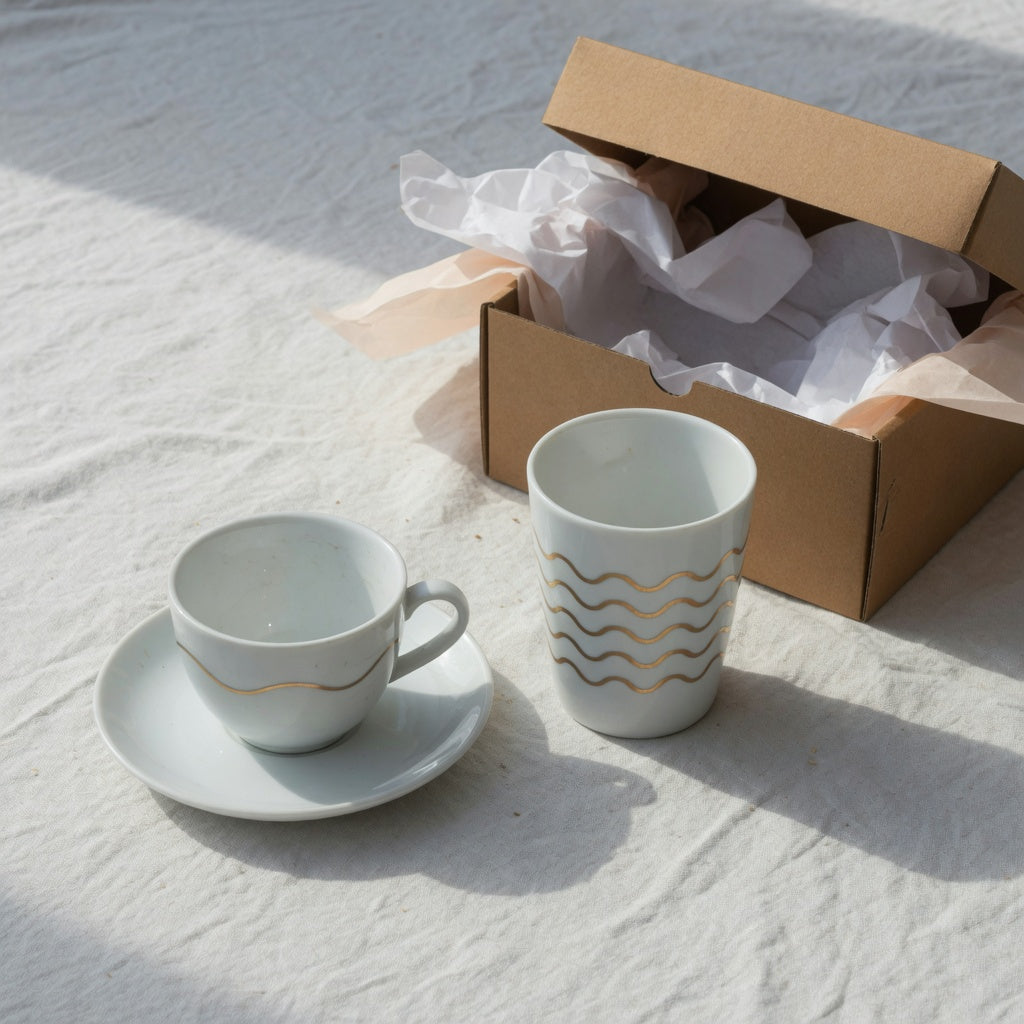
White Golden Waves Tea Cup Gift: What Buyers Should Compare
Shoppers often mix three different objects under one white golden waves tea cup gift search: a painted gold line, a wavy gold rim, and a molded wave cup. We cover set size, the listing details that...
Read more
Christmas Tea Mug Home Decor: What Buyers Should Compare
A Christmas mug often has to hold hot tea and look right on a shelf. We compare capacity, food-use glaze, metallic trim, dishwasher fade, and when a sculpted piece should stay on display.
Read more
Leave a comment
This site is protected by hCaptcha and the hCaptcha Privacy Policy and Terms of Service apply.