
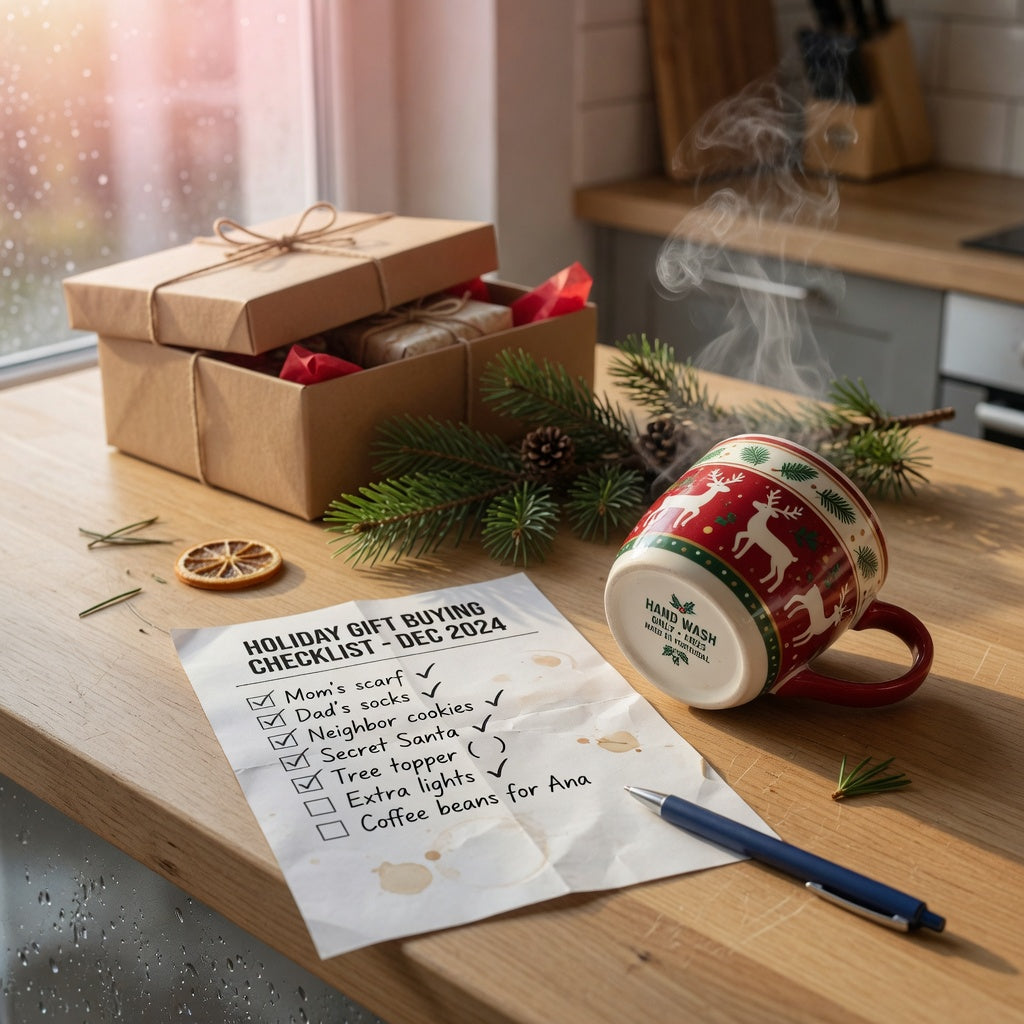
Christmas Coffee Tea Mug Buying Checklist: What Buyers Should Compare
Reading time: about 12 minutes
Last January we unpacked a customer return that still had the gift bow on the box. The mug looked fine until it caught the light: the snowflake print had dulled to gray, the gold rim showed a hairline of wear, and the raised tree inside the well still smelled like last year's cocoa. That box is the holiday-mug problem in one object, and it is why our Christmas coffee tea mug buying checklist lives taped to the packing table. Festive design and a Tuesday morning pour do not automatically get along.
The sequence below is the one we walk through with shoppers who compare options before they buy: food-contact status and glaze first, then capacity against the actual drink, then care stamps, then handle fit, packaging, and how the mug will live after December. None of it requires expert knowledge. All of it requires reading the current listing instead of trusting the photos.
What a Christmas coffee tea mug buying checklist should cover first
Most listing photos sell the season. They do not sell the Tuesday after New Year's. Run these five checks in order before you fall for a Santa face or a metallic snowflake. Skip one and you usually discover the miss in the sink, the microwave, or a gift unboxing that ends with packing peanuts in the handle.
- Food-contact status and labeling. Decorative does not equal drinkable. Confirm the piece is sold as beverage drinkware, not as ornamental ceramicware.
- Capacity against the real pour. An 8 oz festive cup that photographs beautifully will overflow with a cafe coffee or cocoa plus whipped cream.
- Care stamps versus marketing copy. "Holiday ceramic" is not the same sentence as dishwasher safe or microwave safe, especially once foil, glitter, or metallic rims enter the design.
- Handle clearance and filled weight. A sculpted mug that looks charming empty can feel awkward once it holds hot liquid.
- Packaging and post-holiday storage. Gift-ready protection matters on arrival. Stackability and a smooth interior matter in March.
When that list brings you to the holiday piece itself, open our Christmas coffee tea mug listing and verify the stated material, capacity, and care marks on that page. Do not infer specifications from styled photos. If a detail is missing, treat it as unanswered until the current listing states it. That is the standard we hold other sellers to, and the one we hold our own page to.
Ceramic, stoneware, porcelain, glass, or stainless: which material fits the drinker?
Material is the first trade-off that shows up in the kitchen. Ceramic and stoneware are the workhorses we see most for Christmas coffee and tea: they carry glaze and printed color well, they feel substantial on a desk, and they stay festive without turning into sculpture. Porcelain is usually thinner and more refined, so it photographs cleanly and feels lighter in the hand, which some giftees love and others read as fragile. Glass shows the drink, which is nice for layered cocoa or watching tea steep, but it chips in a crowded holiday sink and loses heat faster than a thick ceramic wall. Stainless steel holds temperature and survives a commute, yet it cannot go in a microwave and never gives you that classic ceramic sip.
Match material to the person, not the tree. A ceramic holiday mug suits the desk drinker who reheats in the office kitchen. A stainless holiday tumbler suits the commute, but it is the wrong gesture for someone whose morning routine ends at the microwave. If you are weighing a festive piece against year-round shapes, browse our unique coffee mugs collection with the same material questions in mind. A mug that only works on a mantel is a display object; a mug that can sit beside a plain weekday cup is the one people actually use.
One limitation we are blunt about: heavily sculpted ceramic, 3D characters, and cookie-slot rims make poor daily drivers. They look generous under a tree. They are not what you want in an office dishwasher, and they are misery for anyone who hates scrubbing crevices.
How many ounces do you actually pour? Matching capacity to coffee, tea, and cocoa
Shoppers ask us for "a Christmas mug" and mean three different drinks. Plan the liquid first, then add headspace: a mug filled to the rim is a spill, not a generous serving.
| Drink | Pour to plan for | Shape details that matter |
|---|---|---|
| Drip or home-brewed coffee | About 8 to 12 oz, plus splash room | Straightforward cylinder, balanced handle, a rim you can sip from without a novelty in the way |
| Loose-leaf tea | About 10 to 14 oz, with room for an infuser basket | A mouth wide enough for the basket to sit below the sip line; a flavor-neutral interior glaze |
| Hot cocoa or topped latte | A 12 to 16 oz mug for a 10 to 12 oz pour | Extra headspace, a sturdy base, a handle that still clears knuckles when the cup is heavy |
Those ranges are planning numbers, not promises about any single listing. Read the stated capacity on the product page, and if the ounces are missing, do not guess from a lifestyle photo. Our guide to how many ounces a typical coffee mug holds shows how differently similar-looking cups can measure.
Tea adds a problem coffee drinkers skip: the infuser. A basket that sits too high leaves wet leaves in the sip zone; a basket too wide for a tapered holiday interior will not drain. If one mug must handle morning coffee and evening loose leaf, prioritize a smooth, unobstructed well over a 3D interior scene. Raised snowmen and painted interiors above the glaze line trap tannins and fight your spoon.
Dishwasher and microwave reality: which festive finishes fail first
The question arrives every January with the first dishwasher cycle: is the print, foil, or metallic accent actually appliance-safe, or will it fade, peel, or spark? Marketing adjectives are not care instructions. Turn the mug over and read the stamp on the foot. If the listing and the stamp disagree, believe the more conservative one.
- Overglaze decals and budget prints dull or ghost after repeated high-heat cycles, because the design sits on top of the glaze instead of being fired into it.
- Foil, glitter, and metallic rims flake, mark the dishwasher rack, and are a microwave risk. Treat any metallic decoration as microwave-off until the listing and the stamp both say otherwise.
- Vinyl wraps and exterior skins peel at the handle junction first, the spot where thumbs and dishwasher spray both attack the edge.
- 3D figures, cookie slots, and interior relief collect cocoa fat and tea film that a bottle brush cannot always reach. If nobody in the house hand-washes, do not buy the sculpture.
A customer told us the carton said dishwasher safe and the gold rim still came off by February. A care icon on a gift box is not a lab result. If the rim looks metallic, keep it out of the microwave and hand-wash the first few weeks while you watch for wear.
Thermal shock is the quieter failure. A mug stored in a cold garage and filled immediately with boiling water can craze or crack even when the glaze is sound, so let stored holiday mugs come to room temperature before the first pour, especially thinner porcelain and glass. And if the recipient reheats coffee twice a day, a metallic-painted novelty is simply the wrong gift: send a plain, fully glazed ceramic mug or a stainless travel cup instead, and keep the showpiece for display. For a second skeptical pass on decorated or branded ceramics, our what to check before you buy a branded coffee mug walkthrough applies the same logic.
Lead, cadmium, and labels: is that decorative holiday mug food-safe?
Pretty glaze is not automatically food-safe glaze. The FDA monitors glazed ceramicware, including cups and mugs, for leachable lead and cadmium precisely because people pour hot, acidic drinks such as coffee, tea, and citrus cider into them. The agency's position is blunt: lead used in pottery can leach into food and drink, and there is no known safe level of lead exposure.
For ceramic cups and mugs, the FDA action level for extractable lead is 0.5 µg/mL of leaching solution, measured on any one of six units tested. That is a regulatory trigger for enforcement, not a consumer slogan for "safe enough." Ornamental ceramicware that looks suitable for food is supposed to carry conspicuous labeling stating it is not for food use, or have a hole bored through it so it cannot hold liquid, if it contains lead that could leach. A Christmas "mug" with no care stamp, no food-use statement, and decoration closer to a figurine than tableware should not be assumed to be a drinking vessel. Ask the seller; if the answer is vague, walk away.
Red flags we tell shoppers to treat as stop signs:
- No maker, no country-of-origin mark, and no food-contact or care statement anywhere on the listing or the mug foot.
- Chalky, pitted, or unevenly glossy glaze, especially on the interior and the rim you sip from.
- Decoration on the drinking surface: interior 3D scenes, loose glitter in the well, metallic paint inside the lip.
- Seller photos showing the mug full of coffee while the fine print calls it a decorative object.
We will not invent a "lead-free" claim the listing does not make, and we cannot certify a mug we have not lab-tested. Nobody honest can. Buy for children and daily drinkers from listings that clearly sell drinkware with a smooth, fully glazed interior, not from souvenir figurines that happen to have a handle.
Handle fit, gift packaging, and where the mug lives after December
Ergonomics get ignored in holiday photos because nobody in them is holding a full cup. Check knuckle clearance: a ceramic holly ball on top of the handle looks festive and then meets a hot wall. A tiny C-handle that suits a small hand torques in a large one, and weight compounds the problem, because stoneware plus 12 oz of cocoa is a different object than the empty mug on a prop table. People put down mugs that fight their hands, no matter how good the print is.
Gifting adds logistics the drinker never thinks about:
- Protective packaging. A fitted gift box or molded insert arrives ready to give; loose ceramic in a poly mailer is how handles arrive in two pieces.
- Set versus single. A four-mug set is efficient for a family breakfast; a single statement mug is safer when you do not know the person's cabinet space or taste. Sets also chip in storage when they do not stack.
- Personalization lead time. Custom names and dates are not overnight objects in December. Order earlier than feels necessary and keep a non-custom backup.
- Limited-edition collectibles. Cafe holiday mugs can be fun to own and poor to use. Collectors want the box and the year mark intact, while daily drinkers want a mug that survives the dishwasher rack. Decide which recipient you are buying for.
Storage is the test novelty makers fail. Sculpted snowmen do not stack; they chip the rim of the mug beneath them, and glitter sheds onto the shelf liner. If the piece will live on an open shelf as kitchen display, that can be a feature. If it is meant for daily coffee, choose a smooth exterior, a foot ring that does not trap water, and a profile that fits a standard cabinet without a custom cubby. A Christmas mug is also the wrong gift for a minimalist who resents seasonal clutter, and the wrong daily cup for a large-pour commute traveler who really needs a travel tumbler. Match the object to the life, not the wrapping paper.
Run this list before you add to cart
Screenshot this section. It is the same Christmas coffee tea mug buying checklist we run before any holiday mug goes into a shipment, and it works on any seller's listing, including ours. If you cannot answer a line from the current product page, that line is still open.
- Is this sold as drinkware with a fully glazed interior, or as ornamental ceramic?
- What capacity is stated in ounces, and does it leave headspace for my actual coffee, tea, or cocoa pour?
- Is there a dishwasher statement and a microwave statement, and do they still hold if the design uses foil, glitter, or metallic paint?
- Is the interior smooth, or will 3D relief, a cookie slot, or an interior scene trap residue?
- Can I see handle clearance and judge filled-weight comfort, or only a styled empty-mug photo?
- Does it ship in packaging that protects the handle and rim, and is it gift-ready if that is the point?
- Will it stack and store without chipping, or is it a display piece I should not pretend is a workhorse?
If a listing clears those checks, start with the Christmas coffee tea mug product page and confirm the live details there. Our team keeps that page as the single source of truth for what the mug is, not what the season wants it to be. Want to compare it against year-round designs first? Open the unique coffee mugs collection and run the same seven lines side by side. The right next step is a product page with answers you can read out loud before you pay for shipping.
Frequently asked questions
Is a Christmas mug with gold foil or metallic paint dishwasher and microwave safe?
Only if the current listing and the stamp on the mug foot both say so, and even then metallic accents are the first finish to wear. Foil, glitter, and painted rims commonly dull or flake in dishwashers, and metallic decoration is a microwave risk. If you reheat coffee at work, choose a mug with no metallic decoration and an explicit microwave-safe care mark.
How do I use a christmas coffee tea mug buying checklist when the listing photos look festive but the specs are thin?
Refuse to fill gaps from the photo. Write capacity, material, dishwasher, microwave, interior shape, and packaging down as questions, then answer them only from the current product page. If a line stays blank, email the seller or pick a listing that states it, because a festive photo is not a specification.
What capacity should I choose for coffee versus tea or hot cocoa with toppings?
Plan the liquid, then add headspace. A home coffee pour is comfortable in roughly 8 to 12 oz, loose-leaf tea wants a wider 10 to 14 oz shape that takes an infuser below the sip line, and cocoa or a topped latte usually needs a 12 to 16 oz mug so the pour does not avalanche over the rim. Confirm the stated ounces on the listing rather than trusting a photo.
Are cheap or unlabeled decorative Christmas ceramic mugs food-safe?
Not automatically. The FDA monitors glazed cups and mugs for leachable lead and cadmium because they are used with hot, acidic drinks, and the action level for extractable lead from ceramic cups and mugs is 0.5 µg/mL of leaching solution. Ornamental ware that looks usable for food is supposed to be labeled not for food use, or bored with a hole, if it could leach lead. Skip unlabeled decorative pieces for kids and for anyone's daily coffee.
Should I buy a set, a personalized mug, or a limited-edition holiday collectible?
Buy a set when several people will drink matching cups at one table and the profiles stack without chipping. Buy a single when taste or cabinet space is unknown. Personalized mugs need extra production time in December, so order early or hold a backup. Limited-edition cafe mugs are usually better collectibles than daily dishwasher residents, so choose them only when the recipient values the year mark over a workhorse.
More from our blog
Read more

Mountain Sea II Mug: What Buyers Should Compare Before Ordering
A straight comparison of the Mountain Sea II mug: 450 ml ceramic capacity, wooden-handle grip and care realities, coffee-versus-tea fit, desk use, and who should skip this style. Written from the q...
Read more
Green Waves Coffee Tea Mug Buying Checklist: Compare Before You Buy
A practical green waves coffee tea mug buying checklist from the team that packs these mugs daily: compare glaze versus print, capacity, handle fit, care labels, and food-contact safety, then map t...
Read more
Leave a comment
This site is protected by hCaptcha and the hCaptcha Privacy Policy and Terms of Service apply.